Tag: Eleanor Parker
-
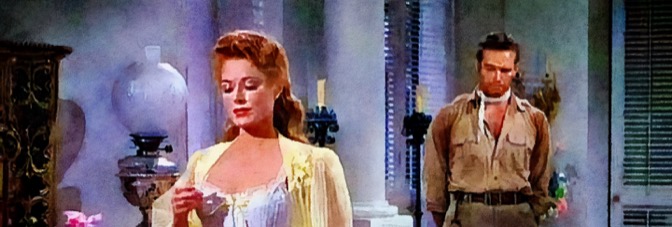
If there are faults with The Naked Jungle, ones not the result of having to follow the Hays Code–which the film skirts thanks to Ben Maddow and Ranald MacDougall’s excellent dialogue, Eleanor Parker’s fantastic, intelligent performance and Charlton Heston’s brute force approach–they fall on director Haskin. The film is well-directed with Parker and Heston’s character…
-

Once you get past Jeffrey Hunter (at thirty-seven) playing a character about fifteen years younger–and some other significant bumps, Seven Miles of Bad Road isn’t entirely bad. It shouldn’t be entirely bad, even with those bumps, but it’s an episode of “The Chrysler Theatre,” shot on limited sets with limited imagination from director Douglas Heyes.…
-
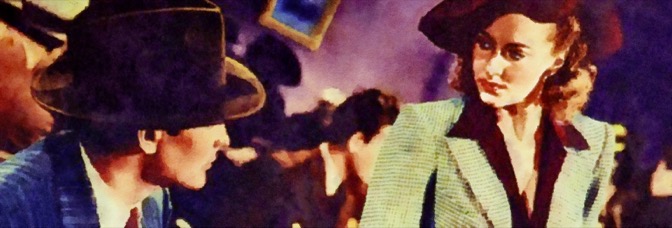
Busses Roar is a slight propaganda film. It doesn’t fully commit to any of its subplots, not even the patriotism. With the exception of the establishing the villainous Japanese, German and the gangster at the opening and the flag-waving speech at the end, it’s not too heavy on it. Most of the film’s almost an…
-

Scaramouche is a deliberately constructed film. I’m curious if screenwriters Ronald Millar and George Froeschel followed the source novel’s plot structure, because it’s a very peculiar series of events. It doesn’t open with the leading man, instead starting out with villain Mel Ferrer. Janet Leigh, as his love interest, gets introduced long before Eleanor Parker–who’s…
-

Madison Avenue somehow manages to be anorexic but packed. It only runs ninety minutes and takes place over a few years. There’s no makeup–which is probably good since Dana Andrews, Eleanor Parker and Jeanne Crain are all playing at least ten years younger than their ages. Director Humberstone doesn’t do much in the way of…
-

Trying to figure out where The Great American Beauty Contest stands on the women’s lib movement is a headache. Actually, the whole thing is a little misogynist but not for the obvious reason–not because the titular contest’s participants are being objectified (I doubt director Day could competently objectify anything or anyone), but because it presents…
-

Knight’s Gambit plays a little like a serious, American James Bond variation. Roger Smith is a former CIA agent–he inherited hundreds of millions and quit–out to seduce Eleanor Parker for information. Parker is a disgraced politician’s secretary; they’re living in Spain, in exile. The spy stuff is terrible. Smith’s boss–Murray Matheson–wears around long shorts and…
-

Men of the Sky opens with General Henry H. Arnold addressing a graduating class of air cadets. Charles P. Boyle’s Technicolor photography is glorious and Harold McKernon’s editing is outstanding and Sky feels like an almost too precious time capsule. Only then the realism shatters when Arnold starts directly addressing actors, not actual air cadets.…
-

Half a Death gets off to a troubled start thanks to Tod Andrews. He’s only in the episode for the first scene, but he’s just awful. Watching Eleanor Parker act opposite him is painful. While Henry Slesar’s script is no great shakes in the dialogue department, Parker still turns in a good performance. Andrews just…
-

Everett Dodd’s editing makes Soldiers in White painful to watch. Some of the fault is director Eason’s, of course. His insert close-ups are awful. Given Soldiers is half comedy and half Army propaganda film (the titular soldiers are Army doctors), it’s hard to believe Eason was worried about running short and felt the need for…
-

Director Moxey has–there’s no better word for it–a compulsion for zooming. He absolutely loves it. I imagine it saved the time and money needed for additional set-ups–and I think short zooms from character to character were a 1970s TV movie standard–but it looks just terrible. It kills some of the scenes in Home for the…
-

There are a few problems with The Man with the Golden Arm. It’s hard to think of the film actually having any defects, since it’s such a brilliantly made motion picture. It was one of the first Preminger films I saw and was I ever surprised when they all weren’t so beautifully put together. The…
-

I’m a fan of Warner Bros.’s old hour-long b-movies, so I found The Last Ride particularly distressing. It’s not poorly directed–Lederman even has one or two really good shots–and the writing, at least scenically, isn’t bad. There are some funny moments and the teaser is excellent. It all falls apart pretty quickly, however (it is…
-

If only it weren’t for Bill Travers… his performance drags the film into the realm of absurdity. It isn’t just his inability to act, it’s also his utter lack of charisma. It’s unbelievable anyone could like Travers the movie star (I’m thinking there must be or have been Victor Mature fans and George Raft fans,…
-

I can’t believe I’ve never heard of Stuart Whitman before–I just went through his filmography and nothing jumped out (except Interrupted Melody and it’s a bit part, but going to be amusing in a moment)–anyway, I can’t believe I’ve never heard of him because he’s kind of like a Glenn Ford who can’t act. An…
-

A Millionaire for Christy exemplifies why the screwball comedy doesn’t work outside its era without a lot of tinkering. I can’t even think of a good example of one working outside the 1930s right now, but I’m pretty sure there have been some. Maybe even recently. But Christy adapts a regular screwball comedy script for…
-

Jerome Cowan’s detective in Crime by Night slides through the film soaked in bourbon. While the film’s mystery isn’t a bad one, perfect for a seventy minute running time, the suggestions of off-screen actions are a lot more fun to think about. The detective, with his love interest secretary along (played well by Jane Wyman,…
-

Half a great Gothic about drawing instructor Gig Young starting work at an English manor instructing Eleanor Parker. He soon finds himself in embroiled in a mystery involving sinister (and phenomenal) Sydney Greenstreet, an escape mental patient, as well as a love triangle between Parker and her best friend, played by Alexis Smith. Extremely well-made…
-
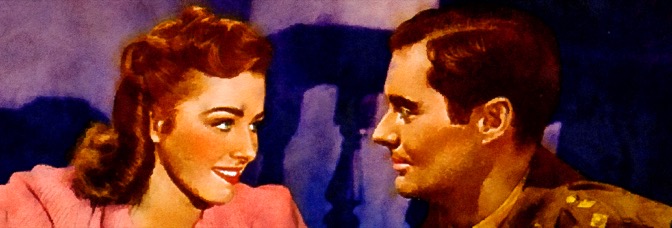
Apparently, the last time I saw The Mysterious Doctor (in 2001), I didn’t think much of it, rating it at one and a half. It’s a little low, since the film transcends propaganda, which many 1940s propaganda films did, but The Mysterious Doctor does it in interesting ways. Its mood isn’t the usual for a…
-

If there’s some lost Frontier genre–not a Western, because there aren’t horses or cowboy hats–but a Frontier genre, with trappers and woods and… I don’t know, some other stuff, Many Rivers to Cross is probably not the ideal example of its potential. I realize now, mentioning it, Michael Mann’s The Last of the Mohicans is…
-

Both critically and popularly, Chain Lightning gets classified as one of Bogart’s lesser, late 1940s films. While the film certainly is a star vehicle for Bogart, it’s only “lesser” if one compares it to Bogart’s stellar films (basically, the ones everyone remembers). On its own, Chain Lightning is far from perfect, but it’s a fine…
-

Above and Beyond breaks one of my severest rules–don’t start with narration and then drop it. Above and Beyond starts with Eleanor Parker narrating the film, mostly because otherwise she wouldn’t be in it for the first hour. Once she is in the film full-time, the narration quickly disappears. I can’t remember the last time…
-
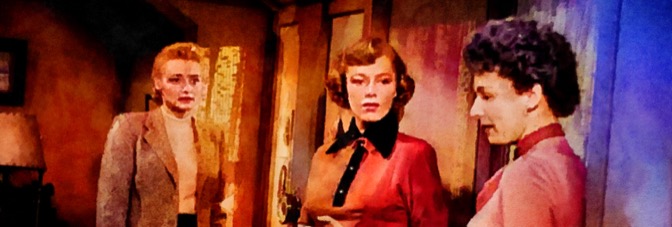
Three Secrets plays like a knock-off of A Letter to Three Wives, only without the writing. Secrets‘s problem is mostly with the writing. There are the three women–all of whom have secrets, except actually only two of them–played by Eleanor Parker, Patricia Neal, and Ruth Roman. The secret is each put a child up for…
-
Delmer Daves–for someone whose directing occasionally makes me cover my eyes in fright–does an all right job with The Very Thought of You. He has these tight close-ups and, while there are only a few of them, they work out quick well. Otherwise, technically speaking, he doesn’t have many tricks. He’s on the low end…
-

Stupefyingly bad sequel to PEYTON PLACE without any of the original cast returning. Unfortunately, none of the replacements are up-to-par–though, to be fair to Tuesday Weld and Eleanor Parker (in for Hope Lange and Lana Turner, respectively) the parts are the problem not the performances. Really bad lead performance from Carol Lynley, who’s back in…
-
Middling adventure picture about archeologist Robert Taylor searching Egypt for proof of the Biblical Joseph. Wrapped up in the pursuit are unhappily married Carlos Thompson and Eleanor Parker. It’s only a matter of time before Taylor seduces Parker away from Thompson (who’s awful). Bad script and direction from Pirosh. Taylor’s great but there’s only so…
-
Black comedy–spoofing the very idea of itself–about actress Amanda Pays getting wrapped up in a mystery involving dreamy rich guy Corbin Bernsen (Pays’s real-life husband) and his weird cousin (a fantastic John Glover). Is Pays in danger herself? Is she in love with Bernsen or does Glover have a chance? There’s a great goofy feel…
-
Godawful romantic quadrangle picture about irresistible composer Errol Flynn (maybe it’s the lederhosen, the film’s ostensibly set in 1900 Vienna) cheating on wife Ida Lupino with brother Gig Young’s fiancée Eleanor Parker. Parker’s lost as the villain, Flynn and Lupino are both terrible and competing for who can be worse; Young’s okay enough, all things…
-
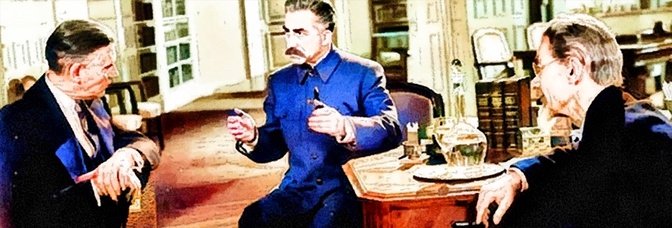
Far from bad propaganda picture about U.S. ambassador Joseph E. Davies (played by Walter Huston) taking his family to the Soviet Union and seeing all the wonderful things they’ve come up with there. Based on the real Davies’s book, which came out when relations between the U.S. and Soviet Union was in its salad days.…
-

Outstanding not soapy soap opera about wealthy Texan Robert Mitchum, suffering wife Eleanor Parker, and his two sons–the legitimate one, George Hamilton, and the bastard, George Peppard. Once Hamilton comes of age and starts hanging out more with Peppard, away from Parker’s helicoptering, everyone gets in a lot of trouble. Fantastic performances from the entire…
 The Stop Button