• Doom Patrol (2019) s03e10 – Amends Patrol

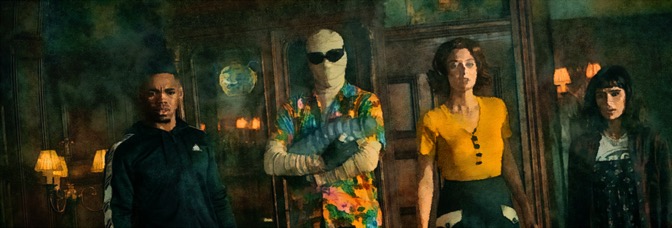
    This season finale of “Doom Patrol” is not perfect because it realizes all my hopes for the season; it’s perfect and just happens to realize all my hopes for the season. First and foremost, it doesn’t play chicken with the network (or, in this case, streaming service) as far as renewal. We get closure. There are open plot threads, with things primarily unresolved for about half the team, but nothing to ruin a binge or rewatch if they didn’t get a fourth season. Not like they did last time, though Rona played a part there.

    The episode opens with a resolution to the previous episode’s cliffhanger and a return of the Sisterhood of Dada. Well, at least Wynn Everett, who’s got some strong words for April Bowlby while also working on her low-key seduction of Diane Guerrero (who can exist in Everett’s inter-dimensional fog separate from her host). Everett takes Bowlby to task for everything Bowlby needs to be taken to task about and sets up a resolution for that arc.

    Bowlby gets her whole arc this season, ditto Matt Bomer and Matthew Zuk, ditto Michelle Gomez. Brendan Fraser and Riley Shanahan get some resolution, but there are also some open issues. Guerrero and Joivan Wade are similarly in the resolved enough camp. Good enough for a finale. It’s really Bowlby, Gomez, Bomer, and Fraser’s episode, with the show really leveraging Gomez and Bowlby. Gomez “wins” in terms of best performance, but it’s also because she’s got something of a softball compared to Bowlby, who’s still gazing into the abyss.

    Especially after Bowlby confronts the villainous Brain, who’s assumed Fraser’s robot body, meaning Zuk gets to go wild with the physical performance this episode. The way the show’s been able to introduce the Brain and sidekick Monsieur Mallah into the main narrative and get them a complete arc in, what, three episodes, is incredibly impressive. It’s not as remarkable as the closure on the Bowlby and Gomez time-traveling stuff, but it’s still fantastic work. The time travel stuff and the layers upon layers of character development running through it are “Doom Patrol: Season Three”’s singular achievement. I didn’t think they’d ever be able to pull it off, and they do. Just right, scene after scene, beat after beat.

    Guerrero’s got a reasonably good arc about placating bossy fellow persona Catherine Carlen before getting a nice tense, cliffhanger-ready plotline with Fraser. Wade’s entirely support this episode, starting with Bomer and Zuk, but it’s good support; Bomer’s got to make some big life decisions, which juxtapose nicely with Wade’s recent big life decisions. So while Wade doesn’t get his own thing here, he’s set to have an exciting arc next season.

    “Doom Patrol”’s successes here are, obviously, hard to compare to anything else because “Doom Patrol”’s not really like anything else. Even as it plays with the same toys as other superhero media, its character development-driven stakes are entirely different. Not to mention the acting’s mostly spectacular and leagues beyond other franchises.

    It’s an actually wonderful show, and I can’t wait for season four. I mean, I can because season three wraps up so nicely—the thing could jump every shark (impossible thanks to the cast, of course), and there’d still be a fantastic thirty-five-episode complete narrative. “Doom Patrol”’s such rare delight.

  • Rocky IV (1985, Sylvester Stallone), the director’s cut

    Sylvester Stallone’s director’s cut of Rocky IV arrives four sequels and thirty-five years after the film’s original release. Stallone says it’s for the thirty-fifth anniversary; Robert Doornick (who voiced Burt Young’s robot in the original cut and owns the copyright on the robot) says it’s because Stallone didn’t want to renew with him and had to cut out all the robot scenes.

    So, if “Rocky vs. Drago” replaces the original cut in streaming services… we’ll find out.

    There are some other changes to the movie besides the goofy robot being gone, like a trimmed-down version of Rocky III tacked onto the beginning. It’s weird because it goes on way too long and isn’t a good encapsulation of the film–it also emphasizes Stallone’s relationship with Carl Weathers to enlarge their relationship in the Rocky IV footage. Only there’s no actual echoing between the two. Because Stallone doesn’t change Rocky IV’s story or its beats, he just excises a few of them. He doesn’t do anything to fix the problems, which are obviously insurmountable because it’s fairly terrible.

    Stallone’s writing, direction, John W. Wheeler, and Don Zimmerman’s editing are all quite bad. There’s no new editor credited with the Rocky vs. Drago cuts, but whoever did Final Cut Proing or Adobe Premiering doesn’t have much in the way of timing. Though, since this version comes after Creed II, which is a sequel to this film, bringing back Dolph Lundgren decades later, you could almost read something into how Lundgren’s cut to see if it implies character development. Only it doesn’t. And Rocky vs. Drago isn’t like cut to tie into Creed II. Stallone’s just cobbling something together here—does anyone believe he didn’t have the full director’s cut of the original in 1985, with that craptacular “We Can All Change” speech to the Soviet people, who embrace Rocky over Gorby? So why not tie into Rocky V. Nothing would be better than seeing all the stupid patriotism end with Stallone brain-damaged. It’d explain his final speech.

    The movie also misses out on soundtrack revising, which… I mean, why not. Something to juice it up.

    Also, that last fight is poorly done, especially after seeing Stallone learn how to direct action in the intervening decades since he shot this film. It’s not exactly any more embarrassing than the original Rocky IV, but it’s definitely pointless.

    Especially since it’s all about Stallone, Weathers, and Lundgren all basically just being toxically masculine narcissists. It might be a little different for Stallone and Lundgren—because Weather’s hubris literally gets him killed, which doesn’t not have a racial component to it. Like, Weather is openly Black here. Bad dad. Stallone’s a bad dad too. Stallone made movies about these guys being bad dads. It’s such a weak revisit.

    Maybe I’m just embarrassed I thought it might be any different, like Stallone might’ve actually tried. Because even with the miserable mise-en-scène of Rocky IV, there are obvious places you could just cut it better if you had access to the footage.

    Finally, because I can’t any more with the rest of it, does Talia Shire come off as miserable in the original version? Like she’s raising a son and then tending a douchebag husband? Not to mention Young.

    Oh, okay, this bit is the last—Young. Stallone stops playing him for laughs but keeps the pratfalls, which just makes him seem like a despondent drunk the whole time.

    So fingers crossed Doornick’s for real, and they pull the original, robotic Rocky IV and only Rocky vs. Drago remains. It’s a futile gesture of egomania from Stallone, which, coincidentally, describes the film in either cut.

    Rocky IV’s awful.

  • The Limey (1999, Steven Soderbergh)

    The Limey is all about the foreshadowing. It’s about flashbacks, flash-forwards, and flash asides, but the foreshadowing figures into all of those devices. It’s got a “twist” ending, which then informs previous scenes but not like figuring out Terence Stamp is a ghost or whatever. Instead, it’s knowing something about why he half-smiles—and only something, another thing about The Limey is it’s Stamp’s story. To the point of excluding the audience. There’s a lot we don’t see in The Limey, but it happens. Arguably the most interesting aspects of Stamp’s character development occur offscreen. We get to see the action, which is the MacGuffin.

    Juxtaposed against Stamp is Peter Fonda, and we get to see all his character stuff on screen, even though he’s an utter twerp from his first scene and will continue to be throughout the film.

    Stamp is a recently released career criminal from the UK, come to Los Angeles to find out what happened to his daughter, Melissa George. Before the present action, George dies in a car accident. Not suspiciously enough for the cops to care, but enough for Stamp to fly over to find out what happened.

    Fonda is George’s boyfriend. He’s a successful music producer, rich enough to be oblivious to reality, dim enough to make bad decisions, a sixties leftover who hasn’t done anything worth talking about since then. He’s already moved on to a new girlfriend—Amelia Heinle, who’s his friends’ daughter; he suggested her name to them when she was born. At first, it seems like he’s a major creep instead of just a weak one.

    The juxtaposition is Stamp and Fonda living their respective legacies of the late sixties, Stamp a seemingly unstoppable old man vengeance, Fonda a narcissistic jackass.

    The film’s first act is Stamp getting to Los Angeles and meeting George’s friends, Luis Guzmán and Lesley Ann Warren. Guzmán is an ex-con gone straight and sticking to it (very much unlike Stamp, who we learn spent most of his life and George’s in the nick), and Warren is a functioning LA action coach. Her sixties dreams didn’t come true, but she’s at least contributing to the world, not sucking from it (like Fonda).

    Guzmán quickly becomes Stamp’s sidekick in the movie sense, but there’s a deeper emotional bond between the men the film doesn’t let us see. The Limey’s got a very detached narrative distance; director Soderbergh and writer Lem Dobbs forcibly push the audience away too. They make an effort to keep the viewer off guard, to keep The Limey in an almost dreamlike state, which then ties into Fonda’s wistful remembrances of the sixties.

    Well, 1966 and some of 1967.

    When Stamp meets Guzmán and Warren, the film flashes forward to different settings and activities, their conversations bopping forward and back until the conversation flows through the time and place jumps. Because The Limey’s all about memories; well, foreshadowing and memories.

    Stamp’s investigation will eventually get him some attention from Barry Newman, who’s Fonda’s fixer. Newman brings in local psychopaths Nicky Katt and Joe Dallesandro to deal with the problem, which has some unexpected results. The acting in The Limey is incredibly measured and restrained. Stamp loses his temper at most twice and possibly then only in a daydream. Fonda has his freak-outs, but he’s usually trying to impress Heinle, so he keeps it in check. Newman’s restrained too, because as long as he can hire Katt, there’s nothing to get worked up about.

    So Katt and Dallesandro are then Limey’s wild cards and where Soderbergh lets the performances get the loosest. One of Katt’s scenes is just a series of jaw-dropping but mundane observations from a psychopath. It’s momentarily funny, quickly becoming very concerning, with Katt establishing himself not just a clear and present danger to the good guys but to everyone standing near them. The Limey runs a confined ninety minutes and wraps its main story up with a tidy bow, but Katt and Dallesandro’s presence does a whole lot implying the world that story takes place in.

    Ditto uncredited Bill Duke, who shows up at one point for a fantastic scene.

    Speaking of uncredited one scene cameos, The Limey goes out of its way to include an “Entertainment Tonight” interview with George Clooney—after he and Soderbergh had made their first movie together—it goes on so long it seems intentional. But then even the shortest sequences in The Limey are fully intentional.

    After the first act, after Stamp’s mission and compatriots are set up, the film introduces flashback footage to a young Stamp (as Limey is pre-obsequious CGI- de-aging, it’s footage from Ken Loach’s Poor Cow). Stamp occasionally talks through the clips, though sometimes they’re presented without context; they’re limited because they’re not really for this story. They’re about being young and making bad decisions—Stamp’s didn’t pay off, Fonda’s did. They’re presented without audible dialogue, just like flashbacks to George’s life in Los Angeles before her death, and also with Stamp’s memories of her as a child. Again, it’s all about the memories.

    And regrets.

    So, foreshadowing, memory, and regrets.

    Soderbergh and editor Sarah Flack cut the hell out of the first act, presenting The Limey as a jumble of Stamp’s thoughts, with Fonda’s half of the film eventually leading to it calming down a bit. But while The Limey always looks good (photography by Edward Lachlan) and sounds excellent (Cliff Martinez’s score is terrific, and the sixties pop soundtrack is outstanding), it’s how Soderbergh and Flack use the editing to guide the narrative and establish the distance.

    It really makes you wonder how Dobbs’s script worked; was it fragmented, or did Soderbergh break it up later.

    Great performances from everyone. Stamp’s mesmerizing. Fonda, Newman, Guzmán, Katt, Heinle, and Warren are all excellent too. Warren gets the least to do, active character-wise, but is phenomenal doing it. Heinle gets the least character (she could be a figment of Fonda’s imagination for her first two scenes) but makes herself an essential insight to Fonda.

    The Limey’s spectacular. Soderbergh and Stamp take it seriously but also not too seriously, and then once everything’s revealed, it’s more affecting than seemed possible. So good.

  • Shang-Chi and the Legend of the Ten Rings (2021, Destin Daniel Cretton)

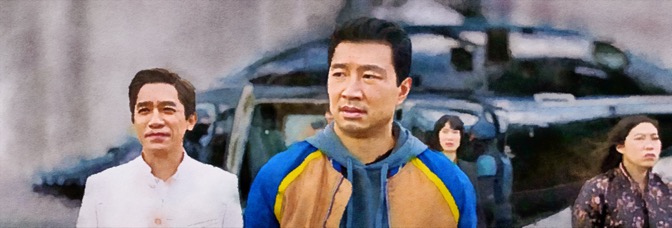
    The third act of Shang-Chi makes it real obvious what’s been wrong with the movie the whole time–it doesn’t matter if Simu Liu is onscreen. The third act has a bunch of different characters fighting a bunch of different bad guys, and Liu disappears for a few minutes to do the whole “how’s the hero going to get inspired from the edge of death” bit and… the movie doesn’t need him. Because even though Liu’s Shang-Chi, the star, he’s never the interesting character in a scene.

    The film starts with Tony Leung Chiu-wai (who apparently spoke English this whole time, which is devastating because he finally “comes” to America, and it’s this movie). He’s a near-immortal warlord who wants to capture a mythic village so he can see dragons or something. It’s an Alexander wept moment, don’t ask questions. Leung gives a captivating performance in an absolutely crap part. He went nine hundred and seventy-five years without ever doing any character development, and now he’s rushing to get some in.

    Anyway. Still the opening. Leung meets Fala Chen in the village, and they have a wuxia fight. Or at least as close as Shang-Chi gets to a wuxia fight. Director Cretton at least tries with this fight. None of the other fight scenes in Shang-Chi have any real… what’s the word. Effort. The other fights don’t have a style goal. Or at least they don’t have a visible style goal. If Cretton was actually going for something, it’d be worse because he, cinematographer Bill Pope, and the three editors (Elísabet Ronaldsdóttir, Nat Sanders, and Harry Yoon) never achieve it. Or even make it clear they’ve got actual ambitions other than getting to the next scene.

    Leung and Chen fall in love, and throughout the film—via flashbacks—we learn he gave up a life of international crime bossing for her, settled down, had a couple kids who grow up to be Liu and Meng’er Zhang. Chen dies under mysterious circumstances, but only to the audience; it’s just the flashback doesn’t want to tell us yet. Because Dave Callaham and Cretton’s script is tediously manipulative. There aren’t any surprises in Shang-Chi, which just makes it all the more amazing it’s able to get to so many compelling moments thanks to the cast and, I don’t know, a competent production’s momentum. And it’s a low competent. Like, Disney did not pony up for real effects money on Shang-Chi. The composites are so bad it’s almost a Warner Bros. superhero movie. Almost.

    In the present, Liu’s a San Francisco valet parker who spends all his time hanging out with best friend, Awkwafina. They’re just friends. It’s never explained why they’re just friends, possibly because Liu, Awkwafina, and Zhang are weirdly asexual, but they basically lead this amusing sitcom life. Just with fast cars. What’s weird about the Liu and Awkwafina stuff is the actors can obviously do comedy—Awkwafina from this movie and, you know, Liu from “Kim’s”—but Cretton doesn’t know how to do it. Or more, he doesn’t try to do it. It’s the aforementioned lack of effort kicking in again. Instead of it actually being funny, it’s a too-brief nod at funny.

    Really quickly, Liu has to fight some bad guys on a bus, which ends up forecasting Cretton’s inability to do action sequences, and then he and Awkwafina are off to Macau to meet up with previously unrevealed sister Zhang.

    They then meet up with dad Leung, who reveals he’s going to go get all the dinosaurs from Isla Sorna. Sorry, wait, I’m thinking Lost World: Jurassic Park but Cretton cribs a scene from there, so I got confused. Leung wants to invade the village and rescue the soul of dead wife Chen from the shitty villagers who wouldn’t let them live there because he’s a warlord.

    Even though Awkwafina’s already the comic relief, they need more, so Ben Kingsley comes back from Iron Man 3 (more specifically, the superior Marvel short, All Hail the King), and occasional smiles occur during the subsequent action. Up until they get to the secret village, where Michelle Yeoh enters the movie, and all of a sudden, it’s interesting. Because even though Leung’s mesmerizing, it’s a lousy part. Yeoh’s part isn’t good, but it’s not a terribly underwritten villain part. She’s the cool aunt. She’s basically the hero of the last third of the runtime.

    Eventually, Liu will be critical in saving the world from dragons or whatever, but he doesn’t have to act while doing it. Most of the time, he’s just a part-CGI model in extreme long shot.

    There’s no one who doesn’t take over the scenes with Liu. Awkwafina from go, then Zhang, then Leung, then Yeoh, but also the supporting actors in scenes, like bit player Ronny Chieng. There’s an astounding lack of direction from Cretton when it comes to his actors. All of them muscle through—I mean, relatively, like Zhang’s likable but not particularly good and Awkwafina is one-note—just not Liu. He’s so unimportant in his own movie it can lose him, and it doesn’t matter, which makes the hero’s quest finale all the more lackluster.

    Shang-Chi’s never bad—it’s incredibly safe—but it feels like it’s never bad because Cretton and company figured out a way to produce the film without any stakes. Certainly not for Cretton. Or Liu.

    For a specific viewer, Leung will more than make it worth it. Even when he becomes CGI. Or more, he doesn’t become CGI for long enough for it to hurt him. Ditto Yeoh, actually, whose big action sequence ends up being as a too-small CGI model. Then there’s Kingsley; his return is fun but underwritten because Cretton and Callaham are dreadful at comedy.

    Also, since the flashbacks to Chen’s story go on for so long—it’s third act before we get the whole story and the movie completely, and very intentionally wimps out on the implications—even though Chen’s okay, she just reminds if they’d gotten Maggie Cheung for the part… I mean, then you’d have a movie worth Tony Leung Chiu-wai. But no. Because it’s a rote and joyless outing, albeit an aridly competent one.

  • Superman & Lois (2021) s01e10 – O Mother, Where Art Thou?

    Turns out when “Superman and Lois” wants to do a fairly straightforward “Superman” episode, they can do it. Like it balances out well, even if Elizabeth Tulloch gets shockingly little to do but stand around in a show where her character’s name is in the title. And there are some performance problems, but it’s a solid action suspense episode.

    The episode starts with a resolve to last episode’s two cliffhangers, beginning with season villain Adam Rayner dropping a truth bomb on Tyler Hoechlin. Everything Hoechlin always knew to be true was a lie—or at least a truth from a certain, lying point of view—and he spends the first ten or fifteen minutes recovering from it. There’s not a lot of time because eventually, they’re going to have to run Emmanuelle Chriqui through the Kryptonian brainwashing machine to stop Rayner.

    Despite being relatively thrilling—it’s the end of the world as we know it, after all—Chriqui’s pretty terrible in her new part this episode. One of the things I’ve always liked about CW Arrowverse shows—outside “Arrow,” I suppose—is they clearly tested the actors with material not in the pilot. They really should’ve tested Chriqui with this plot development. She completely fumbles it. The new part—essentially an extended cameo—is difficult, sure, and underwritten (Adam Mallinger gets the script credit, which bungles a lot while still being effectively plotted)… but Chriqui’s bad in it.

    And it’s an otherwise well-acted episode. Like, even Angus Macfadyen. Okay, maybe Macfadyen isn’t good, but he’s better than he’s ever been before, as he reveals his Jor-El is kind of… not super… smart? Like, if Macfadyen’s overcompensating, his performance makes a lot more sense. As well as Hoechlin being sort of mediocre at being Superman without Dylan Walsh around to tell him what to do.

    A lot of the runtime is Inde Navarrette trying to figure out what’s going on with her parents, as mom Chriqui teams up with Hoechlin, Tulloch, and Walsh—since Rayner’s basically uncovered as the season villain now—and dad Erik Valdez has been possessed by an evil Kryptonian. Of course, no one was going to tell Navarrette until Jordan Elsass (fed up with adults lying and not learning from their mistakes) tells her the whole story. It’s a good arc for Elsass and eventually Navarrette, with Alex Garfin doing an all-right support job.

    As for Rayner… I mean, given the way the plot’s going I guess he’s better post-big reveal. He’s still not really good, but it’s also a fairly bland character. It’d be nice if “Superman and Lois” had something up its sleeve besides recycled Man of Steel or “Supergirl” plots.

    But still, pretty good “Superman” action episode. Pretty, pretty good.

  • Doctor Who (2005) s13e02 – War of the Sontarans

    So, one thing I don’t understand about “Doctor Who: Flux” is writer Chris Chibnall’s Marvel Cinematic Universe nods. Last episode, they established the only good special effects were going to be the Thanos disintegration effect (presumably the VFX staff bought an iPhone app for ninety-nine cents to get it done), but this episode…. Well, this episode goes overboard right from the start.

    The first scene has Doctor Jodie Whittaker and companions Mandip Gill and John Bishop waking up at the end of the universe. It looks just like the end of the universe in “Loki.” Of course, it turns out not to be the end of the universe, and instead, they’ve been thrown in time back to the Crimean War, but it looks just like “Loki.”

    And then the episode ends with a snap. After a bunch of Thanos disintegrating. And the snap is a Snap.

    I can’t tell if Chibnall is doing terrible, desperate homage or if he really thinks… there’s no crossover between “Doctor Who” viewers and, you know, people who have seen the second and fifth highest-grossing movies of all time. Because even if they didn’t watch “Loki,” those lucky bastards, they might recognize the Snap.

    Anyway.

    The Crimean stuff is excellent. Best “Who” in ages, with Whittaker teaming up with historical figure Mary Seacole (played by Sara Powell; also Seacole was a subject on “Horrible Histories” if anyone needs to Google a refresher) as she discovers the Sontarans have done a temporal assault and are the bad guys in the Crimean War now, not the Russians. Were the Russians the bad guys in the Crimean War? I mean, they were from the British perspective, but… you know what, never mind.

    Whittaker and Powell have to deal with an asshat British general (Gerald Kyd) in addition to the Sontarans. Now, these Sontarans aren’t from the past, they’re from the present (or future) and know the Doctor is their enemy, but they don’t realize the Doctor might be a girl now. Whittaker’s a lot better without her companions to clutter the scenes, and both Powell and Kyd are excellent.

    Meanwhile, new companion Bishop goes back to the future, where he amusingly teams up with his parents (Sue Jenkins and Paul Broughton) to fight the Sontarans there. Lots of lousy CGI but Bishop’s slightly more amusing with the ‘rents than with Whittaker and Gill, or on his own. It’s actually a rather tense plotline, which has Bishop having to coordinate with Whittaker in the past.

    Gill’s off at a magical time temple where she meets agents from the Time Bureau before—just kidding, she meets future human dude Jacob Anderson, and they have to try to repair the cheap holograms for the flying, talking triangles. The talking triangles don’t cast shadows, which is initially one of the big effects fails. There are more extensive effects fails later on, but the lack of shadows is the first hint at the eventual problems.

    The time temple is also where time-traveling super-villain and Red Skull wannabe in a cheap Halloween mask Sam Spruell figures in. He and sidekick Rochenda Sandall do a lot of super-villain posturing, and it seems like the whole thing has to be a gag because it’s crappy camp.

    But the Crimean War period stuff is solid, although it feels like Whittaker doing a leftover Peter Capaldi script. Whatever works, though. Whatever works.

  • Superman & Lois (2021) s01e09 – Loyal Subjekts

    Right up until the second, harder cliffhanger—the first cliffhanger ought to be a hard one, but ends up being soft, which actually might end up being better given the characters involved—but right up until the finale, it’s a really effective episode with solid acting throughout. And a good explanation for why bad guy Adam Rayner is so fixated on Smallville, even though his insidious, ominous headquarters is clearly in some office park. Not quite LexCorp Towers, or whatever.

    Heck, they may even explain—or start to explain—why Rayner’s okay with it.

    But there’s also solid character drama for everyone in the episode. Tyler Hoechlin is recovering from experimental synthetic Kryptonite gas, making him more susceptible to damage than usual. It turns out he passed the “infection” on to super-son Alex Garfin. Lousy timing since Garfin needs to play piano at Inde Navarrette’s school recital; he stepped up when Navarrette’s dad, Erik Valdez, flaked out on helping her (again). So when Garfin gets too sick, Elizabeth Tulloch decides it’s time to cut dad Dylan Walsh (who made the Kryptonite gas to kill her husband if need be) out of her life, which really upsets both of them. Caught in the middle is Jordan Elsass, who’s recovering from a wounded teenage boy ego hit already, and having family drama really isn’t helping things.

    Neither is Rayner deciding it’s time to move on to the next phase in his plan and deal with Tulloch. She’s been frustrated at not getting the dirt on Rayner’s evil plans, so she goes and curses him out in the office park, leading Rayner to suspect Emmanuelle Chriqui has been snooping for her.

    Lots and lots of drama, eventually lots of suspense, and some decent Super-action from director Eric Dean Seaton. There’s still the muscle suit shoulders issue (though Hoechlin does a buff shirtless scene, so you wonder why they have the pads unless maybe his chest’s CGI), but the actual action stuff is cool.

    Though the suit is too grey. They need to brighten up the super-suit.

    The acting’s strong across the board, with only Hoechlin and Tulloch slow-burning to get there. As usual, it’s not entirely their fault. Tulloch gets a bunch of exposition dumps before some id broadcasting. Then Hoechlin’s, you know, stuck acting opposite Angus Macfadyen’s voice, and Macfayden’s performance can always drag a scene down. But they both get to good places. Elsass, Navarrette, Garfin, Walsh, Chriqui, and Valdez all do consistently good work, in that order. It’s almost like when Valdez isn’t implying his MAGA hat without wearing it, he does a good job.

    Also, guest star Leeah Wong. She’s really effective as one of Rayner’s test subjects.

    Rayner… well, he’s wanting. Very wanting. Maybe he’ll turn it around as the season enters the grand finale. Probably not, but maybe.

  • Hitman: Ten Thousand Bullets (1996-97)

    Hitman: Ten Thousand Bullets

    So when I said I was going to keep going with Hitman after reading the first volume last June, I meant it. I did not go back and reread it (though I’ve perused since finishing this second collection) and was able to mostly follow the story so Hitman can withstand a sixteen-and-a-half-month break, which is impressive.

    I also didn’t read the introduction by Kevin Smith. It’s a little bit too effusive about Hitman writer Garth Ennis. So it stings when you get through a quarter of the collection and agree with Smith’s effusiveness, jealous he got to be the one to tell Garth, and you didn’t. Like, there’s a moment where Hitman just clicks, and then it keeps going all the way through.

    Ten Thousand Bullets is a collection of three stories; six comics, three stories. The first is a four-issue arc–Ten Thousand Bullets, then there’s an Ennis one-shot-aside single issue, then there’s an annual. Joel McCrea does the art on most of it, with Carlos Ezquerra and Steve Pugh doing the art on the annual. They take turns, with Ezquerra doing a riff on McCrea’s art, then Pugh doing a riff on it, then Ezquerra again. It’s a great-looking issue because there’s so much contrast between the artists, but you’re already used to the Hitman visual motif because they’re doing the “house” McCrea style, so you can see the choices better having just deep-dived with five issues of McCrea.

    The main story has Hitman Tommy Monaghan trying to take down a vigilante who kills drug dealers, then sells their stuff himself. Kind of like an evil Robin Hood. The vigilante’s name is NightFist, and he’s a direct riff on Jim Valentino’s ShadowHawk. Like, if the one-shot and annual hadn’t been so affecting, I was going to open this post asking what Jim Valentino ever did to Garth Ennis because there’s a story there. And if there’s not… I mean, ShadowHawk was always a good punchline.

    For help with the job, Tommy calls in his old friend, Natt, and welcomes him to the regular supporting cast, which includes the bar buddies and then Wendy, the girl Tommy met before in the series.

    At the same time, the existing series bad guy is back and after Tommy, hiring a better hitman—one who knows how Tommy’s superpowers (mind-reading and x-ray vision) work.

    There’s action, there’s comedy, there’s tragedy, there’s McCrea’s enthusiastic art. Some of the tension in the action comes from the visual pacing alone, with McCrea building between panels. They use the same tension in the comedy sequences, where Tommy and Natt’s constant bro banter isn’t exactly funny, but it hits really well. Especially after Tommy explains we’re about to hear the story of how he lost his girl and his best friend. Ennis actually understands how past tense works, which might be where I wanted to be the one to get to write his introductions, and it brings this sense of impending tragedy in just the right way. Because the comic’s still funny, it’s just bittersweet. And then Ennis sort of leans on the bittersweet nature of it all. Though in Hitman parlance, it’s more like he pushes his thumb into a bullet wound, intensifying Tommy’s experiences, tying into the narrator versus the actor.

    It’s really well-written comics.

    More than makes up for the story getting loose a couple times.

    The one-shot and the annual aren’t ever loose. Ennis has got them tightly controlled, he and McCrea finding the perfect pacing for the Final Night tie-in one-shot. While the Super Friends fight to save planet Earth from—was it evil Green Lantern—Tommy and his friends hunker down in the bar.

    Of course, we know now if Superman got on the news and told us to stay inside or we’d get vaporized, forty percent of us would go out on the streets. Maybe it happened back in the sixties in the comics and Darwin and all.

    Anyway.

    The guys in the bar sit around and tell stories of when they came closest to death and what saved them. Ennis does war stories, he does parables, he does kid stories. McCrea keeps it all steady between the vignettes, doing some minute style changes, but more like he’s expanding the visual palette than switching to a new one. It’s real good and echoes back to a flashback from the main story, which is another place Ennis takes a big swing with the series and the tone.

    Of course, nothing prepares for the annual, which is a homage to the Sergio Leone and Clint Eastwood “Dollars Trilogy.” Tommy ends up in a modern spaghetti Western, playing good guy off bad. There’s a great Klaus Kinski joke too. It’s a funny story—lots of jokes, probably the most per capita—and a nice friendship arc for Tommy and a guest star. Ennis homages deep, sometimes running a riff on a Leone narrative beat underneath scenes related to the Hitman content. It’s very nicely done.

    Though you probably need to have some strong feelings about whether Good, the Bad, and the Ugly is actually the best to get as jazzed up as me, Ennis, or Tommy get jazzed up. But seeing Pugh go wild doesn’t need any context. There’s some excellent art from both him and Ezquerra on the annual.

    So, once again, I can’t wait to keep going on Hitman.

    Once again, I really, really intend to do it sooner than sixteen months from now.

  • Nightwatch (1997, Ole Bornedal)

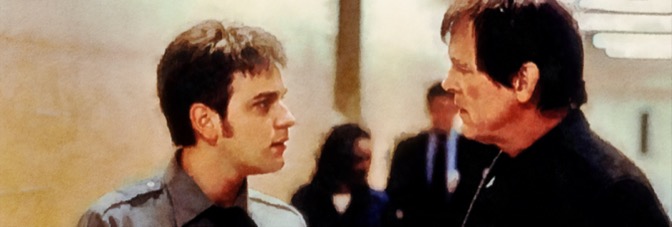
    Thanks to a weak performance from lead Ewan McGregor and an obviously altered ending, Nightwatch straddles being a reasonably perverse suspense thriller and a scalding commentary on middle-class white male masculinity. McGregor is a third-year law school student who takes a job at the morgue to help pay for he and girlfriend Patricia Arquette’s giant apartment. She’s from a wealthy family, but McGregor wants to pay his own way. The film takes place in L.A. but never emphasizes it; the action is either the apartment, the morgue, or one of the various locations McGregor ends up with best buddy Josh Brolin. Those locations usually involve drinking and Brolin feeling bad because he’s not toxically macho enough. Being shitty to girlfriend Lauren Graham is getting less and less rewarding to Brolin, so he needs to take it up a notch.

    We get this character set up during the opening credits; the film opens with a girl being murdered, then there’s opening credits with the four friends—McGregor, Arquette, Brolin, Graham—having a party (complete with McGregor wearing a native war bonnet, which simultaneously ages terribly but also tells you just what kind of dipshit McGregor will turn out to be). Intercut with the party are clips of cop Nick Nolte on the news giving an interview about a serial killer; the opening scene showed one of the murders.

    Nolte’s going to be very important to Nightwatch—the eventual star and absolutely fantastic—but he’s not going to show up until the second act. The first act is about McGregor getting settled at the morgue, and then he and Brolin’s middle-class, white-collar white boy attempts to butch up. Or Brolin’s attempts and McGregor fawning over him because McGregor’s in deep need of a male authority figure. It actually figures into the plot and puts McGregor and Arquette in danger, so it turns out the first act buildup pays off. Even with the reshot ending, which ends things a little too abruptly and artlessly (I mean, Nightwatch has a killer Taxi Driver homage, it ought to have a good ending), everything in the film eventually pays off so well it smoothes over the bumps.

    The second act will have Brolin escalating and becoming more and more dangerous to McGregor’s well-being—bringing sex worker Alix Koromzay into their lives. Koromzay does pretty well with a bad part; one of the bumps the film has to smooth out is when Brolin humiliates her for his own pleasure while McGregor sits by dumbfounded. Because Nightwatch is all about guys being shitty, actually. They’re either abusive like Brolin, impotent like McGregor, resigned like Lonny Chapman (the former nightwatchman), doped up like doctor Brad Dourif (it’s a small part, but he’s outstanding), or content with the failure like Nolte. It’s a profoundly misanthropic film and is the better for it. McGregor being a limp noodle makes his unsure performance hit better. In the first half the problem’s McGregor’s American accent; in the second half, everyone is more interesting than him—including Brolin, who gets astoundingly far on just an “I’m an asshole” bit. Especially once Arquette gets something to do.

    For the first half of the movie, Arquette’s barely in the film. She snuggles McGregor every once in a while and sends him off to work, but she’s not active. But once she gets active, once McGregor and Brolin’s shenanigans start getting more serious, it’s kind of her movie. Outside being Nolte’s movie, because Nolte runs off with it. Director Bornedal holds off on letting Nolte loose because there’s no way to bring the film back once he does. Nolte runs it. It’s a mesmerizing performance.

    The excellent performances—Nolte, Dourif, Chapman—and the eventually really good performances—Arquette and Brolin—make up for McGregor. Plus, the character’s a twerp, so there’s not much required of the performance; a better performance from McGregor, one capable of holding its ground with Nolte, would entirely change the film. Nightwatch gets away with the juxtapose of thriller and masculinity musing because of McGregor. With a good performance in the part, it wouldn’t.

    Technically, Nightwatch is stellar. Bornedal’s direction, Sally Menke’s editing, and Richard Hoover’s production design are the big winners. Dan Lausten’s photography and Joachim Holbek’s music are both good and sometimes essential, but they’re not actively excelling the other cylinders.

    The script’s also got some really intense moments—Bornedal adapted his Danish version, with Steven Soderbergh cowriting—particularly for Nolte.

    Nightwatch is good.

  • The Equalizer (2021) s02e05 – Followers

    Oh, come on, "Equalizer," stop getting my hopes up.

    Thanks to this episode—directed by movie "star" Mark Polish (quotations because I knew he existed but have never seen him in anything, and I also thought he co-directed all those) and with a script credited to Zoe Robyn—I am once again approaching bullish on "The Equalizer."

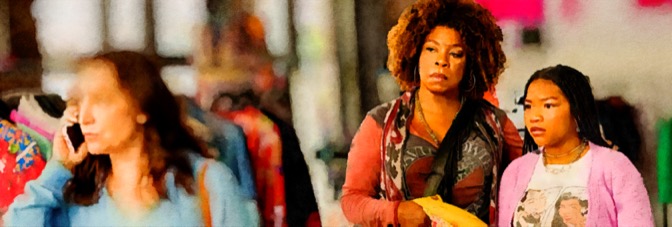
    The secret appears to be not having Chris Noth in the show—I think he's been on once, max twice, this season—and relegating Tory Kittles to de facto "and" credit. Kittles is still good, but the show all of a sudden seems very aware it can't really do a regular cop-adjacent show in 2021. Especially not with this episode's subplot about some shitty white woman (Diana Henry, who either deserves an Emmy or to be dragged) harassing Lorraine Toussaint in a store then calling the cops on the Black lady. It leads to a few phenomenal scenes for Toussaint, including a rending monologue.

    Credited scriptwriter Robyn is a white lady, so… it's one of those things where if we find out Toussaint didn't want to do the scene, it's going to be messed up, but at face value, it's outstanding stuff. It's all for teen Laya DeLeon Hayes's benefit. Hayes is an inclusive zillennial who thinks if white ladies are racist pieces of shit, it's just because they haven't read the right New York Times both sides op-ed (to which Toussaint has a killer response), and it turns into an arc for Hayes as well. Everyone involved, including the shitty cops, gives excellent performances, but Toussaint's is truly wondrous.

    The main plot is about a couple Internet detectives, Nadia Gan and Erik Jensen, hiring Queen Latifah to investigate some stalking videos. They're from the dark web and clearly creepy and dangerous, if not worse, but—in another way too real moment for the show—Facebook's cool having them in groups because engagement.

    It's a decent mystery, with lots of twists and turns, with decent or better performances from all the guest stars. Kevin Isola is a standout as the prime suspect. The show even gets some decent mileage from Adam Goldberg and Liza Lapira's exposition dumping about the case. Also, it helps a woman and a child are in constant, terrible danger to ratchet up the suspense.

    "Equalizer" is at its best with Toussaint and Hayes—oh, wait—the opening. They're talking about a family movie outing, and they're going to see a (fictional) superhero franchise movie only from the character names they use… it seems "The Equalizer" takes place in a universe without Rona, but one where Gods of Egypt got three sequels.

    Anyway. The show's best when it's Toussaint, Hayes, and Latifah at home, which isn't ideal for a domestic para-espionage procedural thriller, but it's where the show's most sincere. And the acting's the best.

    So, yeah, once again… getting ready for "Equalizer" to disappoint thanks to it raising its bar.

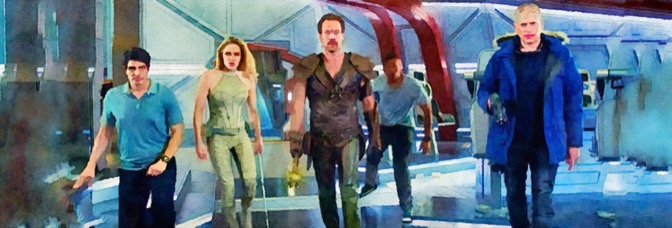
  • Legends of Tomorrow (2016) s07e04 – Speakeasy Does It

    I don’t know what other time period “Legends of Tomorrow” could get trapped in for a season—which presumably keeps costs down (as does no one really having any expensive superpowers anymore)—but the twenties is working out. Especially with Tala Ashe getting to directly address the racism, sexism, and homophobia they’re all now experiencing. Well, except Nick Zano. And she calls him out for it too, which is great (especially since the show did an “it’s okay, it’s not your fault for being a white man” on Zano a few episodes ago).

    This episode has the Legends stuck in Chicago and getting involved with Hamza Fouad’s speakeasy troubles. Fouad runs an unsegregated speak, which—historian Zano explains—the mob didn’t allow, making it an extraordinary spot. The team’s running low on funds thanks to Adam Tsekhman’s overtipping (one of the episode’s many great quick details), and so they team up with Fouad to replenish their coffers. Likewise, Foaud’s running low on booze, and they just happen to have a magical inter-dimensional mansion with an endless supply of whiskey.

    Except they don’t account for Foaud’s mobbed-up landlord, Sage Brocklebank, taking issue with the replacement booze. So all of a sudden, the Legends—led by Ashe—have to find a way to help Foaud.

    Meanwhile, Olivia Swann, Lisseth Chavez, and Amy Louise Pemberton are on their way to Chicago from Texas. They’ve just hooked up with Aubrey Reynolds’s girl band, and they’re trying not to disrupt the timeline, which isn’t easy with Pemberton blurting out future facts to the various people they meet and Swann refusing to let men push them around.

    When they get to Chicago, they find themselves between a rock and a hard place because Reynolds’s boyfriend turns out to be very bad guy Brocklebank, who Swann knows from her time in Hell.

    There are many good moments for Swann, Chavez, and Reynolds in that plot; ditto Ashe and Fouad in the other one. Plus, a great “action” sequence for Jes Macallan and Caity Lotz, with a great punchline. And then there’s this bonding C-plot for Tsekhman and Zano.

    Keto Shimizu and Emily Cheever get the script credit; it’s got some very strong moments. Kristin Windell directs, getting some excellent deliveries from Swann and Chavez in particular. Ashe’s fantastic, but she’s always great, no matter what the show throws at her. But Swann and Chavez finally get to deliver on the potential the show usually screws up for them.

    And Pemberton is getting comfortable on screen as well. She’s still a little awkward—some of it’s obviously the character—but she, Swann, and Chavez are delivering an excellent “B” team.

    “Legends” obviously can’t go on forever, but it easily has a couple more seasons in it. This episode showcases how well the actors keep the characters going no matter what budget, cast departures, or worldwide pandemics throw at them.

  • Doom Patrol (2019) s03e09 – Evil Patrol

    The episode opens with a flashback to 1917, when April Bowlby is still new to the past, and before Michelle Gomez has killed her boyfriend and turned all of her friends into unwilling weapons. It provides some more context for Bowlby and Gomez in the present, ready to duke it out, only Bowlby isn't prepared for Gomez to run instead of fight. The juxtaposing of Bowlby and Gomez, two recovered time travelers now floundering, is one of the episode's more subtle moves. They'll both have big moments—eventually—but they start from an exhausted quiet.

    The rest of the world is recovering from last episode's Eternal Flagellation, which didn't just affect the show's cast, but everyone on the planet. Including Phil Morris, who's just discovered son Joivan Wade has had his super-power enabling cybernetics replaced with regular-looking (albeit technologically based) skin. Morris bares his soul to Wade, and it's too little too late, making for a devastating scene. Unfortunately, it's also the only time director Rebecca Rodriguez doesn't do a good job—were Morris and Wade even on the same set—which makes it a little less effective, but it's still devastating stuff.

    Meanwhile, Matt Bomer and Matthew Zuk are having nightmares about trying fatherhood again, Brendan Fraser and Riley Shanahan are on the outs with daughter Bethany Anne Lind, and Diane Guerrero is trying to figure out what's going on with her and Skye Roberts. Everyone's got a lot going on, but it seems they're in slightly better shape than before having their externalized emotional meltdowns last episode.

    It leads Bowlby, who's been away from her friends for thirty years but is willing to let them think she's still the same person as before she left, to believe they are ready for a mission to take on Gomez. Bowlby figures Gomez has regrouped with the Brotherhood of Evil, specifically the Brain and Mallah, who have retired to comic effect in Boca Raton. Bowlby's right about the villain team-up; she's just wrong about the team being ready for a mission, especially since Gomez is very much prepared to prove her evil self.

    There's a great action scene, a great dramatic scene, a great cliffhanger. Also, an impressive physical sequence from Shanahan. Lots and lots of great… although it does take the episode a while to get going. The episode rushes the post-Eternal Flagellation stuff for the team as a whole; they've got their own stuff going on, so they don't have to bond for a while, but their own stuff just gets teased. For example, Roberts and Guerrero are in unknown, internal danger, but Bowlby berates Guerrero for wanting to deal with it instead of going on a team mission, delaying the reveal.

    Though there's a great twist with it, which kicks off the aforementioned great cliffhanger. It's a chain reaction setup to the cliffhanger, with pieces established throughout the episode.

    If that early scene with Morris and Wade had been better directed, it'd probably be a standout "Doom Patrol," even with the sluggish first act. It's still fantastic; it's just not the most fantastic "Doom Patrol"'s been. Especially after last episode, which is a singular hour of television.

    Some outstanding acting throughout, particularly Bowlby, Gomez, Bomer, and Fraser. Guerrero and Wade just don't end up with as much to do.

    The episode's also impressive in how much new plot it works in, establishing Gomez as a villain in the present just two episodes after she was–if not one of the good guys, good guy adjacent. But it also makes the Brain and Mallah into active villains when they've just been cameos before. It's real good.

    And that cliffhanger's just mean, especially for the penultimate episode of the season. It's "big" enough it could've been the season finale cliffhanger; somehow, having to wait a week is worse than waiting for the next season.

  • Doctor Who (2005) s13e01 – The Halloween Apocalypse

    Jodie Whittaker’s lame-duck season gets off to an inglorious start. It’d be inglorious no matter what—it’s Whittaker’s last season—but there’s an added dig with the next series being outside the BBC’s control or something. Sadly, instead of going out with a bang, writer Chris Chibnall, whoever hired the effects companies, and director Jamie Magnus Stone have decided it will be a struggle to even get it to a whimper.

    After an awful “action-packed” opening with Whittaker and companion Mandip Gill escaping an actually very easy to win no-win scenario, the episode starts going through some of the old tropes. Whittaker lying to Gill? Check. Whittaker not remembering something because there have been seventy-bazillion Doctors, and she only remembers a handful of them? Check. End of the universe? Check. Familiar aliens? Check. Familiar aliens desperately used for effect? Check. There’s even a future companion (Annabel Scholey) running into Whittaker before they meet. It really doesn’t help Scholey looks like former companion Jenna Coleman and has a very similar name. I was wondering if they’d just recast the part.

    And some of these tropes aren’t even new to Whittaker’s “Who.” I’m pretty sure last season was Gill being mad at Whittaker for lying to her most of the time too. There’s a quick mention of the departed Bradley Walsh and Tosin Cole, who apparently took all the heart with them when they left, but most of the companion stuff is setting up new guy John Bishop. He’s a Liverpool jingoist with a heart of gold, alternating between giving free tours in the Liverpool museum and working at a soup kitchen (even though he doesn’t have any food on his own shelves). He figures in coincidentally, with the bad guy who was after Whittaker at the open—Craige Els, whose alien costume reveal is one of the episode’s few smiles–kidnapping him from planet Earth.

    Only Els’s motives turn out to make most of the twists involving the character, including the opening attempt to execute Whittaker, nonsensical. To be fair, I didn’t realize the giant plot hole was a massive plot hole until after the episode was over because I was too busy concentrating on the apparent season nemesis, played by Sam Spruell. I don’t think he gets a name in this episode because Whittaker doesn’t remember him, but he’s the Red Skull with Thanos’s zapping powers. They didn’t spend any money on the costumes—some of the masks are dollar store cheap or the big effects sequences requiring composite shots. Still, they did get an okay app to do the Thanos disintegration effect, which Spruell uses on various people throughout the episode.

    Spruell’s got a nice and silly backstory—he’s been imprisoned from the start of time at the end of the universe (odd the Doctor didn’t run into him at the end of the universe a few seasons ago)—and it reminds of Star Trek V, which is the second time “Who”’s leaned on that Trek. Of course, they already did an imprisoned Satan years ago, just as ostensibly oblivious to the source material.

    But this episode also ups the ante with a Star Trek: Generations “nod.” There’s a destructive force moving through the universe, destroying everything in its path. The only one who can stop it is a boy named Bastian Bux—wait, wait, whoops, NeverEnding Story. It’s not the Nothing, it’s not the Nexus, it’s the Flux, which is also this season’s subtitle.

    Flux, not Not the Nothing, Not the Nexus, It’s the Flux, which is too bad because it’s a better title. “Who”’s something of a hopeless property, but it’s off to an even worse start than usual. Especially since the episode very intentionally doesn’t give Whittaker or Gill anything to do.

  • The Stop Button Guide 45

    A collection of film responses discussing the HALLOWEEN movies, starting with the 1978 original directed by John Carpenter and ending with the 2021 sequel, HALLOWEEN KILLS, directed by David Gordon Green. Includes all twelve movies in the franchise, as well as the alternate cuts (the two TV cuts, a producer's cut, and two director's cuts).

  • Halloween Kills (2021, David Gordon Green)

    Halloween Kills is a fascinating sequel. It’s a terrible movie—though probably better than the previous one just because there’s so much less Jamie Lee Curtis, so you’re not watching her embarrass herself the entire time (though she’s got some really embarrassing moments). But given it’s the ninth Halloween sequel and the second remake of Halloween II… a lot is going on in what the filmmakers do and don’t do. And if you’ve suffered through the other twelve movies or whatever… as a viewer, you too can see the creative choices in context.

    So fascinating.

    And terrible.

    It’s so bad. At least the first forty-five minutes are a gory, cruel, humor-drained riff on a fan service sequel. Then, after establishing Will Patton didn’t die last time and then flashing back to the original Halloween and doing a non-Halloween II sequel in flashback—how they missed a Curtis in the hospital joke is beyond me, but I’m not sure I’d feel good if I felt simpatico with Kills’s makers—the movie brings back supporting cast from the first movie. Not Halloween H40 first movie—we’ve established everyone’s back already—but Halloween 1978 first movie. Nurse Nancy Stephens is back, plus little kid grown up Kyle Richards. Anthony Michael Hall appears as the other little kid grown up, as does Robert Longstreet, but Longstreet’s so indistinct it seems like a retcon. Because Halloween movies need retcons in 2021.

    Charles Cyphers is also back, but later in the movie and entirely coincidentally—fatefully? Also returning are Michael Smallwood and Carmela McNeal as the disposable Black couple. They were in the last movie but apparently not memorably enough. And Dylan Arnold as Andi Matichak’s boyfriend (and Longstreet’s son). This Halloween is the one where we get the Elm Street parents going after Freddy, basically. Though not emphasizing the teenagers in danger because… well, why do teenagers when you can do stunt cameos and then little kids. Though the little kids in danger stuff turns out to be a Season of the Witch: Halloween 3 reference, which is kind of the only thing actually cool in the movie. Like, they do a solid job working it in.

    Oh, and there’s also some good gore animatronics. Kills’s Michael Myers is cruel and gross, basically doing anatomy experiments, and there are occasionally good gore animatronics. The rest of the time, it’s just gross for gross’s sake, but they do an actual fine job at least twice.

    Some of John Carpenter, Cody Carpenter, and Daniel A. Davies’s score is good. Mainly in the first forty-five when it’s the not-funny spoof of itself. During those moments, it seems like making a good Halloween escaped director Gordon Green and his co-writers, Scott Teems and Danny McBride, with them knowingly avoiding past tropes only for it to fail.

    It’ll turn out Gordon Green, Teems, and McBride have some big ideas to work out in the second half of the movie, so no, it was just them killing time before their “unjust, lawless mob” plotline, which isn’t the movie but also is the movie. It’s this movie; it’s just this movie is actually only set up for the next movie. Not doing a “Michael Myers Will Return in HALLOWEEN ENDS” is actually the filmmakers’ worst move, and they don’t make a single good one. They just don’t let the film acknowledge itself because they’re pretending it’s serious. And we get to see how Gordon Green does serious with Halloween, and it stinks. It’s embarrassing and silly, and you can tell they tried real hard.

    Anyway.

    Lots of bad and middling performances. Judy Greer looks really underwhelmed her sequel option got picked up. Curtis and Patton, who bond in their own Halloween II pseudo-remake, are bad. Hall’s not good, but it’s also a lousy part. The supporting cast ranges. Occasionally there will be some effective slasher sequences, possibly thanks to Timothy Alverson.

    It’s hard to tell if anything’s good about Kills, production-wise, because Gordon Green makes an absurd choice every thirty seconds, and it distracts, but Alverson’s editing seems good, actually. Whereas Michael Simmonds’s photography is just not incompetent. Also not sure about Richard A. Wright’s production design. Is it terrible, or is it bad at making South Carolina look like Illinois, or is it referencing the Rob Zombie redneck Halloween remakes? Or is it all three?

    Again, it’s a fascinating sequel.

    Shitty movie, though. Just an utterly shitty movie.

  • The Amazing Mr. X (1948, Bernard Vorhaus)

    Around the halfway mark, The Amazing Mr. X gets a whole lot more interesting without ever being able to get much better. The film starts as a supernatural thriller, with widow Lynn Bari convinced her dead husband is calling to her, pissed off she’s getting close to accepting suitor Richard Carlson’s marriage proposal. Bari’s little sister, Cathy O’Donnell, is pressing her into accepting, while Bari secretly finds Carlson super-annoying. We know she finds him annoying because when she meets mentalist Turhan Bey on the beach, he can read her subconscious and reveal those grievances to her.

    It’s a particular sequence with terrible composite shots—not just poorly matched as far as lighting. However, cinematographer John Alton’s achievement is basically never having a well-lighted scene or a well-composed angle on the composite shot. The angles on the backgrounds are wildly off, which might lend to an otherworldly, impressionist vibe, but director Vorhaus never goes for one. And then Bari’s terrible. Lots will change through Mr. X; the film’s got three major big twists, a couple big reveals, but the constant will always be Bari’s terrible performance. It’s not entirely her fault—Muriel Roy Bolton and Ian McLellan Hunter’s script is a combination of mysticism, deception, and light comedy; Vorhaus is particularly inept at the light comedy—but she’s still terrible. She’s never sympathetic, and pretty much everyone else, regardless of performance, manages to be sympathetic at one point or another.

    If Bari were good, Mr. X. might be able to overcome its other failings like O’Donnell, Carlson, and Harry Mendoza. O’Donnell’s never good, but she’s enthusiastic; surprisingly, she was twenty-five in the film, she seems younger, not quite teenage but definitely not twenty-five. She’s particularly bad at the supernatural sequences. Actually, Bari’s better at them. O’Donnell plays them like there’s eventually going to be a punchline, which never arrives because it’s not actually light comedy no matter how much the script tries. Bari at least takes them seriously. But there’s some charm to O’Donnell’s failed approach, which gives Mr. X personality.

    Especially after O’Donnell falls for Bey. She and Carlson have hired private investigator Mendoza (a real-life magician they presumably cast for his card tricks and not his screen presence; another mistake for the pile). His big idea to snoop on Bey is to get O’Donnell to go undercover for a reading. Except Bey’s able to see right through her subterfuge and instead seduces her.

    That plot development—O’Donnell killing the investigation momentum—ought to stall out the picture but instead, Mr. X. does a deep dive into Bey. So the narrative focus goes from Bari to O’Donnell to Bey. It dollies back and widens the narrative in the third act, but it always keeps Bey in the proverbial shot. Partially because he’s the only one who knows everything going on once the third plot twist arrives, partially because he’s the only main actor giving a compelling performance. At the start, it seems like Bey’s going to be a stunt cast, an extended “exotic” cameo, with the focus being on Bari and Carlson… until the plot starts twisting and turning and Mr. X ceases to be predictable.

    Even when there’s clarification and revelation, the film’s got another big twist waiting. It’s a neat plot. Shame the script’s bad; with a good script, Mr. X could probably get away with Vorhaus’s mostly inept direction, though it’d still need a better lead performance than Bari. Not even a great one, just a not always bad one.

    Mr. X (which is a terrible title, especially since Bey’s name is “Alexis” and they never once lean on the “X”) is neat without ever being cute; a good idea victim of a too low budget, with a surprisingly excellent performance from Bey. He does a whole lot without any help from the director, the script, or his costars. Though O’Donnell’s mooning is believable enough, given the object of her affection.

  • The Equalizer (2021) s02e04 – The People Aren’t Ready

    I’m not getting roped into the “maybe ‘The Equalizer’ will actually be good” game again, but this episode’s solid. It improves some things, it maintains some things, it fails at some things.

    The fail is Tory Kittles teaming up with Dominic Fumusa for a bit. Kittles has all these buddy cop one-liners he dismissively spouts just before the cut like a “Law & Order” spoof. The one-liners ring particularly hollow because they’re the only interactions Kittles has with Fumusa where the episode doesn’t go out of its way to remind Fumusa is a complete asshole. There’s even a secret origin reveal of his character to further explain the assholery. It’s a bunch.

    The improvements are for—almost unbelievably—Liza Lapira and Adam Goldberg. They go out in the world on a mission together, and Goldberg’s a buffoon, and Lapira has to save their bacon, but it’s actually cute. Even with Lapira’s socially conscious expository dump in the first few minutes about prosecutors holding people of color in pretrial detention for years on end. It’s the second time “The Equalizer” has tried this information dump from Lapira, and it works better this time. It also doesn’t end up being very important to the actual plot, which has Queen Latifah getting arrested and having to save the day from jail.

    Latifah’s got information about a threat against Karen DA Jennifer Ferrin, but Ferrin doesn’t believe it at first. Once there’s an incident, Ferrin makes Kittles and Fumusa work together to try to stop the would-be assassin—aggrieved father Michael Chenevert—while Goldberg and Lapira are pretty sure it’s a frame-up.

    Meanwhile, in jail, Latifah meets a young woman (Imani Lewis) whose stubbornness is stopping her from getting out of a bad situation. So Latifah becomes a mentor, whether Lewis wants one or not.

    Then at home, Lorraine Toussaint and Laya DeLeon Hayes are freaking out about Latifah being in jail—as part of the family’s new honesty policies, Latifah discloses her arrest—though no one knows her identity. So lots of good, quick family drama for Toussaint and Hayes.

    Combined with the Lapira and Goldberg all of a sudden being charming and an inventive episode setup… maybe “Equalizer” is getting better. Or at least it seems to be raising the bottom.

    The script—credited to Joseph C. Wilson—still manages a bunch of awful dialogue.

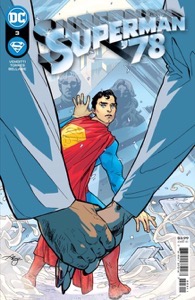
  • Superman ’78 (2021) #3

    Superman '78 #3

    If Superman ’78 weren’t written for eight-year-old fans of Superman: The Movie—ones who don’t have home video technology yet because otherwise you’d just rent the movie instead of reading this terribly written comic—I’d say this issue were the best. Even with the retconning for fan service’s sake and the pointless stunt cameos. Writer Robert Venditti, faced with the limitless budget of comic book action, goes the Canon Quest for Peace route and chickens out on doing the tougher cameo.

    It’d be embarrassing if the writing weren’t so terrible. There’s some of Venditti’s worst dialogue in the comic, which is saying a lot.

    The issue picks up with Brainiac arresting Superman. It’s the Metropolis fight from Superman II, only with a different ending and terrible “acting.” It’s not fair artist Wilfredo Torres gets tied to such a lousy script. It makes his Gene Hackman Lex Luthor “act” far worse than Hackman did in the movies (including IV).

    Also, Brainiac’s a limp noodle of a villain. He’s probably Venditti’s worst writing, which is—again—saying a lot. He brings Superman up to his spaceship, and there we get a big reveal or four in the best visually paced scene in the series. You almost wish it were a movie, right until Venditti’s “fan” servicing ruins it.

    Quotation marks on fan because if this comic were a real “sequel”—to what, II, right? Like, III hasn’t happened yet? Anyway. If it were an actual sequel, it’s a turn of events no one was asking for because for that period… it’d be a cop-out turn of events. Whereas post-big budget fan service in the twenty-first century has shown no one cares about cop-outs if there’s fan service.

    I didn’t have an iota of hope for the comic after the previous two issues, but I guess #3 decides I’ll finish it. Morbid curiosity and Torres’s nostalgia plucking art outweighing Venditti’s truly insipid writing.

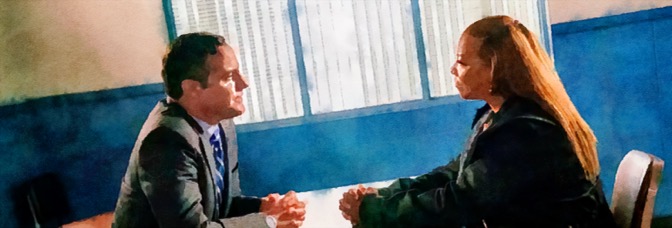
  • Superman & Lois (2021) s01e08 – Holding the Wrench

    This episode starts like it’s going to be a “Lois Lane in therapy” episode—a la Aunt May and Ultimate Spider-Man, obviously—but it quickly turns out Elizabeth Tulloch’s entire arc is to support the boys. I think it technically passes Bechdel—the therapist is a woman, played by Wendy Crewson—and there’s one portion where they don’t mention boys, but they’re really talking about the boys. Whether it’s Tyler Hoechlin, Jordan Elsass, or Wolé Parks; this episode’s about Tulloch finding out her alternate universe history with Parks, complete with flashbacks to womanly traumas on both worlds.

    It’s all somewhat manipulative and all moderately successful. The episode juxtaposes Parks’s interrogation with Tulloch and Elsass investigating his mystery RV. At the same time, Inda Navarrette has a typical high school kid subplot involving trying out for the musical while relying on unreliable dad Erik Valdez. Navarrette gives the best performance in the episode, followed by Dylan Walsh. This episode might be Walsh’s best overall performance. Everyone else runs hot and cold.

    Worst is Parks, who’s got a concerning lack of chemistry with Tulloch—if they tested them together, whoever okayed it made a big mistake—but Tulloch and Elsass will both disappoint as things go along. Tulloch’s never able to make her past trauma subplot take-off (the dialogue’s just too generic), and Elsass never gets to do any character development. Things happen then he goes off-screen to deal with them, only coming back for the resolve moments. It’s not Norma Bailey’s direction’s fault either; the script, credited to Kristi Korzec, never delivers.

    There’s some good action—Bailey gets to direct Hoechlin in a Kryptonian street fight—and some great humans in jeopardy moments, but for the big resolution to Parks’s subplot to this point… it’s a goofy finish. The show’s got the problem everyone in it could be the protagonist, so the show’s too unfocused.

    It does end up having a reasonably nice subplot for Alex Garfin, who’s barely in it and nothing with the Super-Family, rather doing support for Navarrette. There are also some C plot machinations for Emmanuelle Chriqui.

    Given the end result of the episode is getting Parks settled and Tulloch and Hoechlin informed, it’s actually a bridging episode, albeit a busy, cluttered one. It’s middling, but with some good moments. And the show’s aiming so high with the “Superman and Lois” family drama bit, even being mildly successful given all the soapiness is… fine.

    Though it’d have been nice if Crewson were better. The show really needs to do better with its guest spots.

  • Outlander (2014) s01e08 – Both Sides Now

    At the end of this episode, I momentarily marveled at “Outlander”’s ability to bore and offend me for almost an hour, then make me care about the obnoxious characters on the screen. Then I realized it was just they’d finally threatened to rape Caitriona Balfe enough; I was moved when they didn’t. Especially since the second interrupted rape involved gleeful mutilation on the part of Tobias Menzies, playing an ancestor of time traveler Balfe’s husband.

    The episode’s all about Menzies mooning over disappeared Balfe in the 1940s while she’s busy enjoying marital bliss with hunky highlander Sam Heughan in the past. Well, until it turns out public sex in 1700s Scotland is less safe than Balfe and Menzies’s public sex in 1940s Scotland, and a couple redcoats ambush them and decide to rape Balfe. It gets interrupted with a godawful slow-motion action sequence, and then Balfe wanders around recovering for a bit with emphasized side boob going on. Once again, it’s Anne Foerster directing, so it’s a woman doing her damndest to appeal to male gaze. And doing godawful action sequences.

    In the present, Menzies is dealing with cops who don’t care—they’re trying to do them all folksy and charming, but they’re really just terrible men who hate women and don’t care what happens to them—and finally deciding he’s going back to Oxford. Turns out the figure he saw in the pilot episode was Heughan somehow in the future. Big yawn.

    In the past, Menzies will catch up with Balfe—not caring she’s married to a Scot now—and she’ll blather in the narration about how she’s going to outsmart him using her future knowledge. It’s knowledge we got in the pilot, too, but it didn’t seem significant. Though none of “Outlander” is significant.

    There’d be some potentially okay character development for Balfe, but it goes to pot for sensationalism and exploitation. Heughan’s gotten blander the more he moons over Balfe—I asked regular viewers if the stars ever got chemistry together, and they said yes, but I should’ve clarified good chemistry. Balfe and Heughan are so tedious together, the supporting cast is downright endearing when they show up. Including Graham McTavish, who’s not rapey this episode, so next one, beware….

    It’s an exceptionally manipulative show, like the whole gimmick is how manipulative it can get, which I guess gives Ronald D. Moore (who gets the writing credit) something to do, but it’s atrocious storytelling. And Menzies is so laughably miscast they have to promise gore to make him threatening. But he’s still worse in the present as a potential cuckold.

    At one point, it seems like Balfe might leap back home, and I know she can’t because there are a million more hours of this show, but for the sequence, I desperately wished she would, and it would be over. Alas, magical thinking is just that.

    Anyway, Bill Paterson’s cute; shame he’s only it for three minutes.

  • Legends of Tomorrow (2016) s07e03 – wvrdr_error_100 oest-of-th3-gs.gid30n not found

    It’s the one-hundredth episode spectacular, which makes sense given the litany of guest stars, but it’s also the episode where Amy Louise Pemberton becomes a proper Legend. Since the pilot, she’s been on the show, but just her voice; she’s the AI running the time-traveling spaceship. She’s appeared a few times over the years in physical form, and this episode handles transforming her from a “voice credit” to a regular one.

    The episode starts with Pemberton, Olivia Swann, and Lisseth Chavez traveling 1925 Texas trying to get to New York before the rest of the team to save them. It’s unclear what will happen when they get there, but it’d be nice if they got a move on. Even though the season’s only three episodes in, they spent the end of last season in 1920s Texas, so it feels like forever. Luckily the reunion spectacular is a worthwhile stopover.

    Pemberton—who might be human but still has a supercomputer’s brain and all her memories of the timeline—has a mental crash, and Swann and Chavez need to magic themselves into her brain to figure out what’s wrong. When they get there, they find themselves back on the spaceship, only it’s Pemberton’s subconscious and Franz Drameh’s running it. Drameh left in season three, so it’s been a while. He’s probably the most welcome return because he gets the most to do.

    There’s also Victor Garber, Wentworth Miller, Brandon Routh, Courtney Ford, and then Arthur Darvill. Darvill, of course, was the original “lead” and hasn’t been back for years; they hinted at him last episode, but I wasn’t counting episodes, so I didn’t think they’d bring him back the very next one.

    Pemberton’s journey to human-hood involves a bunch of memories of the show at various points in its run. Oh, wait, they also bring back Hawkman Falk Hentschel, who hasn’t been back since the first season and hasn’t been mentioned since because they were probably going to use Hawkman in a movie and were scared to confuse viewers back then with multiple versions of the same characters. But he’s back for a funny enough cameo.

    It’s a good trip down memory lane; a clip show, but obviously better because the scenes are geared towards being memorable without having to do any work. Dominic Purcell is conspicuously absent, of course, and the eventual drama is… well, it’s not a rip-off of “WandaVision,” but they’ve definitely seen “WandaVision.”

    We also get some more information on the season’s big bad—the last episode revealed they’d be robots; in this episode, we get hints at who might be building them.

    Caity Lotz directs and does a fine job. She leans into the fun and silly.

    It’s far from the best “Legends”—it’s like a very soft sci-fi take from hard sci-fi aficionados–but it’s a bunch of fun. Though most of the charm is going to require having seen the last seventy hours of the show.

  • Doom Patrol (2019) s03e08 – Subconscious Patrol

    On rare occasion, a show will do an episode where they realize all the things I’ve been waiting for it to do, good or bad. But nothing has ever quite come along and repudiated my concerns like this episode of “Doom Patrol.” Subconscious Patrol, directed by Rebecca Rodriguez, with a script credited to Tanya Steele, is an almost inconceivable success. The show takes all the things it’s been working on this season and finally brings them together, both tonally and physically, and hashes it all out.

    If it weren’t for one of the cliffhangers interrupting a mega-action beat, it’d be a perfect season finale. The season’s laborious character development pays off, with the episode managing to bake a bunch more in at the last minute.

    I’m now also wondering if Matthew Zuk plays Matt Bomer’s character in the trench coat and gauze wrap… ugh. Yep, a quick Google later, and it’s Zuk on set. Whoops. I’ve been crediting it wrong the whole time. Major props to Zuk, of course.

    Anyway. The episode.

    The Eternal Flagellation is underway, and it’s time for the Doom Patrol to figure themselves out, thanks to art and April Bowlby. It’s still unclear how Bowlby got together with the Sisterhood of Dada once she got back to the future, but there’s a flashback explaining how the time travel memories thing works. While Brendan Fraser and Riley Shanahan, Joivan Wade, Diane Guerrero and Skye Roberts, and Bomer and Zuk, all get to hash themselves out on screen, in front of one another and themselves, Bowlby’s character development happens in the past. She has a final face-off with Michelle Gomez in the past, which seems like it’s going to be the episode’s impossibly high acting point, but then almost everyone’s going to get one. I’m not even sure Bowlby wins by the end of the episode.

    Because it’s also time for Fraser to confront himself about what a shitty person he’s committed to being and how it’s threatening everything, particularly his relationship with daughter Bethany Anne Lind. Great acting from Fraser—who appears onscreen as a personification of the character’s subconscious—and Shanahan. Their scene opposite each other is phenomenal.

    But is it better than Zuk and Bomer’s scene? Maybe, maybe not. Absolutely fantastic acting from Bomer (onscreen) and then Zuk and Bomer doing the costumed stuff. Fraser’s backstory is about being a shitty human being; Bomer’s is about forcing himself into the closet. They’re both intense and tragic, but they also have some agency to them. We find out Wade’s backstory is all about the time dad Phil Morris told him to start acting respectable so racist white people wouldn’t try to get him killed by cops. It’s devastating stuff, with Wade’s subconscious alter ego coming in the form of Richard Gant as a (Black) army toy.

    But then Guerrero and Roberts’s hashing out is about something entirely different, which makes sense since last season was about working through their backstory. Some of their subplot involves a felt puppet talk show. It’s wild and amazing and wonderful and gut-wrenching. Guerrero gets to play the part straight for a while—with Roberts possibly doing the voice of the adult Guerrero as she interacts with the other avatars of her teammates—and it really works out.

    The episode just gets better and better, starting like another splintering of the cast but then bringing them all together and doing the impossibly hard work. It’s beautiful work.

    Gomez’s also great, but she’s support to Bowlby—outside her fabulous first meeting with the Brotherhood of Evil.

    Subconscious Patrol is a perfectly executed, truly exceptional hour of television. It’s going to be so great to get to when someday marathoning the show.

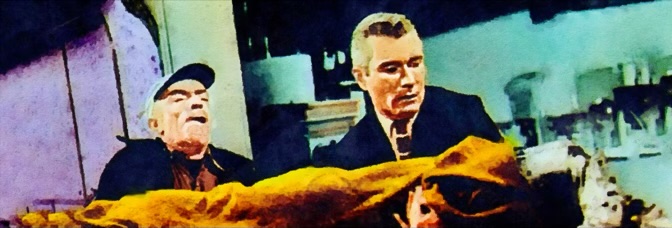
  • Frankenstein’s Daughter (1958, Richard E. Cunha)

    Frankenstein’s Daughter ought to be good camp. If the rest of the movie could keep up with Donald Murphy (as Doctor “Frank”), it’d be something to behold. Because Murphy gives it his all opening to close, seemingly more aware of the picture than the picture’s aware of itself. Though he’s never quite good—he’s better than anyone else, except maybe Wolfe Barzell as his assistant—but he’s captivating.

    Unfortunately, he’s captivating in the wrong movie.

    Because while this movie does a pretty good riff on modernizing old Frankenstein movies—modernizing to the late fifties—it’s also a late fifties teen movie, so literal rapist Murphy comes off less creepy than regular gaslighting fifties boyfriend John Ashley. Ashley gives the film’s worst performance, which is saying something because there are lots of terrible performances. Even the better performances have some terrible stretches, like damsel-in-distress Sandra Knight and slutty-girl-who-deserves-it-for-dressing-that-way Sally Todd. If H.E. Barrie’s script were better, it’d all be about Ashley having forced Todd while they were dating, then dumped her for good girl Knight, because even though that story’s not in the script… it’s unintentionally in the performances when you try to imagine the character relationships.

    Sadly Ashley figures into the third act a bunch and drags it down a bit. The movie misses the one way it could do the right thing as far as comeuppance, and it completely fails.

    Though it’s hard to imagine director Cunha ever having a good idea. He’s never got any ideas. The camera stays in medium long shot outside a couple reveal close-ups. Cunha can’t even direct over-the-shoulder shots. Then again, editor Everett Dodd wouldn’t be able to cut them, but still. Oddly, Meredith M. Nicholson’s photography is fine. Frankenstein’s Daughter looks like a movie shot in and around someone’s suburban Los Angeles house and whatever sets were still up at the rental studio, but the lighting’s always solid.

    The story has Murphy posing as a lab assistant to lovable old scientist Felix Locher (who’s not unlikeable but gives a lousy performance). Locher has a fetching young niece, Knight, and a lab in his house. Apparently, Murphy gets him to hire Barzell to be the live-in gardener but really to help Murphy with his monster-making. Murphy keeps trying to force himself on Knight, which is expected in the fifties, so she never really complains—besides, he’s a bookworm and not a my-daddy’s-a-lawyer regular guy like Ashley. Daughter unintentionally says a whole lot about its cultural norms.

    The movie kicks off after Murphy starts knocking Knight out when Locher goes out. Not for anything rapey, but rather to inject her with experimental serum to turn her into a monster. Albeit a bulletproof one. Knight’s ostensible friend Todd sees her and tries to tell people, but she’s one of those girls who’ll say anything for attention, so why listen to her says ex-boyfriend Ashley and his bro, her current beau, Harold Lloyd Jr. Junior’s terrible but much better than Ashley.

    Though Ashley at least wants Knight to wed and obey him, it turns out Lloyd Jr. could give a shit about Todd.

    Todd starts flirting with Murphy to get back at Knight for stealing Ashley away. Things go atrociously for all involved. John Zaremba and Robert Dix are the credulous but still unhelpful cops. Who shoot first and ask questions later, even with white kids, so… they could be worse? Dix seems like he’d be better with direction, something Cunha doesn’t provide.

    Competent music from Nicholas Carras. Indescribable shoehorned music numbers from The Page Cavanaugh Trio—if you’ve only ever heard good white kid music from the fifties, they’re an experience.

    Frankenstein’s Daughter probably plays better with people talking over it, so you can’t be so horrified at its actual content. It seems like it was made with the express purpose of being mocked on “Mystery Science Theatre.” Concerningly, of course, it was not.

    so you can’t be so horrified at its actual content. It seems like it was made with the express purpose of being mocked on “Mystery Science Theatre.” Concerningly, of course, it was not.

  • Batman ’89 (2021) #3

    Batman '89 #3

    Did the Michelle Pfeiffer/Tim Burton Catwoman movie never get made because she refused to wear the new outfit from Batman ’89? Or are the costume designs on the comic just going to be wanting overall. Robin seems inevitable, and I’m concerned.

    But the banter between Batman and Catwoman—Michael Keaton and Pfeiffer—is kind of exactly what I’d always wished it would be. Their rooftop rendezvous is half-great, then a quarter hints at a reveal, and the last quarter is set up for next issue’s A plot. It’s a little too efficient when it needs to be prolonged, especially since writer Sam Hamm has spent the entire issue teasing the scene.

    The issue’s got a bunch of action at the start, only not really. Billy Dee Williams goes from star of the comic to the “And” credit after we get the ’89 origin of Two-Face. Sorry, Harvey Two-Face; I wonder if they’ll go there. Worse, Harvey receives a couple dream sequences. Now, artist Joe Quinones does a fabulous job with most of this issue—Catwoman’s new costume aside—and really shows off in the banter sequences between Bruce Wayne and Alfred (and their cat), and then Bruce and (Tim) Drake (Winston) Robin (Zeddemore) or whatever his name’s going to end up being, but he does not do a great dream sequence. Maybe, you know, Tim Burton would’ve done it well or whatever, but in the comic… it looks like a rushed riff on the High Anxiety VHS box cover. Not really worthy of Billy Dee Williams’s Two-Face origin story.

    Actually, given the villain origin sequences in Batman and Batman Returns… it’s even more of a bummer. But they may still have time to fix it. I was worried when I thought it was issue four, and there were only two more left, but it’s the third, and there’s possibly time. Hamm and Quinones do a good job packing in content, but they could obviously use another five pages. It feels like a surprisingly good comic book adaptation of a non-existent movie, which is probably the best approach.

    I’d be more enthusiastic for next issue if there’d been another page of Keaton and Pfeiffer flirting and less dream sequence. And maybe at least an appearance from Commissioner Gordon, who’s strangely absent like Pat Hingle’s likeness isn’t under contract or something.

    But Bruce and Drake are potentially a fun duo. As ever, fingers crossed they pull ’89 off.

  • What We Do in the Shadows (2019) s03e10 – The Portrait

    So, it’s a completely fine season finale.

    And by completely fine I mean, amusing and adequate. It’s intended to close off this season and prepare the next, with lots of plot machinations going on throughout. Until the final reveal, it’s mostly Harvey Guillén’s episode but not a great one for him. Looking back at the season from here, it’s clear they never figured out what to do with him post-vampire hunter reveal—I kept waiting for Kristen Schaal to flirt with him to give it some personality, but no. There’s no character development, no relationship development, just getting things in order for hiatus.

    The episode opens with a reasonably decent gimmick—the vampires are having their portrait done because portraits are very important in vampire culture. There’s a quick recap of why they’re important, but it’s a new thing coming in at the end of season three when they’ve had portraits around the whole show, and none of those other portraits come with a similar story. Doesn’t matter, the Sire and the Baron are back for the portrait, and it’s kind of adorable having them around. Plus, Donal Logue is painting the portrait. The episode does a deep dive into Donal Logue’s filmography for gags instead of doing an episode for the regular cast.

    Again, it’s okay. Logue’s kind of too good for it to work. If his performance were hacky—like if he’d never learned to act—it’d be funnier. Instead, just adequate.

    The worst part of the episode is never showing the completed portrait. Though the Ocean’s Twelve twist and plot unfolding reveal in the last five minutes is worse for the show itself.

    There’s some good acting from Kayvan Novak and Matt Berry, though Natasia Demetriou gets the better material. She’s at least got a subplot. Guillén ought to be better, but the writing’s too broad.

    The episode’s totally fine, and next season should be hilarious. But it most definitely wasn’t worth blowing the last three episodes of this season to set it up.

  • My Life Is Murder (2019) s02e10 – Pleasure & Pain

    Well, I certainly hope we get another season, especially since we don’t get an answer about a particular couple of characters’ relationship status, any resolution for Lucy Lawless’s brother (who doesn’t appear in this episode), or just her life in general. In fact, this episode sort of walks back some of the character development from the last episode. Or at least ignores it. Or seems to ignore it.

    The hook of the episode is Renée O’Connor guest-starring, reuniting with Lawless from “Xena.” Instead of friends, O’Connor is a suspect, or at least would be if it weren’t a locked room murder. Or maybe murder.

    O’Connor runs a wellness cult; her husband, Michael Hurst, died during a sex game with their chief assistant, Shoshana McCallum. But it’s apparently not murder; self-induced, as it were. Only copper Rawiri Jobe doesn’t believe it—the cult’s too weird, especially with O’Connor professionally embracing husband’s mistress McCallum—and so Lawless and Ebony Vagulans investigate.

    The initial part of the investigation is fun; Lawless acts like a rube to ingratiate herself to O’Connor and McCallum. Meanwhile, Vagulans buddies up with O’Connor’s son, Miles Muir (also O’Connor’s real-life actor son, no explanation why they don’t have accents), who runs all the computer stuff. Vagulans then finds out Muir’s got a crush on McCallum and fought about it with his dad, who cut him out of the will.

    So everybody’s got a motive if Lawless can just prove there was an actual murder and not an accident.

    But in trying to establish the crime, the relationships change between Lawless, O’Connor, and McCallum and cease being much fun. O’Connor’s doing an actual creepy cult leader thing, not like a fun reuniting cameo. She’s too good of a villain for it just to be a smile. Her performance is fine too, ditto Muir. Neither of them is great, but they’re fine. McCallum’s good in an impossible part (a relatable cult devotee).

    There’s not really a B plot; Lawless is bitching about social networking this episode, resulting in some amusing scenes, and there’s some nice camaraderie stuff between her and Vagulans, but again… they’ve already done this character development.

    I wonder if this one’s airing out of order.

    Regardless, fingers crossed they get another season. If it’s back to Australia for a refreshed supporting cast, something might get lost overboard in the Tasman.

  • The Equalizer (2021) s02e03 – Leverage

    Every time I think “The Equalizer” is getting better, it stalls out, though at least some of this episode is fine, and the worst stuff (Liza Lapira acting tough) is predictable. This episode, writing credits to Keith Eisner and Erica Shelton, is a combination of “The Wire”-lite and “The Shield”-lite. And it’s directed by Eric Laneuville, a very measured, thoughtful, experienced TV director.

    If Laneuville can’t make it play, it just can’t play.

    The plot has Queen Latifah trying to rescue teenager Justiin A. Davis from a life in the game. The show goes out of its way to imply that situation, only to reveal he’s being forced into it by yuppie DEA agents Michael Drayer and Jacqueline Nwabueze. Drayer’s a white guy; it’s clear he does not give a shit about Black teenager Davis. Nwabueze’s a Black woman; it’s clear she knows they’re doing the wrong thing but is hoping Drayer’s imperviousness to accountability will go for her too. Neither are exactly bad, just terribly miscast. It’s unbelievable Latifah doesn’t beat the shit out of them after meeting them.

    So while she’s trying to figure out what gang they’re trying to get Davis to infiltrate, a new cop on the vigilante case, Dominic Fumusa, is after her. But most of his pursuit is making “is the okay sign really racist” comments to Tory Kittles, who’s demoted to office work this season, where Fumusa likens himself to a Great White Hunter. It’s weird. Like “The Equalizer” can’t really address some things because then Kittles’s whole character falls apart. Like cops can’t be villains, even though whenever they’re on the show too much and get too many lines, they’re clearly villains, racist villains.

    It’s actually downright subtle compared to the DEA blackmailing Black teens into working undercover, which the episode spotlights in three or four expository dumps. Sure, the dumps feel contrived, but they’re at least informational, save maybe when Lapira and Adam Goldberg are doing one.

    The home plot is Laya DeLeon Hayes giving a eulogy for the kid who got killed in the last season finale when Hayes found out her mom’s “The Equalizer.” Lorraine Toussaint provides sturdy support. It’s not particularly well-written, but it’s at least effective, thanks to good acting.

    Maybe next episode will be better. It usually goes better, worse, better, worse, so the show can’t get any real momentum going.

  • Grantchester (2014) s06e08

    So, “Grantchester” has already been renewed for season seven, which might be the first time ever “Grantchester” hasn’t given the impression of being a bubble show. At the beginning, I think it was Robson Green who wasn’t sure about signing up for a new ongoing; then it would’ve been James Norton, but apparently, Green’s over it, and they got another season before this one premiered.

    Because some big things go unresolved and unaddressed this episode. They make swings at moving certain story elements along, but then others they just pass ahead or just use to cliffhang. Big, ginned up cliffhanger this episode. The lackadaisical attitudes of the last few episodes all of a sudden make a lot more sense.

    There is some capital-A acting from Green, who completes his arc with war “buddy” Shaun Dooley. Green drops all the truth bombs on Brittney—the unspoken things between Dooley and Green everyone has been asking about since Dooley’s first appearance—and the show finds an unexpected potential avenue amid the regular ones. Who knows if it’ll play any better, but it’s some character development, which isn’t there for pretty much anyone else.

    Everything with Brittney is on hold; even when Kacey Ainsworth calls him on not actually being a good vicar to Green, it doesn’t lead to anything; it’s just Ainsworth moving some of the pieces into position for later. There’s a tiny bit with Brittney and new curate Ahmed Elhaj, but it’s mostly a retraction for Elhaj. Turns out he’s got to be more likable if they’re getting another series.

    And then Al Weaver and Oliver Dimsdale can wait for then too.

    The case involves a singer—Michelle Greenidge—with an abusive husband, Tristan Gemmill. It ends up being a far more compelling mystery than it seems, even if John Jackson’s script falls apart during the finish. It’s like Jackson had a good mystery but didn’t know how to write anything around it, not for the case or suspects, not for the regular cast members either. Maybe it’s a Rona episode. It’ll be too bad when things can’t get a rubber stamp for being Rona episodes.

    There are good moments, particularly for Green, Brittney, Weaver, and Dooley, but it’s too rushed, even if they are getting another season. And they’re making broad strokes to cover all the unfinished threads.

    Some absolutely fantastic little moments for Nick Brimble and Tessa Peake-Jones too.

    It’s going to be a longer wait for next season than usual.

  • Outlander (2014) s01e07 – The Wedding

    I’m not sure how to take “Outlander” seriously. It’s somewhat offensive the show ever implies I should try; this episode makes me want to see if it somehow breaks my eighth amendment rights or something. It’s shockingly bad at what it’s trying to do, starting with what it’s doing in the first place.

    The last episode ended with British time traveler from the future Caitriona Balfe agreeing to marry hot highlander Sam Heughan to foil evil British red coat Tobias Menzies’s plans for Balfe. Making matters worse, Menzies is an ancestor of Balfe’s husband in the future—also played by Menzies. Menzies doesn’t appear in this episode, which is fine. It’s got enough problems with the actors it does have.

    This episode is all about their wedding night, including their sexy times. At this point, Balfe’s been living in the past for four months minimum, so you could think of her widowed four months. Except her plan is to go back to the future, where Menzies (the future one, not the rapist one) is still alive. Maybe. You wouldn’t know it from this episode’s narration, which might be the worst ever? And “Outlander”’s narration for Balfe is some of the worst narration I’ve ever heard, so… it’s an achievement to dig to a new bottom. Kudos Anne Kenney or whoever. Kenney gets the credit, but maybe it’s from the room; perhaps it’s from the source novels. Who cares.

    Outside they’re decidedly dull nooky—it’s hilarious because Balfe and future Menzies were legit exhibitionists—they talk and flashback to Heughan’s day. While Balfe’s just marrying the sexy Scot barbarian because she doesn’t want to go to eighteenth-century prison, Heughan’s actually sincere in his wedding desires. Balfe’s a good match for him. Only the supporting cast has just recently become likable, and then they roll it way back with Graham McTavish, so spending an episode with them is tedious. But at least they’re not having boring conversations and bad sex. Though I think we get some man bum. There is lots of female nudity (the director’s a woman, Anna Foerster), but it’s still male gaze-y. All of it is unnecessary.

    The episode never answers important questions—like how Balfe marrying wanted man Heughan makes any sense—and then probably some other ones. I don’t care. It’s so lousy commercial breaks would’ve been an improvement. Seriously, how did they decide to make this show but not decide the rules for Balfe’s narration—or, you know, figure out the character relationship with her and Heughan. In every episode, it seems like they’re strangers meeting for the first time even though they’ve known each other since the first episode.

    I’m not sure if it’s unintentionally bewildering or just terrible, but given even usually sturdy McTavish can’t sell his latest mood swing, it’s probably the latter.

  • Legends of Tomorrow (2016) s07e02 – The Need for Speed

    This episode is really Season Premiere, Part Two, with the season villain getting a reveal in the cliffhanger. They tease the reveal earlier, with Tala Ashe spending her time in the episode getting stoned, mooning over departed Matt Ryan, and trying to figure out what friend, foe, or category of either is the big bad this season. It’s a little forced and a waste of time for Ashe, but it references “Rip Hunter” for the first time in ages, so it’s occasionally engaging.

    Plus, Ashe gets the punchline at the reveal later on, and it works out.

    The main plot is Nick Zano pretending to be J. Edgar Hoover (Giacomo Baessato), so no one finds out Baessato’s dead. The show breaks its back complimenting the historical Hoover while “acknowledging” the problems, ending with Zano getting a pass for all the racism he easily commits while in the part. It’s messed up. For a while, they seem like they’re going to try with the Zano “when you look into the abyss” stuff, but then they rush the conclusion, and so it was all just pointlessly gross.

    Jes Macallan and Caity Lotz spend the episode honeymooning and occasionally checking in with Ashe to move the C-plot along. Macallan’s got some funny scenes. It’s probably the least forced thing in the episode.

    The B-plot is Olivia Swann and Lisseth Chavez discovering a human version of the ship’s computer, played again by Amy Louise Pemberton. Pemberton’s had physical appearances in the part on the show before, and they worked? I think they worked. Like the show never really leveraged it but could have.

    Anyway. Swann resurrected and incorporated A.I. Pemberton instead of rebuilding the actual spaceship. Only Pemberton can’t talk, so it pisses Swann off. I’m not sure if it’s the script or the direction, but something’s not connecting with Swann’s performance here. Maybe because it’s shoving the character development back a few steps so there can be another life lesson from Alexandra Castillo. And Castillo’s life lessons are good and all, but it’s redundant. And derails Swann’s performance.

    But it seems like it’s resolved by the finish, and we can get on with the actual show now.

    What’s funny is “Legends” always sets up the next season in the finale but didn’t last season, and now they’ve spent two episodes getting it done instead of two to four minutes.

    The episode’s fine. It’s just a low fine.