• The Incredible Hulk 53 (July 2003)

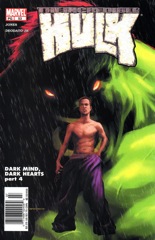
    901318I haven’t talked about Deodato’s tendency towards wide faces because there have been more interesting things to talk about. Not anymore. Sadly, Jones’s stalling has continued and gotten worse–this issue and the previous easily could have been wrapped into one.

    What happens this issue? Bruce finds out about the girl, whose motives are simple and noirish but way too small for such a big story, and the Abomination gets out.

    The problem’s how Deodato breaks out the story. He doesn’t have a good way of visualizing Banner’s forced hallucinations, he doesn’t have a good way of visualizing the Abomination’s rampage. Yes, he can do a splash page of destruction, but there’s no gravitas to it. There’s no sense of mood. Sure, the art’s dark, but dark isn’t mood.

    The cliffhanger promises a final issue to the story arc. Hopefully Jones can correct the series’s decline once he’s done here.

    C 

    CREDITS

    Dark Mind, Dark Hearts, Part Four: Enemy Mine; writer, Bruce Jones; artist, Mike Deodato Jr.; colorist, Studio F; letterers, Richard Starkings and Wes Abbott; editors, Warren Simons, John Miesegaes and Axel Alonso; publisher, Marvel Comics.

  • Robocop Last Stand 008 CoverSo Ed Brisson gets the job of sending the original Robocop into the sunset. My first thought–he does an admirable job, though he could have easily turned it into three issues. He’s got a lot of ideas for how to bring things together. And that spark, even if it’s hilarious fan fulfillment, leads me to my second thought.

    It’ll be too bad if Boom! doesn’t continue with the license for these types of series. Experimental ones, where an artist like Öztekin gets free run. Or, if the artist doesn’t get free run, at least it appears he or she does.

    This issue, with Brisson’s writing, makes me want more of he and Öztekin’s Robocop. Maybe a prequel… the creative spark seems like it might have mileage.

    Robocop, regardless of marketers, was never a film needing a sequel. But Brisson and Öztekin give that franchise a fine send off.

    B 

    CREDITS

    Writer, Ed Brisson; artist, Korkut Öztekin; colorist, Michael Garland; letterer, Ryan Ferrier; editors, Alex Galer and Ian Brill; publisher, Boom! Studios.

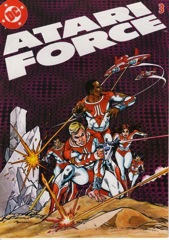
  • 49386 20130522174834 largeEven with some great Gil Kane art, the last issue of Atari Force is a tad meager a finish for the series. Kane doesn’t have to suffer through a lot of video game-type space action, but there’s some and it’s too much.

    Worse is the romance. Thomas and Conway promote it to a full-fledged subplot for the issue–worthy of a real flashback, then don’t give it one. Instead, the flashback is to these alien pacifists. That element of the story–intense non-violence–is kind of nest in a comic about blowing up Cthulhu-like space monsters, but it’s underdeveloped too.

    The issue ends with a promise of another series, which might explain some the problem with Conway and Thomas’s script. They’re already looking ahead instead of concentrating on what’s going on here. Or maybe they just made things so big they’re unmanageable.

    Still, gorgeous Kane art.

    C 

    CREDITS

    Galaxian; writers, Gerry Conway and Roy Thomas; penciller, Gil Kane; inker, Dick Giordano; colorist, Adrienne Roy; letterer, John Costanza; editor, Andy Helfer; publisher, DC Comics.

  • Velvet (2013) #4

    Velvet  4

    Strange thing about this issue… I think Brubaker’s started worrying about whether or not Velvet is likable. He makes her sympathetic right off with her recap of the aftermath of the previous issue’s soft cliffhanger. She recounts having sympathy herself for the abused Russian wife.

    More than that detail, her narration is very explanatory. There’s exposition here and there, a lot of background hints, but Brubaker’s now letting the reader into her head. She’s in the middle of a huge, contrived conspiracy and she’s the good guy. Why shouldn’t the reader like her?

    The big moments in this issue revolve around some kind of carnival in Monaco. Lots of good costumes from Epting, followed by a great action sequence. Even the way Velvet narrates her action sequence makes her more sympathetic.

    It’s good enough, but with the overused first person narration, Brubaker’s not letting Velvet surprise the reader much anymore.

  • Suicide Risk 11 (March 2014)

    SuicideRisk 11 coverLeo–see, only took me ten issues to remember his name–is now under control of his other-dimensional evil self who’s trying to figure what’s happened. I can’t quite remember the fill-in explaining everything, but the villains are just criminals brainwashed and dumbed on regular Earth?

    There’s a lot of megalomania interior monologue for Leo. Carey pretty much does him as an evil Superman, which gets boring fast. It’s not even interesting for a whole page, I don’t think.

    One of the bad guys might know what’s going on and it seems like the daughter’s powers will finally get explained but if they were transported there, how did the brainwashers set up the marriage. Is the wife brainwashed too?

    All of these questions and more will undoubtedly be answered in a vaguely interesting, but not really compelling way.

    Carey’s got too many ideas in Risk and no restraint.

    C+ 

    CREDITS

    Seven Walls and a Pit Trap, Part 1 of 3; writer, Mike Carey; artist, Elena Casagrande; colorist, Andrew Elder; letterer, Ed Dukeshire; editors, Dafna Pleban and Matt Gagnon; publisher, Boom! Studios.

  • The Incredible Hulk 52 (June 2003)

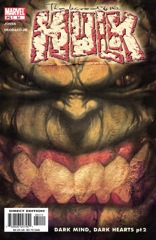
    901317Jones slows down the pace a lot. Deodato gets to draw the Hulk for a while and the Abomination is still an undetermined factor in the story–Jones and Deodato are laying on the ominous foreshadowing–but it’s a breather of an issue. Bruce bonds with Nadia, who is also warming to him. Even though she’s working with the villains.

    Maybe.

    The issue isn’t bad but Jones has been so frantic it can’t help but disappoint. Having the other double agent take out a bunch of assassins isn’t really interesting. This guy isn’t a major player in the book. And Jones is trying hard to make the supporting villains into significant ones, but they’re anonymous persons in black. It’s not compelling.

    Worst might be the cliffhanger where Jones teases a big revelation… of a plot detail he’s ignored for a long, long time.

    Hopefully he can recover from the stall.

    C+ 

    CREDITS

    Dark Mind, Dark Hearts, Part Three: Vicious Circles; writer, Bruce Jones; artist, Mike Deodato Jr.; colorist, Studio F; letterers, Richard Starkings and Wes Abbott; editors, Warren Simons, John Miesegaes and Axel Alonso; publisher, Marvel Comics.

  • 297713 20140305160323 largeStrange thing about this issue… I think Brubaker’s started worrying about whether or not Velvet is likable. He makes her sympathetic right off with her recap of the aftermath of the previous issue’s soft cliffhanger. She recounts having sympathy herself for the abused Russian wife.

    More than that detail, her narration is very explanatory. There’s exposition here and there, a lot of background hints, but Brubaker’s now letting the reader into her head. She’s in the middle of a huge, contrived conspiracy and she’s the good guy. Why shouldn’t the reader like her?

    The big moments in this issue revolve around some kind of carnival in Monaco. Lots of good costumes from Epting, followed by a great action sequence. Even the way Velvet narrates her action sequence makes her more sympathetic.

    It’s good enough, but with the overused first person narration, Brubaker’s not letting Velvet surprise the reader much anymore.

    B 

    CREDITS

    Before the Living End, Part Four; writer, Ed Brubaker; artist, Steve Epting; colorist, Elizabeth Breitweiser; letterer, Chris Eliopoulos; editor; David Brothers; publisher, Image Comics.

  • 61706Andru’s back for exactly the type of comic I expected with the title Atari Force. It’s roughly eighteen pages–I’m not counting the double-page spreads–and most of those pages is like watching someone else play a video game. Only it’s an Atari game, so the designs are pretty childish. (Not to knock Atari game designers, but how many bits of graphics did they have? Two?).

    The issue recounts the victories of a fighter pilot who singlehandedly shuts down an evil alien species mining planets with slave labor. The regular cast does make some appearances, but only once do Conway and Thomas bother giving them any depth in their scenes. And that one instance is never resolved. The rest of the issue makes that scene moot anyway.

    It’s generally competent, licensed material dreck. Andru’s art isn’t interesting, but endless space battles with goofy ships isn’t going to be interesting.

    D 

    CREDITS

    Phoenix; writers, Gerry Conway and Roy Thomas; penciller, Ross Andru; inker and editor, Dick Giordano; colorist, Adrienne Roy; letterer, John Costanza; publisher, DC Comics.

  • Starlight 1 (March 2014)

    Sl1Starlight is not an original idea. Goran Parlov’s composition even mimics The Incredibles when establishing the protagonist, one Duke McQueen. He’s not a John Wayne character, he’s Flash Gordon or Buck Rogers. Except he’s gotten old. His kids are selfish little pricks–again, not original–but he’s pushing through.

    He’s also exceptionally well-established in just one issue. Mark Millar uses flashbacks to his adventuring to show who he was and then little scenes in the present to show how he hasn’t changed too much.

    Is Duke going to go and save the galaxy again? One hopes–oh, wait a second, didn’t Garth Ennis do Dan Dare with this treatment. Like I said, not original.

    But it’s earnestly done. Parlov’s art is fantastic. The fantastical stuff gets pushed further thanks to Parlov’s realistically minded but not realistic stylings. So obvious the Earth stuff works.

    It’s light reading, but wonderfully so.

    B 

    CREDITS

    Writer, Mark Millar; artist, Goran Parlov; colorist, Ive Svorcina; letterer, Marko Sunjic; editor, Nicole Boose; publisher, Image Comics.

  • The Incredible Hulk 51 (May 2003)

    128323I do admire Jones’s dedication. He resolves my concerns over the appearance of contrivance by revealing the conspiracy to be even more convoluted than he had previously suggested. But he doesn’t stop with the conspiracy, he makes this issue’s plot even more convoluted and surprising.

    The issue has a couple strange turns of events–not to mention a few of those false cliffhangers Jones uses to keep the reader engaged in what’s basically a setup for things to come. Jones doesn’t come off as gimmicky because those plotting decisions are what his Hulk is all about. He never wants the reader to feel he or she is on firm ground; the surprises, even if they’re only important for five or six pages in the story, are essential.

    Consciously playing with reader expectations is an interesting move. If the reader buys in, it still means the payoff needs to be substantial.

    B 

    CREDITS

    Dark Mind, Dark Hearts, Part Two: Killing Season; writer, Bruce Jones; artist, Mike Deodato Jr.; colorist, Studio F; letterers, Richard Starkings and Wes Abbott; editors, Warren Simons, John Miesegaes and Axel Alonso; publisher, Marvel Comics.

  • Veil 1 (March 2014)

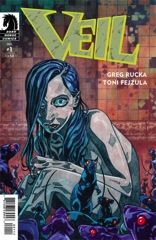
    297779 20140306122217 largeI’m hesitant to wonder if Greg Rucka and Toni Fejzula are going to be able to maintain Veil’s success into a second issue and beyond. Fejzula’s art approximates watercolors, which is a complete disconnect from the issue’s content. Lovely watercolor panels set against the story of a woman who wakes up naked in an abandoned subway and then in a bad neighborhood.

    Rucka and Fejzula are challenging the idea of Sturm und Drang with it, not to mention with the girl–the titular Veil–actually finding a nice person. Even in the moments of ultra violence (watercolor ultra violence is another new one), Veil retains some positivity.

    For that reason, along with its deliberate, self-indulgent (yet justified) pace, Veil is one of the best things Rucka’s ever done. He and Fejzula aren’t pushing the comics medium’s limits, but they are knocking it over to see how it works.

    B+ 

    CREDITS

    Writer, Greg Rucka; artist and colorist, Toni Fejzula; letterer, Nate Piekos; editors, Roxy Polk, Shantel LaRocque and Scott Allie; publisher, Dark Horse Comics.

  • 2334Even though the characters are still visually bland, Atari Force gets Gil Kane on the art and he knows what he’s doing. It’s a big read instead of a long one. Writers Conway and Thomas split the issue into three chapters, but it’s more like two–there’s even a cliffhanger mid-point.

    For this issue, there are no more flashback introductions. Instead, there’s a somewhat weak flashback explaining the alien planet they find. It’s bumpy but passable.

    Conway and Thomas to continue their rather serious look at what should be a goofy comic. One of the characters is a pacifist, burnt out by all the warring on Earth, and he doesn’t give up his convictions. There’s not a lot of fallout from it, but the writers do return to it a few times and the guy does turn out to be right.

    With Kane, Force is all around competent now.

    B 

    CREDITS

    Enter — the Dark Destroyer!; writers, Gerry Conway and Roy Thomas; penciller, Gil Kane; inkers, Dick Giordano and Mike DeCarlo; colorist, Adrienne Roy; letterer, John Costanza; editor, Giordano; publisher, DC Comics.

  • In Heaven There Is No Beer (2012, David Palamaro)

    Watch In Heaven There Is No Beer with a notebook handy, because you’re going to want to write down some of the band names. A lot of them. And waiting for the end credits doesn’t help unless you’re quick with the pause button.

    Beer is the story of the Kiss or Kill “club,” which was a weekly music event in L.A. in the mid–2000s. Mid-aughts, not 2050s. While he doesn’t draw attention to his participation, director Palamaro was in one of the bands playing. Occasionally he’ll pop up in interview footage to bridge a couple ideas, but it’s always sparing and always on target.

    The documentary is a gentle tragedy–none of the wronged people refused Palamaro an interview–as the club gets more and more popular, then thing start to fall apart. The causes for its decline are shockingly mundane but seem very dramatic as the viewer has spent about an hour with the people describing these personally difficult periods. Palamaro never comes down on one side or another and never really encourages the viewer to place blame either. The film’s lucky to have interviewees with a good sense of perspective.

    Palaramo mixes historical footage, music videos, modern interviews. He shows how L.A. needed this kind of communal event, where bands supported one another–it’s sort of shocking to see how communal it got, with band members in the audience for the fellows, hanging out with fans.

    The documentary’s outstanding; Palaramo guides a narrative but allows seepage.

    3.5/4★★★½

    CREDITS

    Written, produced, photographed and directed by David Palamaro; edited by Curtis Bisel, Rebecca Gillaspie, Rick Levy, Patrick Nagy, Palamaro, Erik Rosenbluh and Mike Schnee; released by Modern Distributors.


    RELATED

  • Juice Squeezers 3 (March 2014)

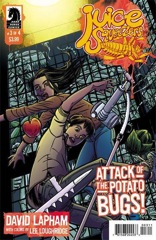
    297646 20140305123327 largeLapham sets up a perfectly good–by perfectly good, I mean predictable–cliffhanger and doesn’t use it. He doesn’t even use it when he’s building up to the cliffhanger. Instead, he goes with a logical choice. It’s not the most dramatic he could, it’s just the right one to do.

    All of Juice Squeezers plays out similarly. Lapham never goes for the big money shot or the most drama. He’s patient with it, patient with how he develops the character relationships and the subplots. He’s restrained. It’s never cheap. Not once.

    This issue has huge developments with a new member joining the team, some investigation into gossip about the teacher and one of the kid’s moms, not to mention the romance subplot actually taking off. And Lapham puts all these behind the giant bug plot, which also has some new developments.

    Juice Squeezers’s fabulous. Great vibe to the art too.

    A 

    CREDITS

    The Great Bug Elevator, Part Three: Going Down; writer and artist, David Lapham; colorist, Lee Loughridge; letterer, Nate Piekos; editor, Jim Gibbons; publisher, Dark Horse Comics.

  • The Incredible Hulk 50 (April 2003)

    901296Oh, Bruce Jones, did you really set Bruce Banner up with the Abomination’s wife? It’s kind of a spoiler–though not really because Jones reveals it before the end of the issue (going out on a soft cliffhanger instead)–but it’s just about the most contrived thing one could imagine.

    So long as Jones owns the contrivance, I imagine it’ll work out. And new artist Mike Deodato Jr. does draw Bruce rather handsome and heartthrob so I guess it’s conceivable the woman’s going to go for him. Hopefully it’s all part of the giant conspiracy I don’t really like.

    Those obvious complaints aside, it’s a solid issue. Not much happens–secret agents go see the Abomination, Bruce finds the woman in a roadside cafe–but Jones gets a full issue out of it. I think he gears up to cliffhangers, ratchets down, does more story, ratchets up again.

    It works.

    B- 

    CREDITS

    Dark Mind, Dark Hearts, Part One; writer, Bruce Jones; artist, Mike Deodato Jr.; colorist, Studio F; letterers, Richard Starkings and Wes Abbott; editors, Warren Simons, John Miesegaes and Axel Alonso; publisher, Marvel Comics.

  • She-Hulk 2 (May 2014)

    297656 20140305124726 largeI wanted two more pages of content in this book. There’s a double-page spread for effect and it and really good effect but I still wanted two more pages. Pulido does this tour of Jennifer’s new offices where he has her and her landlord walking through a long panel… backwards, actually. They walk backwards, getting the reader to the starting point for the bottom row of panels.

    In other words, even though I want two more pages, everything in the book is excellent. Pulido does an outstanding job.

    And Soule does a great job writing the issue. But a lot of it goes to Patsy Walker, which is fine. Soule seems to be setting up a supporting cast for the comic and he sets up two supporting members this issue. Unfortunately it’s instead of really developing Jennifer’s currently situation.

    It’s a small quibble. The comic’s skillful, outstanding and fun.

    B+ 

    CREDITS

    …And?; writer, Charles Soule; artist, Javier Pulido; colorist, Muntsa Vicente; letterer, Clayton Cowles; editors, Frankie Johnson, Jeanine Schaefer and Tom Brennan; publisher, Marvel Comics.

  • Evil Empire 1 (March 2014)

    Evil Empire 001 coverANoam Chomsky it ain’t.

    With Evil Empire, Max Bemis is out to show how the United States could become an evil empire. Not sure exactly why he didn’t base it off of other societies who became “evil empires,” seeing as how there are two or three really good examples from the twentieth century alone.

    Instead, Bemis does a liberal’s pipe dream about a Republican admitting to murder, in front of a cross no less.

    Bemis has his leads–the secretly earnest white guy Democrat who wants to date–professionally and personally–this Beyonce-like underground political rapper. Empire isn’t just not Noam Chomsky, it isn’t just not “West Wing,” it’s not even Mars Attacks! in terms of rational political imagination.

    Not to be too negative, of course. Bemis’s dialogue is okay about thirty percent of the time and Ransom Getty’s art’s fine about seventy. The comic’s just a moronic idea.

    D+ 

    CREDITS

    Writer, Max Bemis; artist, Ransom Getty; colorist, Chris Blythe; letterer, Ed Dukeshire; editors, Jasmine Amiri and Dafna Pleban; publisher, Boom! Studios.

  • Beware! The Blob (1972, Larry Hagman)

    Could Beware! The Blob be less competent? Possibly not.

    Screenwriters Jack Woods and Anthony Harris approach Beware! like a spoof. It’s a comedic early seventies handling, complete with hippy jokes, racism, some cracks at small businessmen, pot, Eastern Europeans… Woods and Harris cover just about everything they can except maybe feminism. Some of these jokes are funny. Not many, but some of them. For the most part, they flop. Why? Because Larry Hagman cannot direct a movie.

    Beware! is clearly low budget, but Hagman’s completely incapable of working around those issues. There wasn’t, apparently, money for establishing shots. Not just of the Blob, but of the locations in general. Daytime long shots are rare in the picture; one imagines the crew running up and filming and running off before the cops show up. Except, of course, that approach would have led to some enthusiasm, something Beware! desperately lacks.

    Shelley Berman and Godfrey Cambridge are the two biggest guests. Berman does a little better than Cambridge, though Hagman’s lack of comedy timing hurts his scene too. Cambridge is supposed to be this goofy, drunk black guy who hangs out with the hippies we later meet. It’s terrible, terrible stuff and his opening “cameo” takes like fifteen minutes.

    Of the main actors, Gwynne Gilford is easily the worst. Both Richard Webb and Richard Stahl have okay moments. A few anyway. Lead Robert Walker Jr. is occasionally good. Cindy Williams is in it for a second, probably giving the best performance.

    It’s wretched.

    0/4ⓏⒺⓇⓄ

    CREDITS

    Directed by Larry Hagman; screenplay by Jack Woods and Anthony Harris, based on a story by Richard Clair and Jack H. Harris; director of photography, Al Hamm; edited by Tony de Zarraga; music by Mort Garson; produced by Jack H. Harris; released by Jack H. Harris Enterprises.

    Starring Robert Walker Jr. (Bobby Hartford), Gwynne Gilford (Lisa Clark), Richard Stahl (Edward Fazio), Richard Webb (Sheriff Jones), Shelley Berman (Hair Stylist), Godfrey Cambridge (Chester Hargis), Marlene Clark (Mariane Hargis), J.J. Johnston (Deputy Kelly Davis), Rockne Tarkington (Deputy Williams), Gerrit Graham (Joe), Carol Lynley (Leslie), Randy Stonehill (Randy), Cindy Williams (Randy’s Girl), Dick Van Patten (Scoutmaster Adleman) and Tiger Joe Marsh (The Naked Turk).


    RELATED

  • King Conan: The Conquerer 1 (February 2014)

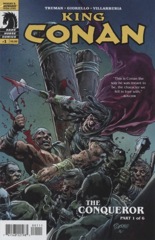
    297106 20140226101215 largeKing Conan is a fine enough Conan comic, I suppose. Timothy Truman has the lingo down, Tomás Giorello and José Villarrubia do well on the art. It’s moody while still appropriately classical.

    But it’s just a Conan comic. It’s a pretty one, in line with the other pretty Dark Horse Conan comics, lots of romanticism and heroism. I love how Conan’s not necessarily a good guy but he’s a moral one, which goes far.

    The problem’s Truman’s plotting. He’s adapting a novel, presumably faithfully, but he’s done little to make it a dynamic reading experience in the comic book form. There’s a very nice double-page spread and some of the panels are well-done, but the narrative doesn’t compel.

    The bookends might be part of the problem. Truman’s playing dangers to Conan without winking at the idea he might get killed. No one has a stake in anything here.

    C+ 

    CREDITS

    The Black Hand of Set; writer, Timothy Truman; artist, Tomás Giorello; colorist, José Villarrubia; letterer, Richard Starkings; editors, Everett Patterson and Philip R. Simon; publisher, Dark Horse Comics.

  • Day Men 3 (March 2014)

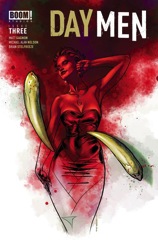
    297685 20140305132044 largeThere’s an astounding amount of exposition this issue and very little inventive art from Stelfreeze. He does very well with what he’s got to do–the protagonist is on the run with a beguiling girl, the vampires are plotting–but none of the art really plays to Stelfreeze’s strength. At one point I even questioned whether or not he was still on the art.

    The issue reads fairly well until writers Gagnon and Nelson start the false endings. Every time I finished one of the pages, I waited for the “to be continued.” There are a lot of natural endings in the comic, but the one they go with reveals their willingness to totally waste the readers’ time.

    I suppose the action sequence is fairly cool–there’s only one. Stelfreeze does a great job with it. Unfortunately it’s not two pages longer, then it would’ve eaten into some useless exposition.

    C+ 

    CREDITS

    Writers, Matt Gagnon and Michael Alan Nelson; artist, Brian Stelfreeze; colorist, Darrin Moore; letterer, Ed Dukeshire; editor, Eric Harburn; publisher, Boom! Studios.

  • Moon Knight 1 (May 2014)

    297651 20140305124015 largeThe Declan Shalvey art is nice and Warren Ellis gets a kick out of some of the comic, but it’s still just another Moon Knight comic. I’m not sure if there’s anyway to make an exciting Moon Knight comic. It sure doesn’t seem like it.

    Ellis has got Moon Knight in a white suit and mask, traveling New York in a driverless limo–so he’s also cool enough to get exclusive Google betas. Ellis doesn’t seem interested in those parts. He doesn’t do them well.

    He writes the crime scene investigation stuff well, even if he’s just aping “Law and Order: Criminal Intent.” He’s not visibly interested in those scenes though.

    But when he has Moon Knight facing off against Mean Machine’s unhealthy ancestor? Then Ellis is engaged. Shame he follows that part of the comic up with lame Moon Knight retcon (or revelations).

    Shalvey alone can’t carry the comic.

    C+ 

    CREDITS

    Slasher; writer, Warren Ellis; artist, Declan Shalvey; colorist, Jordie Bellaire; letterer, Chris Eliopoulos; editors, Ellie Pyle and Stephen Wacker; publisher, Marvel Comics.

  • Big Trouble in Little China (1986, John Carpenter)

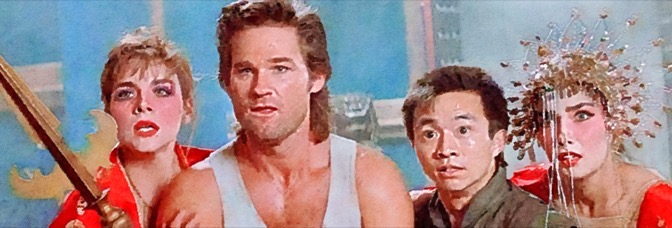
    Although Big Trouble in Little China takes place in modern day San Francisco and has a whole bunch of awesome special effects, it’s really just John Carpenter doing another Western. This time he’s doing a light comedy Western and he’s got the perfect script for it. W.D. Richter (credited with an adaptation no less) has some great rapid fire expository dialogue. Practically everything Kim Cattrall says in the film until halfway through is exposition, but Cattrall and Carpenter sell it.

    It works because Carpenter’s already established Big Trouble’s tone with star Kurt Russell. Russell’s doing a John Wayne impression, but John Wayne as a goofball who can’t figure anything out. He ends up playing sidekick to Dennis Dun. Carpenter, Russell and Richter take every opportunity to use the character for laughs. But Russell’s able to play the obnoxiousness as likability. It makes for a constantly entertaining film.

    There’s also the James Hong situation. Hong plays the villain, both as a seven-foot tall sorcerer and as a wizened old man. Even though the villain’s obviously dangerous–something the film establishes right off–most of his scenes are played for outlandish humor. Carpenter’s big on getting physical humor out of his cast. Cattrall’s especially good in those scenes.

    The film’s got excellent production values–particularly the editing. Dean Cundey’s photography is nice, but the fight scene editing is just phenomenal. Also essential is the frantic and playful score from Carpenter, in association with Alan Howarth.

    Trouble’s a lot of fun.

  • Kubrick // One-Point Perspective (2012, kogonada)

    In a couple minutes–less, actually–kogonada takes the films of Stanley Kubrick and one of their shared elements, the titular One Point Perspective, and runs a bunch of them together. The short is of particular interest for what’s missing and, assuming kogonada is thorough (after watching Perspective there should be no doubt), one can see the technique is one Kubrick developed. Of Kubrick’s early films, Paths of Glory gets the only memorable inclusion.

    But the short doesn’t just work as an examination of Kubrick. It could just as well be a brilliant advertisement for a new Blu-Ray set, as kogonada goes both for the emotions (the betrayal of The Shining) and the iconic (the monolith figures in often and effectively).

    kogonada takes the viral film clip video, easily made and distributed, to a new level. Art about someone else’s art, made with recombinations of their art.

    It’s spectacular.

    3/3Highly Recommended

    CREDITS

    Edited by kogonada.


    RELATED

  • The Blob (1988, Chuck Russell)

    The Blob is a mixed bag. On one hand, director Russell does a good job throughout and he and Frank Darabont’s script is well-plotted. On the other hand, the script will occasionally have some idiotic dialogue and the actors just stumble and fall through it.

    Similarly the special effects. There’s a lot of good work on the Blob effects, but the composites are often iffy. Russell does come up with an amazing, strobe flash sequence for the movie theater attack. Photographer Mark Irwin does quite well too, which makes the bad composite shots all the more perplexing.

    Russell and Darabont plot the film to be a constant surprise, at least for the first half or so. Even after establishing traditionally safe characters are not, they still manage to surprise with how they take things.

    A lot of the effects thrills are derivative, but Russell still manages them with aplomb. It helps he’s got Shawnee Smith in the lead. She sort of stumbles into the lead after a couple false starts and does exceedingly well. The film often succeeds simply for putting Smith in somewhat awkward set pieces and character interactions.

    Kevin Dillon and Donovan Leitch play her two admirers, sort of. Leitch is the jock, Dillon the punk. Dillon’s appealing, but his dialogue’s often terrible. Leitch somehow manages to be likable if painfully straight edge.

    Very nice supporting turns from Jeffrey DeMunn, Candy Clark and Paul McCrane. Terrible one from Jon Seneca.

    The Blob’s problematic, but it’s not bad.

    1/4

    CREDITS

    Directed by Chuck Russell, screenplay by Russell and Frank Darabont, based on an earlier screenplay by Theodore Simonson and Kay Linaker and a story by Irvine H. Millgate; director of photography, Mark Irwin; edited by Tod Feuerman and Terry Stokes; music by Michael Hoenig; production designer, Craig Stearns; produced by Jack H. Harris and Elliot Kastner; released by Tri-Star Pictures.

    Starring Shawnee Smith (Meg Penny), Kevin Dillon (Brian Flagg), Donovan Leitch (Paul Taylor), Jeffrey DeMunn (Sheriff Herb Geller), Candy Clark (Fran Hewitt), Joe Seneca (Dr. Meddows), Del Close (Reverend Meeker), Paul McCrane (Deputy Bill Briggs), Sharon Spelman (Mrs. Penny), Michael Kenworthy (Kevin Penny), Douglas Emerson (Eddie Beckner), Beau Billingslea (Moss Woodley), Ricky Paull Goldin (Scott Jeske) and Art LaFleur (The Pharmacist).


    RELATED

  • The Incredible Hulk (2000) #49

    There’s something wrong with this issue and I’m having trouble pinpointing it. Maybe how Jones bookends with what he’s doing next, maybe with how he does a talking Hulk going nuts without any explanation. I can’t believe I’m wanting for exposition, but Jones’s keeping the reader way too far away from what’s going on in Bruce’s head. Especially after an issue like this one.

    The design problem remains with the villain; the Immonen and Koblish Hulk make up for it a little, but there aren’t any money shots in this issue. Even the splash page of the transformed Banner is more for mood than it is reader gratification. It’s a dangerous, constantly shifting world. And Jones is just make it more so… and every shift make the characters more distant.

    They aren’t just superheroes, they’re corrupt supervillains and the like. Jones has removed the humanity for the sake of narrative.

  • 2333This issue covers two more team members–both new members whose little origin stories come right after their introductions–and both of their stories are, once again, rather rough.

    First there’s the Indian guy, who only got out of poverty because some British guy mistakenly accused the kid of theft and a tragedy followed. Then there’s the head of security. For her, Thomas and Conway have a really depressing war story. Atari Force, for all its jumpsuits and Atari lingo, is a rather grown-up comic. Not what one would expect from a game tie-in geared at kids (were Atari consoles aimed at kids?).

    There’s also the bigger story. The team comes together to travel between alternate realities to find a world for the benevolent Atari corporation to colonize. So no big sci-fi action yet, but soon.

    The art’s still a little off, but it’s fine enough.

    B 

    CREDITS

    Berserk; writers, Gerry Conway and Roy Thomas; penciller, Ross Andru; inkers, Dick Giordano and Mike DeCarlo; colorist, Adrienne Roy; letterer, John Costanza; editor, Giordano; publisher, DC Comics.

  • Five Weapons 7 (February 2014)

    297483 20140302101142 largeI love the way Robinson is able to use exposition–not to mention Enrique’s internal monologue–the draw the reader’s attention to particular facts. In the most extreme examples, it’s the thought process–showing the reader what they missed by not paying enough attention (though, if the reader did pay enough attention, the pleasure of the lesson wouldn’t be there). But he also uses it for the cliffhanger this issue. He agitates the reader quietly, then ends the comic. It’s a neat device.

    Keeping the reader focused on how Enrique experiences the comic’s events also helps with the suspension of disbelief. He changes his mind about something being true between two panels and Robinson’s able to sell it with the presentation of the follow explanations. It’s kind of like Robinson understands how to do an educational comic and applies those rules to Five Weapons.

    It’s a rather neat reading experience.

    B+ 

    CREDITS

    Tyler’s Revenge; writer, artist and letterer, Jimmie Robinson; colorist, Paul Little; editor, Laura Tavishati; publisher, Image Comics.

  • 128321There’s something wrong with this issue and I’m having trouble pinpointing it. Maybe how Jones bookends with what he’s doing next, maybe with how he does a talking Hulk going nuts without any explanation. I can’t believe I’m wanting for exposition, but Jones’s keeping the reader way too far away from what’s going on in Bruce’s head. Especially after an issue like this one.
    The design problem remains with the villain; the Immonen and Koblish Hulk make up for it a little, but there aren’t any money shots in this issue. Even the splash page of the transformed Banner is more for mood than it is reader gratification. It’s a dangerous, constantly shifting world. And Jones is just make it more so… and every shift make the characters more distant.

    They aren’t just superheroes, they’re corrupt supervillains and the like. Jones has removed the humanity for the sake of narrative.

    C+ 

    CREDITS

    Pratt Fall; writer, Bruce Jones; penciller, Stuart Immonen; inker, Scott Koblish; colorist, Studio F; letterer, Comicraft; editors, John Miesegaes and Axel Alonso; publisher, Marvel Comics.

  • Trillium 7 (May 2014)

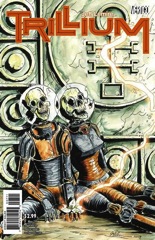
    297641 20140305122523 largeUntil the hard cliffhanger, which is just too jarring both in the narrative and visually, Lemire finally gets back to fulfilling Trillium’s potential.

    He makes a decision about his characters too. He’s been wishy-washy on assigning a protagonist lately–not just for issues, but for the whole series; letting his time and star crossed lovers share the position wasn’t working. He decides well.

    What’s most impressive is how he lets himself go with the sci-fi spectacular visuals. Lemire’s been doing a lot with trying to dictate how the reader approaches the book (the vertically flipped pages, reading back to forth, practically choose your own adventure). This issue had grandiose visuals (many tying to previous issues’ imagery). It works beautifully without any artificial attempts to control how the reader digests it.

    Lemire does well with the B plot too.

    As far as penultimate issues go, this one’s outstanding.

    A- 

    CREDITS

    All the Shadows Have Stars in Them…; writer and artist, Jeff Lemire; colorists, José Villarrubia and Lemire; letterer, Carlos M. Mangual; editors, Sara Miller and Mark Doyle; publisher, Vertigo.

  • 2332Atari Force is immediately strange on three levels. First, it’s game tie-in to the company, not a game. Second, it’s a reduced size comic and all the art looks too spacious. Ross Amdru is clearly trying to fill things out.

    Finally, writes Gerry Conway and Roy Thomas borrow lots of sci-fi movie tropes. But they don’t apply them in the standard way–they turn them into action set pieces. Atari Force, despite Andru’s awkward page layouts, is something of a direct precursor to the 2010 film. It’s technological excitement in a sunny post-apocalypse.

    This issue deals with a couple characters who are heading to Atari headquarters–it’s called something else, maybe the Atari Institute–to help save the world. Something along those lines. There’s actually a really tough flashback to post-World War III Africa. It’s not gritty looking, but it’s serious.

    It’s a rather strange comic.

    C 

    CREDITS

    Intruder Alert; writers, Gerry Conway and Roy Thomas; penciller, Ross Andru; inkers, Dick Giordano and Mike DeCarlo; colorist, Adrienne Roy; letterer, John Costanza; editor, Giordano; publisher, DC Comics.