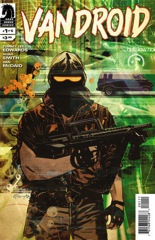
• Real Heroes 2 (May 2014)

    Real Heroes #2Hitch does the whole Galaxy Quest with comics beautifully, but ups it with a lot of references to the superhero movie industry. It’s a lot of fun to read–though I have no idea how it would read to someone not up on all the industry news. Hitch goes far with it. Too far? I can’t know as I get all the references.

    There’s also a bit of Galaxy Quest in the plot reveal. The fake heroes are there to do a public service announcement to reconcile with the bad guys. There’s some good character moments and a couple funny parts and it all plays out well. Then Hitch implies the big villain is actually trying to make the reconciliation work.

    Or maybe he doesn’t. Hopefully he does, because it’d make Real Heroes something different. It can continue to amuse with the Galaxy Quest riff. But maybe it’ll be more.

    B 

    CREDITS

    Writer and penciller, Bryan Hitch; inkers, Paul Neary and Andrew Currie; colorist, Laura Martin; letterer, Chris Eliopoulos; editor, Drew Gill; publisher, Image Comics.

  • Stray Bullets 23 (January 2002)

    Stray Bullets #23Lapham is still uneven. He’s trying too hard. This issue has the reveal Spanish Scott is Rose’s brother, which no doubt Lapham also had set up–it makes things make sense (her and Joey being around)–and it’s got a bunch of stuff with Joey getting traumatized. Joey grows up to be the guy who goes berserk in the first issue.

    See how it all connects? Who cares. Lapham should have gone in and taken out the reveals and put the comic out. The texture would all be there without the painful exposition.

    And this issue has some really good stuff. Scott and the kid, Scott and Rose, Scott and the kid’s babysitter. Great dialogue, great narrative flow. But then the ending goes too far to traumatize Joey. If the comic were somehow centered around this character and the first issue’s events, maybe, but it isn’t.

    Lapham’s attention is erratic.

    B- 

    CREDITS

    The Secret Box; writer, artist, and letterer, David Lapham; editor, Deborah Dragovic; publisher, El Capitán Books.

  • Minimum Wage 5 (May 2014)

    Minimum Wage #5Fingerman achieves a nice, lyrical quality with this issue of Minimum Wage. The issue has a couple repeating elements. Rob isn’t working on his licensed comic job, he’s hanging out a lot with his old roommate, he’s sweating. There’s a lot of sweating to this comic. It’s very hot in New York during this comic.

    Rob’s friend keeps trying to help with Rob’s love life, which puts Rob back in bed with Deputy DeeDee. She’s a really fun character, especially since she never gets flustered or mad. Makes her appearances consistently enjoyable.

    Not so with the ex-wife, who shows up in the color dream sequence. Fingerman’s trying too hard with her.

    But then Rob does get another lady friend and it’s a previous acquaintance and Fingerman makes up for the evil ex-wife who’s dressed like Vampirella. Something about the issue, maybe the way elements keep repeating, really connects. Good work.

    CREDITS

    Writer and artist, Bob Fingerman; publisher, Image Comics.

  • Tom Strong 17 (August 2002)

    Tom Strong #17Moore’s subplot for this issue is Tesla and her fire monster boyfriend, Val. Mostly with her mom trying to keep the progress of their relationship quiet in front of Tom. It never gets a full resolution but Moore foreshadows one nicely.

    The main plot is the preparation for the space battle against the giant ants. Giant space ants. Moore is kind of doing fifties sci-fi with the ants, but not exactly–Sprouse gets to mix sci-fi elements. It’s simultaneously retro and mainstream modern. Moore and Sprouse fit a lot into Tom Strong, they never let it get too much into one genre or another.

    The only dragging scene is Tom going and visiting the intelligence on Venus or whatever planet. It’s a talking heads scene with a rock. It’s not bad, it’s just pointless.

    Great subplot with the Strongmen too. Moore certainly appears to love writing for them.

    B+ 

    CREDITS

    Ant Fugue!; writer, Alan Moore; penciller, Chris Sprouse; inker, Karl Story; colorist, Alex Sinclair; letterer, Todd Klein; editors, Neal Pozner, Kristy Quinn and Scott Dunbier; publisher, America’s Best Comics.

  • The Woods 1 (May 2014)

    The Woods #1While The Woods seems like the most movie or TV ready comic to come out in a while–a high school is teleported to an planet with flying demons–writer James Tynion IV never actually panders to that goal. Even with a couple really uneven sections and a problematic soft cliffhanger, he's writing a comic. It's nice to read a comic, not a pitch.

    The art is essential, however. It might feel like a pitch without Michael Dialynas. Dialynas paces out the quick scenes beautifully. There's one device he has where he moves into close-ups after his establishing shots–again, it works because he draws the teenagers' expressions so well.

    And Tynion does quite well with the teenagers. Yes, he's writing really self-aware teenagers (it feels like a Beach movie–everyone's just a little too wise) but he's writing them well. Tynion's not pandering and trying to get a young adult audience.

    It's nice.

    B 

    CREDITS

    Writer, James Tynion IV; artist, Michael Dialynas; colorist, Josan Gonzalez; letterer, Ed Dukeshire; editors, Jasmine Amiri and Eric Harburn; publisher, Boom! Studios.

  • Stray Bullets 22 (September 2000)

    Stray Bullets #22Lapham’s floundering. He finally brings Beth back, but now she’s in LA and Virginia is nowhere to be seen. She’s getting drunk at a bar and some married guy tries to pick up on her. Of course, she’s not the protagonist of the issue, it’s the married guy. His wife’s out of town and he’s trying desperately for female company.

    Everything in the comic is forced. Someone Lapham has misplaced his ability to get sympathy for the dregs of humanity; about the only time there’s any life in the issue is when Beth’s life is threatened. Not because she might die, but because she’s been a regular cast member for so long. Her death would be interesting as it relates to the narrative, not as a loss of a character.

    It’s a shame; she’s been one of Lapham’s strongest creations.

    The art’s got some energy and it does read fast.

    C 

    CREDITS

    Bring Home the Devil; writer, artist, and letterer, David Lapham; editor, Deborah Dragovic; publisher, El Capitán Books.

  • Sons of Anarchy #9Here’s the problem with Sons of Anarchy, at least how Brisson is pacing it. It’s a licensed comic with a not comic shop traditional audience so Brisson is pacing it for a collection. It makes this issue really frustrating because of the cliffhanger. Brisson does well building up his story for the unfamiliar reader, so he or she is invested in the plot, not the characters.

    And it’s a really good plot. The stuff in prison isn’t anywhere near as interesting as how things play out on the outside. The action in the prison just can’t compete, not with a fantastic multi-part Couceiro chase sequence at the end of the issue.

    What’s particularly nice is the texture Brisson gives the scenes. Sure, he gets some mileage out of getting to use well-established characters, but there’s a lot of implied depth. It keeps the series lean but also not.

    B 

    CREDITS

    Writer, Ed Brisson; artist, Damian Couceiro; colorist, Michael Spicer; letterer, Ed Dukeshire; editor, Dafna Pleban; publisher, Boom! Studios.

  • Tom Strong 16 (April 2002)

    Tom Strong #16Moore has a bunch of fun this issue. He enlists the Strongmen of America and they even get to sleepover with the Strong’s. The way he handles the absurdity of these kids getting to sleep over at a superhero’s is great and all, but having Dhalua call their mothers’ to get permission is even better.

    And then there’s Tesla’s little fire monster boyfriend who Tom doesn’t like. That subplot’s wonderful because Moore shows it a little from Tom’s perspective–his daughter’s moon-eyed and he doesn’t approve–but Moore’s really showing it from Tesla’s. And she knows what she’s doing.

    The main plot has to do with an alien invasion–it’s actually a little Cowboys vs. Aliens (I’m sure Moore was fine not getting credit for that movie) as the guest star is an intergalactic cowboy. Great details from Moore on that back story and some wonderful art.

    Outstanding stuff.

    B+ 

    CREDITS

    Some Call Him the Space Cowboy; writer, Alan Moore; penciller, Chris Sprouse; inker, Karl Story; colorist, Alex Sinclair; letterer, Todd Klein; editors, Neal Pozner, Kristy Quinn and Scott Dunbier; publisher, America’s Best Comics.

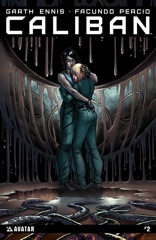
  • Caliban 2 (April 2014)

    Caliban #2The beginning of the issue is slightly better than I expected. Not because Ennis has any good characters, but because he handles the scene with the big alien laboratory pretty well. There are all these alien species in preservation tanks, the humans freak out. It’s a decent scene.

    Then there’s a standard briefing scene and I figured Ennis might just be trying to move things along logically. Then comes the scene from one of then Alien movies, then comes the scene ripping off possession or androids or whatever. KISS Meets the Phantom of the Park maybe. It doesn’t matter. Ennis doesn’t actually have any new ideas or even thoughtful ways to compile his bad ideas.

    It’s supposed to be smart sci-fi and it comes off like a bunch of clips from famous sci-fi movies.

    Percio’s art is mediocre and unimaginative as far as design.

    It’s boring and unoriginal.

    C- 

    CREDITS

    The Hall; writer, Garth Ennis; penciller, Facundo Percio; inker, Sebastian Cabrol; colorist, Hernán Cabrera; letterer, Kurt Hathaway; publisher, Avatar Press.

  • Trancers: City of Lost Angels (1988, Charles Band)

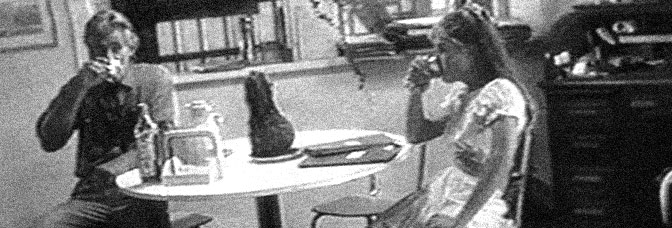
    Tracers: City of Lost Angels was originally intended to be part of an anthology film but it doesn’t feel much like a short subject. With the obviously limited budget, director Band treats it like a television production more than a film. Most of the action plays out in one or two of the sets. It’s all very constrained.

    It’s also rather intelligently handled. Without any budget, the story mostly involves Tim Thomerson’s problems with girlfriend Helen Hunt. He’s from the future, living in his ancestor’s body, she has to be the breadwinner–it’s a difficult situation all around. Thomerson and Hunt (who’s basically just cameoing) are both wonderful. Writers Paul De Meo and Danny Bilson frequently surprise with the character developments.

    Lost Angels is a fine effort. The sincerity and the concept–spoofing hard-boiled detectives, but without drawing too much attention to the absurdities–work out surprisingly well (awkward plotting aside, of course).

    2/3Recommended

    CREDITS

    Produced and directed by Charles Band; written by Paul De Meo and Danny Bilson; director of photography, Mac Ahlberg; music by Mark Ryder and Phil Davies; production designer, Giovanni Natalucci; released by Full Moon Features.

    Starring Tim Thomerson (Jack Deth), Helen Hunt (Leena), Art LaFleur (McNulty), Telma Hopkins (Engineer Raines), Alyson Croft (Baby McNulty), Grace Zabriskie (Warden) and Velvet Rhodes (Edlin Shock).


    RELATED

  • Stray Bullets 21 (April 2000)

    Stray Bullets #21Maybe, instead of actually putting the money into publishing this issue, Lapham should have sat down and thought about a different one. A non-imaginary one. Because an imaginary story breaks the series. It means Lapham doesn’t have to play fair–and he doesn’t here. (I’m not talking about Amy Racecar, which has a context).

    This issue takes a character and breaks him into pieces. Lapham props up the villain of the story and twists him into a hero. It’s all a big joke and it’s a complete waste of the reader’s time. It’s predictable, manipulative and unimaginative. It also shows how Lapham has established the series as one where the fantastic seems possible, which isn’t necessarily a good thing.

    It makes him an untrustworthy writer, especially given it’s a periodical.

    The rushed art doesn’t do the issue any favors either.

    I’m shocked at the poor quality of this one.

    D 

    CREDITS

    Little Love Tragedy; writer, artist, and letterer, David Lapham; editor, Deborah Dragovic; publisher, El Capitán Books.

  • Lumberjanes #2I can’t remember exactly what was wrong with the last issue but this issue has a rather obvious problem–writers Stevenson and Ellis think they’re writing a cartoon. Not because of the action, but because of their character approach. They think their characters are rather entertaining just with the superficial personalities they give them. Towards the end of the issue, during some banter, I realized–the writers are assuming the reader can “hear” the characters’ voices.

    Except Stevenson and Ellis do nothing to give these characters distinctive voices. There’s so much action–all the banter is in between or leading up to action–and there’s no time spent on defining these characters.

    Allen’s art has a lot of energy, but her design work is lazy. Or maybe the monsters are all supposed to have three eyes. It doesn’t really matter, because the writers aren’t creating any mystery.

    I had hoped Lumberjanes would be better.

    C 

    CREDITS

    Writers, Noelle Stevenson and Grace Ellis; artist, Brooke Allen; colorist, Maarta Laiho; letterer, Aubrey Aiese; editors, Whitney Leopard and Dafna Pleban; publisher, BOOM! Box.

  • The Comics Fondle Podcast – 1×13
    And here Vernon and I thought we were running late but we’re just on time for the latest episode. We talk about a whole bunch of indie books–I don’t think there’s a single Big Two issue covered, sorry folks–and then move on to discussions of online comics reviewers and how they get their copies, not to mention our argument over Suicide Risk. Give it a listen.

    WHERE TO LISTEN

    Apple Podcasts
    Spotify
    Stitcher
    RSS
  • Tom Strong 15 (March 2002)

    Tom Strong #15Moore plots out the issue precisely, not just how he uses the action, but also how he uses Tesla. The issue is just as much hers as Tom’s… or maybe even a little bit more.

    The issue opens with her disappearing under extreme circumstances. Tom, Dhalua and Solomon have to go rescue her. Moore gets his expository dialogue about Tesla’s history exploring volcanos done while he’s talking about the protective suits everyone is wearing. It’s a little thing, but brilliantly executed.

    The issue then has some exploration before Moore brings Tesla into it. A lot of the issue is spent with Tom not thinking and Tesla thinking. The characters figure things out–Moore doesn’t pause to let the reader figure them out, the reader’s going to hear about them, Moore needs the characters to do it.

    It’s an interesting form of action.

    Excellent art from Sprouse and Karl Story too.

    B+ 

    CREDITS

    Ring of Fire!; writer, Alan Moore; penciller, Chris Sprouse; inker, Karl Story; colorist, Matt Hollingsworth; letterer, Todd Klein; editors, Neal Pozner, Kristy Quinn and Scott Dunbier; publisher, America’s Best Comics.

  • Red Team 5 (September 2013)

    Red Team #5Ennis sets up an obvious plot development for the end of the issue and doesn’t go with it, though he’s got time. Instead, he sneaks in a different surprise. He’s been setting it up for a number of issues, but very discreetly. It’ll be interesting to see if he goes with that first obvious one.

    Now, neither of these plot developments are the big twist. The issue ends with a big twist. Who knows what Ennis will do with it, but it’s a definite fifth issue twist. He’s winding down the comic; the surprises will be limited from here on, just because he’s not trying to make the reader care about new things anymore.

    The rest of the issue is decent. A couple really good little moments, some interesting talking heads scenes–not so much in content, but in Ennis giving them the time.

    He’s having fun winding things down.

    B 

    CREDITS

    The Night of Nights; writer, Garth Ennis; artist, Craig Cermak; colorist, Adriano Honorato Lucas; letterer, Rob Steen; editor, Joe Rybandt; publisher, Dynamite Entertainment.

  • Stray Bullets 20 (July 1999)

    Stray Bullets #20Odd theme Lapham’s developing now–cruel women. This issue has a coed having an affair with her professor and she calls the wife during their lovemaking. It partially redeems the unfaithful husband, who seems weak instead of cruel himself. How else would he have fallen in with such a girl.

    Then Monster shows up for an incredibly contrived reason–the mystery big boss needs something in code translated and the professor is the guy for it–and Lapham does a very lengthy action and suspense sequence.

    There’s some really good art during that sequence. It’s set in a motel in the woods and the absence of anything but trees around it plays quite well on the page.

    The writing on the professor and his wife are good, but the thing with the coed isn’t just shallow, it’s simplistic. Unfortunately, Lapham can’t imagine her situation, just her dialogue.

    It’s too bad.

    B 

    CREDITS

    Motel; writer, artist, and letterer, David Lapham; editor, Deborah Dragovic; publisher, El Capitán Books.

  • Fatale 22 (May 2014)

    Fatale #22Until the last sequence, which tries too hard, this issue of Fatale is one of Brubaker’s strongest in a while. It starts with the big bad guy, the Bishop–who I can’t remember if Brubaker has named before–investigating what Jo’s been doing. Then it goes into a long flashback of the Bishop’s life since 1906.

    It ties into a lot of big historical events, with the San Francisco earthquake being the result of the ceremony giving the Bishop his power. Brubaker and Phillips tie it all together, with pitch perfect narration and some great summary art from Phillips. World War I, World War II, it’s like getting a war comic and an Indiana Jones comic from Phillips all in one.

    But the finish, where Brubaker ties it into the modern events, is problematic. It’s more setup for the finale and, worse, it’s contrived setup.

    Still, it’s mostly masterful stuff.

    B+ 

    CREDITS

    Writer, Ed Brubaker; artist, Sean Phillips; colorist, Elizabeth Breitweiser; publisher, Image Comics.

  • Adventure Into Fear 19 (December 1973)

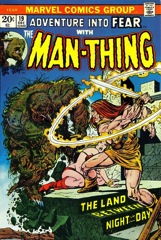
    Fear #19Apparently Mayerik and Trapani are keeping this new style, which is Trapani doing bad faces most of the time. Very unfortunate.

    The issue is a mess of alternate realities, barbarians, ducks, GIs and something else. Magicians. Gerber is writing about the walls of reality collapsing and somehow he’s just got to get Man-Thing involved. But he doesn’t until towards the end of the issue and not well.

    The story’s imaginative but there’s just no point to it. Man-Thing isn’t a full character in the comic, not with Gerber constantly trying to pull away from him–which is fine, so long as you don’t pretend otherwise. And the Jennifer girl is a problematic protagonist too. She’s the one who’s having the great adventure, yet Gerber can’t stick with her.

    So he sticks with the guest stars, then brings in Man-Thing. It’s an okay hodgepodge. Except the weak art.

    B 

    CREDITS

    The Enchanter’s Apprentice!; writer, Steve Gerber; penciller, Val Mayerik; inker, Sal Trapani; colorist, Stan Goldberg; letterer, Artie Simek; editor, Roy Thomas; publisher, Marvel Comics.

  • Supernatural (1933, Victor Halperin)

    Supernatural is a strange little film. I say little just because it's just over an hour; it has a great pace, however, and always feels full. Maybe because it introduces two subplots before getting to top-billed Carole Lombard. Then Lombard sort of encounters one of the subplots and the other one merges with her own story for the picture.

    There's fantastic acting throughout–Lombard doesn't really get to shine until the second act, when she's possessed by an evil spirit. But H.B. Warner's great as her psychiatrist, who also has his own subplot going. It all relates to Vivienne Osborne's death row murderer. Her ex-boyfriend, a sham spiritualist (Alan Dinehart), targets Lombard, who's grieving from her own loss.

    Harvey F. Thew and Brian Marlow's script wastes no time. The exposition is always to the point and perfectly integrated. Randolph Scott's returning from a trip so he'll naturally get exposition from other characters to fill him in. Scott's good as Lombard's love interest. Very likable. Oh, and William Farnum is hilarious as Lombard's attorney. Supernatural is serious and dangerous–Dinehart's a bad guy–and Farnum's around to let off the pressure.

    Director Halperin does a good job too. He can't figure out how to visualize the spirits, which is a problem, but the excellent miniature effects make up for it. Maybe it's because the film goes through how Dinehart sets up his fake spirits, which draws attention to how the film's going to do the real ones.

    Supernatural is quiet, short and quite good.

    3/4★★★

    CREDITS

    Directed by Victor Halperin; screenplay by Harvey F. Thew and Brian Marlow, based on a story by Garnett Weston; director of photography, Arthur Martinelli; produced by Edward Halperin and Victor Halperin; released by Paramount Pictures.

    Starring Carole Lombard (Roma Courtney), Alan Dinehart (Paul Bavian), Vivienne Osborne (Ruth Rogen), Randolph Scott (Grant Wilson), H.B. Warner (Dr. Carl Houston), Beryl Mercer (Madame Gourjan) and William Farnum (Hammond).


    RELATED
  • Red Team 4 (July 2013)

    Red Team #4The issue has some of Ennis’s most ambitious ideas and he doesn’t connect with them. He’s got the female cop–darned if I can remember any of the characters names except Eddie the good cop protagonist and Duke the team leader–getting into an altercation with an attempted rape at a night club. It’s just after she’s had an argument with her sister. They’re in a bar. There are a lot of layers. And Ennis tries to move them all together, but it doesn’t work. His characters aren’t strong enough.

    However, there are some really nice scenes in here. Even when the scenes aren’t entirely successful, like the talking heads between the female cop and good guy Eddie at the end. It’s a decent enough scene, paced really well.

    Just not great.

    Cermak can’t do the action either. He can’t maintain the figures for the fight scene.

    Still, perfectly decent.

    B 

    CREDITS

    The Bullet-Dodgers; writer, Garth Ennis; artist, Craig Cermak; colorist, Adriano Honorato Lucas; letterer, Rob Steen; editor, Joe Rybandt; publisher, Dynamite Entertainment.

  • Stray Bullets 19 (April 1999)

    Stray Bullets #19This issue might be Lapham’s most difficult to pull off, because he’s not just charting the decline of a previously sympathetic protagonist, he’s charting the decline of new, female character. He’s got to do it very, very carefully.
    The story is about a young woman who a couple lousy boyfriends who starts seducing married men (for the rush). The couple lousy boyfriends are really lousy, one even abusive, and Lapham doesn’t handle her reaction sensationally. He does it calmly (when he really could have her start killing her lovers or blackmailing them or something). So it’s depressing. Well, at first it seems like it might not be as depressing, then he clarifies she knows exactly what she’s doing.

    Maybe it’s all the build up cop Roger, who’s the only returning character, and the only one to stand up to her.

    It probably could be longer, maybe doubled, but it’s good.

    A-

    CREDITS

    Live Nude Girls!; writer, artist, and letterer, David Lapham; editor, Deborah Dragovic; publisher, El Capitán Books.

  • Veil 3 (May 2014)

    Veil #3I tried. I really wanted to be wrong about Veil because Fejzula’s style is so unique but no, no way.
    Rucka’s hiding this lame story about big business hiring some guy to conjure a demon in the comic, which ostensibly is about the titular protagonist but isn’t at all. It’s about the evil magician, the dumb businessmen, the really dumb mercenaries–these guys wouldn’t have made it to the special forces, they’d be cleaning latrines–and rats. I think Rucka uses the rats because animal cruelty still gets a result. Cruelty to humans doesn’t.

    Did I mention the bad dialogue yet? Rucka writes a lot of really bad dialogue here. It might be because he doesn’t know how Fejzula’s going to bring the scenes together. I’ll extend that possibility, though I don’t really believe it. The dialogue’s atrocious.

    Rucka doesn’t use Fejzula well either. The art’s interesting, but doesn’t fit.

    D- 

    CREDITS

    Writer, Greg Rucka; artist and colorist, Toni Fejzula; letterer, Nate Piekos; editors, Shantel LaRocque and Scott Allie; publisher, Dark Horse Comics.

  • Rocky and Bullwinkle (2014) #3

    Rb3

    What a splendid comic. I’m not sure of any other word for it. Between the two parts of the feature story, involving Rocky and Bullwinkle having to go to the moon to stop Pottsylvania from claiming it (and taxing anyone looking at it or talking about it or saying it–oops, looks like I owe), and the Dudley Do-Right story, Evanier and Langridge hit a home run.

    The only questionable joke–in a comic with NASA jokes, no less–is when they get to the moon and there’s a one liner about moon restaurants having no atmosphere. It’s one of the first moon jokes and it seems like Evanier’s going to go the easy route. Instead, it’s a one off and it works because of it.

    Great plot twists too. Not just in the feature but in Dudley Do-Right too.

    Also–nice June Foray reference.

    Moon-rockin’ stuff.

  • Adventure Into Fear 18 (November 1973)

    Fear #18It’s really bad art. From Mayerik and Trapani too. Maybe the inks are a little off but I think a lot if it must be the pencils. I really hope it’s not some new style they’re working on. Because it’s bad.

    Gerber tries very hard with this story, which is sort of a talking heads disaster story, very self-aware microcosm of American life thing. He tries so hard and he fails. He fails miserably. The tone is off and none of the many things Gerber does to even establish one fails. It’s like he’s got an earnest idea and no way to honestly do it in this comic.

    But then there’s the bit action finale and it’s great. It’s a classic horror problem with a modern, slightly askew approach to it. Gerber sort of saves the issue; he gets credit for the attempt.

    That art is really bad though.

    B 

    CREDITS

    A Question of Survival!; writer, Steve Gerber; penciller, Val Mayerik; inker, Sal Trapani; colorist, Linda Lessmann; letterer, Artie Simek; editor, Roy Thomas; publisher, Marvel Comics.

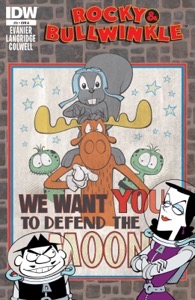
  • Rocky and Bullwinkle #3What a splendid comic. I’m not sure of any other word for it. Between the two parts of the feature story, involving Rocky and Bullwinkle having to go to the moon to stop Pottsylvania from claiming it (and taxing anyone looking at it or talking about it or saying it–oops, looks like I owe), and the Dudley Do-Right story, Evanier and Langridge hit a home run.
    The only questionable joke–in a comic with NASA jokes, no less–is when they get to the moon and there’s a one liner about moon restaurants having no atmosphere. It’s one of the first moon jokes and it seems like Evanier’s going to go the easy route. Instead, it’s a one off and it works because of it.

    Great plot twists too. Not just in the feature but in Dudley Do-Right too.

    Also–nice June Foray reference.

    Moon-rockin’ stuff.

    A 

    CREDITS

    Writer, Mark Evanier; artist and letterer, Roger Langridge; colorist, Jeremy Colwell; editor, Sarah Gaydos; publisher, IDW Publishing.

  • Honour (2014, Shan Khan)

    It's been a while since I've seen something to remind me how much I hate a fractured narrative in film. There are the handful of good examples and then the multitude of terrible ones (usually aping one of the good ones). Honour is one of the bad ones. Writer and director Khan wraps the film into a ball, going with bombastic scenes to remind the viewer of their place in the timeline. Unfortunately, the bombast carries over to the rest of the film, which utterly lacks subtext.

    Aiysha Hart plays a young Muslim woman with a hideous family. Her mother (Harvey Virdi) hates her for dishonoring the family and controls her also evil, dimwitted brother (Faraz Ayub). They conspire to kill her because she's carrying on with Nikesh Patel. Patel has been lying to Hart about his engagement status and his willingness to be with her. Khan opens the film with some Muslim women getting assaulted on a train–in public, so you know the rest of the world doesn't care–then proceeds to show all Muslim men (and half the women) are awful anyway. Except Shubham Saraf, as the reluctant, well-meaning brother.

    But none of the family members have honest relationships so it all feels cheap and exploitative. If Khan had just given Hart a machete and done a proper revenge thriller, it'd have been at least diverting exploitation.

    The crappy script and pedestrian direction don't help either.

    Hart's appealing, but her character's so lame, it's hard to care.

    Big fail.

    0/4ⓏⒺⓇⓄ

    CREDITS

    Written and directed by Shan Khan; director of photography, David Higgs; edited by Beverley Mills; music by Theo Green; production designer, Andy Harris; produced by Nisha Parti and Jason Newmark; released by Entertainment One UK.

    Starring Aiysha Hart (Mona), Paddy Considine (Bounty), Faraz Ayub (Kasim), Shubham Saraf (Adel), Harvey Virdi (Mother) and Nikesh Patel (Tanvir).


    RELATED

  • Stray Bullets 18 (February 1999)

    Stray Bullets #18It’s an odd issue. Lapham does another Amy Racecar story to emphasize how Virginia is uncomfortable around sex, which makes sense since he’s constantly threatening to have someone rape her.

    Still, it’s not bad. Lapham does a lengthy Chandler-inspired detective story, convoluting it more and more each panel. By the end it’s impossible to keep track of who killed who and why, but the solution isn’t the point. The joke at the end is the point, since it reveals something about Virginia, only it’s too much. Lapham writes the Amy character well. He doesn’t need to get all fancy with it.

    None of the other characters have much presence and Lapham seems to get it so the big solution scene at the end constantly has people being identified by name. But there are ten or twelve of them. A lot of characters for a single issue.

    Still, it’s moderately successful.

    B 

    CREDITS

    Sex and Violence (Part 2); writer, artist, and letterer, David Lapham; editor, Deborah Dragovic; publisher, El Capitán Books.

  • Madame Frankenstein 1 (May 2014)

    Madame Frankenstein #1I was going to try to temper myself, but I can’t. There’s a lot of self-indulgent drivel out there, but Madame Frankenstein might be the current prize winner. Maybe it’s because there’s never a moment writer Jamie S. Rich takes the reader’s experience into account. If it were just the bad dialogue or the unlikable characters or the purposelessly convoluted timeline, it wouldn’t be so bad.

    But then there are little fairies only the protagonist knows about. They might be the straw.

    Megan Levens is a perfectly decent artist, but the wrong one for this series. It’s set in 1932 and nothing about the art, besides some inserted details, sets it in that year. Though there’s only so much the art could do for this thing.

    And it’s not just a crappy comic, it’s a really fast, superficial one too. Even being a fast read somehow makes it worse.

    F 

    CREDITS

    Writer, Jamie S. Rich; artist, Megan Levens; publisher, Image Comics.

  • Adventure Into Fear 17 (October 1973)

    Fear #17This story is the best so far in Gerber’s Man-Thing run so far. He does a story introducing a Superman analogue, only without growing up in the world and some other significant changes. But what’s important is how Gerber writes this character as encountering the world. Gerber does a second person thing and it’s fascinating stuff.

    The Superman analogue becomes the reader or vice versa. If Gerber’s aware how he’s presenting this story, as a guided tour into how someone is going to experience the reading of the story itself, is he purposefully casting the comic book reader as a superhero. If so, a Superman analogue with its familiarity, works perfectly.

    Trapani inks Mayerik again to even more success because there’s this goofy big time superhero action sequence in the middle of a small town. It’s simultaneously delightful and bewildering.

    It’s a fantastic, multilayered story. Gerber does singularly well.

    A+ 

    CREDITS

    It Came Out of the Sky!; writer, Steve Gerber; penciller, Val Mayerik; inker, Sal Trapani; colorist, George Roussos; letterer, Jean Izzo; editor, Roy Thomas; publisher, Marvel Comics.

  • She-Hulk 4 (July 2014)

    She-Hulk #4Soule kind of rushes things and gloriously so. She-Hulk is fast, surprisingly deep and gently funny. Soule doesn’t go for the laughs, which is good. It wouldn’t work with Pulido’s art style. It might turn the comic into a parody, actually.

    For example, Pulido and Soule at one point having Jennifer jumping from rooftop to rooftop. Why would she do such a thing? Well, she’s She-Hulk. It’s a family tradition. But to draw attention to it would bring the reader out of the comic. Soule would never do such a thing, especially since he and Pulido work very hard to get the comic to exist about a full ten percent entirely in the reader’s imagination.

    There’s a double page spread of She-Hulk and guest star Daredevil in a fight, with narration succinctly explaining it’s their night out. No fisticuffs, just establishing shot. It’s awesome.

    The whole issue’s awesome.

    A- 

    CREDITS

    The Zealous Advocate; writer, Charles Soule; artist, Javier Pulido; colorist, Muntsa Vicente; letterer, Clayton Cowles; editors, Frankie Johnson, Jeanine Schaefer and Tom Brennan; publisher, Marvel Comics.