• All-Star Comics (1976) #68
    Top Image

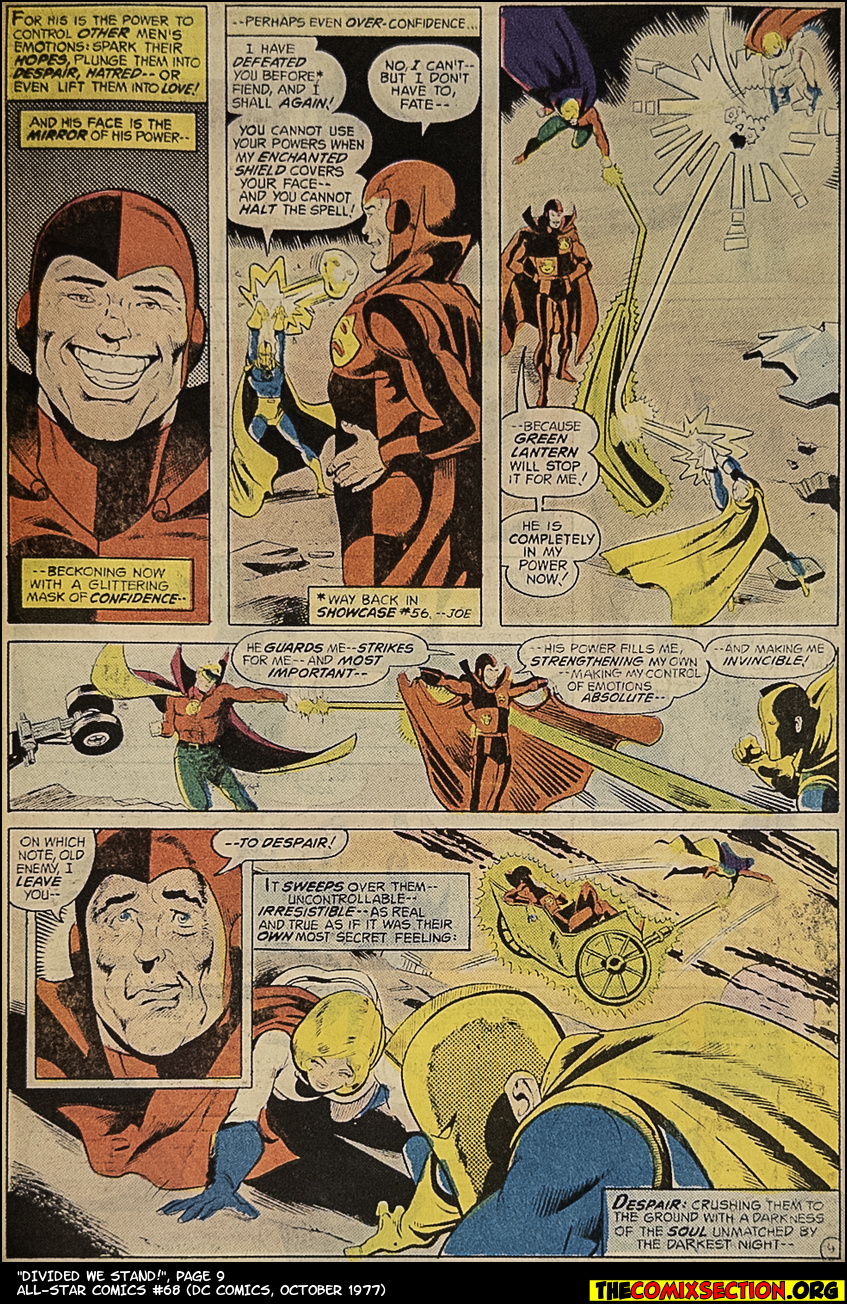
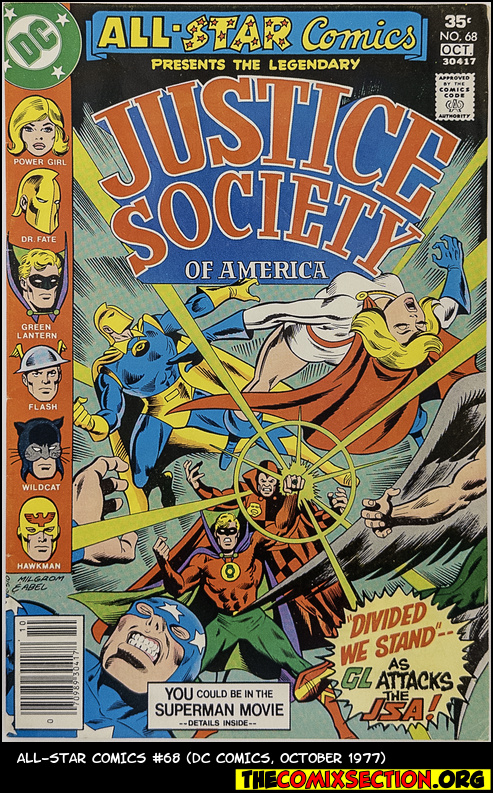
    Writer Paul Levitz makes a twelfth-level intelligence move with this issue; it’s not a great script—Wildcat’s “docks” accent is forever obnoxious—and the stakes are haywire, but the reveal is about the only way All-Star could move forward.

    Psycho-Pirate has been micro-dosing the Justice Society with negativity for ages. How long? Long enough to cover all their jerk moves in All-Star, which started in the first issue with the sexism? Don’t ask, just be glad it’s getting resolved. Presumably.

    And, at first, it doesn’t seem like they’re resolving anything. The heroes get back home from last issue and start bickering with Dr. Fate, who’s got no time for their malarkey. Power Girl then reminds them they’re supposed to act like teammates, and Flash whinges about it. Luckily, Fate’s got a mission to interrupt them–stopping Green Lantern from destroying the Gotham International Airport.

    Lantern’s destroying the airport in an attempt to extort money from the city, which hasn’t done enough to appreciate him as a superhero over the years. The big team fight reveals Psycho-Pirate as the real villain, and he and Green Lantern escape to parts unknown.

    After another team member defects to the other side, the good guys figure out where they’re hiding and mount an offensive.

    The subplot for the issue is Dick Grayson and Hourman getting back to Gotham City and meeting up with Police Commissioner Bruce Wayne, whose fears about Green Lantern breaking bad now seem founded. Of course, Wayne’s on a righteous crusade, and he may be blinded to the truth (hopefully it won’t turn good men cruel). If he’s even willing to listen. All-Star frequently hinges on this team of superheroes refusing to communicate with one another; maybe it’s just the way Earth Two works.

    The way Levitz has gotten the comic working has been fairly simple—if this issue does prove a turning point, anyway–because the whole thing hinges on Dr. Fate, who doesn’t have the most personality. But then no one has personality, except general sexism on the part of the boys, with some dismissiveness of the youth thrown in for good measure. Power Girl and Fate “lead” the team and feature into most of the action—one forgets Star-Spangled Kid is even there—but they’re not the leads of the story. The characters have lost their personal stakes, which allows Levitz to make every issue a good jumping on (or off) point.

    Even if the actual content of the comic, good storytelling mechanics aside, is still fifty-something white guys yelling at those damned kids, while always being proven wrong.

    Also this issue, throw in penciller Joe Staton committing to showcasing Power Girl’s… ahem… physique more. Except only in action scenes where she’s just taken a hit. Because there’s always got to be something else off; Staton and inker Bob Layton don’t bring much, but they do make one forget Wally Wood was ever on this book.

    Still—thanks to Levitz—the book seems poised for a not negative turn. Fingers crossed.

    Bottom Image
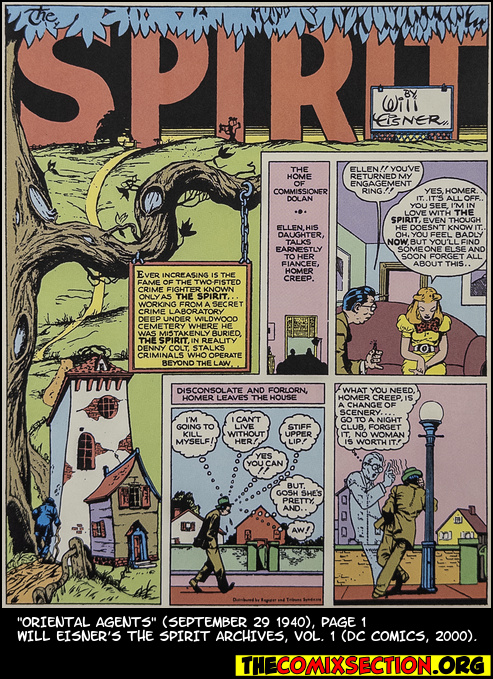
  • The Spirit (January 12, 1941) “The Silk District Beat”
    Top Image

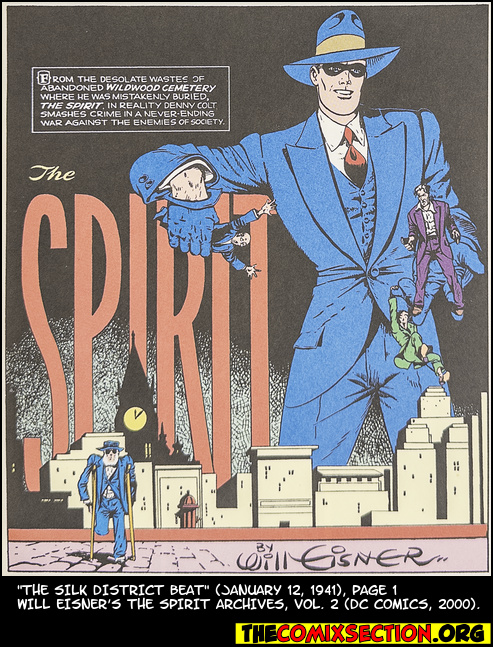
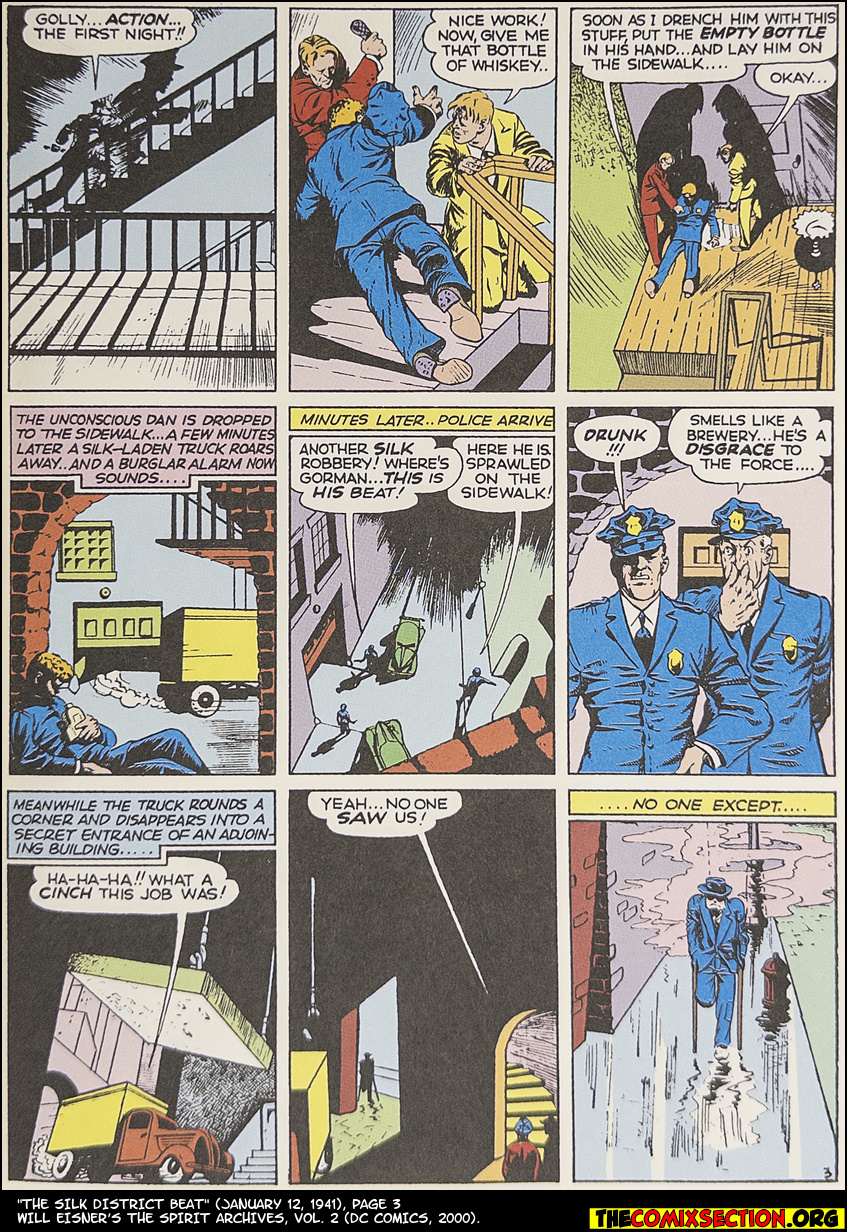
    The strip’s a simple outing—Spirit helps young copper Dan Gorman, who runs afoul of the hoods on his new beat. There’s a great action sequence with the Spirit and Dan knocking heads; lots of great movement. Otherwise, the most interesting thing about Silk District is how little the Spirit’s in it.

    He’s around a bit more than he’s active—in one of his disguises (this one much better than his previous efforts, which usually just had him putting on a pair of glasses)—but Eisner takes a more global view of the story. It opens with Dan and his mom, Mom full of pride, and a local thug showing up to pay him off.

    From there, the strip shows the hoods framing Dan to get away with their latest robbery, leading to his immediate dismissal, and the Spirit interceding because he witnessed the frame-up.

    In order to be a witness (including showing up at the police station to give a witness statement), Spirit had to be hanging around the Silk District. Why didn’t he just foil the robbery or track the robbers himself? Very unclear. Other than there needed to be a “help your neighbor” message to the strip.

    While Spirit and Dan are planning to apprehend the robbers and clear Dan’s name, Commissioner Dolan is contending with the shady Squire Sampson. Sampson’s a recurring character, the legit front for numerous rackets around Central City; Dolan can’t prove anything, however, so he has to put up with it. Spirit, on the other hand, takes multiple opportunities to manipulate Sampson—positioning the strip’s narrative dominos.

    The Sampson angle adds approximately a page to the strip, which struggles to make it to the eight pages (minus one for the lovely, spoiler-y splash page). The final page of the strip has a “ladies will talk” trope, and then Spirit providing a brief recap of his adventure to Ebony. There’s also a lot of rumbling from Dolan about how he’s just got to solve the case before the Spirit.

    All very solid, with nothing distinct about it. Maybe the Spirit’s disguise is supposed to be doing more. The disguise does have certain elaborate aspects to it—and they make the Spirit uncomfortable—but they never figure into the narrative.

    Again, at least it’s not just a pair of spectacles.

    Bottom Image
  • Alien: Earth (2025) s01e04 “Observation” D: Ugla Hauksdóttir. S: Sydney Chandler, Alex Lawther, Essie Davis, Samuel Blenkin, Babou Ceesay, Adarsh Gourav, Timothy Olyphant. Strong comeback kicks off the science, espionage, manipulation, deceit, and danger arcs, all entwined and engaging. It also reveals it doesn’t matter if Lawther can’t deliver: Chandler, Olyphant, and Davis are giving the only real performances. Everyone else is tediously mid. It’s fine as long as the one of the trio’s there, however. EARTH’s Michael Crichton’s ALIENS, but sure.

    Alien: Earth (2025) s01e05 “In Space, No One…” D: Noah Hawley. S: Babou Ceesay. Hawley’s back directing (and writing) with a breathtaking homage to the 1979 ALIEN, albeit far more STAR WARS-aware than the original. It’s also Ceesay’s profile episode; we find out his tragic backstory, which has multiple reveals, as the flashback reveals what happened aboard the crashing ship before it crashes. Very smart, very well-directed, very safe.

    All Creatures Great & Small (2020) s05e02 “Holding the Baby” [2024] D: Brian Percival. S: Nicholas Ralph, Samuel West, Anna Madeley, Rachel Shenton, James Anthony-Rose, Imogen Clawson, Tony Pitts. Everyone gets something to do–Ralph tries to learn how to be a dad while on a vet call (with Anthony-Rose along), Shenton and sister Clawson catch up (with dad Pitts about), and West and Madeley run into complications with her Home Guard supervisor, guest star Jeremy Swift. Shenton’s arc’s maybe the best, but they’re all real good.

    All Creatures Great & Small (2020) s05e03 “Homecoming” [2024] D: Stewart Svaasand. S: Nicholas Ralph, Samuel West, Anna Madeley, Rachel Shenton, Callum Woodhouse, Imogen Clawson, Tony Pitts. The show has to resolve one of its great unresolved plot threads, and does so with aplomb. Amidst that additional chaos, the household is already preparing for Ralph and Shenton’s baby’s christening, which has brought family in town. Shenton and mother-in-law Gabriel Quigley have an awkward time together. Plus a couple fun, gentle veterinary cases.

    All Creatures Great & Small (2020) s05e04 “Uninvited Guests” [2024] D: Stewart Svaasand. S: Nicholas Ralph, Samuel West, Anna Madeley, Rachel Shenton, Callum Woodhouse, James Anthony-Rose, Patricia Hodge. Woodhouse is trying to adjust to being back home and isn’t particularly pleased brother West is indifferent to his discomfort sharing his room with Anthony-Rose. But, first, snake-hunting. Meanwhile, Ralph’s having his own adjustment as people keep asking about his medical discharge. Great episode for Woodhouse. Hodge also figures in with a nice arc. Excellent episode.

    My Life Is Murder (2019) s05e04 “Top Two Inches” [2025] D: . S: Lucy Lawless, Ebony Vagulans. Awesome–season best, in the series best–episode has Lawless and Vagulans crashing a trivia night for the Auckland elite. The intrigue plays out not quite real-time but tightly consecutively, involves a returning pest (Benedict Wall), and gives guest star Marta Dusseldorp an excellent part. Especially when opposite Lawless. Great performances all around. The format really works.

    My Life Is Murder (2019) s05e05 “Thirteen O’Clock” [2025] D: . S: Lucy Lawless, Ebony Vagulans. Very fun, often cute episode has Lawless and Vagulans investigating a mysterious death at a mysterious party at a toy maker’s mysterious mansion. The investigation is all about unraveling an unrelated secret, so there are lots of hijinks. There’s also a creepy doll, a romantic subplot for Vagulans, and… well, not much else. It’s briskly and assuredly executed.

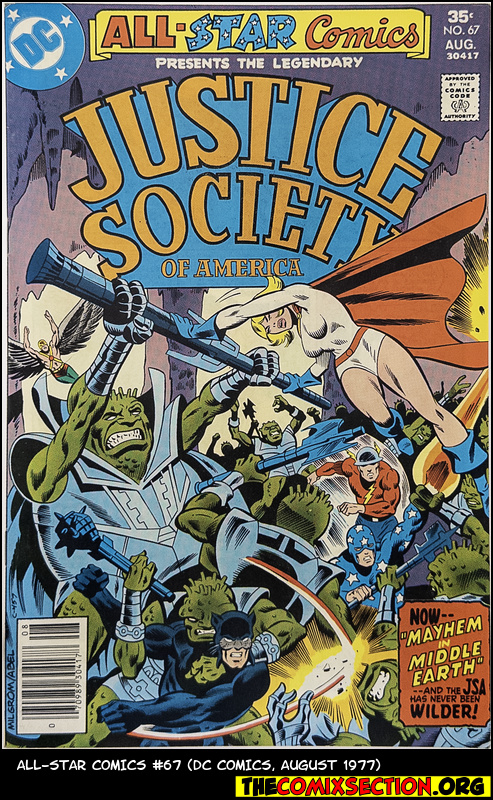
  • All-Star Comics (1976) #67
    Top Image

    For this issue of “your favorite Golden Age superheroes hate working with each other and helping people in general,” the bickering is once again the main plot. The story opens with Power Girl trying to convince Wildcat and Star-Spangled Kid to investigate a giant hole in the Earth where the supervillains were suspiciously hanging out. The subterranean creatures who come out of the hole and attack the heroes convinces Star-Spangled Kid he doesn’t want to investigate.

    Power Girl has to knock him out to get him to go quietly. He had been arguing for going into the giant hole because he thought Wildcat was just being an old sexist during that first argument (of three or four throughout) with Power Girl. What changed Kid’s mind? Apparently, there definitely being bad guys in the hole. It’s unclear. The issue occasionally feels like writer Paul Levitz can’t keep track of the heroes’ petty grievances, which makes sense. The bickering never leads to anything, even when it’s potentially deadly.

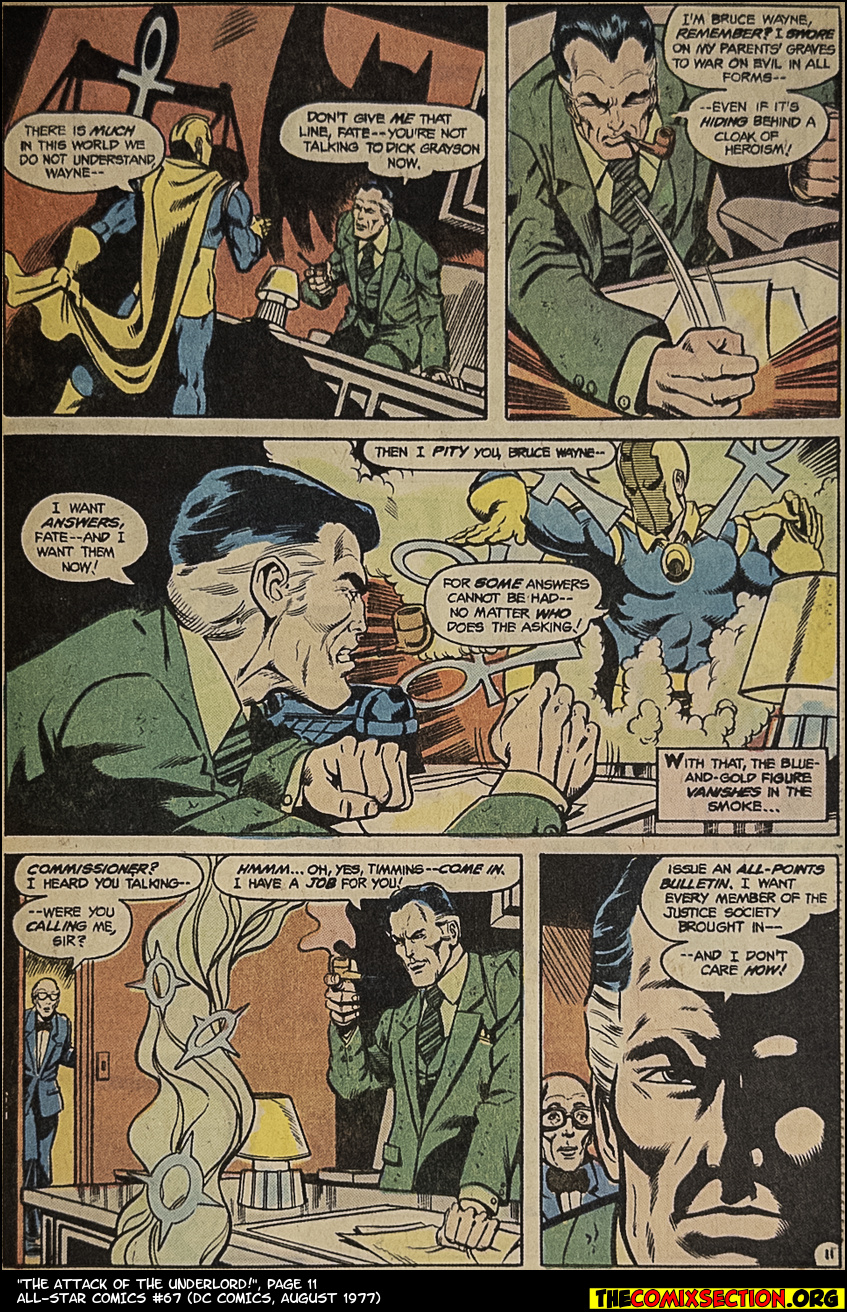
    But before that level of bad teamwork, there’s Bruce Wayne’s plot line. He’s now the Gotham City Police Commissioner, and he’s got city leaders upset Green Lantern is having hissy fits and causing property damage. Wayne’s conservative in his plans, cautious. He assumes bringing in Golden Age superhero Green Lantern for police questioning will lead to Green Lantern killing police officers to avoid capture. How chill.

    Robin sends Wayne a telegram about how all the Justice Society members are acting like a bunch of jerks, which just confirms Wayne’s suspicions. Of the heroes being jerks and bad teammates. There’s no higher drama.

    Back in the main story, Power Girl activates her distress beacon, calling the team away from a nosy Robin and their latest hospitalized teammate. Flash, Hawkman, and Doctor Fate go down to help, but then Doctor Fate leaves immediately upon arrival. Presumably, Fate knew the “Middle Earth” adventure was less important than him going to visit Commissioner Wayne and telling Wayne to relax. Wayne’s internal turmoil over his friends being a bunch of jerks is unsettling the cosmic balance.

    Once the team meets up, Flash and Hawkman decide they’re not going to help Power Girl, after all. They don’t think going into the hole to investigate the supervillains was a good idea. So she can just go get killed to learn her lesson.

    Things do get to a more positive resolution, but only because Levitz manages to make Power Girl wrong in her reckless behavior despite being the only responsible adult. He doesn’t write anyone chastising her for that behavior, at least, which is a not insignificant win for this strange comic book about quinquagenarian misanthropes.

    Bottom Image
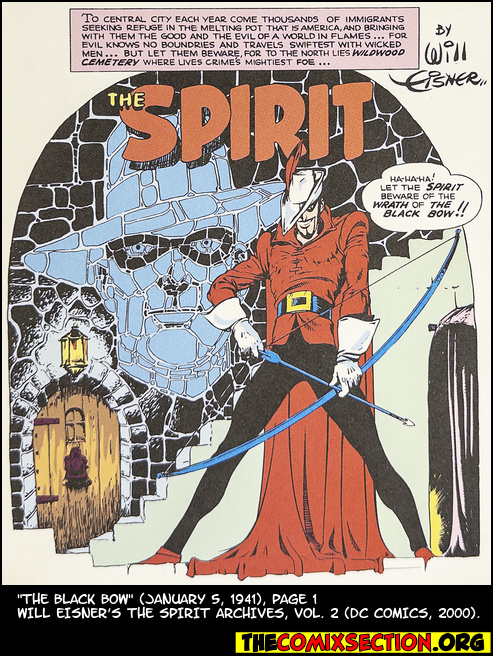
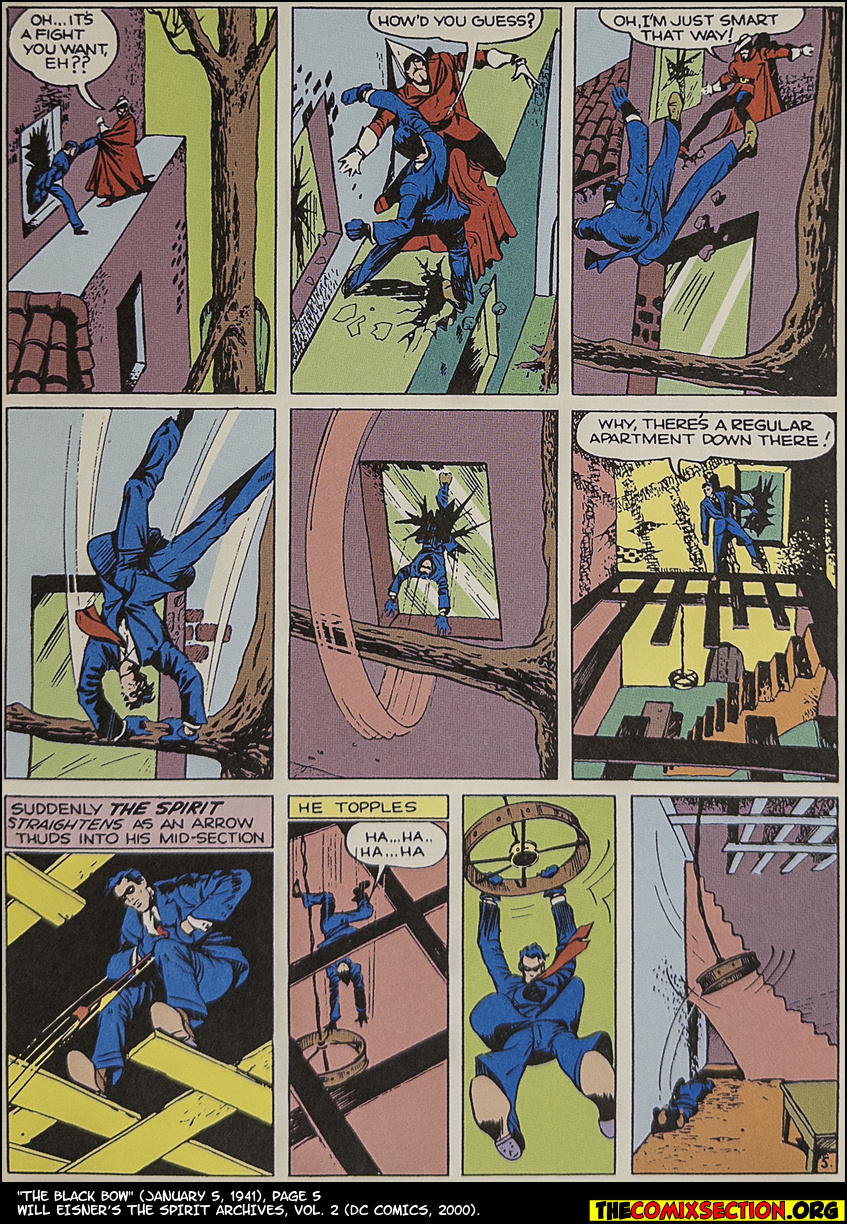
  • The Spirit (January 5, 1941) “The Black Bow”
    Top Image

    Eisner and studio start the new year one big change for the strip—The Spirit now takes place in “Central City,” and has always done so. Then there’s also the approach to the war in Europe; Eisner’s still not using the proper nouns, but this strip’s all about the influx of European refugees fleeing from the Nazis.

    The strip opens introducing the title villain and how immigrants from a particular country are terrified of The Black Bow. Fortuitously, some of these immigrants bury the Bow’s latest victim in a desolate corner of Wildwood Cemetery, where Spirit’s curious about the gaggle of old men doing an illicit burial. So he eavesdrops.

    There’s some wild present action going on this time; the inciting incident happens in October (of the previous year), then the Spirit and Ebony (who’s just around for this scene) cook up a scheme to investigate the mysterious burial. Presumably, other strips were happening during this investigation, which involves accent work, disguises, and home rentals.

    While Spirit sets himself up as a sitting duck for the Black Bow, another victim literally stumbles into Commissioner Dolan’s arms, asking for help. Dolan sees it as an excellent opportunity to get one over on the Spirit and solve the case before Spirit even knows what’s happening.

    Of course, by that time, Spirit is in the middle of spirited (no pun) fisticuffs with the Black Bow; the two acrobatic adversaries even banter at one another through the fight scene.

    It’s a good action strip. The movement during the chase (the fight starts inside an abandoned mansion, moves to its exterior, ends in its basement) is phenomenal. The banter’s solid. The patriotism is a tad much. These European immigrants are just too embarrassed to go to the cops about their problem, which they consider imported: the Black Bow’s their country’s historical extorting murderous archer. We get a little back story on that setup, but not enough. Especially not for a villain who keeps up with Spirit so much.

    1941’s off nicely to the races; we shall see if the strip continues to find ways to incorporate Spirit into current events-related adventures.

    Bottom Image
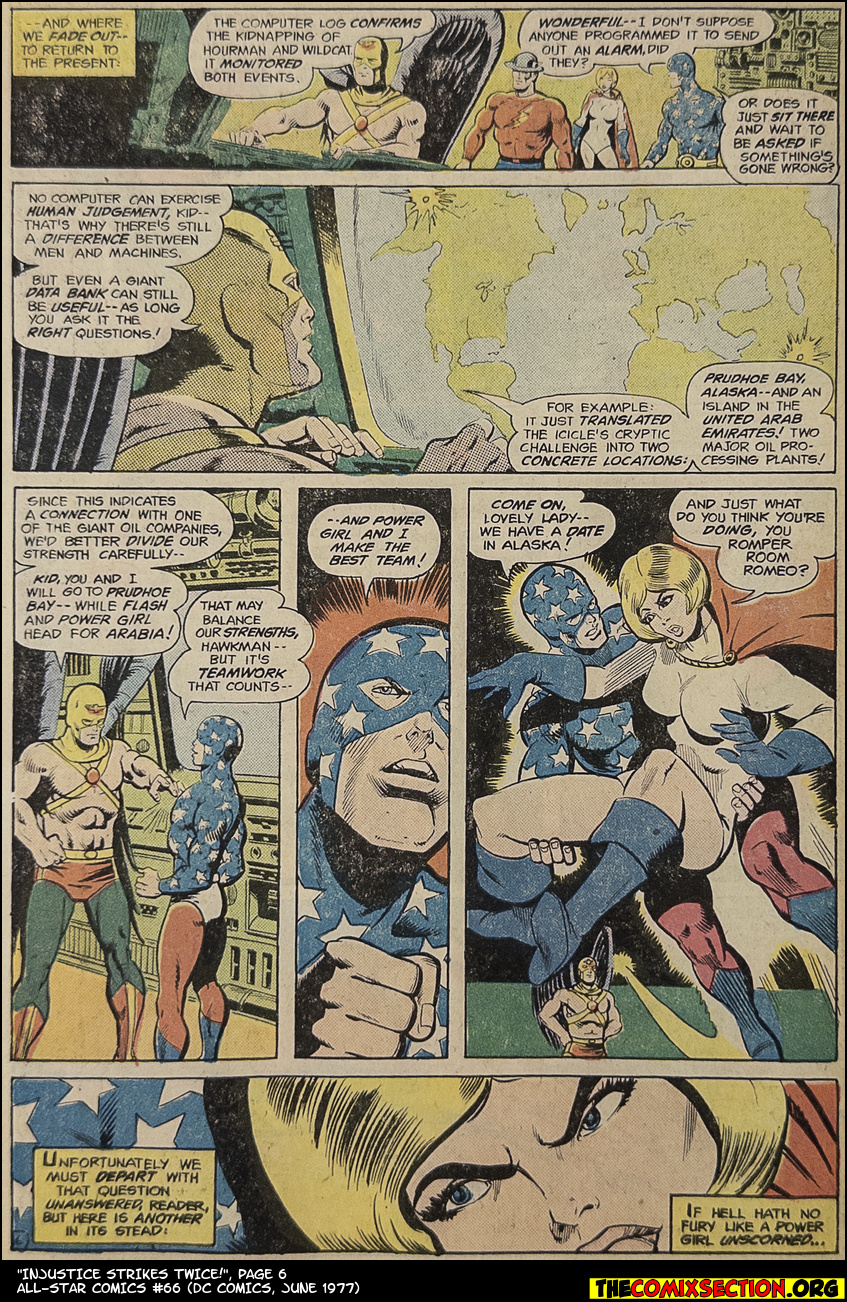
  • All-Star Comics (1976) #66
    Top Image

    Paul Levitz (script)

    Joe Staton (pencils)

    Bob Layton (inks)

    Elizabeth Safian (colors)

    Joe Orlando (editor)

    If I take back the things I said about Wally Wood being mid last issue, can he come back retroactively and save me from Joe Staton and Bob Layton? We can keep Paul Levitz finding his sexism towards Power Girl and embracing it: turns out he needed Star-Spangled Kid to creep on her like a lech.

    But Levitz does get a couple points for Earth-Two (maybe not when Gerry Conway was writing the book, incidentally) no longer having an apartheid South Africa. The exposition also mentions superheroes started on Earth-Two in the forties, not the fifties; maybe the extra ten years ground out the fascist, racist trash.

    Anyway. Back to Joe Staton and Bob Layton. Staton’s figures are often bewildering, and Layton inks into the “curve.” There are a handful of okay close-ups, including Bruce Wayne (who seems to be a character Levitz might actually want to write; time will tell), but the bodies—and especially the extremities—are bad; real bad.

    Levitz opens the issue in a flash-forward so he can wrap up the cliffhanger from last time (no Shining Knight, again; his agent obviously told him to stay away from All-Star Comics), which basically means Superman going off on his own so he won’t just save the day. Before Superman leaves, Power Girl is not nice enough to him, and she regrets it. However, she does not regret whining there are too many male heroes for her to compete with.

    These character moments are nowhere near the most unpleasant. Star-Spangled Kid gropes her and gets away with it, then at one point pervs on her instead of saving Wildcat. It’s a lot. Especially since Kid’s in the silly power belt (and also, the colorist at one point gives him white outside undies), he’s just a creep—and Levitz’s lead character on that plot line.

    The story has the JSA trying to save Hourman and Wildcat; the reunited Injustice Society has captured them. Injustice Society’s been after the heroes for a few issues now, starting during Conway’s tenure, and one has to wonder if their motivations were always the same. Levitz hasn’t got a lot of time for them. They’re disposable, easy-to-defeat villains, especially once Dr. Fate comes back.

    Levitz also seems to like writing Dr. Fate, who he characterizes as taking over the human host with no concern for its well-being, even having Mrs. Dr. Fate plead with Fate not to leave. It’s an all-right bit.

    All things considered.

    The ending sets up (adult) Robin coming back into the book–maybe—while Power Girl, Kid, and Wildcat (the book’s most obnoxious grouping, presumably worse now) going on an adventure together.

    Swell.

    Bottom Image
  • The Spirit (December 29, 1940) “The Leader”
    Top Image

    Will Eisner (editor, script, pencils, inks)

    Joe Kubert (colors)

    Sam Rosen (letters)

    The Spirit gets his first mission as a special government agent: identifying enemy powers’ fuel depots on the Mexican coastline. The military doesn’t want to let the Mexican government know about it because then they’d want to investigate and they don’t want to investigate themselves because gunboats will scare off the other bad guys. So they send the Spirit, who meticulously plots his jump point from the military plane, but fails to expect armed sentries.

    By this time in the war, Italy had joined on the Axis side. Eisner and studio had plenty of possible ways to go with the enemy forces. They went with “Nargoff,” which is neither German nor Italian. According to the Internet, it’s either Norwegian or Jewish. And Germany had been occupying Norway for months at this point. Maybe he’s Norwegian; Nargoff, the enemy leader.

    He’s also an author, who’s written a book about world politics with gems about larger countries having the right by size to take smaller ones. Spirit helps Nargoff understand that system on a personal level later in the strip.

    First, Spirit’s got to disrupt the submarine fuelingS station, which he’s able to do rather conveniently because it’s made out of wood—and wood burns.

    The strip goes through three distinct sets of stakes in its eight pages. The Spirit’s got to investigate and resolve the possible fueling station. Then the stakes move to Nargoff having to survive that resolution. And then there’s Nargoff having to survive, well, the Spirit.

    When the Spirit’s adversaries die, they rarely do so with the Spirit directly involved. In many cases, he may not even be present. And he generally turns the crooks in alive. So despite the lively, colorful art—lots of blues—and the energy to the action, the strip’s third act is dark. The Spirit’s solution for the situation is just a little unexpected given his… amiable vibe.

    But, it’s not wrong about how you deal with fascists.

    The strip’s got lumps and bumps; also, some rather solid moments. Spirit’s first mission as agent could’ve gone a lot worse.

    Bottom Image
  • The Spirit (December 22, 1940) “Christmas Spirit of 1940: Black Henry and Simple Simon”
    Top Image

    Will Eisner (editor, script, pencils, inks)

    Joe Kubert (colors)

    Sam Rosen (letters)

    For Christmas, the strip does a story without the Spirit. He shows up in the bookends; at the beginning—with some lovely art—Spirit and Ebony discuss Christmas plans. Ebony had been expecting Spirit to go after some known crooks, but instead, Spirit’s going to leave it up to the “Spirit of Christmas.”

    The action cuts to those known crooks, who’ve decided to rob a bank. It’s Christmas Eve, people are busy, and the bank’s just gotten a ten thousand dollar deposit (from the Spirit, actually); perfect night for a heist.

    They even dress up as Santas to pull it in the holiday spirit.

    The robbery itself goes swell, but when the crooked Saint Nicks are on their way out of town, they slow to listen to the tranquil sound of Christmas carols from a nearby church. Worse, the kindly priest comes out and invites them in—after all, they’ve spent their whole day working with the needy or whatnot.

    After some consternation, the crooks agree to attend, and get a dose of the true meaning of Christmas. In addition to the church having a peaceful vibe, their fellow attendees show them kindness, which softens our crooked Santas a little. They just get softer when they hear the money they stole was going to get needy orphans their first ever Christmas presents (and Christmas dinners).

    The crooked Krises Kringle scurry out, the guilt too much.

    Their individual (and, eventually, joint) resolutions will get the strip to its appropriate Christmas vibes, with the Spirit and friends returning for the finish. They’re still not involved in the case—they’re just reading about it in the paper on Christmas morning. It’s interesting to see who makes the regular cast at the Dolan house—Dolan, Ellen, Spirit, Ebony, and Finnegan, one of Dolan’s coppers (who I’m pretty sure at least once tried to railroad Spirit). However, Finnegan’s just there as a gag, not participating in the revelry.

    It’s a good strip. Lots of dotty inking but not too severe. Little cloying but it’s Christmas, after all. It’s the time of miracles. And spirits.

    Bottom Image
  • The Spirit (December 15, 1940) “Slim Pickens”
    Top Image

    Will Eisner (editor, script, pencils, inks)

    Joe Kubert (colors)

    Sam Rosen (letters)

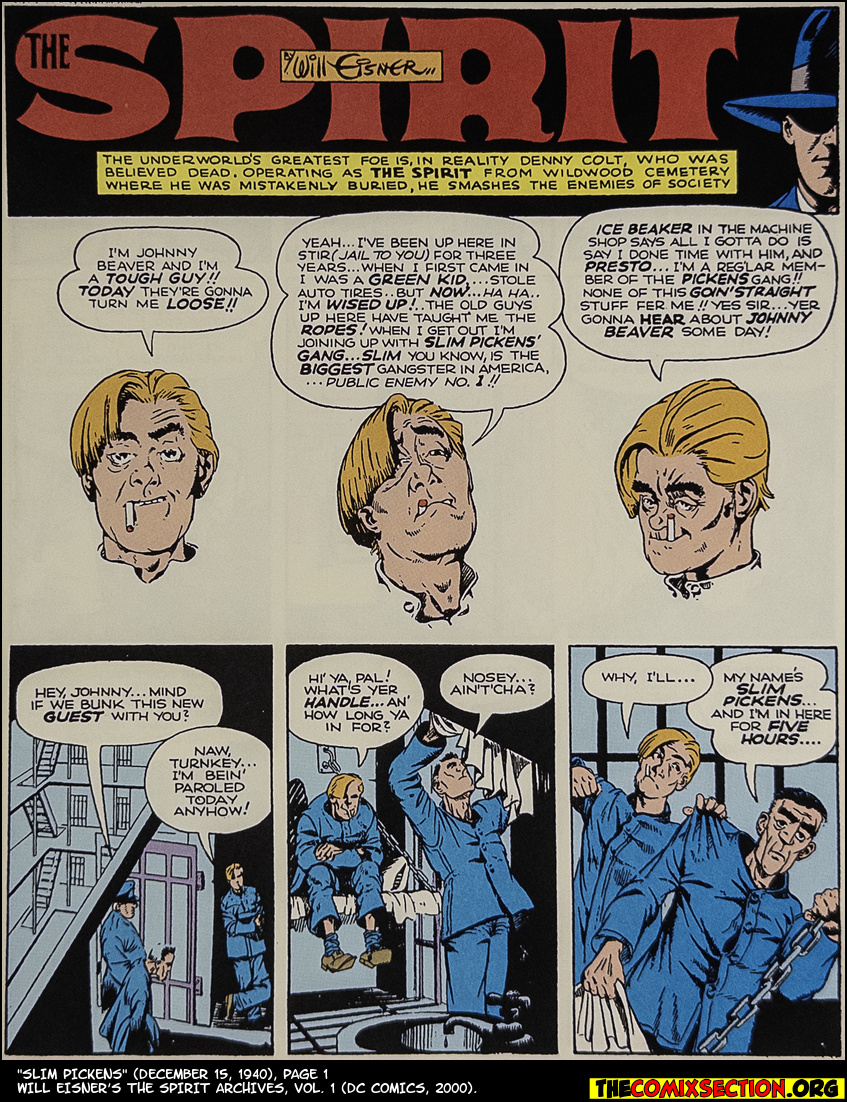
    This strip’s an incredibly (and intentionally) didactic tale. A young prisoner is about to be paroled and plans on joining the Slim Pickens gang. But just before his parole, wouldn’t you know it, he’s got a new cellmate… Slim Pickens.

    Pickens regrets his successful life of crime. To convince the kid crime doesn’t pay, he gives his life story, starting with robbing a grocery warehouse and selling the produce on the street. That robbery includes killing the grocery store owner (who Slim worked for), which proves rather crucial later in Slim’s tale.

    Then we get a recounting of Slim’s rise to power. Whenever he finds someone in his way, he just knocks them off and keeps knocking them off until he’s a-number one. Commissioner Dolan, the Mayor, and the Spirit are the only people he can’t bribe or kill.

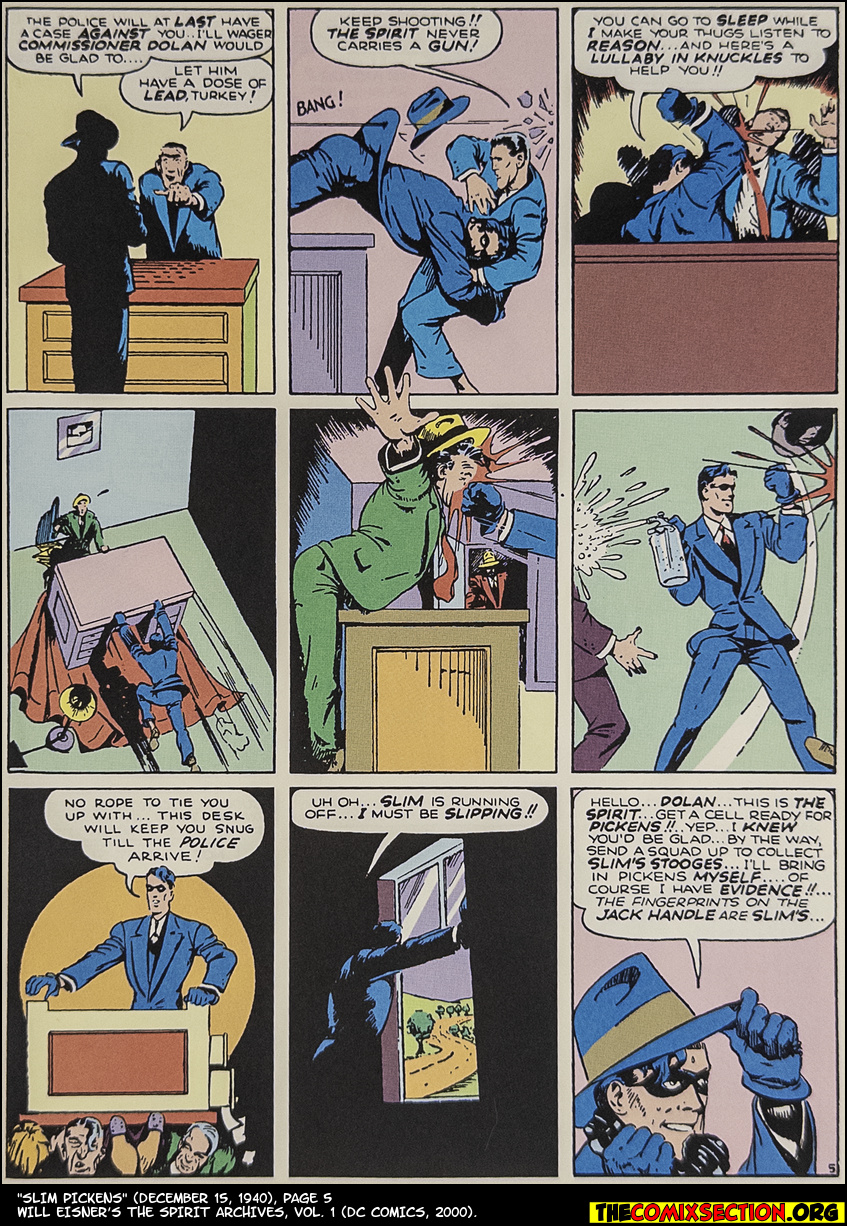
    When the Spirit finally comes knocking, looking for evidence to lock up Slim, everything starts going wrong. Not for the reader, who gets the treat of Spirit taking out Slim’s entire office of thugs in a beautifully rendered sequence. This strip’s got a bit too much of the dotty inks (with some very nice line work, too), but that page where the Spirit two-fists his way through the gangsters is sublime.

    Minus some occasional Spirit observations, the strip sticks with Slim. We don’t follow the Spirit chasing him, but Slim running from the Spirit. He finds himself in an utterly contrived situation, and it convinces him he should’ve just stayed straight and not become a crook.

    After Slim finishes telling his story, the postscript drives home the “crime doesn’t pay” message, just in case any readers missed it the other three times.

    It’s a decent enough strip. The didacticism isn’t a surprise (or even particularly cloying) and the way Eisner constructs the narrative, the various reveals work well enough.

    The dotty inking hurts some pages worse than others, but never enough to drag it down.

    Spirit’s found a very reasonable minimum level. Even when the story’s a little simple, there’s always enough creativity in the art—if not the narrative—to keep things running well enough.

    Bottom Image
  • Alien: Earth (2025) s01e01 “Neverland” D: Noah Hawley. S: Sydney Chandler, Alex Lawther, Essie Davis, Samuel Blenkin, Babou Ceesay, Adarsh Gourav, Timothy Olyphant. The ALIEN franchise gets a Disney-fied horror, action, sci-fi Prestige Format television show, set just before the first movie. Creator, teleplay writer, and showrunner and (this episode’s) director Hawley’s take is homage-heavy, but all very thoughtfully done. There are a handful of plotlines (and characters for each), which will inevitably congeal as the season progresses.

    Alien: Earth (2025) s01e02 “Mr. October” D: Dana Gonzales. S: Sydney Chandler, Alex Lawther, Essie Davis, Samuel Blenkin, Babou Ceesay, Adarsh Gourav, Timothy Olyphant. Not many surprises–until cliffhanger’s “ALIEN monster acts differently than ever before”–but solidly okay. The acting helps–Chandler and Olyphant are outstanding as the main synthetics, while writer Noah Hawley hovers between deft (the main cast isn’t ALIEN food) and safe (Hawley’s very deliberately focusing the audience’s concern). But is it much ado about nothing?

    Alien: Earth (2025) s01e03 “Metamorphosis” D: Dana Gonzales. S: Sydney Chandler, Alex Lawther, Essie Davis, Samuel Blenkin, Babou Ceesay, Adarsh Gourav, Timothy Olyphant. After resolving the cliffhanger (with more new ALIEN behavior), the episode deemphasizes Chandler and wanders amongst the characters, recovering from their adventure. On one hand, Lawther is also deemphasized and he’s–politely–ineffectual. Impolitely, he might crash the show with his performance. Olyphant’s great. It seems early for a bridging episode, especially such an inert one. Where’s the show?

    All Creatures Great & Small (2020) s05e01 “To All Our Boys” [2024] D: Brian Percival. S: Nicholas Ralph, Samuel West, Anna Madeley, Rachel Shenton, James Anthony-Rose, Patricia Hodge. The war’s still on, but things at home are finding a new normal, especially with a baby and a baby vet around. Meanwhile, Ralph’s adventures are either stranger than fiction or just very well-threaded fiction. Madeley’s subplot about getting more involved with the war effort–and her identity as a (war not animal) vet–is outstanding stuff.

    The Gilded Age (2022) s03e05 “A Different World” [2025] D: Deborah Kampmeier. S: Carrie Coon, Morgan Spector, Louisa Jacobson, Denée Benton, Taissa Farmiga, Cynthia Nixon, Christine Baranski. Lots happens–presumably setting up the second half of the season–with Spector’s business dealings getting rockier, Farmiga’s introduction to England flopping, and Benton making an unpleasant re-acquaintance. Richardson also gets a bunch, and various supporting cast members check in for the subplots. It’s good stuff, but the finish leaves Coon in an all-too-easy villain position.

    The Gilded Age (2022) s03e06 “If You Want to Cook an Omelette” [2025] D: Deborah Kampmeier. S: Carrie Coon, Morgan Spector, Louisa Jacobson, Denée Benton, Taissa Farmiga, Cynthia Nixon, Christine Baranski. Inordinately soapy episode–almost all the subplots have an element, except Coon’s trip to England to support Farmiga. That subplot works out fantastic thanks to the acting and Coon not having a villainous demeanor. Lots of commotion for Jacobson and Benton; we’ll see on the Jacobson story, but the Benton one already delivers. Good episode for Nixon, in particular.

    The Gilded Age (2022) s03e07 “Ex-Communicated” [2025] D: Salli Richardson-Whitfield. S: Carrie Coon, Morgan Spector, Louisa Jacobson, Denée Benton, Taissa Farmiga, Cynthia Nixon, Christine Baranski. Excellent episode puts all the soap to good effect, with various storylines getting new developments with some big surprises. Great episode for most of the cast, in particular Coon, Nixon, and Jacobson. Blake Ritson gets more showcasing than usual (to excellent effect) before disappearing from the very busy second half. Great direction from Richardson-Whitfield, as usual.

    The Gilded Age (2022) s03e08 “My Mind Is Made Up” [2025] D: Salli Richardson-Whitfield. S: Carrie Coon, Morgan Spector, Louisa Jacobson, Denée Benton, Taissa Farmiga, Cynthia Nixon, Christine Baranski. Great season finale resolves a bunch of season threads (and themes) while setting the table for a rather eventful nest season. Baranski finally gets some growth instead of gags, Benton’s got a phenomenal episode, Coon and Spector, too. It keeps the soap suds but they’ve got all sorts of heft. And the gowns are, of course, spectacular.

    My Life Is Murder (2019) s05e01 “Gimme An M” [2025] D: . S: Lucy Lawless, Ebony Vagulans, Dean O’Gorman, Iana Grace, Eden Hart, Sally Stockwell, Evander Brown. Lawless and Vagulans are back and investigating the death of a fitness influencer and how his cheerleader girlfriend figures in. Over enthusiastic (character not performance, performance is delightful) Louise Jiang’s cheerleader teammate is trying to undercover the truth. It’s mostly Lawless irritating the suspects, without a lot of outside activity. But great locations and solidly engaging as ever.

    My Life Is Murder (2019) s05e02 “Catfish” [2025] D: . S: Lucy Lawless, Ebony Vagulans, Martin Henderson, Jackson Gallagher, Yvie Harvie-Salter, Mike Edward, Xana Tang. Complicated solution to a dead aquarium manager (who ended up in one of the tanks), which includes Lawless considering romancing the prime suspect (studly marine biologist Edward). Martin Henderson’s back–and down on his luck, as usual–as Lawless’s brother, setting up his season arc. Lots of fun with the investigation, too, both surf and turf.

    My Life Is Murder (2019) s05e03 “For The Love of Dog” [2025] D: . S: Lucy Lawless, Ebony Vagulans. This episode’s mystery is so complicated Lawless even comments on it. It starts being about dogs, then is about a millionaire dating club, then ends as combination of the two. Vagulans gets a strange arc (as much as anyone gets an arc). It’s okay enough, but the pay-off’s not worth the (intentionally) convoluted trek.

    Resident Alien (2021) s04e08 “Mine Town” [2025] D: Nastaran Dibai. S: Alan Tudyk, Sara Tomko, Corey Reynolds, Alice Wetterlund, Levi Fiehler, Elizabeth Bowen, Meredith Garretson. All sorts of plot threads tie together as various revelations have repercussions. Tudyk gets a scene with pretty much everyone, usually to outstanding effect. Good episode for Tomko and Wetterlund, too, but–again–it’d help to lean harder on a Capracorn angle. Oh, and a great episode for Reynolds, who gets a new partner (of sorts).

    Resident Alien (2021) s04e09 “Tunnel Vision” [2025] D: Robert Duncan McNeill. S: Alan Tudyk, Sara Tomko, Corey Reynolds, Alice Wetterlund, Levi Fiehler, Elizabeth Bowen, Meredith Garretson. Superb penultimate episode opens with a large set piece conclusion to last episode’s cliffhanger, then reveals this episode’s stakes, which do increase as things progress. McNeill’s direction’s absurdly good, letting the episode get away with gravitas from performances deservedly and not. Gary Farmer’s got a phenomenal showcase. Everything’s beautifully set for next time and the grand finale. Cool.

    Resident Alien (2021) s04e10 “The End Is Here” [2025] D: Robert Duncan McNeill. S: Alan Tudyk, Sara Tomko, Corey Reynolds, Alice Wetterlund, Levi Fiehler, Elizabeth Bowen, Meredith Garretson. Okay (enough) series finale gins up a bunch of apparently easily resolvable, somewhat deep-cut conflicts to get away from just doing a farewell episode. But Tudyk and Tomko are both planning on leaving, so there definitely could’ve been more goodbyes than red herrings. Reynolds’s send-off is particularly pat. It doesn’t flop, but doesn’t do much either.
  • The Adventures of Hercules (1985) D: Luigi Cozzi. S: Lou Ferrigno, Milly Carlucci, Sonia Viviani, William Berger, Carla Ferrigno, Claudio Cassinelli, Maria Rosaria Omaggio. Weird but not in a good way sequel has Ferrigno trying to find Zeus’s missing thunderbolts. Despite truly bewildering set pieces and narrative decisions, it’s just too cheap, too poorly made, and too sedate to offer any amusement. Even when it hits extremes. Presumably a Cannon production but the boys left their names off it for some reason.

    Blood Quantum (2019) D: Jeff Barnaby. S: Michael Greyeyes, Elle-Máijá Tailfeathers, Forrest Goodluck, Kiowa Gordon, Olivia Scriven, Stonehorse Lone Goeman, Gary Farmer. Not bad idea for a zombie picture–an Indigenous tribe is immune to the zombie plague but everyone (and everything else) is not. Unfortunately, writer, director, and, unfortunately, editor Barnaby can’t make it happen on the dirt-cheap budget. Greyeyes is fine as the “dad” hero (and Goeman’s a hoot as his dad), but otherwise the acting’s… prosumer.

    Death to Smoochy (2002) D: Danny DeVito. S: Robin Williams, Edward Norton, Catherine Keener, Danny DeVito, Jon Stewart, Pam Ferris, Michael Rispoli. Delightfully strange “black comedy” version of a Frank Capra with earnest children’s show host Norton taking over for scuzball Williams. Williams goes after Norton, who’s also navigating the mob-backed children’s television industry. Great performances (Williams, Norton, Keener, Ferris), some mid-miscasts, and bewilderingly inept direction from DeVito (who goes for zany). Williams and Norton go all out.

    The Fantastic 4: First Steps (2025) D: Matt Shakman. S: Pedro Pascal, Vanessa Kirby, Ebon Moss-Bachrach, Joseph Quinn, Ralph Ineson, Julia Garner, Natasha Lyonne. Narratively rushed, visually spectacular FIRST (fifth, but who’s counting) outing for the Marvel Comics characters. Fine performances from the quartet and frantic enthusiasm keep the ship afloat until the action kicks in to higher and higher gear. Set in the 1960s in an alternate reality (to the Marvel movie universe), there’s no continuity, for better and worse.

    Hard Truths (2024) D: Mike Leigh. S: Marianne Jean-Baptiste, Michele Austin, David Webber, Tuwaine Barrett, Ani Nelson, Sophia Brown, Jonathan Livingstone. Absurdly well-acted family drama about Jean-Baptiste’s detoriating mental state. She’s fantastic but showy, while Austin (as her sister) alternates between frustration, confusion, and devastation. Leigh’s intentionality about showing and not telling maintains an intensity throughout, but then the third act calls too much into question without that same thoughtfulness. But peerless acting from the cast. Beautifully done.

    Moonlight (2016) D: Barry Jenkins. S: Trevante Rhodes, André Holland, Janelle Monáe, Ashton Sanders, Alex R. Hibbert, Naomie Harris, Mahershala Ali. Wrenching, trending, exhilarating tale of a gay Black man at three stages of life; two childhood, one adult. Fantastic performances all around, with Ali (as a father figure) and Harris (as the troubled mother) inhabiting. Hibbert, Sanders, and Rhodes are outstanding in the lead, with some beautiful character work progressing through. Truly exceptional filmmaking from writer-director Jenkins.

    Murder in Greenwich Village (1937) D: Albert S. Rogell. S: Richard Arlen, Fay Wray, Raymond Walburn, Wyn Cahoon, Scott Kolk, Thurston Hall, Marc Lawrence. Murder mystery about society girl Wray getting mixed up with VILLAGE (commercial) artist Arlen. Most of the picture plays like screwball romantic comedy with red herrings instead of gags. Wray and Arlen are game and the production is solid, the script’s just not interested in the actual MURDER. Rogell’s direction could be a lot better, too. But generally fine.

    Nancy Drew and the Hidden Staircase (1939) D: William Clemens. S: Bonita Granville, Frankie Thomas, John Litel, Frank Orth, Renie Riano, Vera Lewis, Louise Carter. Final entry in the series adapts the first novel (HIDDEN STAIRCASE), but it’s a lackluster effort. Litel’s barely around, Orth’s back and around way too much. And the stakes are all off (Granville’s ego is keeping old ladies terrified). She and Thomas are still charming, with Thomas getting to do more of the slapstick again. But an inglorious finish.

    Nancy Drew… Reporter (1939) D: William Clemens. S: Bonita Granville, John Litel, Frankie Thomas, Dickie Jones, Mary Lee, Larry Williams, Betty Amann. Granville’s competing for a young newspaper reporter award and finds herself a murder investigation to cover. Except then she draws the attention of mysterious character Perry (who’s bewilderingly uncredited despite being the heavy). Thomas, with his great comic timing, reluctantly aids Granville’s investigation. Annoying younger kids Jones and Lee get old fast (and never go away). It’s fine.

    Nancy Drew… Trouble Shooter (1939) D: William Clemens. S: Bonita Granville, Frankie Thomas, John Litel, Aldrich Bowker, Charlotte Wynters, Edgar Edwards, Willie Best. When family friend Bowker is falsely accused, lawyer Litel heads to the county to represent him. Litel inexplicably brings Granville, thinking she won’t investigate. She does, but Litel’s too busy romancing Wynters to care. At least until the danger’s too great. It’d be a lot better if Litel weren’t so mean, and there wasn’t the racism directed at Best.

    Nancy Drew… Detective (1938) D: William Clemens. S: Bonita Granville, John Litel, James Stephenson, Frankie Thomas, Frank Orth, Helena Phillips Evans, Renie Riano. Engaging outing for Granville (as NANCY) and her faithful sidekick Thomas as they try to discover the whereabouts of mysteriously missing rich lady Evans. Light on actual DETECTIVE work (the bad guys have their own story arc), enthusiasm, Thomas’s well-timed slapstick, and tenacity carry it through. Litel’s good as Granville’s dad, Orth’s distinct (positively?) as the local copper.

    The Poseidon Adventure (1972) D: Ronald Neame. S: Gene Hackman, Ernest Borgnine, Red Buttons, Carol Lynley, Roddy McDowall, Stella Stevens, Shelley Winters. Reasonably compelling disaster picture about a capsized ocean liner and the assorted survivors trying to make it to the surface. Dynamite pyrotechniques and production design. Hackman’s renegade preacher (with the personality of a drill instructor) is the leader, bickering constantly with cop Borgnine. Nice support from Winters, Buttons, and Stevens, in particular. The end’s just a tad too flat.

    The Survivors (1983) D: Michael Ritchie. S: Robin Williams, Walter Matthau, Jerry Reed, James Wainwright, Kristen Vigard, Joseph Carberry, Anne Pitoniak. Not bad odd couple buddy comedy about yuppie Williams becoming a gun nut, with new pal Matthau unwillingly along for the ride. The third wheel is hit man Reed, who can’t decide if he should kill the duo or befriend them. Even though Reed’s shoehorned in, he helps. Williams can’t handle the second half acting. Matthau saves the day.

  • All-Star Comics (1976) #65
    Top Image

    Paul Levitz, Paul Kupperberg (script)

    Wally Wood (pencils, inks, plot)

    Al Sirois (inks)

    Elizabeth Safian (colors)

    Ben Oda (letters)

    Joe Orlando (editor)

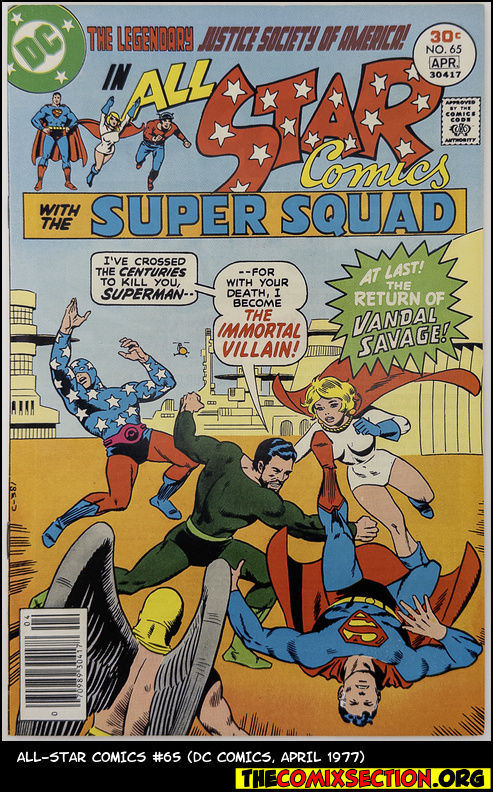
    I spoke too soon. Paul Levitz is back to solely dialogue this issue, with artist Wally Wood contributing to the plot. Presumably, then, it was Wood’s idea to do this issue of The Legendary Justice Society of America in All-Star Comics with the Super Squad as a Golden Age Superman comic. Some of the other heroes get page time, mostly Star-Spangled Kid it works out, but it’s just a Superman comic. Only it’s Superman as icon, not character.

    The issue opens with Power Girl and Superman breaking free of Vandal Savage’s force field bubble to find themselves—apparently—in the far future. Now, they’re not in the far future (it’s never clear where they are, actually, maybe something else for next issue… Levitz promises two other things already), but it doesn’t stop Superman from destroying a bunch of robotics while Power Girl tries to figure out what’s really going on.

    Power Girl isn’t around long; well, she’s not around and conscious long. Savage’s plan involves sapping Kryptonian life energy to replenish his immortality, and he takes her down first, charging himself up so he can handle fisticuffs with Superman.

    Meanwhile, the rest of the JSA—now imprisoned in Savage’s future place—get free, one by one, and try to help Superman and Power Girl. The Flash starts back in Camelot times, going to the future and the distant past, in an excuse for Wood to do some trippy time travel art. It doesn’t serve any narrative purpose otherwise. At least Green Lantern moping about losing his business because he was too busy being a selfless superhero like a chump will be relevant next issue.

    I mean, promises, promises.

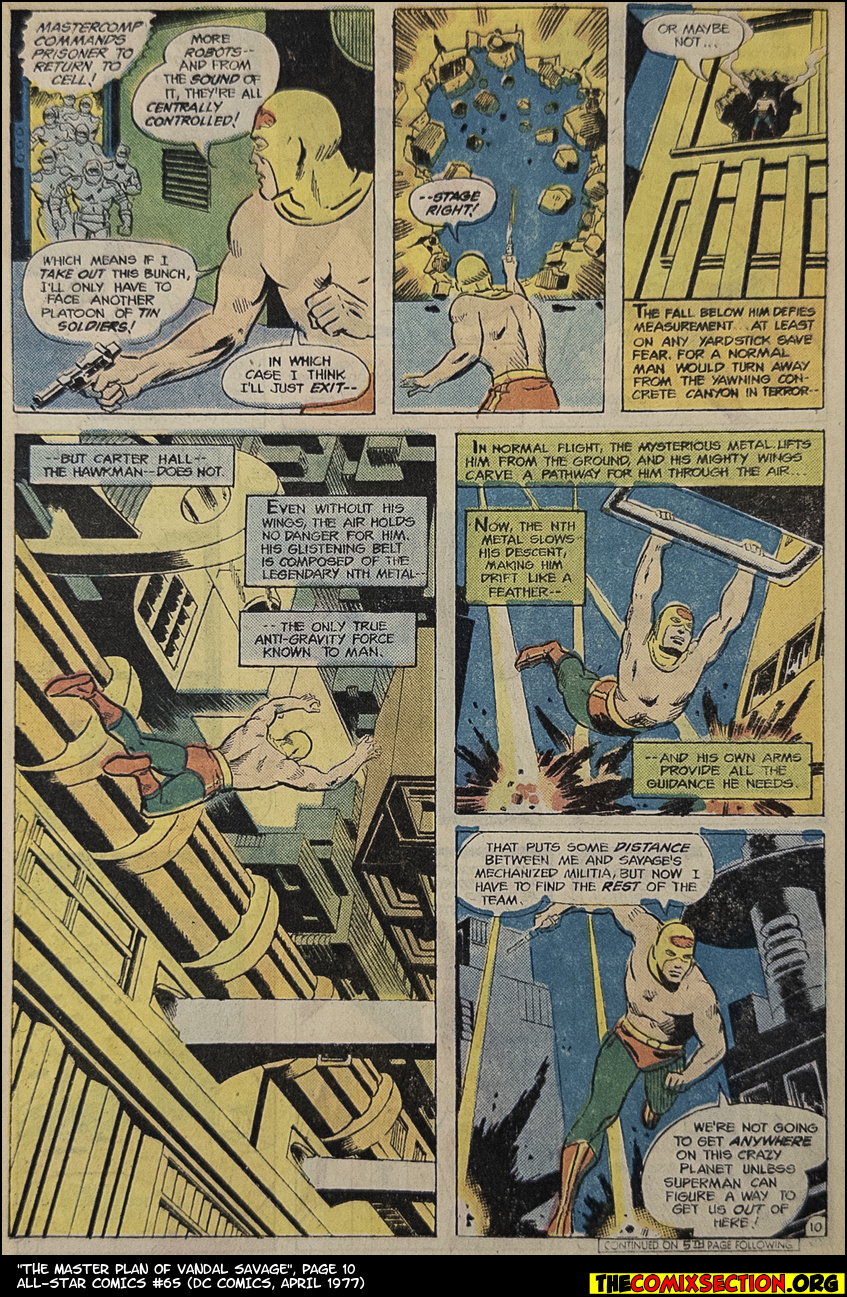
    Hawkman gets a decent all-action sequence after being so annoying a few issues ago. Merlin—in Savage’s future—frees Hawkman, who quickly frees Star-Spangled Kid and gets himself a fresh set of hawk wings. Now, Flash was talking to King Arthur in the past, which means for whatever reason Savage brought Merlin along. It’s never clear whether Savage actually needs Merlin’s magic—maybe just for the time travel—because he’s big into robot armies.

    Star-Spangled Kid’s new cosmic converter belt is silly and looks like a wrestling belt, which may be better than the cosmic rod in terms of giggles but still strange energy.

    The cliffhanger promises next issue will have something to do with the now three-issue old Injustice Society subplot. And Shining Knight gets a mention. Not an appearance, but a mention.

    All-Star Comics is incredibly uneven—Wood’s art this issue, for instance, isn’t as good as the previous one, even though he does seem invested in the Superman in a Flash Gordon future stuff.

    But a handful of neat visuals don’t a comic make.

    Bottom Image
  • The Spirit (December 8, 1940) “The Haunted House”
    Top Image

    Will Eisner (editor, script, pencils, inks)

    Joe Kubert (colors)

    Sam Rosen (letters)

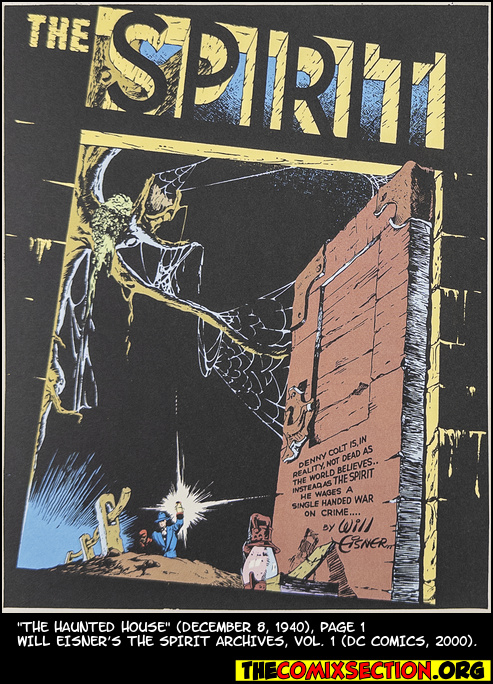
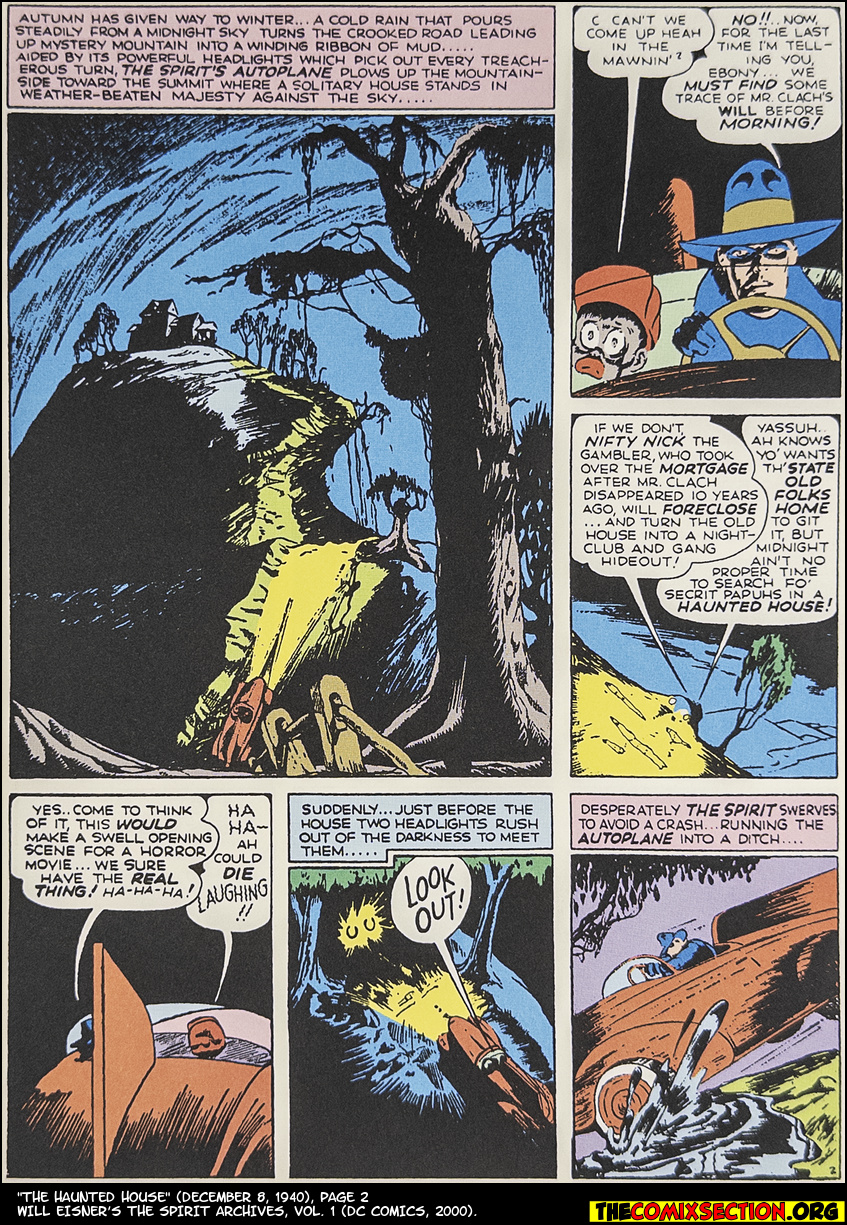
    For a relatively simple strip—the Spirit and Ebony go to investigate a supposedly haunted house—there’s a lot of exposition involved. We get a history of the haunted house—owned by a guy who has disappeared, the bank is about to foreclose, and it’ll go to a gangster who wants to use it as a gambling den (and general purpose hideout), but the Spirit wants the state old folks’ home to get it.

    About halfway through the strip, we’ll get some more exposition about the house, explaining what happened to it before the foreclosure rumblings. A few pages later, we’ll get even more. For all that exposition, however, there are still several unanswered questions in the strip… including why the gangster wanted the house (other than its remote location) and why he never took a look at it.

    The “haunting” elements seem to be permanent installations, so any estate agent and prospective buyer would see them.

    But, no, it’s just Spirit and Ebony bantering on the way there, then Ebony getting scared by everything and Spirit realizing there’s something else going on. Even as there end up being multiple fisticuffs opponents, and a handful of gags related to haunting the house, the strip finishes feeling more than a little slight. The stakes at the beginning—Spirit wanting to keep the house from the gangster—change in the middle, then change before the end, then are different once again in the last few panels. It’s like Eisner and studio had the idea for a setting, but not really what would go on in it.

    Especially considering they reuse actual (and somewhat nonsensical) set pieces.

    It’s still a perfectly okay strip, with Ebony around for the banter and some slapstick. The haunted house stuff proves fake reasonably quickly, so not a lot of Spirit in “supernatural” situations, but some nice, shadowy panels for sure. Even if the art’s never quite as tight as it could be.

    Again, Spirit has raised the bar so much technically, even slighter strips are fine outings.

    Bottom Image
  • All-Star Comics (1976) #64
    Top Image

    Paul Levitz (dialogue, co-plot)

    Wally Wood (pencils, inks, co-plot)

    Al Sirois (inks)

    Elizabeth Safian (colors)

    Ben Oda (letters)

    Joe Orlando (editor)

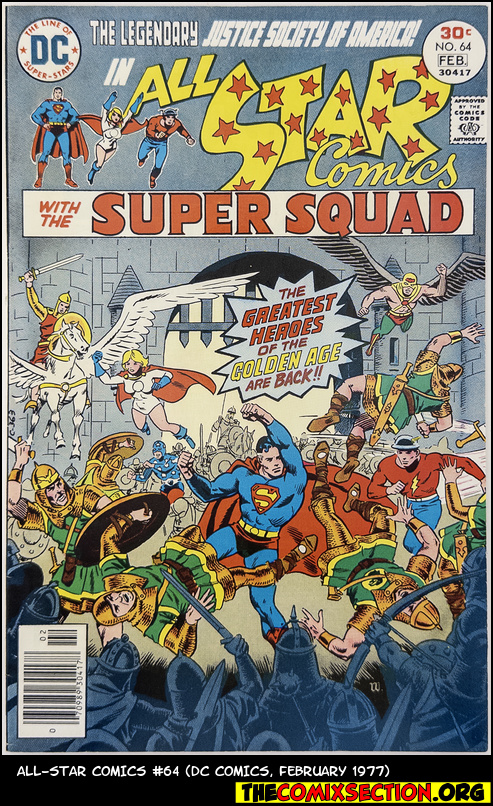
    Wally Wood takes over the full art duties and eighty-sixes Power Girl’s cleavage window, making All-Star immediately feel a little more grown-up. Helping set it back—writer Paul Levitz now makes special time to gripe about Power Girl being too into women’s lib and not gracious enough to the men around her.

    Otherwise, the majority of All-Star’s ongoing problems get a respite. There’s still the whining—Hourman whines about how no one needs him, Green Lantern whines about how no one cares about his money troubles—but there’s also time travel to Camelot and a big reveal at the end.

    In the present, Star-Spangled Kid has turned his cosmic rod into a belt, which doesn’t really feature in the story at all. Other than Kid pissing off Power Girl because he does something nice but she can’t appreciate how men are, actually, just trying to help her. Levitz takes the time to point out her personality defects after these moments, which is cruddy but now expected.

    Superman—who last issue promised he was retiring (again) from the JSA—rejoins this issue (he’s back at headquarters for some reason too, even before rejoining). It works out because Wood clearly enjoys doing Golden Age Superman in “modern” comics. Quotations for modern because they really lean into the Camelot time travel for a bit, complete with slight costume changes.

    They’re back in the past because Flash and Green Lantern show up at JSA headquarters with Shining Knight, who they discovered in Egypt while looking for Dr. Fate’s cure (Dr. Fate’s recuperating off-page). Presumably, original series writer (and editor) Gerry Conway had a different development in store for the Egyptian sojourn, but Levitz uses it to send the team into the past; the Romans are attacking Camelot, which is ahistorical (Camelot being historical could just be an Earth-Two thing, right?).

    After that whining from Hourman and Green Lantern, the team heads back, fighting some knights before ending up at the castle for their briefing with Merlin and Arthur. Despite being a seemingly essential guest star, Shining Knight disappears around this point. He’s definitely not there once the heroes realize something else is going on.

    Specifically, Power Girl notices something else is going on, bringing it to her cousin Superman’s attention. Now, if Golden Age Superman is the crème de la creme, why doesn’t he notice it? Because he’s too busy crying havoc. One wonders if editor Joe Orlando was ever once concerned with internal consistency. Again, probably not.

    The Wood art is nice, even when he’s brushing over plot holes (or creating them himself).

    All-Star’s not exactly good, now, but it’s majorly improved.

    Also doesn’t hurt Wildcat is nowhere to be found.

    Bottom Image
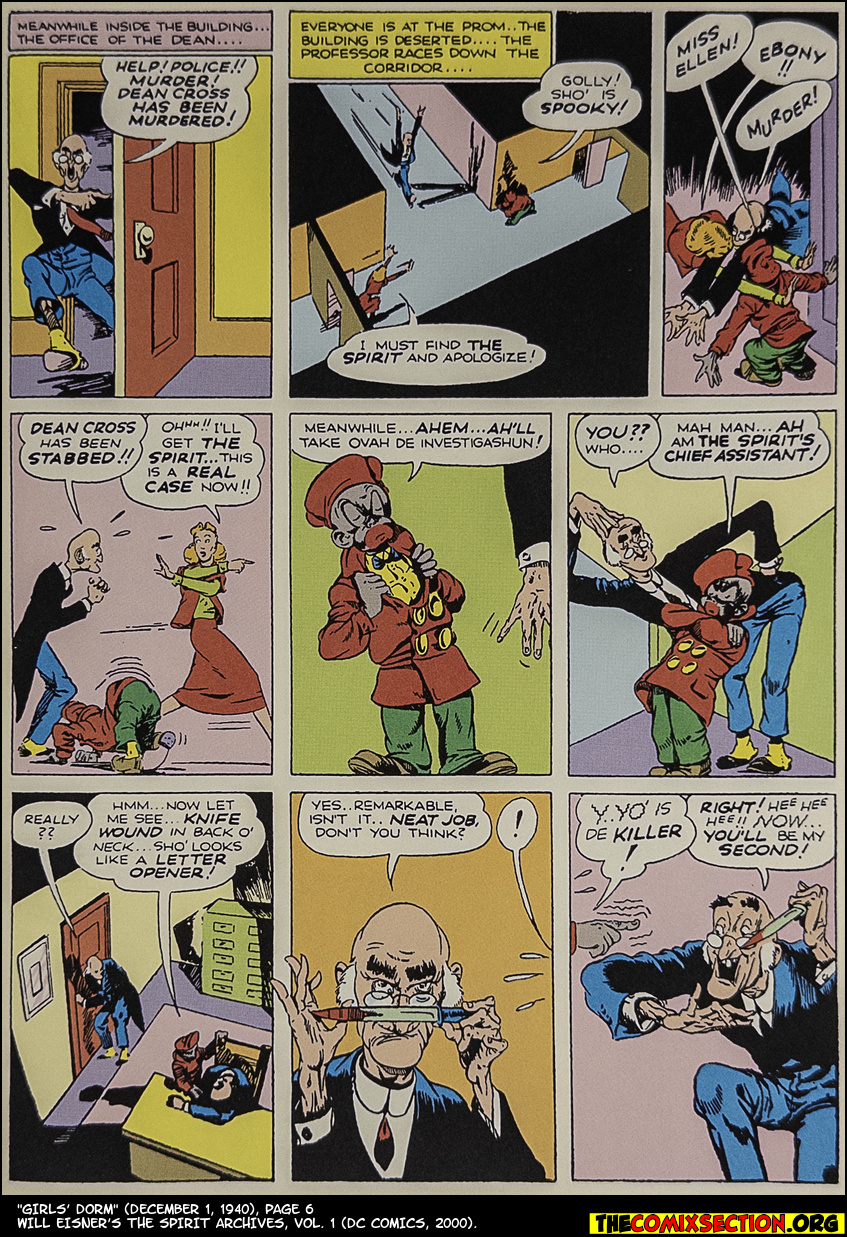
  • The Spirit (December 1, 1940) “Girls’ Dorm”
    Top Image

    Will Eisner (editor, script, pencils, inks)

    Joe Kubert (colors)

    Sam Rosen (letters)

    The splash page has Spirit with Ellen over his knee, giving her a spanking for some reason. That reason? Only the Spirit knows.

    Anyway.

    The strip itself has Ellen luring the Spirit up to her college so she can make him take her to prom. She’s told all her friends she can do it and just needs a cadaver from the medical school to make it work. One panicked call to Daddy (Commissioner Dolan) and Spirit and Ebony are winging their way in the autoplane.

    We’ll also get some nice, gentle teasing about Ellen from Ebony, who knows the Spirit likes her attentions and troubles more than he’s letting on. It’s another of those incongruities with Ebony; he’s the Spirit’s only confidant (Dolan knows his origin and home address, but little else), a faithful, determined sidekick, and yet visualized as racist caricature.

    Ebony will have a particularly good strip, since he’s the one who discovers the actual murder. It just so happens one of the college professors will end up dead as Spirit’s investigating Ellen’s fake murder. She does try to get him to ignore the corpse and take her to the prom, but Spirit’s all business.

    The strip is a mix of gentle, pointed, funny, and dangerous, which seems like a perfect Spirit combo. Except then the art’s a bit of a mess. There’s some outstanding composition, both for the slapstick action (chase and fisticuffs) and the expository long shot panels, but the detail is some of the worst in ages. It’s thin, fine lines, then dotty inks on everyone’s face. It feels like a new Spirit but with the earliest style trappings.

    Almost all of the strip plays for laughs; even when you think it’s going to be a danger moment, it resolves as a comedy one. So, despite the uneven art and the (more gentle than usual) sexism, the strip’s another perfectly solid entry. If only Ellen could come along as a character a little more. Or, at least, not lose her gains between strips.

    Bottom Image
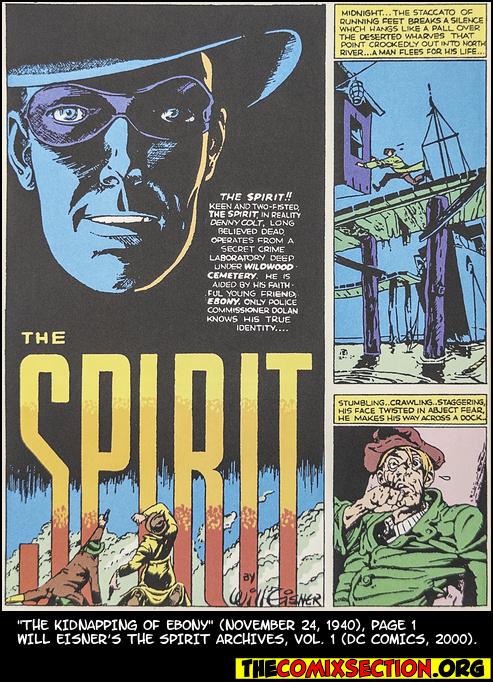
  • The Spirit (November 24, 1940) “The Kidnapping of Ebony”

    Will Eisner (editor, script, pencils, inks)

    Joe Kubert (colors)

    Sam Rosen (letters)

    It’s an all-action strip, opening with a thug on the run from the Spirit, desperately clamoring to be let into the hideout. Moments later, the Spirit breaks through the door.

    The thugs have kidnapped Ebony in order to lure the Spirit away from his hideout, so they can then torture the location information from Ebony and go plant a couple bodies there. The police will find them and the Spirit will be a wanted man.

    Now, as ever, none of the thugs think about just shooting Spirit dead when they have him standing idle, listening to their schemes. Instead, Ebony’s able to get Spirit a pistol—in what, visually, seems to be a racist caricature gag but we’ll not dwell—and so Spirit can start kicking butt.

    Despite being restrained for some of it, Ebony plays a big role in that butt-kicking. It’s a good “dynamic duo” strip for Ebony and Spirit. The thugs’ plan is entirely based on their partnership and friendship, and even though Ebony’s not two-fisted like Spirit, he’s got some moves when it comes to putting down the gangsters. And he never squeals, even though they’re torturing him.

    Juxtaposed with this extended action sequence is the gang’s seemingly legit boss trying to convince Commissioner Dolan and the mayor to investigate the Spirit’s hideout for bodies. The boss just doesn’t know where the hideout’s located… yet.

    The scenes at Dolan’s office—at least after the first one, which sets up the strip—are breaks from the relentless action. And even though it is just action, Eisner and studio turn it up as far as panel composition and choreography. At one point, Ebony is swinging on a hanging light and we get some great POV shots of the floor. Even that opening chase sequence has a lot of angle work. It’s a great looking strip.

    Spirit’s such a delight. Minus the occasional Ebony visual cringes.

  • Superboy (1949) #222

    Cary Bates, Jim Shooter (script)

    Mike Grell, Michael Netzer (pencils)

    Bob Wiacek, Bob Layton (inks)

    Jack C. Harris (assistant editor)


    Murray Boltinoff (editor)

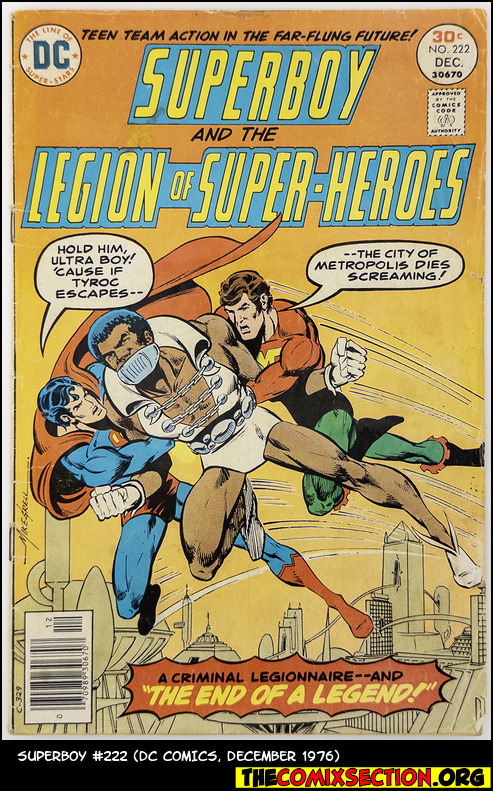
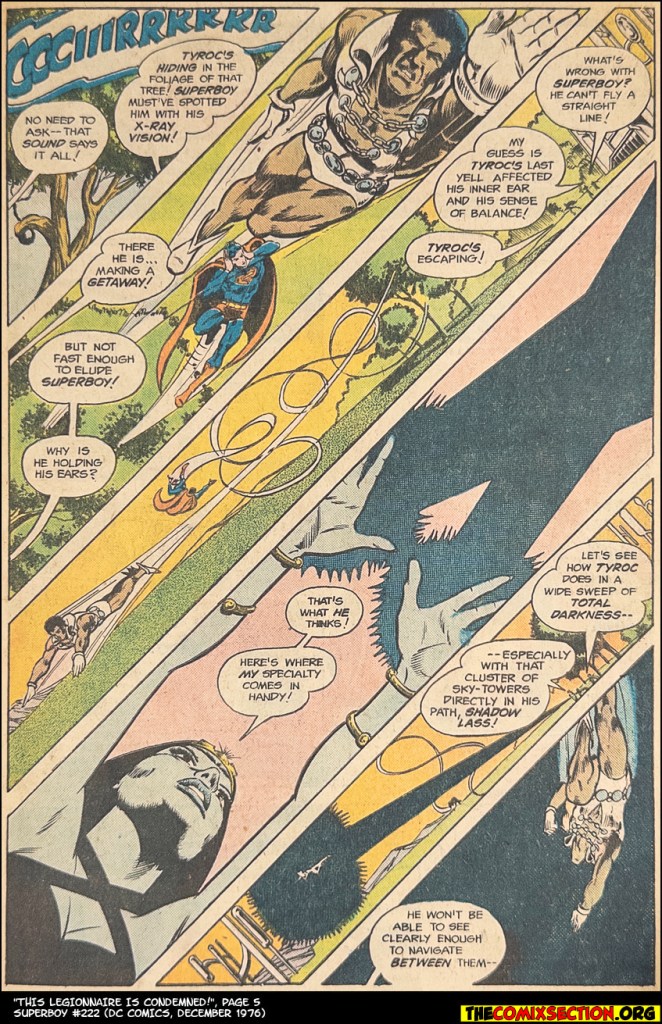
    Mike Grell gets an inker for his pencils on the feature, but Bob Wiacek doesn’t bring anything to improve on them. In fact, the figures might be worse. Some of the close-ups, from certain angles, are better than usual for Grell. Not so the rest.

    Cary Bates contributes the script, which has Tyroc rampaging around Metropolis, angry the Legion doesn’t want to move its headquarters to his island. Even without the later clarifying details, it’s an incredibly thin setup. We get the science police complaining to the Legion, the Legion revealing Tyroc’s having a tantrum, and then the Legion going after him. They catch up to him at a park, where they capture him.

    Not the end of the story by a long shot because then the Legionnaires show up at the jail with another suspect and a whole story about how Tyroc has been framed. If only it weren’t a way for Bates to kill two pages before wiping the stakes and loosing Tyroc back onto the unsuspecting populace. What could be causing the Legion’s latest member to break so badly? Just hang on for two more narrative feints, and Bates will explain everything!

    The remainder of the story is then Bates backfilling on the reasoning for a bunch of other details throughout. The whole thing’s set up to have the reader, the public, and some of the Legionnaires convinced Tyroc isn’t Legion material (seriously, he was the first Black guy on the team, and they gave him this story). It’s unremarkably bad, except in the historical sense. And to see how an inker can somehow make Grell’s figures worse. Superboy goes from having a bulky torso and skinny legs to a skinny torso with skinny legs.

    Jim Shooter, Mike Nasser, and Bob Layton contribute the backup. Superboy, Timber Wolf, and Lightning Lass are going to a faraway planet for some celebration. The president of Earth couldn’t be bothered to attend. On the way, they watch their favorite superhero movies starring Questar, who will also be at the ceremony.

    I assume Shooter didn’t know he’d be following up a feature with a multiple narrative switchbacks, so when he does two of his own… well, it rounds out the issue overall, I guess.

    The art’s not as good as the feature, which isn’t a particularly high bar, but either Nasser or Layton doesn’t understand how fingers look. There are other things they don’t understand, but not knowing how fingers look….

    It’s a particularly bad finish for Superboy, too. He comes off like a callous prick.

    The feature’s tedious and unrewarding. The backup’s more of the same.

  • The Spirit (November 17, 1940) “Dr. Prince Von Kalm”

    Will Eisner (editor, script, pencils, inks)

    Joe Kubert (colors)

    Sam Rosen (letters)

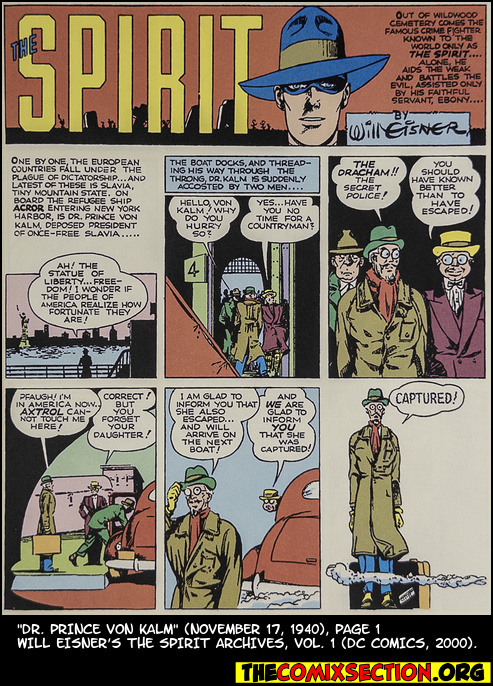
    It’s another political intrigue strip, with a European writer arriving in the U.S. after escaping growing fascism in his country. He’s immediately confronted by secret police from his country, who taunt him with the news they’ve captured his daughter and will execute her unless she returns. So he plans to return immediately, but not quick enough the Spirit doesn’t confront him and offer a plan. What if the Spirit poses as the writer, goes in his place, and gets the daughter out?

    Being an American, the Spirit doesn’t give the writer any choice in the situation, and they start prepping Spirit for the mission.

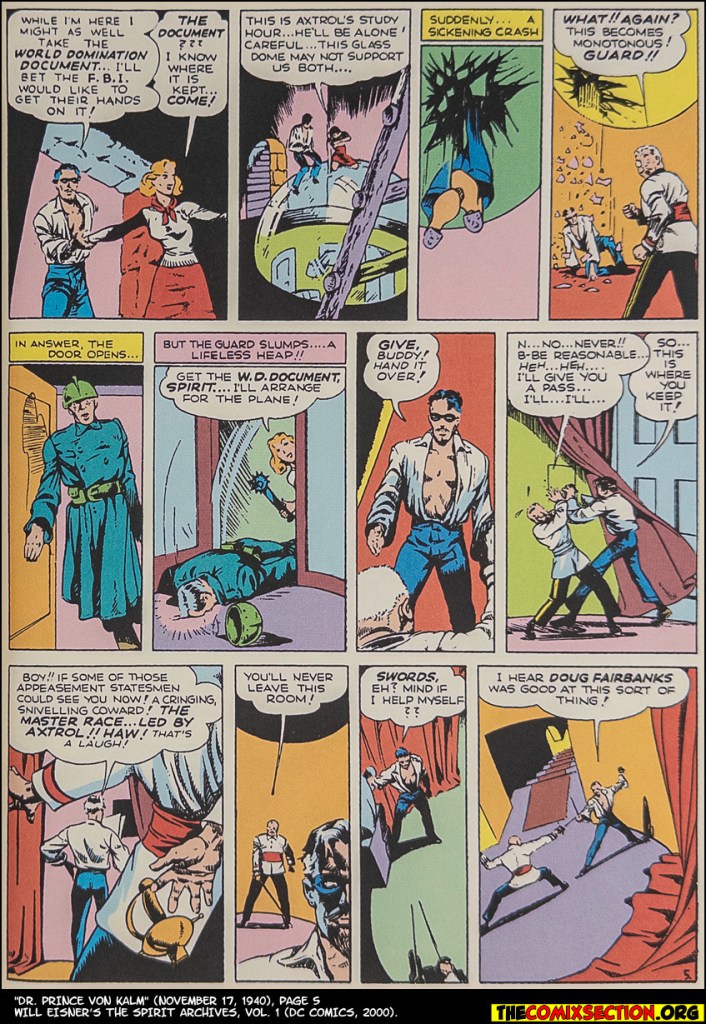
    Once in the (fictional) European country, the disguised Spirit has a brief meeting with the daughter—long enough to discover the country’s dictator isn’t going to free her in exchange as promised—and then goes about breaking out of his cell. There are a couple escape-related gags, with Eisner and studio hurrying things along so they can get to the action.

    In addition to escaping the guards in the palace, Spirit’s going to have to do some swashbuckling, some flying, and some reassuring (the daughter has never heard of the Spirit, being a European gal and all). There’s also the “world domination plans,” which Spirit and the daughter decide to grab before they leave, leading to a few more panels.

    The strip moves briskly, never slowing down too much for an action sequence, though clearly reveling in the swashbuckler sequence. It’s a good sequence. They’ve also got the Spirit in disguise for a good few pages of the strip, leading to the disconcerting moment when they do some beefcake of Spirit punching his way around the castle. It’s fun stuff, if a little slight. This one’s how you do the overt jingoism (save the obnoxious American superiority business, obviously).

    The last page is mostly post-resolution, with Ebony getting his own quick adventure. However, it does draw attention to the strip not knowing what to do with supporting cast when the Spirit’s ostensibly on a six week mission and whatnot.

    Minor gripe for an otherwise solid strip. And it’s not like the finale isn’t amusing, it’s just… nonsensical, too.

  • The Spirit (November 10, 1940) “The Kiss of Death”

    Will Eisner (editor, script, pencils, inks)

    Joe Kubert (colors)

    Sam Rosen (letters)

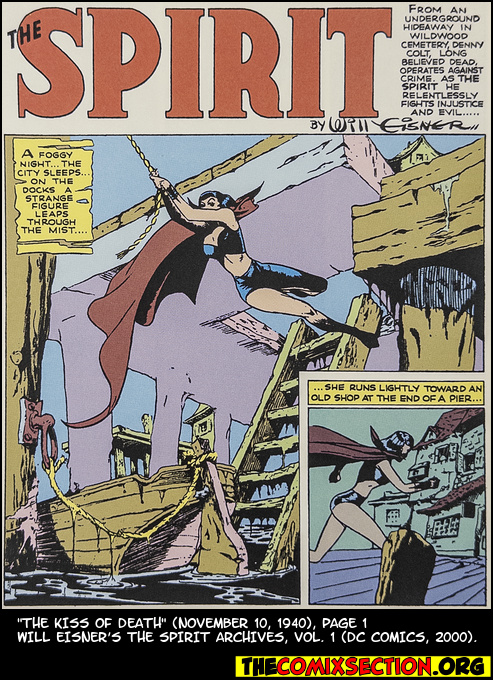
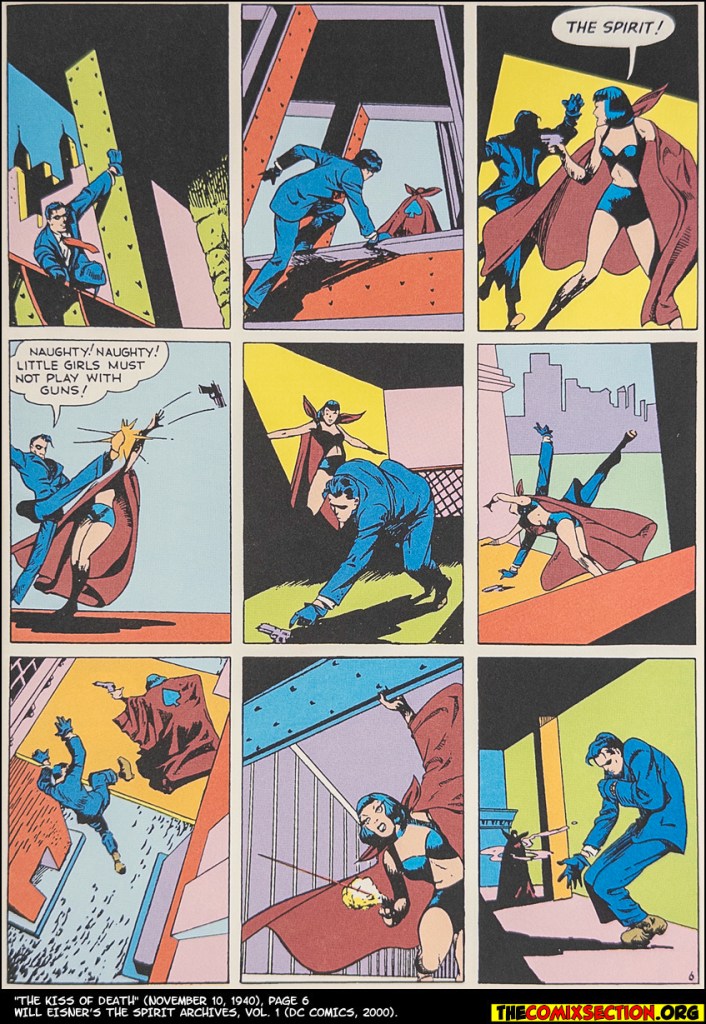
    The Black Queen’s back again, this time fully in her supervillain period, wearing a skimpy outfit and a cape. Far cry from when she was a “notorious female mouthpiece.” But also a far cry from her scheming in the shadows to take over the city with an army of gangsters.

    Now she’s just seducing men, getting them to betray their employers (and wives), then killing them for good measure. With killer lipstick, something Commissioner Dolan really should figure out before the last page of the strip.

    It’s mostly an action strip. After some setup with Black Queen and the connection between her victims, Spirit starts chasing her, and then there are only occasional interruptions to their action sequences. They have a big showdown on a bridge, with Eisner and studio getting to do a lot with the angles not to mention the actual fisticuffs (or whatever the equivalent since Spirit doesn’t want to hit a lady).

    While Black Queen becoming a supervillain is certainly a surprise character development (especially since her plotting has downshifted from robbing the federal reserve to robbing a jeweler), the strip’s got so many great moments one doesn’t slow down to think it through especially since there’s so much humor running through it.

    One of Dolan’s cops is convinced—always—the Spirit has done it. So every once in a while, someone will have to remind him, but no, it’s obviously not the Spirit. But the recurring humor gag works, especially once it’s clear they’re not giving it up just because Spirit didn’t do it.

    There’s also some “Spirit invents” this strip, with suction cup shoes playing into the chase sequence at one point. Again, despite Black Queen putting on a leather bikini, a cape, and some stilettos—it’s a great kitchen sink of Spirit. There’s personality from Dolan (contending with his dimmer bulbs), Spirit getting in some banter, and a nice “first act” setting things up.

    And the art, obviously. The art’s so dang good. And the exposition’s working on getting witty, too.

  • All-Star Comics (1976) #63

    Paul Levitz (assistant editor, script)

    Keith Giffen (layouts)

    Wally Wood (pencils, inks)

    Al Sirois (inks)

    Carl Gafford (colors)

    Ben Oda (letters)

    Joe Orlando (editor)

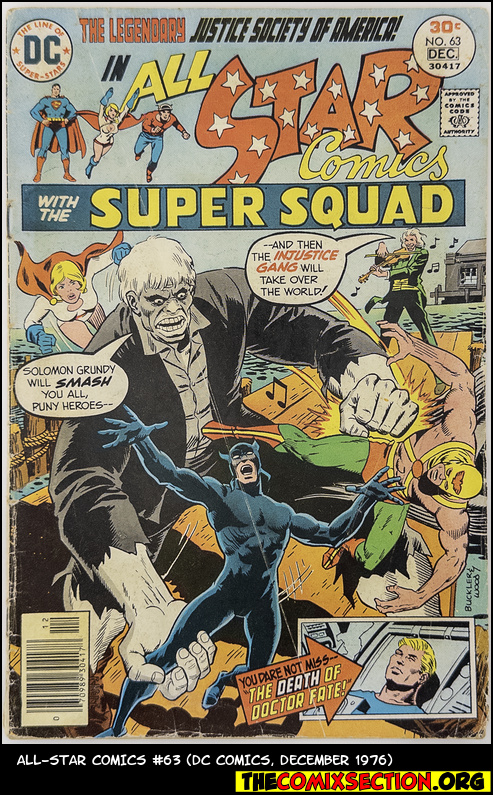
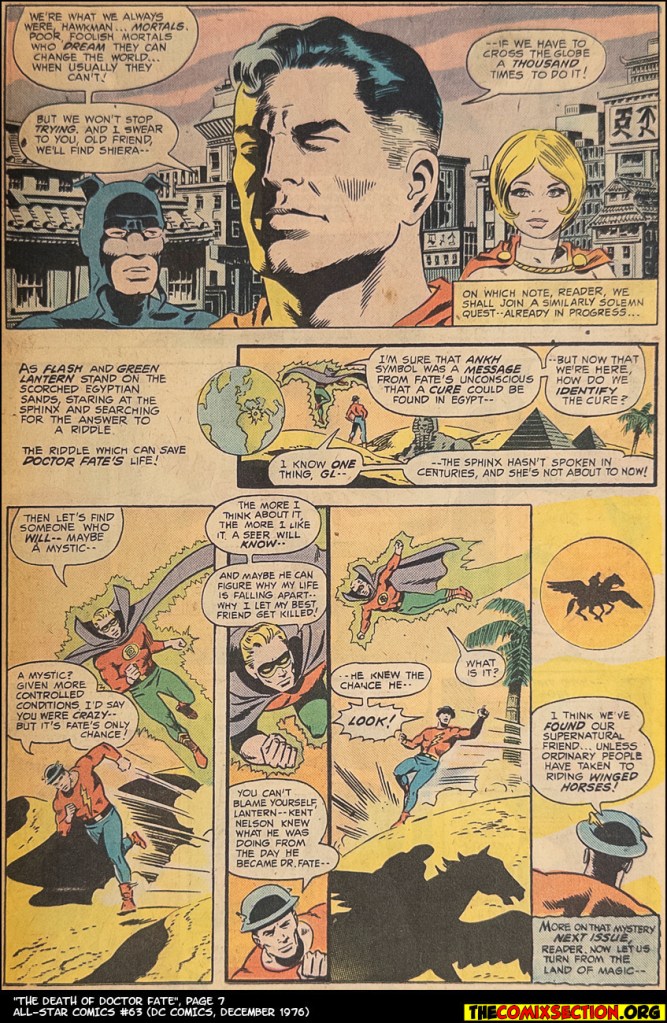
    Paul Levitz takes over the full writing gig, no longer only dialoguing from a plot, and… well, at least there’s not all the misogyny. Otherwise, there’s not much improvement. It’s definitely somewhat different—we get lots of heroes standing around moping about how they can’t possibly be heroes when there’s so much against them. Dr. Mid-Nite quits, and so does someone else (who’s quit at least once before in All-Star, with Levitz using it for the same story beat again). And the whole thing is supposed to be about how Dr. Fate’s on death’s door.

    If only there were a deus ex machina to resolve it. Unexpectedly, it comes a page after filler about Green Lantern and the Flash being in Egypt—at Fate’s subconscious request—to find a cure. There’s also a silly bit with Flash making fun of “mystics,” even though Dr. Fate’s a literal sorcerer and Green Lantern has a magic ring. It’s not so much the internal logic of All-Star not making sense, it’s Levitz not even acknowledging it should.

    The issue opens with a big fight scene involving Hawkman, Wildcat, Solomon Grundy, and the Fiddler. The Fiddler has brainwashed Wildcat into beating Hawkman to death. Despite the promises he’s killed him, Hawkman is, in fact, fine. The exposition goes on and on about Wildcat’s fatal fists, but apparently, he didn’t do much actual damage. As the fight resolves, we find out in addition to Wildcat misunderstanding how killing Hawkman (or anyone) works, we find out the JSA has been operating under the assumption Superman and Power Girl are dead from last issue.

    They are not.

    Wildcat then makes it sound like they just let Superman do all the actual work and wait to see what he’s come up with. With all these heroics on display, what can the rest of the issue hold? Not much aside from the aforementioned moping about not being heroic like in the old days, some oddly static fight scenes (with nice detail from Wally Wood, just not a lot of energy).

    The various stakes of the issue—including the supervillains trying to kill the JSA—either get punted or resolved off-page. Hawkman’s “Real Men Could Save Their Wives” arc is another page-burner. Levitz hasn’t got any actual material, just gristle.

    The various setups for next time don’t promise much, either. More mysteries, more supervillain plotting, presumably the same contrived plotting.
    Levitz doesn’t distinguish himself as the solo writer yet. And doesn’t do anything to imply he will.

  • The Spirit (November 3, 1940) “The Manly Art of Self Defense”

    Will Eisner (editor, script, pencils, inks)

    Joe Kubert (colors)

    Sam Rosen (letters)

    The splash page is Ellen Dolan with a black eye, reading The Manly Art of Self Defense. Given Ellen’s last appearance in the strip, it’s a sensational and not unconcerning opener. But it’ll all work out, with Self Defense possibly the best Spirit strip so far.

    We open in Wildwood Cemetery, Spirit running into the crypt, begging Ebony to hide him. Ebony wonders what could have the Spirit so scared… why, it’s just Ellen Dolan. She’s told the Spirit she loves him and he’s run away. She decides to catch a criminal to prove herself worthy of his attention.

    Except the criminal she goes to catch is dead, and an enforcer is just arriving to find her there. Luckily, the Spirit convinces the thug Ellen’s not the killer, except she then wants to identify herself as the commissioner’s daughter, which would complicate matters.

    The Spirit will eventually find the killer, defeat the gangsters, and generally save the day. Ellen will get that black eye. And, then, in the glorious last page, pay the shiner back in full. Along the way, there are multiple action and suspense sequences. The line work is gorgeous, as are all the shadowy panels. Eisner and studio really go for mood this strip and it pays off. They also play with color in the last action scene, setting it in the dark (blue), and it’s a dynamite visual. The Spirit’s got a lot of gangsters to get through before the day’ll be saved. The strip’s seven pages, not including the splash, and three of those pages are superlative. The flow between the panels, the change in angles and distance, the expressions, the fisticuffs… it’s all just fantastic.

    But what will put it over is how the strip deals with that first plot line—Spirit and Ellen—things have gotten a little more complicated and there’s not exactly a lot of time to wrap it. Still, Eisner leaves the couple’s relationship in a far more interesting place than it’s ever been before. And without being crappy to Ellen.

    Maybe minus her naïveté in going after the criminal at the beginning (the strip has forgotten she’s in school to be a criminal psychologist or whatever).

    Anyway.

    Manly’s a beautiful piece of work.

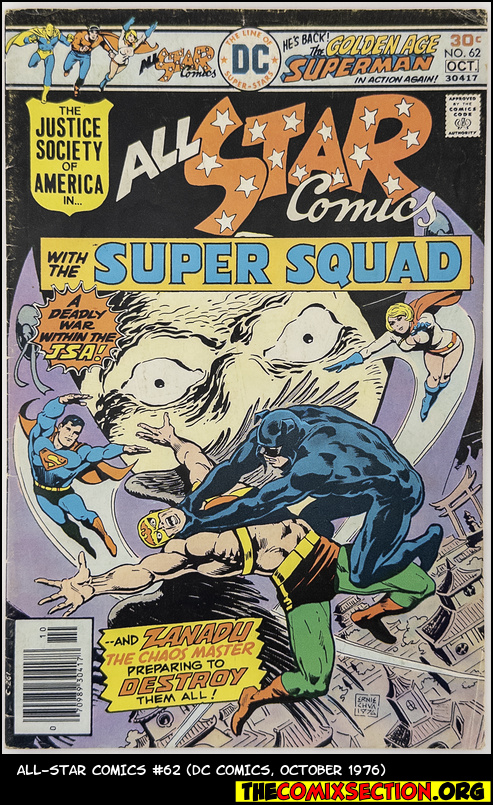
  • All-Star Comics (1976) #62

    Gerry Conway (editor, plot)

    Paul Levitz (assistant editor, script)

    Keith Giffen (layouts)

    Wally Wood (pencils, inks)

    Al Sirois (inks)

    Carl Gafford (colors)

    Ben Oda (letters)

    Jack C. Harris (assistant editor)

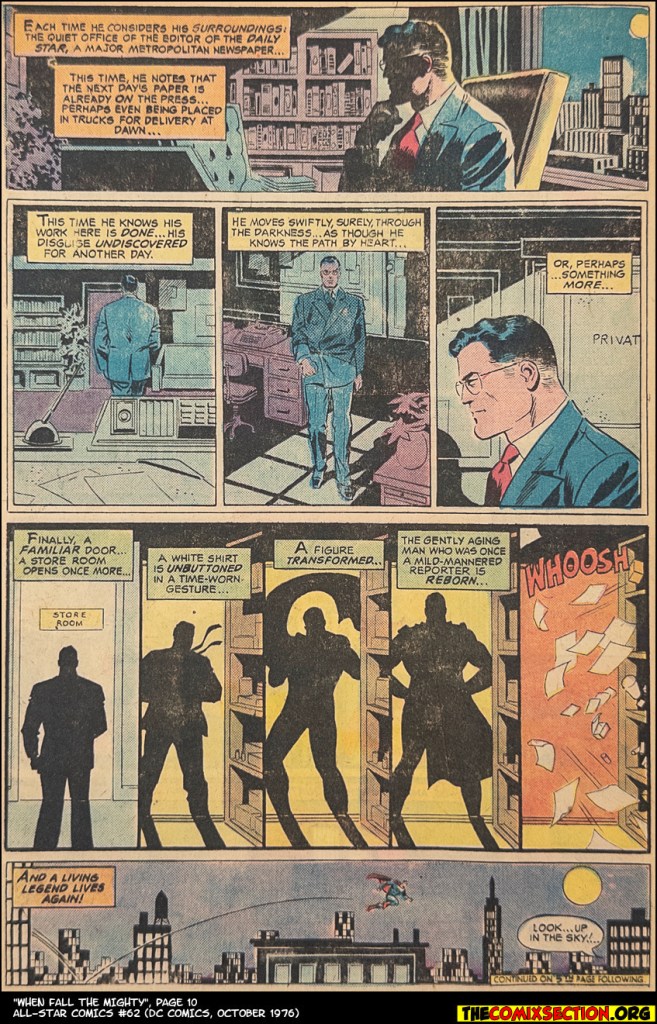
    If the scripter weren’t Paul Levitz, I’d almost wonder if he were making fun of (plotter and editor) Gerry Conway’s take on All-Star to this point. JSA chairman Hawkman comes off like a dipshit; Superman is the only adult on Earth-Two, except maybe Hourman, who spends his guest appearance thinking about how unheroic superheroes have become.

    Because they’re acting like Conway’s still writing them.

    The issue opens with everyone trying to save Dr. Fate, who’s near death from last issue. They use Star-Spangled Kid’s cosmic rod on him while trying to play his internal monologue for his teammates to hear (or actually see). But all they discover is the Ankh, which reminds Green Lantern Dr. Fate’s big into Egypt and magic and stuff and maybe there’s a better way to save him than cosmic rod life support.

    Though at some point, Star-Spangled Kid will pass out off page and stop providing the life-maintaining energy, and presumably, Fate still doesn’t die. But we don’t spend any real time on it because Hawkman’s too busy being a dipshit.

    Hawkman sends Green Lantern and Flash to Egypt, tells everyone else to mind Dr. Fate, then heads home to get into bed with his good lady wife and maybe, just maybe, play around with the giant ancient Lemurian sorcerer he’s got encased in amber. Too bad the amber melted and the sorcerer kidnapped the good lady wife (and killed Hawkman’s treacherous assistant curator).

    At that point, Hawkman immediately sounds the all-JSA alarm—which did not go off in any of the issues where they were saving the actual planet Earth (two)—and recalls Superman to duty. They all meet up at headquarters, where Wildcat and Power Girl have been bickering, and Hourman has been embarrassed to be in a union suit with such unprofessionals.

    Hawkman then whines at the assembled heroes about them not caring enough about his kidnapped wife—one of them has the gall to point out Dr. Fate’s in trouble, too—before everyone just goes along with him. They go to Tokyo, where the sorcerer has Mrs. Hawkman in inter-dimensional suspended animation.

    The people of Tokyo are paralyzed and lying prone on the street. When the JSA arrives, Hawkman tells everyone to concentrate on what’s important—his wife—and ignore the civilians. Superman reminds them to do the opposite, actually.

    I don’t think Levitz is having a laugh at Conway’s expense. I think they’re still playing it straight. But good grief, they’re all a bunch of twerps except Superman and—so far—Housman.

    Interestingly, Levitz doesn’t continue Conway’s characterization of Power Girl as a vocal proponent for women’s lib. She’ll mouth off to the fellows, but Levitz plays it like she’s just a brat. He also makes sure the old men leer at her and talk about it.

    Speaking of old men… Golden Age Superman. Wally Wood—over Keith Giffen layouts—draws Superman like he’s got an almost static head shot every time. Still brings life to it, but it looks like he’s following some style guide from 1943. It’s a vibe.

    The issue moves well enough thanks to the energy in Giffen’s layouts and Wood’s contributions. It’s not like there’s a particularly high bar to clear for All-Star to make par.

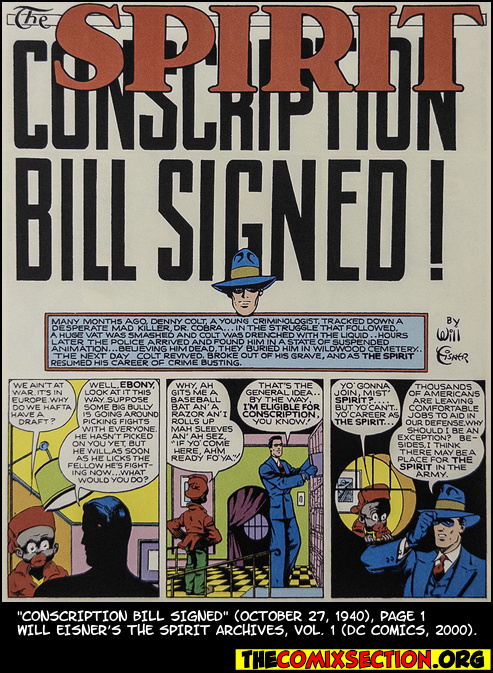
  • The Spirit (October 27, 1940) “Conscription Bill Signed”

    Will Eisner (editor, script, pencils, inks)

    Joe Kubert (colors)

    Sam Rosen (letters)

    It’s a good thing Spirit cleared his name since he needs Dolan’s official recommendation this strip.

    FDR has just signed the Selective Training and Service Act—a peacetime draft—and, being a good jingoist, the Spirit wants to sign up. He’s got some conditions, however. He doesn’t want to reveal his identity and he wants to be put to good use (based on his skills).

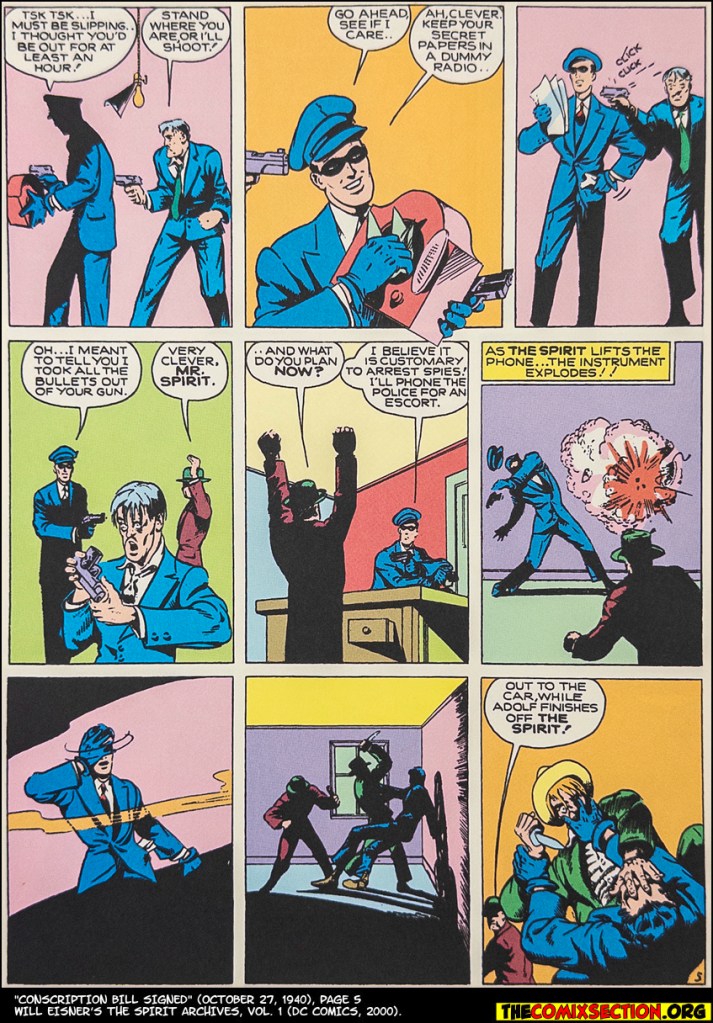
    The Army thinks he’ll make a good espionage agent, especially when the Spirit immediately uncovers a spy in the Army recruitment office. As a try-out for the Army, he roots out the rest of the spies, who call him “Americano” but also have guys named Adolf. Spirit still isn’t willing to be specific about which foreign powers are the baddies.

    The action’s pretty straightforward, with Spirit tracking the bad guys back to their hideout and taking them out. He’s got Ebony along for backup, so there’s some comedy action involving Ebony flying the autoplane and seeing trouble on the ground.

    Dolan’s particularly pissy about Spirit this strip. Dolan’s jealous about Spirit breaking all the big cases, a bit of character development Eisner’s had on a slow boil for a while now, though it never made sense when Dolan was lowkey protecting the Spirit from the rest of the police force.

    The jealousy just leads to banter—and whining—as the Army comes to realize having the Spirit on the payroll will work out, after all.

    While it’s an interesting attempt at being timely—though the draft was for twenty-one to forty-five and the Spirit says it’s just until thirty-five, so they needed some copy-editing—it’s also just propaganda. At times well-illustrated propaganda, to be sure, but there’s no oompf to the story.

    And Spirit mansplaining the United States being the only place on Earth where a man can live in freedom and peace to Ebony (thankfully in long shot in one of those pretty propaganda panels) is one hell of a flex.

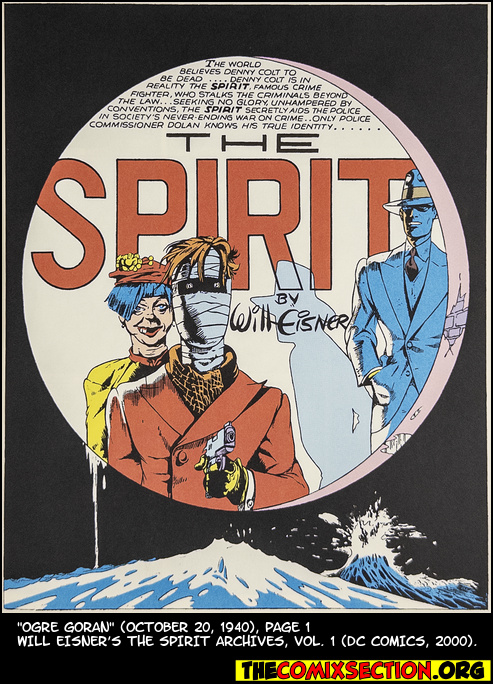
  • The Spirit (October 20, 1940) “Ogre Goran”

    Will Eisner (editor, script, pencils, inks)

    Joe Kubert (colors)

    Sam Rosen (letters)

    It’s another slighter strip, with the Spirit rescuing a damsel in distress from her ex (the titular Ogre Goran), a psychopath who’s just escaped prison.

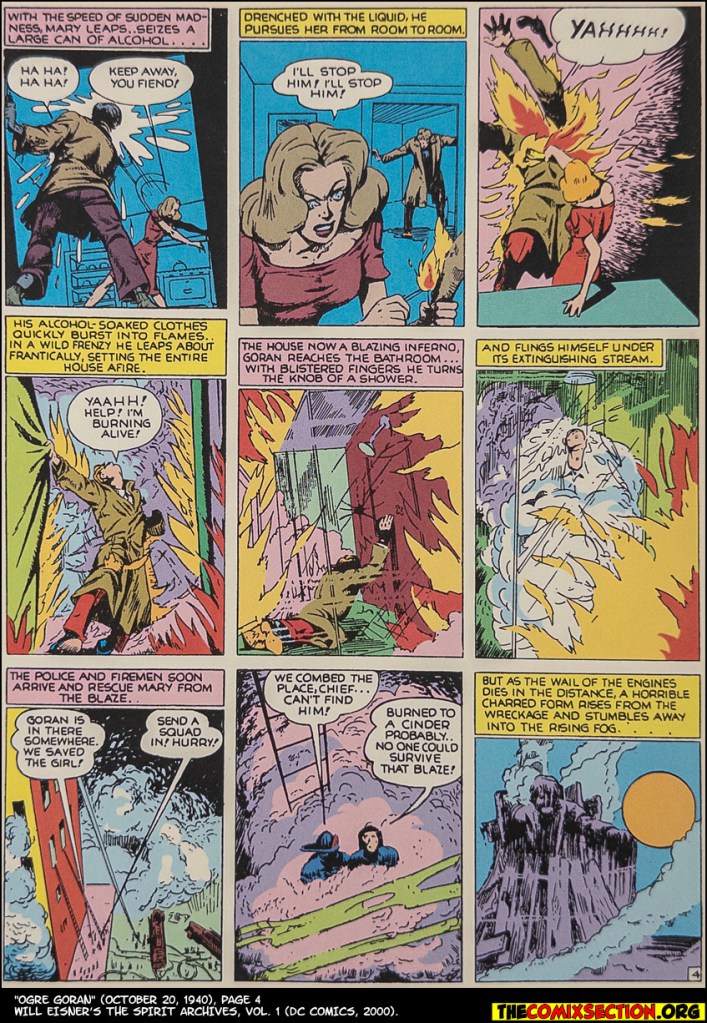
    The opening is the prison break and it’s relatively solid business. The line work is wanting this strip, but the moody long shots of the action are still effective. The action shifts to the damsel, Mary, discussing Ogre’s prison break with her husband. Since it’s a comic strip, Ogre appears immediately following her statement, shooting her husband dead on the spot and ready to kidnap her. Luckily, Mary dowses him in alcohol and sets him (and the apartment) on fire.

    Now, we know Ogre gets away because he gets in the shower and turns on the cold water. Also, there’s a panel (maybe the least discernible in the series to date) of Ogre getting away.

    Fast forward a few days to Ebony trying to get the Spirit interested in the case. After initially discounting Ebony’s thoughts on Ogre’s survival (Spirit thought the shower was only running because someone wanted a bath), the Spirit agrees with Ebony’s conclusions—Ogre’s alive!

    The Spirit tries to find Mary, only to learn she’s gone away with a man entirely wrapped in bandages. Ogre, post-burns. Thanks to Commissioner Dolan giving him information about Ogre’s old hideouts, Spirit heads (by boat) to an abandoned lighthouse where Ogre’s got to be holding Mary. Dolan heads to the lighthouse, too, wanting to beat the Spirit to the punch.

    Spirit’s only cleared his “name” of a murder charge in last week’s strip, so Dolan competing with him doesn’t make much sense. It also doesn’t make sense how Spirit gets to the lighthouse by boat, but then his boat disappears and he can’t take it back to shore at the end of the strip.

    Also nonsensical is Ogre having a new wife, who can—presumably, more appropriately—beat up Mary.

    We don’t even get to see Spirit and Ogre’s fisticuffs.

    Not a lot of pay-off in the strip, though it’s nice to see Ebony developing as a sidekick.

    It’s also the dottiest the art’s been in ages. The line work gains slide back here.

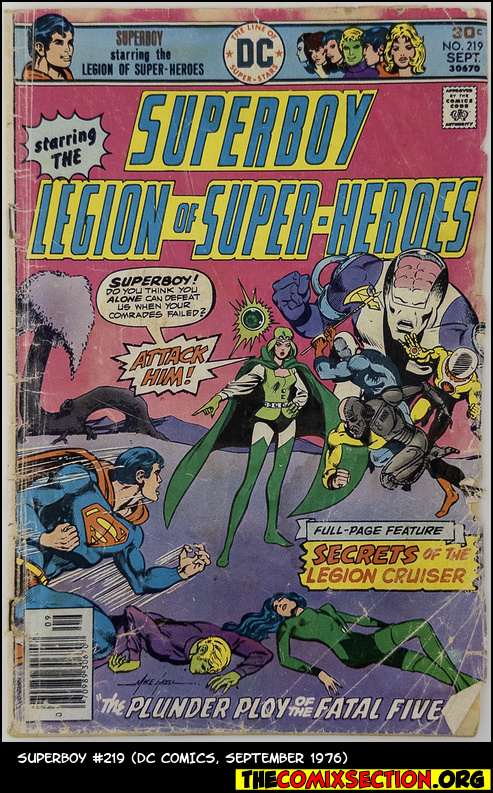
  • Superboy (1949) #219

    Jim Shooter (script)

    Mike Grell (artist)

    Jack C. Harris (assistant editor)

    Murray Boltinoff (editor)


    Ken Klaczak (suggestion)

    Without getting effusive, this issue might be one of artist Mike Grell and writer Jim Shooter’s best Superboy collaborations. There’s only so much wrong with it; they both keep the comic packed and moving, and none of the Legionnaires are exceptionally crappy.

    I mean, they’re still crappy. Lightning Lad’s ableist and Colossal Boy is only nice to the girl he likes when he thinks her boyfriend is going to die so he can get some action. And then Brainiac 5 is a bloodthirsty, callous creep most of the time.

    But other than those characters, it’s all reasonably solid. Lightning Lad barely has anything, and Brainy becomes background. Colossal Boy’s thing recurs (and gets the last word), but it’s amidst a lot of action.

    The Legion’s nemesis team, the Fatal Five (there are like twenty Legionnaires and five bad guys, and the bad guys keep them busy), is pulling a series of heists throughout the galaxy. They’re stealing android parts, experimental goo, toxic gases, and a planet fragment. One of the Fatal Five—Validus—is a super-powered giant who can tear up planets. Comes in handy for this exact story.

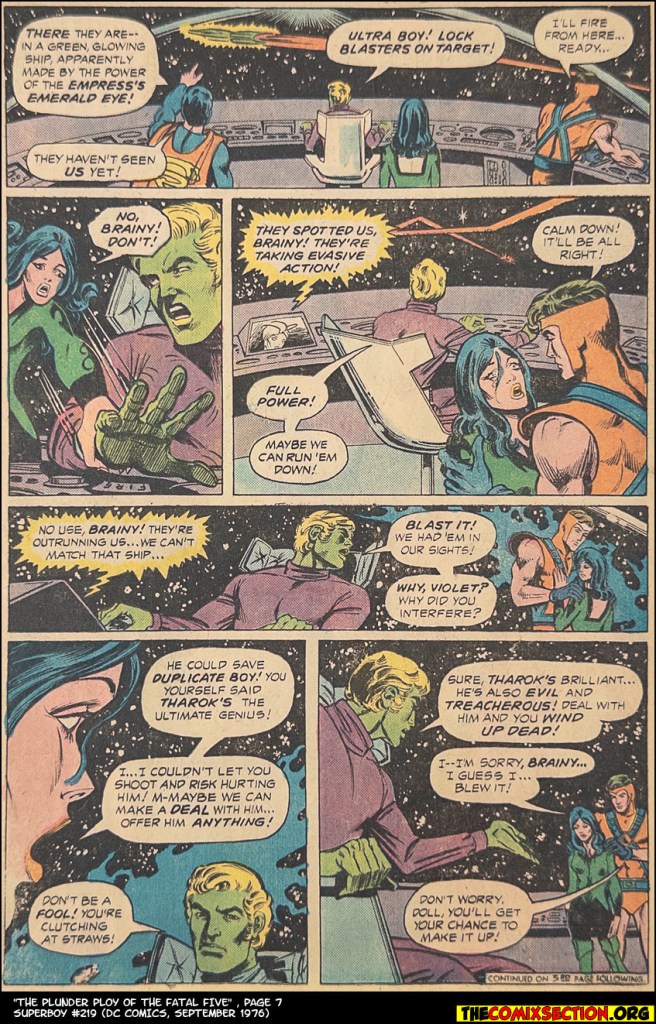
    Shooter splits it into three parts. The first part has the villains striking and almost killing non-Legionnaire but still superhero future teen Duplicate Boy, leading to his girlfriend asking Brainiac 5 for help and kicking off the whole thing with Colossal Boy, too. Brainiac 5 has given up hope on saving Duplicate Boy, so he’s ready to kill the Fatal Five whenever the opportunity arises.

    Now, one of the “charming” aspects of the comic is Superboy wondering what the heck is going on with his teammates. He’ll practically stare through the fourth wall, trying to get the reader to pay attention to the weirdness going on around him. It happens a few times this issue, including for that goofy last story beat.

    The rest of it—the Legion splitting into pairs so they can fight the Fatal Five—is all right. There’s some silly stuff; Emerald Empress has the major hots for Superboy, but without, you know, good writing. And they always talk about her deadly gadget, which is called the Emerald Eye. It’s a silly name, made even more ridiculous how they keep referring to it by the full name. Often with a possessive (the Emerald Empress’s Emerald Eye). Even when they do a whole bit about Validus being a literal infant (with props), the Emerald Eye business is still sillier.

    Now, despite Shooter and Grell keeping things moving, it’s not like it’s a good issue for Grell. His facial characteristics continuity is nil, and you’d think he’d be better at scaling between characters (Colossal Boy and Validus versus the normal-sized folk). However, some of Grell’s more design-oriented moves work better, and they don’t demand much attention.

    The issue feels rote, but it’s a (relatively) okay routine.

  • The Spirit (October 13, 1940) “The Spirit! Who Is He?”

    Will Eisner (editor, script, pencils, inks)

    Joe Kubert (colors)

    Sam Rosen (letters)

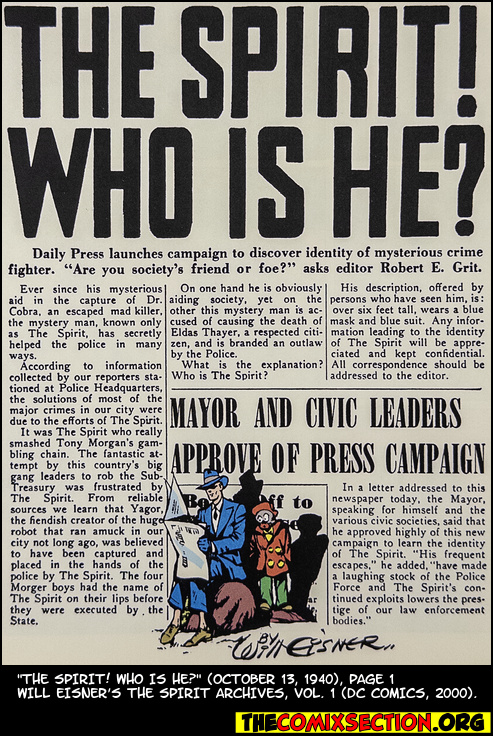
    The splash page for this strip is a newspaper article about the Daily Press declaring its mission to uncover the Spirit’s identity. The article gives a rundown of (some of) the strip so far, including the Spirit being wanted for murder.

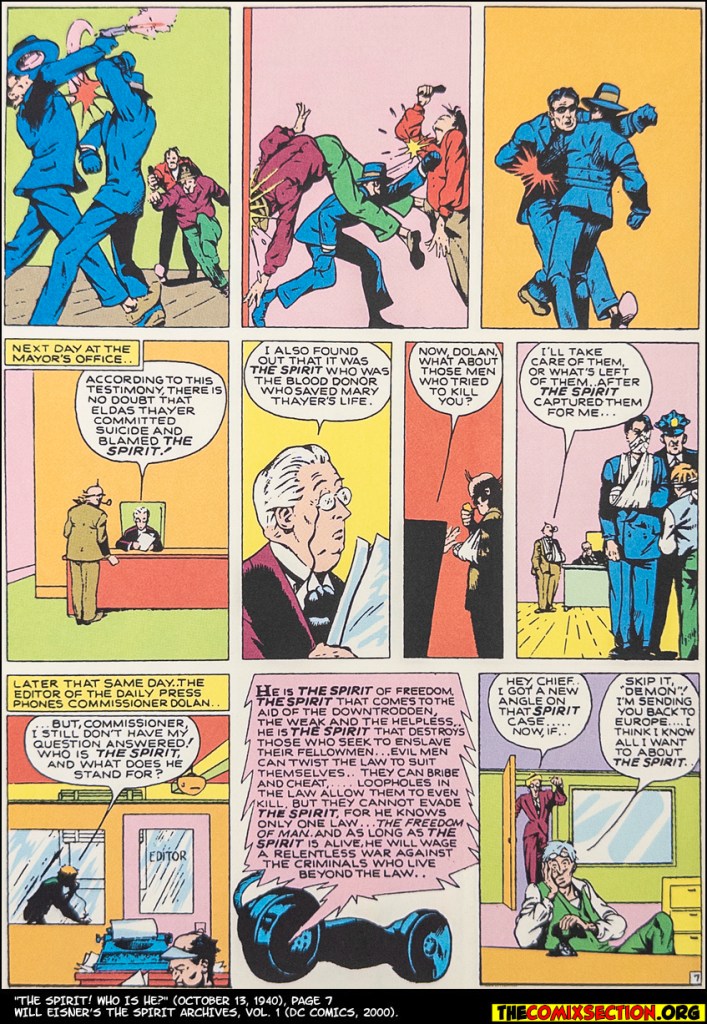
    That murder will get discussed a few more times—and its “solving” is so simple one wonders why the Spirit waited so long to get it cleared up—and Eisner and studio clearly did not think all their readers were getting through that newspaper article. Every time it comes up, we get extra exposition on the subject. At one point, the mayor makes Commissioner Dolan tell him all about the murder charge only to remember he was in that scene so knows all the information.

    Separate from the Spirit’s quest to clear his name, a gangster decides to impersonate the Spirit (all it takes is a blue suit, after all) to commit crimes and taunt the police. Oh, and the Daily Press reporter—in from the war in Europe, but this story’s bigger—gets help from a cop to uncover Spirit’s secrets.

    The three subplots never quite converge—the reporter’s adventures stay mostly distinct except when the plot needs to move along a little—and then Dolan gets the ending. In some ways, it’s an entirely functional strip: the Spirit’s (false) murder charge gets resolved. Along the way there’s some humor at the reporter’s expense (Ebony’s contribution) and a variety of action. Besides the Spirit going around town, the gangster impersonating him is out causing trouble. It all leads to some glorious fisticuffs.

    While the strip itself isn’t particularly ambitious, Eisner has several art flexes. The repetitive exposition usually gets some inventive panel composition. Even with the heavy-handed finish (Dolan talking about the Spirit being the dark knight the city deserves), it all works out. The art and narrative choices put the relatively slight story over.

  • The Spirit (October 6, 1940) “The Mastermind Strikes”

    Will Eisner (editor, script, pencils, inks)

    Joe Kubert (colors)

    Sam Rosen (letters)

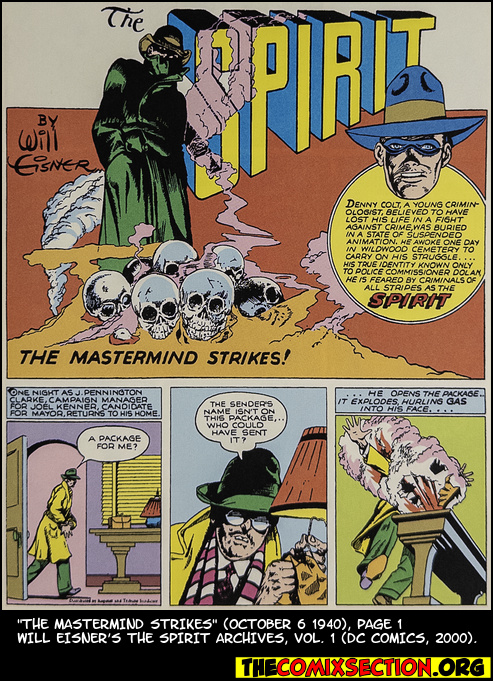
    The Spirit tries—very gently—a “whodunit,” with the reader getting as much information as Spirit or the cops; more, actually. The whodunit aspect seems half-baked, similar to the rest of the strip. While The Mastermind avoids any of Spirit’s problematic pitfalls, it’s also barely a story.

    The strip opens with a mayoral candidate’s aide dying by poison gas, which the coroner can’t figure out. When the candidate visits Dolan to demand action, the Spirit shows up and the candidate remembers Spirit’s wanted for that murder from months ago. The candidate demands Dolan arrest the Spirit, but obviously the Spirit escapes.

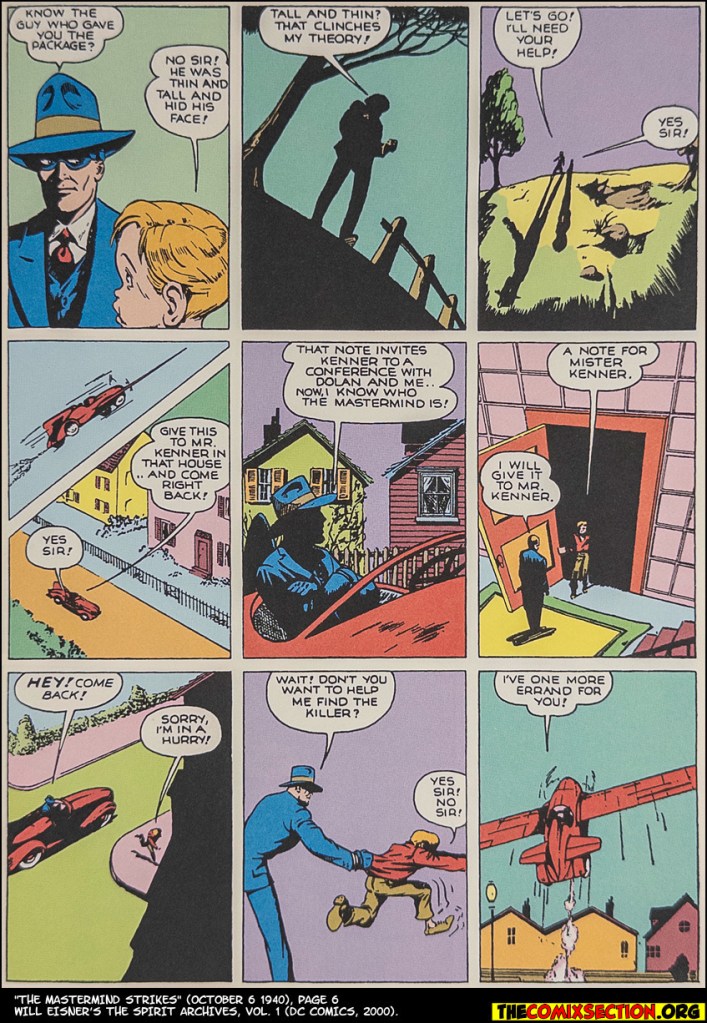
    One more murder and then the “Mastermind” is after the Spirit too, hiring a kid to deliver a bomb to him. Spirit will enlist the kid’s help, intentionally putting him in harm’s way at one point, as he unravels the case. Except he’s just operating off that early clue the reader also got, so it’s not a lot of unraveling.

    The last few pages have the Spirit getting in a fight with the villain. Lots of empty backgrounds as they punch it out. Even the finish is slight, with Eisner and studio wrapping the whole thing in the last couple panels, including the villain’s motives. Given the strip starts promising a “Mastermind”—standing over a pile of skulls on the splash page—having the villain not just be a done-in-one, but also be far from devious and really just in possession of explosives and poisons the cops can’t identify.

    There are some nice establishing shot panels of the city—long shots with good angles and nice line work. The action at the end is fine; it just dawdles through action and hurries through the exposition.

    Even as the least impressive of Spirit so far, it’s still rock solid work, technically speaking. Eisner just seems like he’s run out of things to try this one.

    Outside that gorgeous splash page, of course.

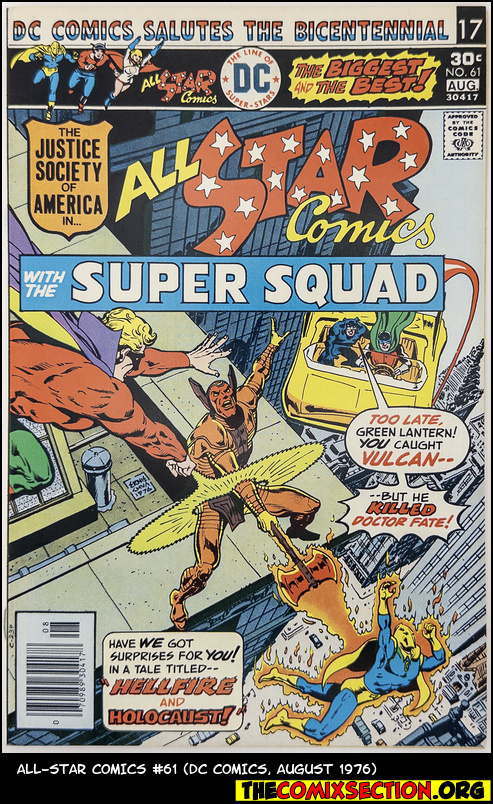
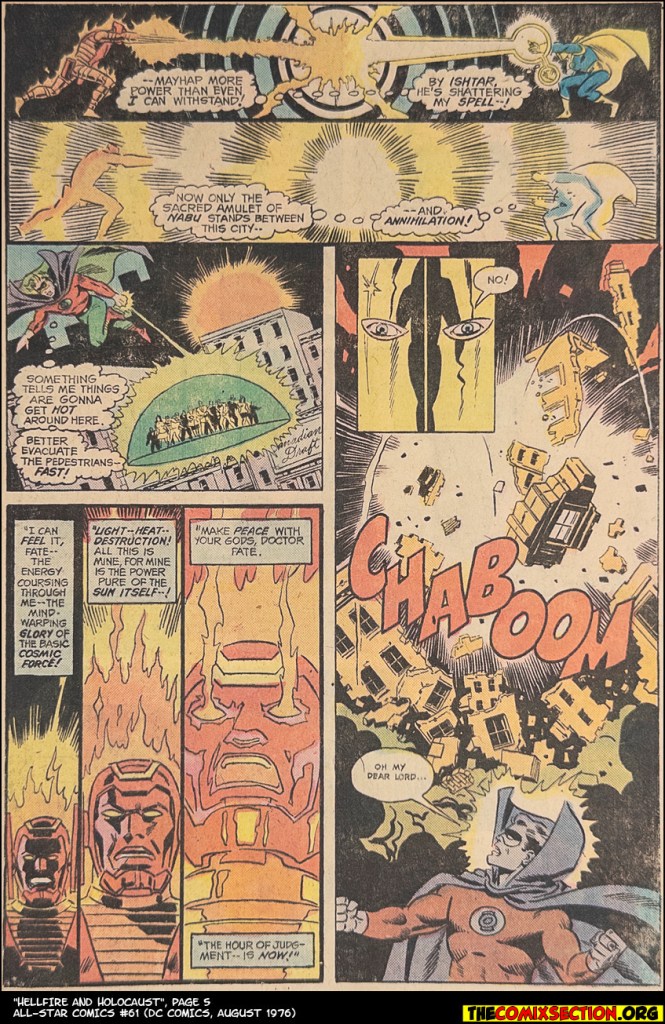
  • All-Star Comics (1976) #61

    Gerry Conway (editor, script)

    Keith Giffen (layouts)

    Wally Wood (pencils, inks)

    Al Sirois (inks)

    Carl Gafford (colors)

    Ben Oda (letters)

    Paul Levitz (assistant editor)

    Writer Gerry Conway likes deus ex machinas so much, he flies one in on a spaceship for this issue. The issue’s got multiple comes and goings, like there was only so much time each hero got in each subplot. For instance, when the deus ex machina lands, the only superhero going to intercept is Power Girl, ducking out on another scene.

    She ducked out just after Mrs. The Flash came to the burned up headquarters from last issue and told Jay it’s time to come home because he’s not young anymore. It’s very strange. Especially since other heroes then arrive to bring the numbers back up.

    The majority of the issue involves the JSA trying to take down Vulcan, having discovered he’s the rogue astronaut gone mad with power. Or maybe he went mad first; doesn’t end up mattering. Conway must’ve decided even though the All-Star heroes are a bit squarer than their Earth-One counterparts, the comic’s going to get unexpectedly and unnecessarily dark from time to time.

    There’s oddly more internal griping from Green Lantern this issue, too. It’s like Conway’s got his various character personality bits to get in—Star-Spangled Kid going on about his cosmic rod, Wildcat being a shallow bully, Power Girl (usually accurately) finding misogyny everywhere. Alan Scott, the Green Lantern, is a petulant man-child narcissist who cannot stop thinking about himself. Even when Dr. Fate runs into trouble, Green Lantern centers himself entirely in the panic.

    There’s some setup for next issue with Hawkman’s alter ego’s museum-related subplot. And Dr. Mid-Nite shows up to do some doctoring, but also do be the only one with x-ray (close enough) vision. Conway’s got everything very neatly arranged, even if all the details are bland.

    Power Girl does get a relatively decent solo mission intercepting the spaceship and its pilot. There’s a multi-page punch-out with penciller Keith Giffen doing some elaborate page layouts. Wally Wood keeps up on the finished art, of course, but when Giffen actually gets to do a busy, creative page, it works out.

    It’s not a particularly compelling read, however. Giffen’s few pages of Power Girl versus space invader, which has panels ranging from the most sci-fi superhero comic fight to a journey through the mind, are very welcome. Except there’s no pay-off because the timer’s gone off, and Conway’s ready for the next batch of characters.

    Despite saving the planet every other issue, the book doesn’t seem at all necessary.

  • The Spirit (September 29, 1940) “Oriental Agents”

    Will Eisner (editor, script, pencils, inks)

    Joe Kubert (colors)

    Sam Rosen (letters)

    Despite the (already) ominous title, Oriental Agents’ main cringe-factor doesn’t involve the titular spies. Instead, wow, does The Spirit think very little of Ellen Dolan, and in general, the female of the species.

    The strip begins with Ellen dumping Homer Creep (née Creap) because he’s not the Spirit. Homer goes off and gets drunk, gets picked up by a spy, and kidnapped. Ellen’s mortified at the thought of him… finding another woman. Just because she doesn’t want him doesn’t mean she wants some other girl having him.

    This generally gross vibe continues throughout the strip, whether when Ellen tries to tag along with the Spirit to investigate or when she gets to the resolution and finds no one cares about her feminine wiles.

    The spies—from the “Asiatic Embassy”—kidnapped Homer to hypnotize him and get him to kill an industrialist. Despite them being the title characters, until the Spirit arrives at their lair—a remote castle—they’re barely around. Most of the time is spent with Ellen, Homer, or the Spirit. Dolan’s got a little time fretting over Ellen’s romantic decisions and expositing about Homer being a murderer (he’s not the first guy they’ve hypnotized into murder). Ebony’s also around for a few panels; he was out doing investigating for the Spirit, who isn’t as disinterested in the case as he conveys to Ellen. He just doesn’t want to be cleaning up her love life.

    Once it’s clear their cases are entwined, Spirit will relent and take Ellen along in his pursuit. That pursuit will involve the Spirit putting on a disguise. The disguise is on his face: muss to make him look old and a ruffled hat. Otherwise he does not change his blue suit. No one can recognize him with that face makeup, despite him wearing the same suit as the scene before.

    It’s an okay strip, certainly the least in a while. While the Oriental aspects of the story seem like they should be in the spotlight, they’re very mild. Ellen being an unlikable, shallow harpy, however, is a problem. Especially since the strip itself seems to dislike her.

    Big “he-man woman haters club” energy here.

  • The Gilded Age (2022) s03e02 “What the Papers Say” [2025] D: Deborah Kampmeier. S: Carrie Coon, Morgan Spector, Louisa Jacobson, Denée Benton, Taissa Farmiga, Cynthia Nixon, Christine Baranski. Thanks to some semi-twists, fantastic acting (Baranski gets to flex), and a killer cliffhanger, the episode distracts from the fast resolutions to outstanding plot threads. The continuing ones seem fine–including setting up Coon for a big season, even though she’s been queenmaking behind the scenes until now–but AGE is finite. Exceptionally good gowns this episode, too.

    The Gilded Age (2022) s03e03 “Love Is Never Easy” [2025] D: . S: Carrie Coon, Morgan Spector, Louisa Jacobson, Denée Benton, Taissa Farmiga, Cynthia Nixon, Christine Baranski. Lots of great soapy scenes distract from the wheel spinning as far as plot arcs are concerned. Most of the first act’s conflicts are completely resolved by the third–it’s still too soon (is it, though) to figure out Coon’s season arc or anyone’s; except maybe Benton’s. Her story–about classism affecting her potential love life–is the highlight.

    The Gilded Age (2022) s03e04 “Marriage is a Gamble” [2025] D: . S: Carrie Coon, Morgan Spector, Louisa Jacobson, Denée Benton, Taissa Farmiga, Cynthia Nixon, Christine Baranski. It’s Farmiga’s wedding episode so it’s unfortunate she never gets centered. Lots of subplots perturb (or seeming resolve) and the show seems to be positioning Coon for a boring villain arc. Good acting, especially Benton and Baranski. It’ll probably all be fine but there’s too many perfunctory closures occurring at once.

    Poker Face (2023) s02e10 “The Big Pump” [2025] D: Clea DuVall. S: Natasha Lyonne, Jason Ritter, Patti Harrison, Method Man, Natasha Leggero, Myra Lucretia Taylor, Laith Wallschleger. Guest star Ritter’s angry he’s not seeing enough fitness results and blames other guest star Method Man. Do they both have secrets worth dying for? Delightful performances–from everyone, particularly Method Man and Harrison as Lyonne’s sidekick–make up for a generally inert, way too easy mystery. However, Brooklyn’s the longest Lyonne’s been in a location; the bit’s ripening.

    Poker Face (2023) s02e11 “Day of the Iguana” [2025] D: Ti West. S: Natasha Lyonne, Simon Helberg, Patti Harrison, Lili Taylor, Justin Theroux, Haley Joel Osment, Taylor Schilling. Harrison and Lyonne are buddies working a wedding where mysterious assassin Theroux is after groom Osment. Harrison thinks Theroux’s cute. Also Helberg’s back for another episode as Lyonne’s FBI body. Lots of intricate setup for very little unraveling, as it turns out it’ll all play into the season finale next episode. Really good performances (and good bits) carry it fine.

    Poker Face (2023) s02e12 “The End of the Road” [2025] D: Natasha Lyonne. S: Natasha Lyonne, Rhea Perlman, Simon Helberg, Patti Harrison, Lili Taylor, Taylor Schilling, Adam Arkin. Season–or is that series–finale is simultaneously accomplished, predictable, and divine. Lyonne and Harrison are trying to find mob-boss-in-witness-protection Perlman so they can escape hit man Theroux. Meanwhile, FBI guy Helberg is trying to find them, too. Beautifully done (though there’s a big BTS question mark at the end), with fantastic performances. Big wow.

    Resident Alien (2021) s04e04 “Truth Hurts” [2025] D: Brennan Shroff. S: Alan Tudyk, Sara Tomko, Corey Reynolds, Alice Wetterlund, Levi Fiehler, Elizabeth Bowen, Meredith Garretson. Tudyk spends most of his episode with returning guest star Edi Patterson, who he loves but finds revolting physically now because he’s just human. Will he or won’t he tell her? Meanwhile, Wetterlund can’t help getting the currently independent subplots closer together. Great episode for very funny Tudyk and Reynolds (who’s learning to love believing in aliens).
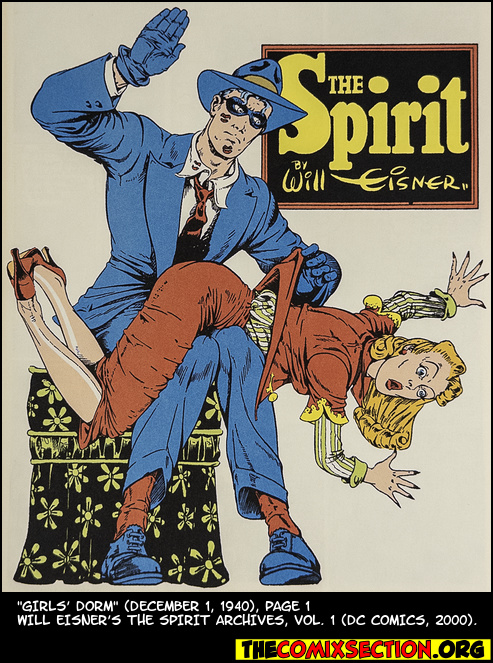
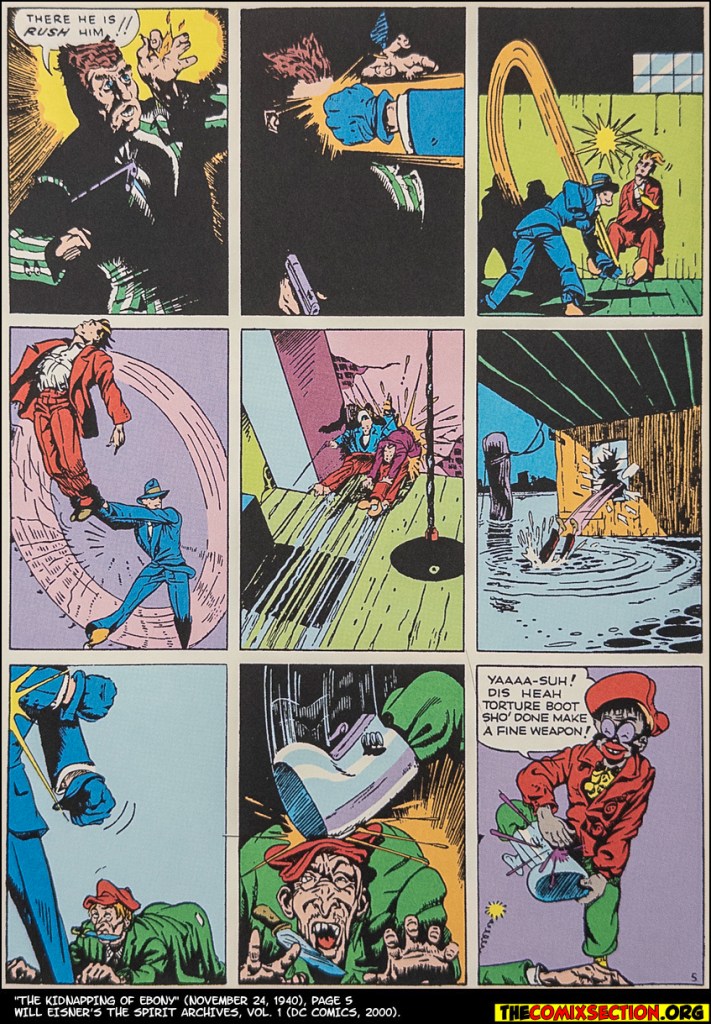
    Resident Alien (2021) s04e05 “The Human Condition” [2025] D: Sydney Freeland. S: Alan Tudyk, Sara Tomko, Corey Reynolds, Alice Wetterlund, Levi Fiehler, Elizabeth Bowen, Meredith Garretson. Tudyk gets a lot of good material as he tries to figure out how to live as a human who used to be an alien, rather than an alien impersonating a human. Tomko’s got a lot going on (albeit reacting to everyone else). Reynolds, Bowen, Fiehler, Garretson all seem ready to combine plot threads. Great Jenna Lamia showcase, too.

    Resident Alien (2021) s04e06 “Soul Providers” [2025] D: Sydney Freeland. S: Alan Tudyk, Sara Tomko, Corey Reynolds, Alice Wetterlund, Levi Fiehler, Elizabeth Bowen, Meredith Garretson. Absurdly sappy episode–which should’ve gotten through as Capracorn–stumbles its way to a lovelily acted conclusion. Tudyk’s on trial at space court and discovers he’s got a soul; meanwhile, Wetterlund tries to find Tomko’s bank deposit, which she drunkenly lost. The episode keeps the laughs coming while going from syrupy to content warning to sincere. Bad directing, though.

    Resident Alien (2021) s04e07 “Daddy Issues” [2025] D: . S: Alan Tudyk, Sara Tomko, Corey Reynolds, Alice Wetterlund, Levi Fiehler, Elizabeth Bowen, Meredith Garretson. Stephen Root guest stars as Tudyk’s alien dad in human form and brings the right energy. The part itself is a little thin. They argue and make faces. Good stuff. Meanwhile, the humans are all in crisis, mostly alien-related but also serious human drama. The show definitely seems to be setting up for a finish. A strong okay.