• Rocket Raccoon 1 (September 2014)

    Rocket Raccoon #1Rocket Raccoon is cute. Part of its cuteness is how it’s not supposed to be cute, even though it’s Skottie Young and he does cute stuff.

    Raccoon isn’t supposed to be cute because it’s all about how Rocket is actually a dangerous space rogue and Casanova. The ladies can’t get enough of him. Why would be the first question? It’s funny, of course, because he’s a raccoon or whatever but it would have been nice for Young to pay it some attention.

    Unless no one can figure it out, other than he’s a cute little critter and the ladies just can’t resist.

    The issue moves pretty well from joke to joke. One problem would be the sitting and talking on the phone sequence. Young tries to keep it lively with Star-Lord having an action sequence but it’s not enough.

    Young’s the right Raccoon artist, but maybe not the right writer.

    B- 

    CREDITS

    A Chasing Tale, Part One; writer and artist, Skottie Young; colorist, Jean-Francois Beaulieu; letterer, Jeff Eckleberry; editors, Devin Lewis, Sana Amanat and Nick Lowe; publisher, Marvel Comics.

  • The Fury of Firestorm, The Nuclear Man #4Conway has got his plotting down again with this issue. He gives Broderick a lot of varied action–it’s an all action issue, but set over a few hours (they just skip the quiet moments)–and Broderick’s ambitious in visualizing the different scenes. There’s the battles in a frozen New York, a fight between Firestorm and the Justice League, a visit to Hollywood and then a stop-off at the JLA satellite.

    The art’s especially important since Conway quiets down the narration quite a bit. He’s letting it play out visually so he can keep some plot twists secret until their respective reveals. Rodriguez does a nice job with the inks too. Can’t forget the inks.

    Playing Firestorm off the other superheroes also gives Conway a chance to develop that character, who’s somewhat different than his two human alter egos.

    The big resolution is fantastic too. It’s great superhero stuff.

    A 

    CREDITS

    The Icy Heart of Killer Frost!; writer, Gerry Conway; pencillers, Pat Broderick and Rodin Rodriguez; inker, Rodriguez; colorist, Gene D’Angelo; letterer, Todd Klein; editors, Carl Gafford and Len Wein; publisher, DC Comics.

  • The X-Files: Year Zero 1 (July 2014)

    The X-Files: Year Zero #1I’m not a big “X-Files” fan; I have not watched many episodes but I have seen the movies. And I do not recall atrocious banter being part of the formula. Karl Kesel writes inane dialogue for his protagonists, who artist Greg Scott questionably visualize. They aren’t going for photo-reference–there’s a decided lack of detail–but everything is so static they might as well have done it.

    The story has the agents investigating a case about cat people. Is it scary? No. Is it interesting? Not really. The Year Zero in the title refers to the comic flashing back to the first FBI team investigating the supernatural. So flashbacks to the late forties. The flashback art, by Vic Malhotra, art runs hot and cold. Just when Malhotra does something good, he flops something else.

    This comic doesn’t offer anything worthwhile to anyone outside an “X-Files” memorabilia collector.

    D 

    CREDITS

    Writer, Karl Kesel; artists, Greg Scott and Vic Malhotra; colorist, Mat Lopes; letterer, Robbie Robbins; editor, Denton J. Tipton; publisher, IDW Publishing.

  • The Mice Templar Volume II: Destiny 8 (April 2010)

    The Mice Templar Volume II: Destiny #8Glass has a lot to deliver with the resolution to this series and he knows it. This issue is just he and Santos upping the ante over and over. They already have a difficult setup and they try for more.

    Cassius meets up with his men as he invades the palace. It gives him a bunch of Templar on his side, but it also give Glass more opportunities for swashbuckling and plot twists. Speaking of plot twists, the resolution to the one from the previous issue has a lot of unexpected turns–Glass excels at never taking the predicted route but always taking the more sensible one. Even if the sensibility isn’t clear.

    There’s also Karic’s attack with the zombie cat and his friends and family’s side of the story. Not to mention the evil king’s plot coming together with everything else.

    It’s awesome; I just hope the finish succeeds.

    A 

    CREDITS

    The Festival of Samhain I; writer, Bryan J.L. Glass; artist, Victor Santos; colorist, Veronica Gandini; letterer, James H. Glass; editor, Judy Glass; publisher, Image Comics.

  • Infinity Man and the Forever People #2I was having trouble keeping track of what happened this issue until I realized the problem–nothing happens this issue. Didio and Giffen aren’t good at the banter with the marooned New Gods–or are they New Gods on their pilgrimage to Earth; it doesn’t matter. The banter’s lame. Four of the five leads are lame. And the last one is apparently a werewolf with some Wolverine influences.

    At least he’s not lame.

    The story has the team going to investigate some crop problems. There, they have an uninteresting battle with some soldiers from Apokolips. Why are they on Earth? No idea; it’s not as important as giving the titular Infinity Man–who looks like a Tron reject–a dramatic entrance.

    There’s nothing terrible about the comic and nothing good either. Tom Grummett and Scott Hanna’s art looks less Kirby influenced than Byrne; strange. It’s all painfully indistinct and unimpressive.

    C 

    CREDITS

    Wake Unto Me; writers, Keith Giffen and Dan Didio; penciller, Tom Grummett; inker, Scott Hanna; colorist, Mike Atiyeh; letterer, Travis Lanham; editors, Kyle Andrukiewicz and Joey Cavalieri; publisher, DC Comics.

  • The Fury of Firestorm, The Nuclear Man #3Conway lays on the melodrama a little thick this issue with Ronnie getting cut from the team, slapped by his dad (in front of his best friend) and dumped. Why? The same reason every other superhero got dumped at one time or another–significant others just don’t understand a person disappearing in the middle of a crisis. Well, for the last of that list. The other two are just the time constraints.

    Except Conway hasn’t shown enough of Ronnie’s regular life to get away with these big events. Maybe if he’d opened the series with them, starting one of his characters down, it would have worked.

    But the rest of the comic–again, especially the interplay between Ronnie and the Professor–works great. The villain–Killer Frost–is a little talky, but her ice kingdom version of New York is when Broderick gets creative again.

    He’s the other problem–he tries, but doesn’t succeed with melodramatics.

    B 

    CREDITS

    A Cold Time in the Old Town Tonight…; writer, Gerry Conway; penciller, Pat Broderick; inker, Rodin Rodriguez; colorist, Gene D’Angelo; letterer, Todd Klein; editors, Carl Gafford and Len Wein; publisher, DC Comics.

  • Ghosted 11 (July 2014)

    Ghosted #11It’s kind of a fill-in issue, with Williamson doing the origin of Agent Anderson (I think her name’s Anderson), only it has original artist Goran Sudzuka. So it’s not exactly a fill-in. It’s definitely filler, with Williamson spending most of the issue telling the story of an utterly unlikable character.

    There are also some problems with Williamson’s first person female point of view. They might not stand out if the story itself were okay. But it isn’t. The series isn’t oriented well for this kind of issue; Williamson writes big, this issue is small and contrived–bikers who are human traffickers? How original.

    Then the comic changes gear to reveal the context of Anderson’s monologue and I just realized it would have worked had Williamson really written it as a conversation. There’s something missing–the banter between her and the protagonist.

    It’s a bad issue, but the series’s fine.

    CREDITS

    Writer, Joshua Williamson; artist, Goran Sudžuka; colorist, Miroslav Mrva; letterer, Rus Wooton; editors, Helen Leigh and Sean Mackiewicz; publisher, Image Comics.

  • The Mice Templar Volume II: Destiny 7 (February 2010)

    The Mice Templar Volume II: Destiny #7It’s hard to know where to start with this one because Glass comes up with a monster cliffhanger. Big twist and some interesting ramifications for what Glass has already revealed, not to mention whatever his explanation will be. It sort of overshadows everything else.

    The issue starts with Karic being difficult. It’s the closest Glass has come in a while to him being an annoying teenager, but that sentiment passes quickly. Once it’s clear he’s got some really good ideas and it’s Cassius who’s being obtuse, the issue flows. It flows right into an awesome action sequence with the zombie cat as Karic reveals his plans.

    Glass skips over to the castle and the setup for the arc’s grand finale. He hits on all the subplots he put in earlier and let sit–not too much exposition either; having royal dialect and mystical mumbo jumbo helps.

    Once again, an outstanding issue.

    A- 

    CREDITS

    Seizing Destiny; writer, Bryan J.L. Glass; artist, Victor Santos; colorist, Veronica Gandini; letterer, James H. Glass; editor, Judy Glass; publisher, Image Comics.

  • Vampirella 2 (July 2014)

    Vampirella #2It would be so much easier to read Vampirella if her costume weren’t so atrocious. I mean, come on–Collins writes her as an espionage agent for the Vatican. She should have appropriate attire.

    The comic’s strangely not terrible, with Collins writing her protagonist a lot better than the book seems to deserve. There’s a whole bunch of exposition and it goes on way too long, but every few pages, Collins writes a good moment for Vampirella and it’s an acceptable read. More nonsense, good moment, once again acceptable.

    Another problem is Berkenkotter’s lack of imagination. He does a Max Schreck Nosferatu visual homage only it’s not done with any humor or acknowledgement of doing a visual homage. It’s supposed to be serious and instead it flops. If it’s going to be goofy and nostalgic, make it goofy and nostalgic.

    Collins reveals her setup for the arc; it seems fine.

    C 

    CREDITS

    Writer, Nancy A. Collins; penciller, Patrick Berkenkotter; inker, Dennis Crisostomo; colorist, Jorge Sutil; letterer, Rob Steen; editors, Hannah Gorfinkel, Molly Mahan and Joseph Rybandt; publisher, Dynamite Entertainment.

  • Firefox (1982, Clint Eastwood)

    Firefox has three distinct phases. First, there's retired Air Force pilot Clint Eastwood getting recruited into an espionage mission. This part of the film barely takes any time at all–there's three missing months–Eastwood, as the director, does not like montage sequences. Even the opening exposition setting up the movie is cut together quickly; Ron Spang and Ferris Webster's editing is fantastic throughout. The opening sequence just introduces them as an essential component to the film.

    The second phase is the espionage phase. Eastwood heads to Russia, where he meets up with dissident Warren Clarke who's going to help him. This part of the film is the most impressive. It's constant action as Eastwood is on the run from the KGB; the script's a little strange–it never lets Eastwood be in control during this section. He's always a few steps behind. Clarke's great.

    The final phase is the extended fighter jet sequence. Most of the film before this sequence–except the opening–is either inside or takes place at night. The flight sequences are effects galore and Bruce Surtees shows off how startling he can make some of the shots. It's not a particularly exciting sequence; it takes over thirty minutes. It's practically its own movie, only it eventually forgets about Klaus Löwitsch as the general tasked with tracking Eastwood down while Stefan Schnabel's bureaucrat harasses him.

    It's a missed opportunity, narratively speaking, but some glorious filmmaking.

    Actually, that description sums up Firefox overall. The espionage stuff is strong, but the flying's gorgeous.

    2/4★★

    CREDITS

    Produced and directed by Clint Eastwood; screenplay by Alex Lasker and Wendell Wellman, based on the novel by Craig Thomas; director of photography, Bruce Surtees; edited by Ron Spang and Ferris Webster; music by Maurice Jarre; released by Warner Bros.

    Starring Clint Eastwood (Mitchell Gant), Freddie Jones (Kenneth Aubrey), David Huffman (Captain Buckholz), Warren Clarke (Pavel Upenskoy), Ronald Lacey (Semelovsky), Kenneth Colley (Colonel Kontarsky), Klaus Löwitsch (General Vladimirov), Nigel Hawthorne (Pyotr Baranovich) and Stefan Schnabel (First Secretary).


    RELATED

  • The Fury of Firestorm, The Nuclear Man #2This issue of Firestorm is a perfect example of how to do superhero action. Even with Broderick’s questionable handling of the human, male cast–he does a lot better with the female characters–he does great with the superhero action. There are some really ambitious fight compositions at the end and Broderick and Conway open with a fantastic visualization to recap the previous issue.

    There are some oddities, of course, given the somewhat strange subject matter–the villain, Black Bison, is a Native American shaman inhabiting a descendant through magic. While Conway tries to be culturally sensitive, he often will go for a bigot character to make a slight joke.

    But the balance between character development and the heroics is perfect. The alter egos get just enough time on their own–and Conway’s working hard to develop Ronnie and the Professor’s rapport outside their Firestorm outings.

    It’s outstanding superhero comics.

    A- 

    CREDITS

    Rage; writer, Gerry Conway; penciller, Pat Broderick; inker, Rodin Rodriguez; colorist, Gene D’Angelo; letterer, Todd Klein; editors, Carl Gafford and Len Wein; publisher, DC Comics.

  • Star Trek 35 (July 2014)

    Star Trek #35I’m having a hard time trying to figure out how to talk about this issue of Star Trek. Not because the comic is all of a sudden doing well or good–and not because new artist Tony Shasteen is doing anything special–but because the comic has finally given in to itself.

    Here we have the new Star Trek franchise crossing over to the “Star Trek: The Next Generation” franchise and, if one can guess from the cliffhanger, its spin-offs. In other words, Star Trek the comic has become the desperate cash grab it was always meant to be.

    This issue has Jean-Luc Picard in a small role. Johnson writes him great. You can hear Patrick Stewart. Similarly, Johnson writes Q great and he also writes the regular cast better than his usual too. He’s finally excited; he’s not updating something old.

    Sadly, Shasteen’s photo-referenced, static, nonsense art can’t match the enthusiasm.

    B- 

    CREDITS

    The Q Gambit, Part One; writer, Mike Johnson; artist, Tony Shasteen; letterer, Neil Uyetake; editor, Sarah Gaydos; publisher, IDW Publishing.

  • Devil’s Knot (2013, Atom Egoyan)

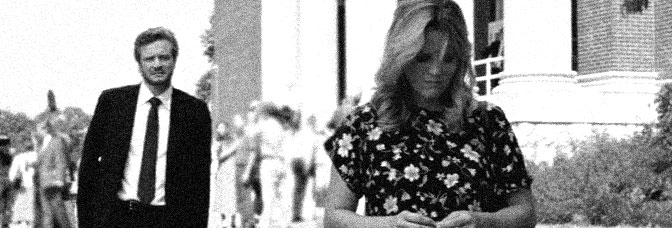
    There are plenty of things one simply cannot do in two hours; if Devil's Knot is any indication, one cannot try to tell the story of the trial of the West Memphis Three in two hours. Paul Harris Boardman and Scott Derrickson's script seems to do quite a bit well–for the first third of the film, the horrific nature of the crimes has the film sympathizing with the police officers (Robert Baker in particular), only to later reveal incompetence and corruption on these characters' parts.

    Then, once the script's obviously manipulative nature becomes clear, it's hard to take Knot seriously. The deception makes little sense, since the film's written for people familiar with the case (as there's no explanation why Damien Echols isn't executed at the end).

    As for second-billed Reese Witherspoon, who plays a grieving mother looking for the truth, her arc's incompetently handled. At least Colin Firth doesn't have an arc or character development. It may very well be historically accurate, but it's far from dramatic.

    There are some excellent performances. Kevin Durand and Alessandro Nivola are both good as suspicious fathers. Amy Ryan has a nice scene. Firth isn't bad. Witherspoon eventually gets a little better–but it's too little too late. Much of the supporting cast and some of the principals are weak. Especially James Hamrick as Echols.

    Mychael Danna's score is manipulative and derivative. Director Egoyan does an insincere job. It's tepid, vaguely incompetent and Oscar-desperate.

    Its compelling nature has nothing to do with the filmmaking.

    1/4

    CREDITS

    Directed by Atom Egoyan; screenplay by Paul Harris Boardman and Scott Derrickson, based on the book by Mara Leveritt; director of photography, Paul Sarossy; edited by Susan Shipton; music by Mychael Danna; production designer, Phillip Barker; produced by Elizabeth Fowler, Richard Saperstein, Clark Peterson, Christopher Woodrow and Boardman; released by Image Entertainment.

    Starring Colin Firth (Ron Lax), Reese Witherspoon (Pam Hobbs), Dane DeHaan (Chris Morgan), Mireille Enos (Vicki Hutcheson), Bruce Greenwood (Judge David Burnett), Elias Koteas (Jerry Driver), Stephen Moyer (John Fogleman), Alessandro Nivola (Terry Hobbs), Amy Ryan (Margaret Lax), Robert Baker (Det. Bryn Ridge), Kevin Durand (John Mark Byers), Michael Gladis (Dan Stidham), James Hamrick (Damien Echols), Martin Henderson (Brent Davis), Kristopher Higgins (Jessie Misskelley Jr.), Brian Howe (Detective McDonough), Matt Letscher (Paul Ford), Seth Meriwether (Jason Baldwin), Rex Linn (Inspector Gary Gitchell), Kristoffer Polaha (Val Price) and Collette Wolfe (Glori Shettles).


    RELATED

  • Dirty Old New York aka Fun City, Part I (2013, Jonathan Hertzberg)

    Dirty Old New York is a multi-part series–presumably always intended by editor Jonathan Hertzberg to be a multi-part series. The project has Hertzberg cutting together clips of seventies and early eighties New York City.

    Hertzberg creates a narrative, sometimes just between two or three clips and those times usually for humor (he succeeds with those). He does not succeed when trying too hard with the narrative editing–there's one lengthy phone sequence in this installment and, even after the constant phone shots is getting tiresome, Hertzberg edits conversations together.

    There are two more technical issues and both seem to be technology related. Hertzberg pauses shots before they fade to other shots or fade out; it's understandable (to avoid the fade) but it's too jarring. And the footage he's using has varying aspect ratios–he doesn't unify them. It too is jarring.

    Dirty is fun, but Hertzberg never manages to make it sublime.

    1/3Not Recommended

    CREDITS

    Edited by Jonathan Hertzberg.


    RELATED

  • Tales from the Darkside (1983) s02e03 – Ring Around the Redhead

    Television is a visual medium but budgetary constraints sometimes lead to a lack of visualizations. I assume Ring Around the Redhead, an episode of “Tales from the Darkside,” had some serious budgetary constraints. The entire episode has two and a half sets–one is inventor John Heard's basement, the other is the prison where he waits on death row.

    The episode has two big problems; both are director Gershuny's fault. First, his direction is pedestrian at best. Sure, he's got a small budget, but he's not inventive either. Second, he adapted the script from a forties short story. Heard's inventor–not to mention Caris Corfman's reporter–make no sense in a modern context.

    Heard's earnest and tries his best. Penelope Ann Miller's appealing as the otherworldly creature he literally pulls from his floor–Ring obviously has some major problems needing ingenuity to visualize. And Gershuny doesn't have any to offer.

    At least it's short.

  • Innocent Blood (1992, John Landis)

    At some point during Innocent Blood–I think it was the lengthy sequence with recently resurrected Robert Loggia wrecking havoc at attorney Don Rickles's house–I realized it was hilarious. The movie moves so fast, director Landis never lets up long enough for a laugh. There's one other really good pause spot a few minutes earlier involving Loggia escaping the morgue, but for the most part, too much is going on.

    There are multiple achievements to the film. Michael Wolk's script is a strange mix of serious vampire film (undead and lonely Anne Parillaud is frequently shown to loathe her life), police versus Mafia drama (Loggia's a terrifying mob boss), tender romance (between Parillaud and undercover cop Anthony LaPaglia) and spoof of the first two. Landis never spoofs the romance. The great Ira Newborn score aids in transitioning between the genres.

    Landis directs the film perfectly; he has these little stylistic devices to control the viewer's experience of scenes. The script's really big–Wolk structures it like a thirties slapstick comedy, with Parillaud and LaPaglia always racing around while the fantastic supporting cast moves things along in their absence.

    Parillaud and LaPaglia have the most difficult roles. Parillaud gets to narrate some of the film, but all the depth to the character is subtly addressed. Wolk's script decidedly does not give her easy monologues to define herself. And LaPaglia has to establish himself over a long period of the film. It's three-quarters through before he's done.

    Innocent Blood is a phenomenal motion picture.

  • The Brighton Strangler (1945, Max Nosseck)

    While a lot of The Brighton Strangler meanders, there are some rather effective moments in the film. It's a B picture, with John Loder as an actor suffering from amnesia who imagines himself his latest role–a murderer. The film's set in London, with blackouts and air raids–not to mention service people–all part of the setting and story.

    Loder has a difficult part; he needs to be both menacing and sympathetic. Unfortunately, the film doesn't really want to deal with the question of responsibility and hurries through the third act to get the film to a nicely tied conclusion. Also unfortunately… this nicely tied conclusion ties to the inept opening. So the film opens and closes on its weakest points.

    The middle section of the film has amnesiac Loder inserting himself into servicewoman June Duprez's life, with only her beau–an earnest but bland Michael St. Angel–suspecting.

    Director Nosseck occasionally does wonders even on the low budget. The entire London bombing sequence is phenomenal and clearly the most expensive thing in the film. Except it's only a few minutes and the film really could have used some expense during Loder's vacation in Brighton. He goes from hotel to house to street–the street scenes aren't terrible, but Nosseck doesn't use establishing shots; there's no sense of scale.

    Duprez is appealing, Miles Mander and Gilbert Emery are both good in small parts. Loder goes overboard, but it's the script. It doesn't know how to handle him.

    Strangler's occasionally boring, but it's got its moments.

    1/4

    CREDITS

    Directed by Max Nosseck; written by Nosseck, Arnold Phillips and Hugh Gray; director of photography, J. Roy Hunt; edited by Les Millbrook; music by Leigh Harline; produced by Herman Schlom; released by RKO Radio Pictures.

    Starring John Loder (Reginald Parker), June Duprez (April Manby Carson), Michael St. Angel (Lt. Bob Carson), Miles Mander (Chief Inspector W.R. Allison), Rose Hobart (Dorothy Kent), Gilbert Emery (Dr. Manby), Rex Evans (Leslie Shelton), Matthew Boulton (Inspector Graham), Olaf Hytten (Banks, the valet), Lydia Bilbrook (Mrs. Manby) and Ian Wolfe (Lord Mayor Herman Brandon R. Clive).


    RELATED

  • The Mice Templar Volume II: Destiny 6 (January 2010)

    The Mice Templar Volume II: Destiny #6Glass continues the series on its way, with some subtle observations from Karic about his lot in life. Having Karic the more mature, thoughtful one–especially as he finds himself amongst old Templars–is still a bit of a surprise. It’s a fine transition, it just changes the series more than I was expecting. With it, Mice Templar loses a number of its similarities to other works.

    The issue also has a lot of action, whether it’s Karic and an old Templar against bugs and bats (physically against bugs, intellectually against the bats) or Cassius leading troops against a scorpion invader. Oh, and Glass really knows how to bring in the danger of the nature; it’s something he’s quietly established but hasn’t run wild with until this issue.

    The characters are mice. They have lots of predators, swords or not.

    The third act’s a little soft, but it’s strong stuff.

    B+ 

    CREDITS

    The Bats of Meave; writer, Bryan J.L. Glass; artist, Victor Santos; colorist, Veronica Gandini; letterer, James H. Glass; editor, Judy Glass; publisher, Image Comics.

  • Satellite Sam 9 (July 2014)

    Satellite Sam #9Until the cliffhangers, Fraction has Sam back on course for the most part. Sure, he doesn’t know what to do with Michael, but everything else is going well enough as long as he has something, it’ll be enough. Or so one would think, because instead it’s just Fraction trying to inch the murder mystery forward without much commitment.

    Satellite Sam has a big cast and its inevitably going to be a slow burn as Fraction moves one pan onto one burner and another into the back for an issue, but having your ostensible main plot line be your most boring and narratively loose? It’s a problem.

    It’s a shame too, because Chaykin is still turning in some great work on the comic. And Fraction is doing some excellent work too, he’s just meandering and it’s hard to have confidence he knows where he’s going with the series when he’s meandering.

    B- 

    CREDITS

    Out; writer, Matt Fraction; artist, Howard Chaykin; letterer, Ken Bruzenak; editor, Thomas K.; publisher, Image Comics.

  • Nailbiter (2014) #3

    Nailbiter  3

    No, really, where’s the rest of the comic?

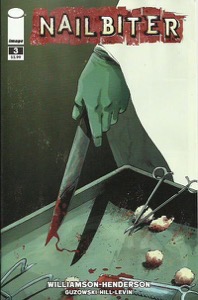
    Williamson is only a few issues in with Nailbiter and he’s already losing some of the sensationalism. Instead of outrageous characters, he’s going for outrageous acts. But not even startling outrageous acts, just kind of average ones. Like there are these constant brownouts in the city and a serial killer pops in and out during one of them.

    Sadly, Henderson composes the sequence in a long distance profile, which isn’t the best way to get tension going. Maybe that lack of tension is the problem–Nailbiter seems too safe. Even though I think someone else died this issue. It’s a little unclear.

    There are a lot of scenes, but none really stick out, which is another problem. Henderson doesn’t have the space to make the town into a character this issue; Williamson is just moving too fast.

    He needs to luxuriate some more.

  • The Fury of Firestorm, The Nuclear Man #1Writer Gerry Conway oscillates between serious and sort of bemusing throughout the first issue of the second Firestorm series. He’s got to recap a bunch–the original series, then the backups in The Flash–and he comes up with a few narrative devices to get it done with brevity.
    He’s also got to establish his characters for this series, which leads to a lot of brief introductions, but he gets the A plot up and running fairly soon (he’s got a great juxtaposing of early morning routines). The main plot involves a Native American high school teacher getting possessed by an angry shaman and running amok. Oddly enough, one of Firestorm’s alter egos just happens to be in this guy’s class.

    There’s an excellent action sequence in the museum; Penciller Pat Broderick isn’t always successful–usually with depth–but he’s always ambitious; it’s a great looking sequence.

    The end’s a little heavy, but otherwise….

    B+ 

    CREDITS

    Day of the Bison; writer, Gerry Conway; penciller, Pat Broderick; inker, Rodin Rodriguez; colorist, Gene D’Angelo; letterer, John Costanza; editor, Len Wein; publisher, DC Comics.

  • The Mice Templar Volume II: Destiny 5 (November 2009)

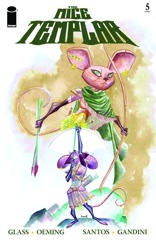
    The Mice Templar Volume II: Destiny #5It’s a strange issue. There’s this romantic interlude between Karic and a girl mouse; they go swimming together. Glass writes the heck of the scene, showing Karic as a youth while simultaneously establishing his maturity. Not to mention Santos gets to draw a fight scene between the two mice and attacking crayfish. It’s an awesome sequence.

    The issue also has some reveals and backstory as it relates to Cassius. He’s getting his own subplot now, his mentorship of Karic forcing him to confront old friends and missed opportunities. Glass also takes the time to show some of the debate between Templar factions. It all comes together very nicely.

    The only problem is the rushed feeling to the ending. Karic’s development is progressing at a rapid rate and it’s a struggle to keep up with it. Glass never lets up on the pace.

    But it’s an extremely successful comic book otherwise.

    B+ 

    CREDITS

    An Order Divided; writer, Bryan J.L. Glass; artist, Victor Santos; colorist, Veronica Gandini; letterer, James H. Glass; editor, Judy Glass; publisher, Image Comics.

  • Thomas Alsop 2 (July 2014)

    Thomas Alsop #2It’s funny what doesn’t work in Thomas Alsop. Again, by not working I mean Miskiewicz’s script. Schmidt’s art is always on it. Even with the severely problematic cliffhanger.

    There’s a lot of successful stuff this issue and the script is plotted quite well, at least in terms of the narrative events in the present action. Except Miskiewicz apparently doesn’t think about the character during the time previous to the art of this series. A big plot point hinges on the protagonist visiting someplace after ten years. Why not before this issue? Because then there wouldn’t be a comic.

    Miskiewicz takes contrived to a new level.

    He also rips off “Warehouse 13” a little.

    While most of the issue isn’t bad and some of it is good, Alsop is apparently now going to be very ambitious (the best part of the comic is how little to resembles the previous).

    I’m unconvinced.

    C 

    CREDITS

    The Hand of the Island, Part Two; writer, Chris Miskiewicz; artist, Palle Schmidt; letterer, Deron Bennett; editors, Jasmine Amiri and Ian Brill; publisher, Boom! Studios.

  • The Flash #304I think Bates must have just learned the word “erg” before writing this issue because he uses it ostentatiously.

    He also seemingly anticipates Tron–maybe the previews were already out–and puts Flash inside a really lame video game. The coolest part of the issue is how Bates doesn’t worry about resolution, just telling the best story he can… even if Barry’s involvement with it is contrived. There’s finally what make be taken for character development–Barry hanging out with his neighbors–and it’s lousy.

    Not to mention there’s no resolution with his parents from the previous issue, which might have been nice.

    Still, it’s not a terrible story and Infantino has room to break out the action. Maybe even too much.

    The Firestorm backup is packed with content–there’s a diary flashback device–and decent if abrupt art from Broderick and Rodriguez. The feature should’ve donated them some space.

    B- 

    CREDITS

    One More Blip… and You’re Dead!; writer, Cary Bates; penciller, Carmine Infantino; inker, Bob Smith; colorist, Gene D’Angelo; letterer, John Costanza. Firestorm, The Heart Is the Hunter!; writer, Gerry Conway; penciller, Pat Broderick; inker, Rodin Rodriguez; colorist, Jerry Serpe; letterer, Pierre Bernard Jr. Editor, Len Wein; publisher, DC Comics.

  • The Terminator: Enemy of My Enemy 4 (July 2014)

    The Terminator: Enemy of My Enemy #4It’s all action but it’s all very good action. I kept waiting for Jolley to slow down and explain some things but he never takes his foot off the gas. He’s missing character moments mostly; he’s definitely not going the lovable T–800 route but he’s falling into the Dark Horse Terminator pitfall… the personalities.
    The Terminator only has personality because of the actor playing the part. A comic book character Terminator loses a lot when it’s just a static killing machine. Comics are already full of those types.

    Then Jolley misses another opportunity for some exposition when the Terminator and his human sidekick find the lab. You know, at the end of the level. They immediately get attacked, which kills the chance for some nice exposition and relationship building.

    It’s a fairly decent book. There’s some great Igle artwork; his action scenes are phenomenal. The rest… just not phenomenal

    C+ 

    CREDITS

    Writer, Dan Jolley; penciller, Jamal Igle; inker, Ray Snyder; colorist, Wes Dzioba; letterer, Nate Piekos; editors, Ian Tucker and Brendan Wright; publisher, Dark Horse Comics.

  • The Mice Templar Volume II: Destiny 4 (October 2009)

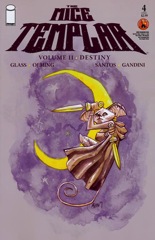
    The Mice Templar Volume II: Destiny #4Just before the issue ended, I realized Glass had finally delivered what I’ve been waiting for on Destiny–the full forward motion. He’s done with the exposition–even his third person narration is sparse; it immediately informs the reader of the setting. The scenes and characters do the rest.

    And Glass is moving away from exposition in a comic with a full flashback to the true story of the fall of the Templar too. The timing of the flashback in the issue is essential and has to do with the character development going on. Karic isn’t just his own character here, he’s separate from his friends and family. That other plot line? It feels liberated too. Destiny is moving forward.

    There’s also a lot of fantastic action in the issue. Glass gets to do fight scenes of various flavors and just a bunch of movement. He and Glass’s work is infectiously invigorated.

    A- 

    CREDITS

    A Measure of Justice; writer, Bryan J.L. Glass; artist, Victor Santos; colorist, Veronica Gandini; letterer, James H. Glass; editor, Judy Glass; publisher, Image Comics.

  • Detour (1945, Edgar G. Ulmer)

    Detour should be episodic, but it's not. The film chronicles the misadventures of Tom Neal's night club pianist, who's stuck not being good enough for Carnegie Hall and having a fickle fiancée (Claudia Drake) from the outset. When he does decide to follow her out to her dreams in California, instead of saving bus fare, he hitchhikes and things go badly for him.

    Along the way–and even from the opening bookend (Detour's almost entirely in flashback)–he runs across interesting people and situations. And even though Martin Goldsmith's script has some great stuff in it, neither director Ulmer nor Goldsmith turn these little encounters into vignettes. They're part of a lengthy narrative, with Neal doing a voiceover for the whole thing. The result is a seventy minute picture with some boring spots, which it shouldn't have.

    Part of the problem is how long it takes Detour to define itself. The script has a full first act setting up Neal's uninteresting back story. He's a whiny jerk, Drake isn't likable, Ulmer doesn't have to budget to do big club scenes–but Goldsmith's script does make it all interesting. Neal doesn't even give a good performance.

    Things start getting interesting after the hitchhiking montage when Edmund MacDonald picks up Neal. MacDonald's a real creep; it softens Neal up a bit. But he's just a MacGuffin to get Ann Savage into the picture. She's a realistically, thoughtfully conceived evil human being. Savage is occasionally histrionic, but she makes Detour special.

    Otherwise, it'd just be boring.

    1.5/4★½

    CREDITS

    Directed by Edgar G. Ulmer; screenplay by Martin Goldsmith, based on his novel; director of photography, Benjamin H. Kline; edited by George McGuire; music by Leo Erdody; produced by Leon Fromkess; released by Producers Releasing Corporation.

    Starring Tom Neal (Al Roberts), Ann Savage (Vera), Claudia Drake (Sue Harvey), Edmund MacDonald (Charles Haskell Jr.), Tim Ryan (Nevada Diner Proprietor), Esther Howard (Diner Waitress) and Pat Gleason (Joe).


    RELATED

  • Sheltered 10 (July 2014)

    Sheltered #10I’m all for some manipulation for the sake of narrative effectiveness, but Brisson takes this issue too far. He’s got his two plots going–the kids in the compound and then the freight delivery guy trying to get to civilization–and he tries to have his cake and eat it too.

    Or however the saying goes.

    Worse, Brisson pushes too hard with the kids. Way too much immediate foreshadowing, way too much effort in getting the reader to try to guess what’s coming next. That cliffhanger is actually something of a surprise because it’s such a pointless one, it’s unclear why Brisson would bother. Except to try to manipulate the reader. And he’d already done it with his other plot so why go for both? Especially when one cheapens the other.

    The issue does have some of Christmas’s best art; he’s getting better and better. But the comic’s a mess.

    B- 

    CREDITS

    Writer and letterer, Ed Brisson; artist, Johnnie Christmas; colorist, Shari Chankhamma; editor, Paul Allor; publisher, Image Comics.

  • The Flash #303It’s a good issue for Bates and Infantino. Bates comes up with a lot of set pieces, but doesn’t hurry them. Infantino actually has time to make them visually interesting.

    This issue has the big reveal with Barry’s evil dad and it’s only about six issues too late. Maybe five. It would have been better if Bates had gone straight from the car accident to the Golden Glider issue to this resolution. None of the previous foreshadowing delivers because Bates revelation isn’t ingenious, it’s contrived.

    Speaking of contrived–why doesn’t Flash call a super friend for help? If Flash is fighting a supernatural power, can’t he just call the Spectre or Dead Man?

    Bates’s logic problems culminate with a huge one at the end.

    The Firestorm backup has Pat Broderick on pencils and Adrian Gonzales on inks; there’s some great art here. And besides the recap, Conway’s writing is strong.

    B 

    CREDITS

    The Top is Alive and Well in Henry Allen!; writer, Cary Bates; penciller, Carmine Infantino; inker, Bob Smith; colorist, Gene D’Angelo; letterer, John Costanza. Firestorm, The Hyena Syndrome!; writer, Gerry Conway; penciller, Pat Broderick; inker, Adrian Gonzales; colorist, Jerry Serpe; letterer, Pierre Bernard Jr. Editor, Len Wein; publisher, DC Comics.

  • Spread 1 (July 2014)

    Spread #1So what’s the Spread? Well, the monster in Spread is a mix of The Thing and maybe Crossed. It killing you turns you into a shape-shifting zombie monster. But the hero of Spread is a mix of Lone Wolf (with the requisite messiah baby for Cub) and Wolverine. Except, of course, Wolverine’s already a riff on Lone Wolf.

    In other words, there’s nothing much original in Spread. It’s possible writer Justin Jordan thinks using an unexpected narrator is fresh, except for, you know, The Road Warrior. But it’s not a bad remixing of old material. The art from Kyle Strahm is awesome. Some of the unoriginal elements might even be his fault, not Jordan’s.

    All together, they don’t add up to much. The post-apocalyptic setting isn’t compelling; everyone has those. The anti-hero hero? Everyone’s got those too.

    While Strahm’s art recommends Spread, it doesn’t make it worthwhile.

    C 

    CREDITS

    Writer, Justin Jordan; artist, Kyle Strahm; colorist, Felipe Sobreiro; letterer, Crank!; publisher, Image Comics.