
 Wild’s End is supposed to be The War of the Worlds meets The Wind in the Willows. Only Dan Abnett’s approach to the quaint British townsfolk isn’t Willows, it’s a bad BBC show. There’s the sexy bruiser, there are the closeted elected officials, there are the annoying townsfolk. It’s dumb.
But End has some more problems. I.N.J. Culbard’s art isn’t anywhere near detailed enough or stylistic enough. The animal (properly attired, of course) cast is boring to look at. Culbard has no personality to the animals. Sure, doing anthropomorphized characters well probably isn’t easy but Culbard doesn’t even seem to be trying.
Some of the problem seems to be the lack of seriousness with End. Willows has, in recent years, become recognized as a work of literature and Worlds certainly has a solid reputation. Abnett and Culbard seem to be cashing in for a possible cheap CGI movie deal.
Boo.
D
CREDITS
The Village Fete; writer, Dan Abnett; artist and letterer, I.N.J. Culbard; editors, Cameron Chittock and Dafna Pleban; publisher, Boom! Studios.

 Bickering. Jones concludes the series with Bruce and Logan bickering. Why are they bickering? Because Wolverine first appeared in a Hulk comic and Jones is trying to tie into their long history together? Who knows–Wolverine sure isn’t remembered for his Hulk appearance.
 What do the Kate Bishop Hawkeye comics read like if you haven’t seen The Last Goodbye?
 It’s Conway’s most ambitious issue in a long time. The first third of the issue is Firestorm versus a natural disaster–a freak tornado in Pittsburgh. Of course, Typhoon is creating the tornado to draw Firestorm out, but Firestorm doesn’t know it. Conway does a lot with the narration and the trying to use it to pace the scenes.
 Prophet: Strikefile, after the entire relaunched series, explains a lot of what's been going on in the comic. The writers of Prophet always let in little details about the universe, without ever doing full exposition. Strikefile simultaneously has that full exposition, but writers Simon Roy and Brandon Graham still tell it in a reserved manner. They still rely on the art to subtly infer, for example.
 Jones maintains a great pace through Six Hours. He’s got his four plot lines going–Bruce and Logan, the villain (the Shredder, because apparently Eastman and Laird don’t know how to copyright), the captive pilot and the missing boy’s parents back in Florida. It moves really well; Jones doesn’t cover a lot of time, but he does spend just the right amount on each characters’ experiences.

 What is it about Kayanan? Why does he never gets the right inker on Firestorm? Mike Machlan is better than the last couple guys, but still not great. For a lot of the pages, Kayanan seems to avoid a lot of close-ups because Machlan butchers the faces.
 Maybe doing a sequel to an in name only movie franchise isn’t a good idea. Because Paul Tobin’s script for Prometheus doesn’t have much to do with the movie. Anything yet, actually. Except the planet. It’s actually a sequel to Aliens, the movie, not the comics (near as I can tell).
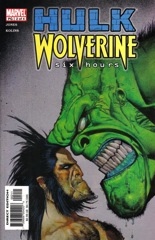 Kolins goes more into detail this issue than he did in the first. The exterior Canadian mountains are precise and intense; it makes Six Hours a distinct-looking comic, even when Kolins occasionally has problems. He doesn’t deal with movement particularly well.
 Soule has a big cliffhanger at the end and a bunch of little ones throughout. He lets his subplots thread out even further and some of these threads practically establish them as their own plot lines. For instance, who would have thought the previous President ever would have been such a big character?
 It’s a thoroughly decent Crisis crossover. Firehawk and Wonder Girl are trying to find loved ones in New York and they run into all sorts of problems since New York City is split between different eras.
 David Lapham takes a really interesting approach with this first Juice Squeezers one-shot. He doesn't try to do too much. He opens the comic with new Juice Squeezer, Lizzy Beedle. She's the only girl on the team of high school students who kill all those giant bugs the world doesn't know about. He changes points of view quite a bit, but it's always Lizzy who's at the center of the character stuff.
 Writer Bruce Jones takes great care plotting out this first issue. He reveals the significance of the Six Hours title towards the middle of the issue, during the first intense, action set piece. There are a couple of those set pieces, with the beginning of the issue instead dedicated to setting up the supporting cast.
 The second issue of Nightworld has even better art than the first. Leandri doesn’t have as many things to draw, but his huge chase sequence between the hero demon and the speed demon adversary is fantastic. There’s a lot of the speed demon on a cross-dimensional treasure hunt with a nice Raiders homage.
 The issue is simultaneously likable and shallow. The first half has Firestorm moving the Pittsburgh and Conway introducing the new supporting cast on the book. Conway gives Martin a whole new supporting cast of colleagues and teaching assistants, while Ronnie has his cast held over. His high school girlfriend, his high school rival. The former works out but the latter feels way too forced.
 Soule pulls one over on the reader. It’s a beautiful job of it too, because he sets the reader up and then distracts him or her from the inevitable.

 It's not a complicated story–writer Roger Langridge sends Captain America (from World War II) and Thor (from the present day) back to Camelot. They discover Loki has wormed his way into King Arthur's court and there's some trouble.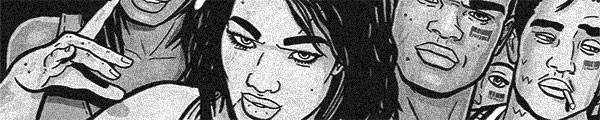
 As much as I like the Demolition Man reference, there are a whole lot of problems with Concrete Park.
 For the first time in a while–maybe ever–Conway dedicates over half the issue to Ronnie. He’s in trouble at school because he did too well on his final exams. He and Martin figure out it’s leakage from Martin, when they’re fused as Firestorm.
 What a surprise ending!
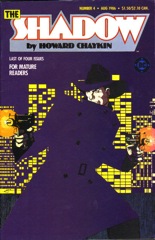 What a terrible comic. Chaykin’s handling of The Shadow reminds of someone trying to catch a hot potato; whenever he does have a hold on it, it’s not for long enough and it always leaves that all right place for an unpredictable direction.
 Sally of the Wasteland is great. It's going to be hard to talk about. Writer Victor Gischler has his post-apocalyptic setting and while it's tough and vicious and has a bunch of mutated animals, it's still humanist. It's thoughtful. Gischler starts with a relatively small cast and grows out from them, revealing the full setting. Or at least as full as he's going to reveal this issue.
 Even though Conway tries a few things, the issue doesn't work out well. He's got both Martin and Ronnie playing detective, with a transformation into Firestorm a way for them to get out of trouble. It's lazy though–turning into a superhero when the detecting gets too dangerous.
 I'm not sure God hates astronauts, but I'm getting the feeling he hates me. Or I just hate myself. There's no other reason I would subject myself to God Hates Astronauts.
 With his third of four issues, Chaykin gets around to showing what his Shadow comic is actually going to be like.

 Even with some amusing jokes throughout, this issue is easily the weakest so far. It’s still pretty darn good–like I said, the jokes are amusing and Powell consistently rewards the reader with them, either big jokes or small. In some ways, Powell is making observations about Big Trouble to its fans, which is fine when the story’s good too.
 The Stop Button