• Manifest Destiny (2013) #12

    Manifest Destiny  12

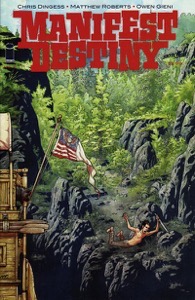
    It’s a fantastic issue, maybe the best in the series so far. Manifest Destiny works best when Dingess is doing more than one thing at a time. This issue doesn’t have much in the way of action, unless one counts arguments and thrown soup, but it still moves at a nice, brisk pace, with the constant threat of danger.

    The issue opens with a two page recap of events since the previous issue. Not much has happened. Then the expedition comes across a Native American tribe and they go talk to them. At the same time, Dingess looks at tensions with the wounded aboard the ship and flashes back to how Lewis and Clark got the job in the first place.

    Not to mention Sacagawea getting a very cool little subplot of her own.

    It’s a smart, carefully executed issue. Dingess and Roberts are full of surprises; rather good ones.

  • Letter 44 (2013) #13

    Letter 44  13

    Soule frames the issue around a speech from the President, revealing the existence of the aliens. He’s also got some scenes in space–the majority of those scenes are useless by the end of the issue–and some earthbound political intrigue.

    He also has the United States and Germany going back to war and nothing happens from it. It’s an exceptionally interesting idea, one with a lot of promise, but Soule just uses Germany as this little group of villains. It’s a strange misstep, given how smart the rest of Soule’s political intrigue usually goes.

    And the stuff in space isn’t great. The issue has some of Alburquerque’s best art at the beginning during a boxing match, but then the encounter with the aliens is poorly illustrated. There’s no depth or perspective to the art.

    As for the aliens… Hopefully Soule has something more going than what he does here.

  • Manifest Destiny (2013) #11

    Manifest Destiny  11

    In some ways, this issue of Manifest Destiny is stronger than I thought Dingess and Roberts would ever actually do. It’s not high concept in the plot–Lewis is simply trying to free the ship of being stuck in the river and to get them away from the giant monster toad.

    But it’s high concept in Dingess plots out this action issue. There’s the tension over the situation, but there are all these other things going on. Dingess has done so well in layering in the subplots, he can easily refer back to them with just a panel or two of Roberts’s close-ups on various characters.

    Sacagawea, for example, only shows up for a couple silent appearances in panels but she’s still a presence in the comic. And the banter between Lewis and his new love interest is brief and fantastic.

    Plus, there’s Lewis and Clark bonding.

    Excellent stuff.

    L

  • C.O.W.L. 7 (December 2014)

    C.O.W.L. #7The issue starts off a little rocky. Reis gets a big action sequence and it’s all style and no substance. Then Higgins and Siegel gradually ease the substance out of that scene as the rest of the comic progresses. Because they’re now introducing the supervillains, or what goes for a supervillain in C.O.W.L. and things are getting very interesting.

    There’s a lot of subplot building, between the murdered union member, the union boss making a deal with the villains, the guy getting out of the hospital. There’s a lot–so much when there’s this thing with one of the regular superheroes and a cop talking, it’s just too much to track. But Higgins and Siegel keep it in line and constantly surprising.

    And Reis gets another good action sequence.

    Then the cliffhanger brings in a whole other issue, since it’s a reveal no one knows but the reader.

    Very cool.

    B+ 

    CREDITS

    The Greater Good, Chapter One: At the Brink; writers, Kyle Higgins and Alec Siegel; artist, Rod Reis; letterer, Troy Peteri; editor, Andy Schmidt; publisher, Image Comics.

  • Another Thin Man (1939, W.S. Van Dyke)

    Another Thin Man is a peculiar blend of old dark house mystery and the Thin Man style of murder mystery. Most of the first half of the film is the old dark house mystery, with healthy doses of humor thrown.

    Frances Goodrich and Albert Hackett’s screenplay brings William Powell and Myrna Loy to New York from elsewhere, stopping off in the city long enough to establish them having a baby and to set up some events for the finish, before sending them out to Long Island. Once there, Powell gets roped into helping C. Aubrey Smith, who’s had some murder threats against him.

    The film has three distinct phases. That first phase, the continuation of the Thin Man series, emphasizing the relationship between Powell and Loy, then that old dark house phase. Once the final phase comes around–when the action moves back to New York–the film starts to feel a little long. Supporting cast members haven’t just been dropping like flies, new ones keep getting introduced.

    Director Van Dyke doesn’t really make an effort to unify the film’s tone. In the city, it feels one way, on Long Island, it feels like an entirely different picture. The script hurries events too much, never taking time to develop anything.

    Sadly, the primary supporting cast lacks standouts–Harry Bellaver, Abner Biberman and Marjorie Main are the strongest and they’re in small parts.

    Weak editing from Fredrick Y. Smith too.

    More of the film works out than not; its missed opportunities are easily forgotten.

  • Letter 44 #13Soule frames the issue around a speech from the President, revealing the existence of the aliens. He’s also got some scenes in space–the majority of those scenes are useless by the end of the issue–and some earthbound political intrigue.

    He also has the United States and Germany going back to war and nothing happens from it. It’s an exceptionally interesting idea, one with a lot of promise, but Soule just uses Germany as this little group of villains. It’s a strange misstep, given how smart the rest of Soule’s political intrigue usually goes.

    And the stuff in space isn’t great. The issue has some of Alburquerque’s best art at the beginning during a boxing match, but then the encounter with the aliens is poorly illustrated. There’s no depth or perspective to the art.

    As for the aliens… Hopefully Soule has something more going than what he does here.

    B 

    CREDITS

    Writer, Charles Soule; penciller, Alberto Jiménez Alburquerque; colorist, Dan Jackson; letterer, Crank!; editor, Robin Herrera; publisher, Oni Press.

  • Manifest Destiny #11In some ways, this issue of Manifest Destiny is stronger than I thought Dingess and Roberts would ever actually do. It’s not high concept in the plot–Lewis is simply trying to free the ship of being stuck in the river and to get them away from the giant monster toad.

    But it’s high concept in Dingess plots out this action issue. There’s the tension over the situation, but there are all these other things going on. Dingess has done so well in layering in the subplots, he can easily refer back to them with just a panel or two of Roberts’s close-ups on various characters.

    Sacagawea, for example, only shows up for a couple silent appearances in panels but she’s still a presence in the comic. And the banter between Lewis and his new love interest is brief and fantastic.

    Plus, there’s Lewis and Clark bonding.

    Excellent stuff.

    CREDITS

    Writer, Chris Dingess; artist, Matthew Roberts; colorist, Owen Gieni; letterer, Pat Brosseau; editor, Sean Mackiewicz; publisher, Image Comics.

  • Gotham by Midnight #2For a good fifth of this issue, which Templesmith paces out well, it seems like the Spectre might show up. He does, but Templesmith doesn’t show him. But for a while, it seems like Templesmith is going to show the Spectre. It’s really cool.

    And Fawkes and Templesmith know what they’re doing with it. Fawkes constructs a whole flashback not just around the origin story of the nun, but also of the villains–and the Spectre gets to show up. Sort of.

    The rest of the issue just isn’t long enough. Fawkes has the nun and another cop with a couple possessed kids at home, then Corrigan and the bean counter (who, surprisingly, isn’t regular cast yet) fighting the big bad of the issue. The action gets the emphasis, but one wants to see Templesmith do it all.

    Fawkes has his bumpy moments, but Gotham by Midnight’s really compelling.

    CREDITS

    We Will Not Rest; writer, Ray Fawkes; artist, Ben Templesmith; letterer, Dezi Sienty; editors, Dave Wielgosz and Rachel Gluckstern; publisher, DC Comics.

  • After the Thin Man (1936, W.S. Van Dyke)

    There is very little economy to After the Thin Man; instead, screenwriters Frances Goodrich and Albert Hackett and director W.S. Van Dyke act with rampant abandon. The first twenty or so minutes of the film is just audience gratification–it’s a sequel to a popular film and the filmmakers are giving the audience what they want. They’re doing it well, sure, but it doesn’t have much to do with the eventual narrative.

    Instead, Goodrich, Hackett and Van Dyke stage massive comedic set pieces, whether it’s William Powell and Myrna Loy getting home to a surprise party in their honor where no one notices them or Asta the dog’s rather amusing (and beautifully staged) domestic problems.

    The murder mystery itself doesn’t start until about a half hour in. The plotting of the film is significant too–it’s a direct sequel to the previous movie and the first sixty-seven minutes are continuous. Once Powell and Loy finally get to go to sleep, there are only about forty minutes left. Strangely enough, the only time the film plods is during those forty minutes. The last twenty minutes breeze by, but some of the investigating is too full of exposition to move well.

    Lots of great supporting performances–Joseph Calleia, Elissa Landi, James Stewart, Jessie Ralph, Levine, Penny Singleton. The script gives the supporting cast lots to do.

    Technically, Van Dyke and editor Robert Kern do have problems with disconcerting cuts to close-ups–and then not cutting to Loy in the finale–but otherwise, the film’s a fantastic time.

  • Flashdance (1983, Adrian Lyne)

    Even though it’s terrible, Flashdance at least sticks with protagonist Jennifer Beals for most of the film. She’s a steel worker who dances at a club and starts dating her boss (at the steel mill, not the club, which is actually a bar). For a while, director Lyne and screenwriters Thomas Hedley Jr. and Joe Eszterhas try really hard to create the atmosphere of camaraderie at the bar.

    All of the supporting cast has a story, especially Sunny Johnson, who dates the cook (Kyle T. Heffner, who wants to be a stand-up comic). She dreams of being an professional ice skater. But gives it up.

    The film’s actually more of a character study than anything else. Just a bad one with a lot of pop music and Giorgio Moroder music playing over montages of Beals dancing sweatily (or her dance double dancing sweatily). When it’s actually just Beals working out, even if it’s scantily clad, Lyne feels the need to immediately follow with a break dancing montage of street performers.

    I guess if it’s called Flashdance, there needs to be a lot of dancing.

    There’s some more terrible stuff–a supporting cast member dies from an acute case of deus ex machina–but Beals is the protagonist. And then all of a sudden the film takes away her most important moment and makes her just a girlfriend character. It’s really upsetting, because Beals is at least likable, even if the movie’s crap.

    The final disappointment is just too much.

    0/4ⓏⒺⓇⓄ

    CREDITS

    Directed by Adrian Lyne; screenplay by Thomas Hedley Jr. and Joe Eszterhas, based on a story by Hedley; director of photography, Donald Peterman; edited by Bud S. Smith and Walt Mulconery; music by Giorgio Moroder; production designer, Charles Rosen; produced by Don Simpson and Jerry Bruckheimer; released by Paramount Pictures.

    Starring Jennifer Beals (Alex Owens), Michael Nouri (Nick Hurley), Lilia Skala (Hanna Long), Sunny Johnson (Jeanie Szabo), Kyle T. Heffner (Richie), Lee Ving (Johnny C.) and Ron Karabatsos (Jake Mawby).


    RELATED

  • Footloose (1984, Herbert Ross)

    Footloose isn’t so much awful as dumb and obvious. Some of it is awful–the scene where Kevin Bacon, fed up with the small town getting him down, just has to go to an abandoned mill and dance it out–that scene is awful. So are most of the courtship scenes between Bacon and Lori Singer.

    But the relationship between Singer and father John Lithgow? While really obvious and thin, the actors do okay with it. Singer’s not good, but she’s convincingly angry. Lithgow’s the emotionally wounded reverend who tries to fix the world through his sermons, only to learn the townsfolk he’s trying to save are perverting his message. It’s just Footloose’s way not condemning the religious in the audience, just the ones who don’t like rock music. Though it does a really bad job of it.

    Some of the problem is Dean Pitchford’s script. It’s dumb and often bad, but Pitchford really doesn’t shy away from difficult scenes. The ones between Lithgow and Singer, the ones between Lithgow, Singer and Dianne Wiest (as the quietly suffering preacher’s wife), they’re really good. But Pitchford doesn’t know how to work them. The most important conversation in the film–between Bacon and Lithgow–doesn’t even occur on screen.

    It’s not like director Ross does much good. He probably can’t make Bacon look any younger and most of the performances are blandly acceptable, but the idiotic dance interludes are Ross’s fault.

    Footloose is often marginally competent, but never any good.

    0/4ⓏⒺⓇⓄ

    CREDITS

    Directed by Herbert Ross; written by Dean Pitchfork; director of photography, Ric Waite; edited by Paul Hirsch; production designer, Ron Hobbs; produced by Lewis J. Rachmil and Craig Zadan; released by Paramount Pictures.

    Starring Kevin Bacon (Ren), Lori Singer (Ariel), John Lithgow (Rev. Shaw Moore), Dianne Wiest (Vi Moore), Chris Penn (Willard), Sarah Jessica Parker (Rusty), John Laughlin (Woody), Elizabeth Gorcey (Wendy Jo), Frances Lee McCain (Ethel McCormack) and Jim Youngs (Chuck Cranston).


    RELATED

  • Fame (1980, Alan Parker)

    It’s sort of amusing how Fame, a film about high school, gets an incomplete. The film is rigidly structured–the four years of high school, plus the auditions at the beginning for the characters to get into said high school, a performing arts school in New York.

    The characters’ stories develop throughout the film in a manner far more natural for one year, instead of four, especially in the case of Gene Anthony Ray. In the film’s silliest plot contrivance, Ray is illiterate, something teacher Anne Meara notices right away. She doesn’t really do anything about it–except negatively reinforce him–until a very dramatic moment towards the end of the film (in the senior year). Fame bends reality for impact, with director Parker trying to distract from it. He uses seriousness to distract from narrative laziness.

    It doesn’t work. Especially given the film constantly drops characters–both Lee Curreri and Laura Dean, who have big story arcs in the first half of the film, disappear once Fame focuses on Barry Miller. Maureen Teefy and Paul McCrane–the first half’s closest thing to protagonists–are around Miller so they don’t disappear, they just don’t have much interesting to do.

    One would think there’s a better, much longer version of Fame, but maybe not. It’s insincere, but rather well-made (the Michael Seresin photography and Gerry Hambling editing is phenomenal), and there’s a lot of good acting.

    Miller’s good, Teefy and McCrane are great. So’s Irene Cara.

    It should be better.

    1.5/4★½

    CREDITS

    Directed by Alan Parker; written by Christopher Gore; director of photography, Michael Seresin; edited by Gerry Hambling; music by Michael Gore; production designer, Geoffrey Kirkland; produced by David De Silva and Alan Marshall; released by Metro-Goldwyn-Mayer.

    Starring Paul McCrane (Montgomery), Maureen Teefy (Doris), Barry Miller (Ralph), Irene Cara (Coco), Lee Curreri (Bruno), Gene Anthony Ray (Leroy), Laura Dean (Lisa), Antonia Franceschi (Hilary), Anne Meara (Mrs. Sherwood), Jim Moody (Farrell), Albert Hague (Shorofsky), Joanna Merlin (Miss Berg), Debbie Allen (Lydia), Eddie Barth (Angelo), Tresa Hughes (Mrs. Finsecker) and Boyd Gaines (Michael).


    RELATED

  • Grease (1978, Randal Kleiser)

    The point of Grease isn’t the story, which is good, because screenwriters Bronte Woodard and Allan Carr do a disastrous job plotting. They also do a terrible job of writing their characters–ostensible protagonists John Travolta and Olivia Newton-John have the worst characterizations in a film full of bad characterizations. It doesn’t help the supporting cast does a lot better with their roles; they may all be caricatures, but actors like Stockard Channing, Jeff Conway, Kelly Ward and Didi Conn manage to do wonders with them.

    The point of Grease is the musical numbers. The ones with Newton-John are terrible. Her acting is bad and her performing during her numbers is bad. Her singing is fine. Travolta apes well during his numbers and his singing is generally all right. When he’s got his melancholy solo, it’s a little much. Maybe because director Kleiser can’t direct the numbers when they aren’t fanciful.

    But when they are fanciful–like Frankie Avalon’s number–Grease is awesome. About half of the musical numbers are good. Unfortunately, the other half tend to be tepid at best–especially the opening one introducing the protagonists.

    There are some really nice smaller turns from Eve Arden and Sid Caesar. The film seems to appreciate it has solid cameo actors, but doesn’t really know how to use them. It doesn’t know how to use the main cast either, so it’s no surprise.

    And after the first act, Grease moves really well. Except the inept car race sequence.

    1.5/4★½

    CREDITS

    Directed by Randal Kleiser; screenplay by Bronte Woodard and Allen Carr, based on the musical by Jim Jacobs and Warren Casey; director of photography, Bill Butler; edited by John F. Burnett; produced by Robert Stigwood and Carr; released by Paramount Pictures.

    Starring John Travolta (Danny), Olivia Newton-John (Sandy), Stockard Channing (Rizzo), Jeff Conaway (Kenickie), Barry Pearl (Doody), Michael Tucci (Sonny), Kelly Ward (Putzie), Didi Conn (Frenchy), Jamie Donnelly (Jan), Dinah Manoff (Marty), Eve Arden (Principal McGee), Frankie Avalon (Teen Angel), Joan Blondell (Vi), Edd Byrnes (Vince Fontaine), Alice Ghostley (Mrs. Murdock), Dody Goodman (Blanche) and Sid Caesar (Coach Calhoun).


    RELATED

  • The Thin Man (1934, W.S. Van Dyke)

    While enough cannot be said about the efficiency of W.S. Van Dyke’s direction of the The Thin Man, the efficiency of the script deserves an equal amount of praise. Albert Hackett and Frances Goodrich get in so much little character stuff for the supporting cast, it’s hard to imagine how the film could possibly function without it. Robert Kern’s editing is essential for it to work too–the pace of reaction shots is fabulous.

    Of course, the script’s structure is also peculiar. Until their second big scene–their first one alone–William Powell and Myrna Loy aren’t the leads of the story. Instead, it’s Maureen O’Sullivan. She starts out the film and it then moves to introduce various people into her story. Even at the end, after O’Sullivan has long since given up the primary supporting role to Nat Pendleton’s police inspector, she’s still integral.

    From Powell and Loy’s first scene, their chemistry commands the film. The script has the banter, but it’s the way the actors play off each other (under Van Dyke’s able direction). Also wonderful is how the intercuts of their dog enhances the scenes. Van Dyke cuts to these reaction shots of Asta the terrier and it makes the viewer feel part of this peculiar family.

    It’s important too, since much of the film takes place in Powell and Loy’s hotel suite.

    The leads are great, the supporting cast is excellent–Edward Brophy, Harold Huber, Minna Gombell, Porter Hall being the standouts.

    The Thin Man’s a masterpiece; it’s brilliant filmmaking.

  • Immortals (2011, Tarsem Singh)

    The best thing about Immortals is probably Stephen Dorff. He gives the most consistent performance and has something akin to a reasonable character arc. No one else in the film has that courtesy.

    The film, which has the Greek gods reluctantly influencing the life of mortals, makes a big deal out of freewill and the ability for people to develop. Luke Evans–as the worst Zeus outside of a car commercial–wants mortal Henry Cavill to rise to lead his people. Of course, these people are a little unclear. The script’s not just awful in terms of dialogue and character–evil villain Mickey Rourke has more moments of tenderness than anyone else in the picture, which is intention and utterly misguided–it’s also moronic in terms of plotting. There are useless characters (Joseph Morgan in a terrible performance as a traitor) and useless plot twists.

    Of course, director Singh doesn’t do much good either. He concentrates on the physical beauty of the film (whether a oil slicked, shirtless Cavill or Freida Pinto–whose eye shadow never comes off–as his love interest) because it’s Greek gods, right? Things should be beautiful. Only not a lot of them are physical. It’s all CG and it’s okay CG but it’s clear these actors aren’t moving in these spaces.

    Maybe if Singh could direct action or if he could direct for spectacle (he goes in way too close). Or if Trevor Morris’s score brought some grandeur.

    Immortals is a terrible big, little movie.

    0/4ⓏⒺⓇⓄ

    CREDITS

    Directed by Tarsem Singh; written by Charley Parlapanides and Vlas Parlapanides; director of photography, Brendan Galvin; edited by Wyatt Jones, Stuart Levy and David Rosenbloom; music by Trevor Morris; production designer, Tom Foden; produced by Gianni Nunnari, Mark Canton and Ryan Kavanaugh; released by Relativity Media.

    Starring Henry Cavill (Theseus), Mickey Rourke (King Hyperion), Stephen Dorff (Stavros), Freida Pinto (Phaedra), Luke Evans (Zeus), John Hurt (Old Man), Joseph Morgan (Lysander), Anne Day-Jones (Aethra), Greg Bryk (The Monk) and Isabel Lucas (Athena).


    RELATED

  • Rumble 1 (December 2014)

    Rumble #1Right off, it’s fairly clear the focus of Rumble isn’t going to be the writing. Not for the reader, anyway. Writer John Arcudi does have some amusing, incisive dialogue. The opening exchange between a bartender and customer has its high points. But it isn’t going to be a talking heads comic.

    It’s also not going to be an action comic, because artist James Harren doesn’t spend a lot of time on the act. His panels are somewhat static, very much snapshots in how Harren catches the characters moving.

    In those panels, Harren creates an expressive world for Arcudi’s slightly off characters to inhabit. There’s a whole lot of mood; even though Harren’s style is playful, there’s an ever present danger. Maybe because of the giant swordsman chasing down a barfly.

    There’s not a lot of meat to Rumble. Arcudi does fine, but Harren is the reason to read the comic.

    B 

    CREDITS

    Writer, John Arcudi; artist, John Harren; colorist, Dave Stewart; letterer, Chris Eliopoulos; publisher, Image Comics.

  • Ms. Marvel 10 (February 2015)

    Ms. Marvel #10In some ways, the more rushed Alphona gets on the art, the better the art gets. The energy in the rushing moves the comic along. Wilson goes for inspirational superhero talk quite a few times this issue, which drags it out. And it’s good she drags it out, because the story consists of a fight scene and the aftermath. Not a long time.

    What’s so shocking about the issue is how traditional it gets. It’s a nice, solid Marvel superhero book. Wilson has gotten Ms. Marvel, after ten issues, to a comfortable point where she has enough built-up character to not worry about big steps in character development. Here, Kamala just gets to apply her knowledge, knowledge the reader knows about at this point so there’s not a lot of exposition related to. It.

    Wilson and Alphona also the sell the heavily foreshadowed ending, but still comes off affecting.

    B+ 

    CREDITS

    Generation Why, Part Three; writer, G. Willow Wilson; artist, Adrian Alphona; colorist, Ian Herring; letterer, Joe Caramagna; editors, Devin Lewis and Sana Amanat; publisher, Marvel Comics.

  • Manifest Destiny #12It’s a fantastic issue, maybe the best in the series so far. Manifest Destiny works best when Dingess is doing more than one thing at a time. This issue doesn’t have much in the way of action, unless one counts arguments and thrown soup, but it still moves at a nice, brisk pace, with the constant threat of danger.

    The issue opens with a two page recap of events since the previous issue. Not much has happened. Then the expedition comes across a Native American tribe and they go talk to them. At the same time, Dingess looks at tensions with the wounded aboard the ship and flashes back to how Lewis and Clark got the job in the first place.

    Not to mention Sacagawea getting a very cool little subplot of her own.

    It’s a smart, carefully executed issue. Dingess and Roberts are full of surprises; rather good ones.

    CREDITS

    Writer, Chris Dingess; artist, Matthew Roberts; colorist, Owen Gieni; letterer, Pat Brosseau; editor, Sean Mackiewicz; publisher, Image Comics.

  • The Comics Fondle Podcast – 1×19
    After a couple delays, we’re here with the end of 2014 special. We go through all the best books–even remembering a few we forgot to put on the list… while asking ourselves why others made it. Give it a listen–an giant-size episode at two hours!

    WHERE TO LISTEN

    Apple Podcasts
    Spotify
    Stitcher
    RSS
  • Afterlife with Archie (2013) #7

    Afterlife with Archie  7

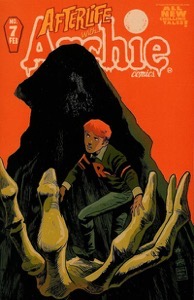
    Aguirre-Sacasa continues the story of the Riverdale survivors in a layered narrative. He uses Betty’s diary as a narrative frame, only she’s recreating her diary from memory, so there are multiple levels of flashback. But he starts near the present action before going back. It’s all over the place in terms of timeline, which is sort of compelling.

    It’s also a way to fill out an issue with a lot of back story into the character and her emotional history, but not a lot of action in terms of the zombie apocalypse. Most of it comes in expository narration in the diary–a summary of someone else explaining the zombies to Betty.

    There’s also the burgeoning romance between Betty and Archie–then Veronica finds out, right before the cliffhanger. It’s almost too intense. The flashbacks humanize the story, but only can do so much.

    And Francavilla appears somewhat rushed.

  • Flash Gordon 7 (December 2014)

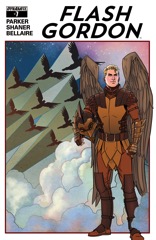
    Flash Gordon #7Well, if this issue of Flash Gordon feels a little light, it might be because Parker and Shaner’s story clocks in at something like fifteen pages. The rest of the comic is promotional material.
    As for the Flash comic… it’s fine until the end, when Parker tacks on a questionable cliffhanger–after racing through some other scenes. Flash, Dale and Zarkov have an adventure with Vultan and the Hawkmen but Parker doesn’t have much story for them. There’s some talking head, some science with Flash is asleep and some banter and very little else. Shaner gets a few awesome things to draw and some average ones. It’s a pretty story while it’s going on.

    It’s just too short. And the cliffhanger is just too abrupt. Parker is done with Flash Gordon an issue early; there’s no more character development–there’s no Ming this issue either. It’s a rather lazy outing.

    B- 

    CREDITS

    Skyfall; writer, Jeff Parker; artist, Evan Shaner; colorist, Jordi Bellaire; letterer, Simon Bowland; editor, Nate Cosby; publisher, Dynamite Entertainment.

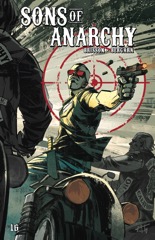
  • Sons of Anarchy #16It’s a really cute issue. Seriously, it’s cute. Brisson manages to tell a cute, life affirming story with Sons of Anarchy. If there’s the Sons equivalent of a teddy bear, he finds it this issue.

    The story has the owner of the pot shop in trouble with an ex; now, said pot shop owner is in business with a biker and he calls the biker for help. So then the biker has this whole investigation thing–the comic really does read like a detective story, but the brute force kind, not the meticulous investigation kind–before he discovers the truth and then there’s go to be the reckoning.

    Artist Matías Bergara is not ready for prime time. With some of the action panels, he’s not even close. Occasionally, it does look like he’s got a good talking heads thing going, but the colors mess him up.

    It’s an awkward issue.

    B- 

    CREDITS

    Writer, Ed Brisson; artist, Matías Bergara; colorist, Paul Little; letterer, Ed Dukeshire; editors, Mary Gumport and Dafna Pleban; publisher, Boom! Studios.

  • Afterlife with Archie #7Aguirre-Sacasa continues the story of the Riverdale survivors in a layered narrative. He uses Betty’s diary as a narrative frame, only she’s recreating her diary from memory, so there are multiple levels of flashback. But he starts near the present action before going back. It’s all over the place in terms of timeline, which is sort of compelling.

    It’s also a way to fill out an issue with a lot of back story into the character and her emotional history, but not a lot of action in terms of the zombie apocalypse. Most of it comes in expository narration in the diary–a summary of someone else explaining the zombies to Betty.

    There’s also the burgeoning romance between Betty and Archie–then Veronica finds out, right before the cliffhanger. It’s almost too intense. The flashbacks humanize the story, but only can do so much.

    And Francavilla appears somewhat rushed.

    CREDITS

    Betty: R.I.P., Chapter Two: Dear Diary…; writer, Roberto Aguirre-Sacasa; artist and colorist, Francesco Francavilla; letterer, Jack Morelli; editor, Jamie Lee Rotante; publisher, Archie Comics.

  • Heat (1995, Michael Mann)

    Until the final scene, director Mann is still carefully plotting out Heat. The film’s narrative construction–when he introduces a character, when he returns to a character, how he transitions from one character to another–is magnificent. Heat is a delicate film, with Mann never letting a single element carry a scene. He’s always working in combination–sound and actor, photography and sound, editing and actors. All of these elements should cause distance between the viewer and the film; instead they bring the viewer in closer.

    Much of the film deals with the relationship between the various men and their suffering women. Even if one of the male characters’ women doesn’t know she’s suffering, she’s going be soon. Mann posits his driven male characters are unable to function in relationships, then he explores the relationship between the driven male characters.

    With crooks Val Kilmer and Robert De Niro, Mann sets up something near a protege and mentor relationship. With De Niro and cop Al Pacino, Mann goes with an alter ego. The scene between Pacino and De Niro, where Pacino finally gets to let down his guard–up almost entirely in the rest of the film–is startling. It’s an island in the chaos.

    Great supporting performances from Amy Brenneman, Diane Venora, Dennis Haysbert, Mykelti Williamson and Kevin Gage. Brenneman’s the closest thing Heat has to a sympathetic character. Everyone else is just extant.

    Nearly three hours, Heat never gets unwieldy. Mann’s deliberateness keeps it painfully, depressingly, beautifully, devastatingly subdued.

  • Princess Ugg 6 (December 2014)

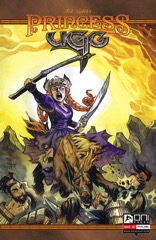
    Princess Ugg #6Naifeh unleashes Ülga in battle, which leads to some decent pages, but he doesn’t let her do much fighting. The story keeps getting in the way. There are a lot of plot twists for just one issue–the worst being how her nemesis is nasty to Ülga even when she’s saving the day–and the ending is a little too light.
    It’s an amusing issue and has a decent presence, but as the conclusion winds down… it’s clear Naifeh didn’t really have much story to tell. To tell the issue right, he would’ve needed twice the space, maybe three times. There are a lot of little battles and all those plot twists.

    He doesn’t seem to like drawing the battle scenes, which is problematic since he’s showing how perfect Ülga is for them. And he gets downright lazy with the art on some of the bad guys.

    Ugg’s got problems.

    CREDITS

    Writer and artist, Ted Naifeh; colorists, Warren Wucinich and Naifeh; letterer, Wucinich; editors, Robin Herrera and Jill Beaton; publisher, Oni Press.

  • Dredd: Uprise 1 (October 2014)

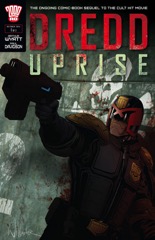
    Dredd: Uprise #1Reading Uprise, it’s hard to see the point. It’s another sequel comic to the Dredd movie, which isn’t clear–if one doesn’t read that information on the cover–until the judges show up in their movie costumes. They take a while show up; writer Arthur Wyatt jumps from regular people to judges to bad people to other people to bad judges. It’s all over the place.

    The issue takes place over three days. There are riots brewing in a slum getting a high rise development. It’s unclear why the story of these riots is worth reading about. It’s a Dredd comic where Judge Dredd just barks at the rookie judge instead of listening to her.

    It’s unclear why Dredd, the movie, needs a pointless comic book sequel.

    Paul Davidson’s art is pretty good. He doesn’t have anything interesting to draw–but his visual pacing is good.

    Shame Wyatt’s plotting isn’t.

    C 

    CREDITS

    Writer, Arthur Wyatt; artist, Paul Davidson; colorist, Chris Blythe; letterer, Simon Bowland; editor, Matt Smith; publisher, 2000 AD.

  • She Makes Comics (2015, Marisa Stotter)

    Almost everyone interviewed in She Makes Comics does indeed make comics. The film never says what most of these interviewees made–I know what interviewee Heidi MacDonald edited because I remember (she’s identified for her current journalism), but I don’t remember what fellow Vertigo editor Shelly Bond edits. I know she edited things I read, but I don’t remember what. As interviewee Raina Telgemeier? I had no idea what she made.

    She made Smile. Smile is a big deal, cross-over success and the movie doesn’t mention it for a quite a while. And there’s a bit of a catch–22 to this observation….

    The interviewees (all female save DC Comics writer and editor Paul Levitz) talk about how their experiences with male comic book readers usually involves being held to a different, higher standard of knowledge. And I’m arguing what She Makes Comics really needed to do was list the interviewees’ resumes.

    But these interviewees have worked on some really big things and instead of just saying Karen Berger is responsible for Sandman and Swamp Thing, the film turns it into some kind of revelation. Using that revelation time for discussion and exploration would have been time much better spent.

    She Makes Comics only runs seventy minutes. It could run four times as long without getting boring. The documentary feels artificially small, like director Stotter and co-editor Patrick Meaney were knowingly cutting out interesting material.

    It’s fine as a limited, cursory introduction, but–frustratingly–it boils with potential.

    2/4★★

    CREDITS

    Directed by Marisa Stotter; director of photography, Jordan Rennert; edited by Stotter and Patrick Meaney; music by Sean Bierbower, Alexa Raquel Casciato, Steve DeLuca, Living Fiction, Hypefactor and Wilneida Negron; produced by Stotter, Rennet and Meaney.


    RELATED

  • Bitch Planet 1 (December 2014)

    Bitch Planet #1The back matter of Bitch Planet describes a bait and switch in the issue. The person writing said back matter doesn’t use “bait and switch” as a pejorative phrase, just a description.

    But she is correct–it is a bait and switch–and I’m being pejorative.

    Bitch Planet is a really cool idea. Oppressive future society, interplanetary travel, women in prison, but not exploitative. What could be an awesome sci-fi comic–and still can be a good one–is a little too straightforward.

    It’s like writer Kelly Sue DeConnick had a property with a sensational title and a great concept and she ran with it as an important property instead of a solid story. The multiple surprises–or bait and switches–are cheap. They distract from what the story could be to instead… I don’t know… give Bitch Planet weight.

    Nice art from Valentine De Landro.

    It’s rather problematic.

    C+ 

    CREDITS

    Writer, Kelly Sue DeConnick; artist, Valentine De Landro; colorist, Cris Peters; letterer, Clayton Cowles; editor, Lauren Sankovitch; publisher, Image Comics.

  • The Autumnlands: Tooth & Claw 2 (December 2014)

    The Autumnlands: Tooth & Claw #2It turns out the savior of the animal Earth of Tooth & Claw is–shock of all shocks–a human. A savage, but honorable warrior, which makes sense because something about the way Busiek writes the exposition about the savior (before his species was revealed) reminds of Conan.

    Oh, and it’s The Autumnlands: Tooth & Claw now. I thought it was just a style thing (since the people all crashed down to the ground from the floating cities), but apparently it’s a trademark thing.

    The result is the story having, so far, nothing to do with autumn. Actually, the issue takes place in one night with a herd of boar attacking–they’re happy the city-dwellers have been brought low–and the savior hatching. There’s arguing and some character stuff from the previous issue’s protagonist, but Busiek’s going for action and lots of events.

    It’s fine, but Dewey’s art makes it worthwhile.

    CREDITS

    Writer, Kurt Busiek; artist, Benjamin Dewey; colorist, Jordie Bellaire; letterers, John Roshell and Jimmy Betancourt; publisher, Image Comics.

  • Evil Dead II (1987, Sam Raimi)

    Instead of establishing Evil Dead II’s tone at the start of the film, director Raimi waits a while, veering between horror and comedy–pushing each to their absurdist extremes–until they meet. And, by then, the viewer is fully comfortable in the world of Evil Dead II. Bruce Campbell can be simultaneously sympathetic, hilarious, horrifying.

    Campbell spends a good portion of the first third alone. He’s either running from an unseen evil, fighting–usually in a ludicrous fashion–the evil or he’s just going crazier and crazier. Something strange about Raimi and Scott Spiegel’s script is how it frequently invites consideration from the viewer. Not so much about the back story of the unseen evil, though there’s some very genre sympathetic exposition, but in the reality of the characters’ experiences.

    The film is so unbelievable in its horrors, as the characters contend with possessed and disremembered mothers and significant others, the viewer sympathizes and imagines being in the characters’ shoes. Raimi and Campbell are so committed, just watching the film commits the viewer as well.

    There’s a lot of good filmmaking going on too. Raimi expertly combines various special effects–make-up, stop motion, projection screens–with he and cinematographer Peter Deming’s tilted, distorted camera angles. Even when Evil Dead II is obvious, it works; Raimi wants to show how important his execution of the film is to the experience of viewing the film.

    Excellent score from Joseph LoDuca, great performance from Campbell.

    It’s crazy, silly, gross and smart.

    3/4★★★

    CREDITS

    Directed by Sam Raimi; written by Raimi and Scott Spiegel; director of photography, Peter Deming; edited by Kaye Davis; music by Joseph LoDuca; produced by Robert G. Tapert; released by Rosebud Releasing Corporation.

    Starring Bruce Campbell (Ashley ‘Ash’ J. Williams), Sarah Berry (Annie Knowby), Dan Hicks (Jake), Kassie Wesley DePaiva (Bobby Joe), Denise Bixler (Linda), Richard Domeier (Ed Getley), John Peakes (Professor Raymond Knowby), Lou Hancock (Henrietta Knowby) and Ted Raimi (Possessed Henrietta).


    RELATED