• Lazarus (2013) #15

    Lazarus  15

    Much of the issue–maybe even most of the issue–is a sword fight. There’s no dialogue, no description; Lark moves through the fight, sometimes showing reaction shots, sometimes working on a subplot, but the point is the two women fighting. It’s brilliantly choreographed and it shows a level of concentration from Lark, who I never thought of as a movement guy.

    The story is good too, with Rucka finding space for some rather good content in the speaking parts of the comic. But the fight and visual nature of it are part of the writing too. Rucka helps the fight and gets to benefit from it and Lark gets to do this lengthy sequence.

    Lazarus first surprised when it managed not to be as terrible as the beginning arc suggested, then it got really good, now it’s getting ambitious with the medium. The book is ever the constant surprise.

  • Inherit the Wind (1960, Stanley Kramer)

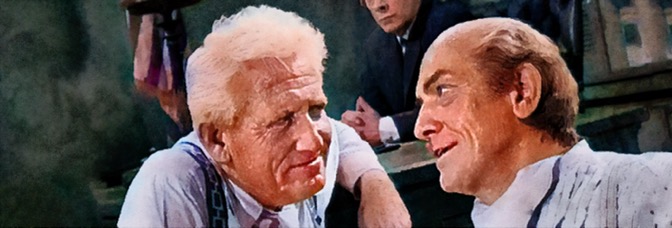
    A lot of Inherit the Wind is about ideas and not small ones, but big ones. Director Kramer is careful with how big he lets the film get with these ideas, because even though Inherit the Wind is about Darwin vs. the Bible as its biggest idea, the smaller ideas are the more significant ones. And when Kramer’s got Fredric March in a bombastic performance on the side of the Bible, Kramer’s careful to put him in front of those smaller, more important ideas.

    The film’s impeccably acted, not just by March or Spencer Tracy as his pseudo-alter ego, but also Gene Kelly as a newspaperman and Florence Eldridge as March’s wife. Amid all these big ideas and small ideas and top-billed stars are Dick York (the small-town teacher teaching Darwin) and his fiancée Donna Anderson (who’s the preacher’s daughter).

    Inherit the Wind has something of an anti-climatic finish, just because Kramer and the screenwriters want to let the viewer figure it out. Kramer sets up the film larger than life then, gently, reveals the film’s never larger than life, just the viewers’ expectation of it. There’s depth to the grandiosity and everyone should have been paying attention.

    A great deal of the film is listening and watching people listen. Almost all of Harry Morgan’s time is spent listening (as the judge). It’s all important. Kramer’s trying to figure out how to make this too big story work. And he does. Mostly.

    Great Ernest Laszlo photography.

  • Safe and Well
  • Video | Safe and Well
  • Stop Button Favorites – 1×1 – King Kong (1976)

    Episode 1 | King Kong ’76 Stop Button Favorites

    An audio commentary of John Guillermin’s 1976 film, “King Kong,” produced by Dino De Laurentiis for Paramount Pictures. Synced to the R1 Paramount DVD release.

    WHERE TO LISTEN

    Apple Podcasts
    Breaker
    Google Podcasts
    Overcast
    Pocket Casts
    Radio Public
    Spotify
    RSS
  • Lazarus #15Much of the issue–maybe even most of the issue–is a sword fight. There’s no dialogue, no description; Lark moves through the fight, sometimes showing reaction shots, sometimes working on a subplot, but the point is the two women fighting. It’s brilliantly choreographed and it shows a level of concentration from Lark, who I never thought of as a movement guy.

    The story is good too, with Rucka finding space for some rather good content in the speaking parts of the comic. But the fight and visual nature of it are part of the writing too. Rucka helps the fight and gets to benefit from it and Lark gets to do this lengthy sequence.

    Lazarus first surprised when it managed not to be as terrible as the beginning arc suggested, then it got really good, now it’s getting ambitious with the medium. The book is ever the constant surprise.

    CREDITS

    Conclave, Part Five; writer, Greg Rucka; artists, Michael Lark and Tyler Boss; colorist, Santiago Arcas; letterer, Jodi Wynne; editor, David Brothers; publisher, Image Comics.

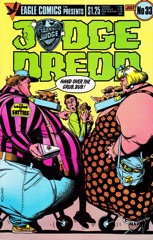
  • Judge Dredd #33This issue of Dredd seems to be the strange issue, like they found all the absurdly funny strips from 2000 AD and gave them their own issue. And artist Ron Smith works for it. He has a jovial, cartoon-y style. He doesn’t draw Dredd very well, but everything else is good. Dredd–and the rest of Judges–seem inserted and static.

    Wagner and Grant’s stories range from what happens with the morbidly obese following the Apocalypse War, where the foodstuffs of the future come from (it’s oddly prescient), then a rabid robo-dog one (probably the weakest) and one about plastic surgery to all look alike. Besides the robo-dog story, Wagner and Grant are certainly getting better at their sci-fi elements. Sure, Dredd and the Judge stuff feels shoehorned in, but shoehorned into a thought-out story.

    Mega-City One’s not quite plausible, but can be intriguing.

    CREDITS

    Writers, John Wagner and Alan Grant; artist, Ron Smith; colorist, John Burns; letterers, Tom Frame and Tony Jacob; editor, Nick Landau; publisher, Eagle Comics.

  • Birthright (2014) #5

    Birthright  5

    Williamson has a surprise in him. Birthright has it’s big surprise, of course, the big overall one, but Williamson totally changes the series with the last scene and it’s pretty cool. Birthright, just because the concept is so defined, occasionally feels like it can’t surprise. Even when it’s really good, it’s because Williamson’s doing really well with that concept.

    Not here. Here, he shows he can surprise and give the series even more depth. Very cool.

    And Bressan gets a hard job–visualizing an “imaginary friend”–and does really well with it. The way the scenes work have the character staggered; on the first appearance, it seems like a big misstep for Bressan. But during the second scene, it’s clear his design is perfect.

    There’s a lot of exposition during the fight scene, both from the people in the know and the people not. It’s all just fantastically well-executed.

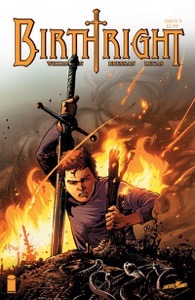
  • Birthright #5Williamson has a surprise in him. Birthright has it’s big surprise, of course, the big overall one, but Williamson totally changes the series with the last scene and it’s pretty cool. Birthright, just because the concept is so defined, occasionally feels like it can’t surprise. Even when it’s really good, it’s because Williamson’s doing really well with that concept.

    Not here. Here, he shows he can surprise and give the series even more depth. Very cool.

    And Bressan gets a hard job–visualizing an “imaginary friend”–and does really well with it. The way the scenes work have the character staggered; on the first appearance, it seems like a big misstep for Bressan. But during the second scene, it’s clear his design is perfect.

    There’s a lot of exposition during the fight scene, both from the people in the know and the people not. It’s all just fantastically well-executed.

    CREDITS

    Writer, Joshua Williamson; artist, Andrei Bressan; colorist, Adriano Lucas; letterer, Pat Brosseau; editors, Helen Leigh and Sean Mackiewicz; publisher, Image Comics.

  • The Comics Fondle Podcast – 1×21
    Comics: Satellite Sam, Squirrel Girl, Nameless, Hawkeye, Casanova, Birthright, Ghosted, Robocop, Nailbiter, Crossed +100, Bitch Planet, Sixth Gun, C.O.W.L., They’re Not Like Us, Empty, Cluster, Lady Killer, Stray Bullets, Walking Dead. Other stuff: Convergence and Secret Wars Mature comics with the indies Other media: The Flash The New Spider-Man

    WHERE TO LISTEN

    Apple Podcasts
    Spotify
    Stitcher
    RSS
  • Friday the 13th (1980, Sean S. Cunningham), the uncut version

    There’s nothing wonderfully terrible about Friday the 13th. It’s not like any of the cast are bad in funny ways, not even Betsy Palmer who’s doing inept histrionics. Are any of the cast members good? Not really. Some are better than others. Kevin Bacon’s probably the most useless (and annoying, due to an affected Southern accent) and Jeannine Taylor is okay, which is strange since most of their scenes are opposite each other.

    Inept is a good word to describe the film in general. Director Cunningham rips off a style or a device from another film and then changes it just enough to make it not work. Without Harry Manfredini’s omnipresent score, there wouldn’t be any tension in the film. Cunningham can’t direct for it and writer Victor Miller can’t plot for it. Friday the 13th is obvious at every moment; there’s no inventiveness.

    Well, except for the special effects, which are a little too slick for the film. Cunningham tries to make an exploitation picture, but does it with a little too much budget and not enough understanding of how to actually be affecting while terrorizing your audience. He and Miller try for “scary” things because it distracts from their inability to form a connect with the viewer. Friday the 13th doesn’t use any of the viewer’s brain cells, unless he or she is counting shockingly obvious moments for later review.

    The single surprise–the ending scare is really well-executed (thanks to Manfredini’s cheap, obvious and effective music).

  • Ghosted 17 (February 2015)

    Ghosted #17Ghosted feels like a much different comic book with Vladimir Krstic Laci on art. It feels like a seventies ghost comic, slick in a classical sense, not a hip sense. It works against a bunch of the book’s concepts and makes Ghosted a much more entertaining read this month. Just the way Laci breaks out the action alone changes the experience.

    The issue has Jackson going over to the ghost town to fight his nemesis. It’s a lot of great talking heads because Laci makes everything feel a little uneasy and Williamson’s ominous dialogue is strong. When the supernatural does come in, Williamson and Laci handle it really well too.

    I’m not sure if Laci’s the best fit for the book, which doesn’t have to be homage to seventies horror comics, but it’s a nice approach to this particular story line. It fits it better. Realistic fantastical stuff going on.

    CREDITS

    Writer, Joshua Williamson; artist, Vladimir Krstic Laci; colorist, Miroslav Mrva; letterer, Rus Wooten; editors, Helen Leigh and Sean Mackiewicz; publisher, Image Comics.

  • Satellite Sam 11 (February 2015)

    Satellite Sam #11The writing on this issue of Satellite Sam is excellent. Fraction hits every subplot, sort of checks its temperature, stirs it a little, then combines a couple of them into the final scene of the comic.

    There’s a lot of plotting and a lot of unfortunate choices and situations. It’s soapy without seeming too soapy. The S&M and drug abuse and swinging certainly give Sam some edge, but there’s also how Fraction approaches the subjects, sans exploitation.

    This issue has some character development, a bunch of surprises, another really good scene for the black actor passing as white. He’s practically Fraction’s only sympathetic character in the whole comic. Everyone else has issues. He’s also one things distracting from the comic’s soapiness.

    This issue also has Chaykin’s worst art on the comic so far. He’s getting lazy, relying way too much on bad digital effects. But, otherwise, Sam is rocking.

    CREDITS

    Good Morning, Good Morning; writer, Matt Fraction; artist, Howard Chaykin; letterer, Ken Bruzenak; editor, Thomas K.; publisher, Image Comics.

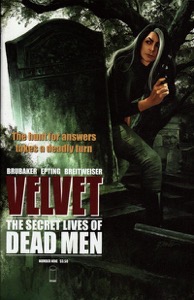
  • Velvet (2013) #9

    Velvet  9

    It’s a decent, not great, issue of Velvet. Brubaker’s resolution to his rip-off of The Rock works out a whole lot better than I would have expected; he and Epting do a nice talking heads comic with the Sean Connery (sorry, Patrick Stewart more like) telling Velvet just enough of what she thinks she knows. And Brubaker writes the hell out of the exposition. He had me trying to anticipate the twists, which I don’t usually care about.

    Epting doesn’t get much action to draw–there are some flashbacks, but they’re limited; the way he draws the conversations is fantastic. His art keeps the pace on those long sequences. Brubaker can be interesting, but without engaged art, talking heads don’t work.

    The cliffhanger is a let down, of course, as is the way Brubaker foreshadows the cliffhanger in the cutaway scene just before it.

    Still, it’s mostly good stuff.

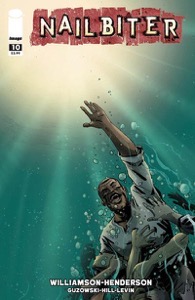
  • Nailbiter (2014) #10

    Nailbiter  10

    It’s a rather good issue of Nailbiter. I’m beginning to think the problem with Williamson’s writing isn’t too many ideas (or a lack of them on the fast issues), but a pacing one. On Nailbiter, his two issues would work better as one than two. The cliffhanger aside. Or maybe muted.

    This issue has the resolution to the school bus kidnapping and then a cliffhanger setting up the series for a big change. Depending on how Williamson handles it. But it’s a really good cliffhanger; Williamson leads up to it intellectually, not through forced events. He thinks his way through Nailbiter, which is what makes the book work in general.

    It’s a more than silly concept, handled very realistically in terms of visual tone and character interactions, and the balance succeeds because of Williamson’s writing.

    Yay, Nailbiter.

    Unfortunately, Henderson is really pressed for time here. He often skips drawing faces.

  • Velvet #9It’s a decent, not great, issue of Velvet. Brubaker’s resolution to his rip-off of The Rock works out a whole lot better than I would have expected; he and Epting do a nice talking heads comic with the Sean Connery (sorry, Patrick Stewart more like) telling Velvet just enough of what she thinks she knows. And Brubaker writes the hell out of the exposition. He had me trying to anticipate the twists, which I don’t usually care about.

    Epting doesn’t get much action to draw–there are some flashbacks, but they’re limited; the way he draws the conversations is fantastic. His art keeps the pace on those long sequences. Brubaker can be interesting, but without engaged art, talking heads don’t work.

    The cliffhanger is a let down, of course, as is the way Brubaker foreshadows the cliffhanger in the cutaway scene just before it.

    Still, it’s mostly good stuff.

    CREDITS

    The Secret Lives of Dead Men, Part Four; writer, Ed Brubaker; artist, Steve Epting; colorist, Elizabeth Breitweiser; letterer, Chris Eliopoulos; editor; Eric Stephenson; publisher, Image Comics.

  • Nailbiter #10It’s a rather good issue of Nailbiter. I’m beginning to think the problem with Williamson’s writing isn’t too many ideas (or a lack of them on the fast issues), but a pacing one. On Nailbiter, his two issues would work better as one than two. The cliffhanger aside. Or maybe muted.

    This issue has the resolution to the school bus kidnapping and then a cliffhanger setting up the series for a big change. Depending on how Williamson handles it. But it’s a really good cliffhanger; Williamson leads up to it intellectually, not through forced events. He thinks his way through Nailbiter, which is what makes the book work in general.

    It’s a more than silly concept, handled very realistically in terms of visual tone and character interactions, and the balance succeeds because of Williamson’s writing.

    Yay, Nailbiter.

    Unfortunately, Henderson is really pressed for time here. He often skips drawing faces.

    CREDITS

    Writer, Joshua Williamson; artist, Mike Henderson; colorist, Adam Guzowski; letterer, John J. Hill; editor, Rob Levin; publisher, Image Comics.

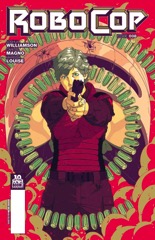
  • Robocop 8 (February 2015)

    Robocop #8I’m not sure how I’d describe Killian, Williamson’s long-in-the-tooth antagonist in Robocop, but soap opera tough guy might be the best description. There’s no depth to the character, which is starting to get really annoying. Though Magno’s design for the him does look a lot like an eighties tough guy, which fits in with it being a sequel to Robocop.

    This issue has Williamson lift a scene from Batman Returns to get stuff done, which is fine (there’s nothing else to do in that situation), but the parts with Robocop all of a sudden an upgraded superhero, doing things impossible to do with a man in a tin can suit? It’s where Robocop breaks. It’s where you can’t suspend disbelief long enough to hear Peter Weller’s voice saying the lines.

    Williamson is still earnest with Robocop, but he’s not restrained enough. Not having a “budget” hurts it.

    CREDITS

    Writer, Joshua Williamson; artist, Carlos Magno; colorist, Marissa Louise; letterer, Ed Dukeshire; editors, Alex Galer and Ian Brill; publisher, Boom! Studios.

  • C.O.W.L. 8 (January 2015)

    C.O.W.L. #8There are some definite issues with Reis’s art here. The people don’t look right; he’s maybe trying a new style and it doesn’t take. Or maybe there are just too many people to draw. The issue is a lot of talking heads scenes, no real action besides the introduction of staged supervillains.

    Higgins and Siegel spend a little time with every character, which leaves C.O.W.L. feeling like it’s in need of a protagonist, or at least someone to follow through all these scenes. Instead, it’s a lot of different people and the writers handle those scenes pretty well, but it feels like a collection of subplot scenes thrown into one issue.

    Not even the cliffhanger, with the supervillains attacking, has much weight. It’s kind of a treading water issue, kind of not. The writers are good with their characters and Reis’s art is mostly strong. The issue just feels slight.

    CREDITS

    The Greater Good, Chapter Two: Doppler Shift; writers, Kyle Higgins and Alec Siegel; artist, Rod Reis; letterer, Troy Peteri; publisher, Image Comics.

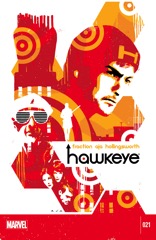
  • Hawkeye 21 (April 2015)

    Hawkeye #21What’s confusing about this very late issue of Hawkeye is how little anyone is invested in it; Fraction has the most fun when doing a one page scene between Clint and Jessica Drew and Aja manages to do some great design, but not turn it into great art. So what does Fraction do? He goes for a gut shot at the end, just to make Hawkeye feel like it matters.

    Only, it’s been so long since Fraction’s done anything interesting with Clint, he’s got way too big a hill to climb.

    Strangest is how they handle the “meat” of the issue. The regular tenants of the building fighting the Eastern European mobsters Home Alone-style, as one character puts it. It seems like a very small fight with only a handful of participants. The coordination, both in writing and art, isn’t there.

    Maybe Fraction should’ve let someone else finish it.

    CREDITS

    Rio Bravo; writer, Matt Fraction; artist, David Aja; colorist, Matt Hollingsworth; letterer, Chris Eliopoulos; editors, Devin Lewis and Sana Amanat; publisher, Marvel Comics.

  • To Be Takei (2014, Jennifer M. Kroot)

    To Be Takei is unexpected, even though everything it presents about its subject’s life is somewhere between common knowledge and readily accessible knowledge. Even though director Kroot opens the film on a jovial note–George Takei (the titular Takei) and his husband, Brad Takei (sort of also the titular Takei), taking their morning walk and bickering about whether they’re walking faster for the benefit of the camera–Takei is serious. Kroot has a lot of fun, but her thesis is it’s serious.

    Of course, she also opens the film with Howard Stern introducing it, so she has to work uphill to get to serious. And George Takei’s life certainly has a lot of serious in it. Kroot often saves clips (and discussions) of William Shatner for when she needs to relieve some of the stress in the film.

    The film does have a somewhat set narrative; it tracks Takei as he opens his first musical, based on his experiences in internment camps. Along the way, Kroot covers everything else Takei’s famous for–“Star Trek”, Facebook, being gay. The Facebook stuff is almost an aside, ditto the “Star Trek” stuff. Takei’s experiences–both as a gay man in the mid-to-late twentieth century and in Hollywood at that time–are exceptional. Kroot never draws attention it, but Takei’s life is uncommon on almost every level. Except maybe the bickering married stuff.

    To Be Takei is surprisingly good. Sure, the protagonists are engaging, but Kroot’s presentation and conclusions make it work.

  • This Is Water (2013, Matthew Freidell)

    This Is Water is incredibly slick. Director Freidell is literally visualizing a commencement speech David Foster Wallace once gave. Wallace will mention cars on a freeway, Freidell has the cars on the freeway. Often, Freidell visually represents parts of the speech–in stylized graphics–in his shots.

    It’s slick.

    And that slickness, whether it’s how well Freidell brings everything together to make a cohesive, predictable narrative, but how he comments on that narrative. The narrative, which isn’t Wallace’s creation, has depth because of how it plays against Wallace’s narrative outline. And Freidell is translating it.

    Wallace’s speech–which basically espouses a humanist belief (I think someone lifted it for a “House M.D.” monologue too–has a shifting point. He appeals to his listeners vanity, then explores their vanity. Freidell’s playing with the same thing–only by engaging with their expectations for a short like This Is Water.

    It’s rather cool.

    3/3Highly Recommended

    CREDITS

    Edited and directed by Matthew Freidell; screenplay by Matthew Freidell, based on a speech by David Foster Wallace; directors of photography, Matthew Freidell and Catherine Asanov; produced by Allison Freidell, Whitney Willison and Jeremy Dunning.

    Starring Hunter McClamrock (Man), Jaycie Dotin (Woman), Shey Lyn Zanotti (Mother), Phoenix List (Child) and Rhoda Pell (Cashier); narrated by David Foster Wallace.


    RELATED

  • Wild River (1960, Elia Kazan)

    Director Kazan opens Wild River with newsreel footage of the Tennessee River at flood. The film is set in the 1930s, something else the newsreel footage establishes. Kazan and screenwriter Paul Osborn spend the least amount of time possible setting up the film. The newsreel takes care of setting, when lead Montgomery Clift starts his new job, he talks to his secretary, taking care of ground situation. River’s quick start lets Kazan fill every minute of the film.

    The Tennessee River floods and the dam Clift’s federal employee is in town to build are barely subplots by the end of the film. They’re details, because it turns out–even though the ground situation’s established–River is more about what happens after Clift decides to poke around in it (since he’s new). That poking around leads to Clift meeting Lee Remick and Wild River is really their relationship and how it affects, and is affected, by the events occurring around them.

    There are subplots with Remick and Jo Van Fleet (as her grandmother, who won’t leave her land), Van Fleet and Clift and then Clift and his forced desegregation of the town. Osborn and Kazan never force anything dramatically; the film has a very specific setting, geographic and in time. What could be melodramatic shortcuts are instead sublime, sometimes painful details.

    The acting’s amazing–Clift, Remick, Van Fleet. Remick’s probably the best.

    Ellsworth Fredericks’s photography and Kenyon Hopkins’s music also exceptional. And Kazan nails every shot.

    Wild River is superior.

  • The Human Condition I: No Greater Love (1959, Kobayashi Masaki)

    The Human Condition I: No Greater Love is about, you guessed it, the human condition and the problems with being a humanist when you’re working in a foreign country your country has invaded and occupied. The film takes place in 1943, in Japanese-controlled Manchuria. It’s a desolate spot, but lead Nakadai Tatsuya doesn’t want to go to war and the assignment lets him get out of the draft and he gets to marry his sweetheart, Aratama Michiyo.

    These developments occur in the first fifteen minutes of Love, which runs three and a half hours. They should be important in establishing Nakadai and Aratama, but really it just shows the actors to have very little chemistry and very poorly written roles.

    Director Kobayashi doesn’t bring much to film (he also cowrites the overcooked screenplay); he can’t direct the actors, wherever they shot on location adds all the tone and, even though Miyajima Yoshio’s photography is good, it’s clear the weak composition is holding it back.

    Love is a historical melodrama. The cast is huge, nothing good ever happens to anyone, but it’s also a political melodrama and Kobayashi doesn’t like subtlety. At all. The film runs head first into any place it can make commentary–racism, classism, sexism–and leaves the characters racing to catch up.

    At least they’re running through gorgeous landscape.

    Yamamura Sô gives the best performance as Nakadai’s sidekick. The rest of the performances are, graciously put, thin.

    Love avoids every interesting possibility and embraces every predictable.

    1/4

    CREDITS

    Directed by Kobayashi Masaki; screenplay by Matsuyama Zenzô and Kobayashi, based on the novel by Gomikawa Jumpei; director of photography, Miyajima Yoshio; edited by Uraoka Keiichi; music by Kinoshita Chûji; production designer, Hirataka Kazue; produced by Wakatsuki Shigeru; released by Shochiku Company.

    Starring Nakadai Tatsuya (Kaji), Aratama Michiyo (Michiko), Awashima Chikage (Jin Tung Fu), Arima Ineko (Yang Chun Lan), Yamamura Sô (Okishima), Ishihama Akira (Chen), Nanbara Kôji (Kao), Miyaguchi Seiji (Wang Heng Li), Abe Tôru (Sergeant Watai), Mishima Masao (Kuroki), Ozawa Eitarô (Okazaki), Mitsui Kôji (Furuya), Kôno Akitake (Captain Kono), Nakamura Nobuo (Head Office Chief), Sazanka Kyû (Meisan Chô) and Sada Keiji (Kageyama).


    RELATED

  • Cluster (2015) #1

    Cluster  1

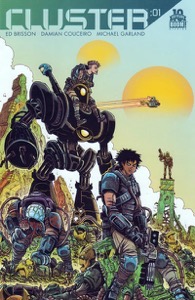
    There’s not much original in Cluster so far. It’s a remix of a lot of sci-fi, popular and not, but writer Ed Brisson manages to coat over all those elements because the story isn’t derivative, the details aren’t homage, they’re just part of the sci-fi language now. Of course there’s something out of BattleTech in Cluster. Why wouldn’t there be?
    The first issue introduces the protagonist, who doesn’t have a memorable name, but is a politician’s daughter serving hard time fighting for a colony planet. She makes a sidekick (not friend) and gets into a fight and goes to solitary. Then goes out on a mission.

    It doesn’t make a lot of sense at times–the way Brisson paces it–but it doesn’t matter. Because Damian Couceiro’s art is awesome. He goes for big scale sci-fi, but still within the constraints of a comic book.

    Cluster‘s solid.

  • Cluster #1There’s not much original in Cluster so far. It’s a remix of a lot of sci-fi, popular and not, but writer Ed Brisson manages to coat over all those elements because the story isn’t derivative, the details aren’t homage, they’re just part of the sci-fi language now. Of course there’s something out of BattleTech in Cluster. Why wouldn’t there be?

    The first issue introduces the protagonist, who doesn’t have a memorable name, but is a politician’s daughter serving hard time fighting for a colony planet. She makes a sidekick (not friend) and gets into a fight and goes to solitary. Then goes out on a mission.

    It doesn’t make a lot of sense at times–the way Brisson paces it–but it doesn’t matter. Because Damian Couceiro’s art is awesome. He goes for big scale sci-fi, but still within the constraints of a comic book.

    Cluster‘s solid.

    CREDITS

    Writer, Ed Brisson; artist, Damian Couceiro; colorist, Michael Garland; editors, Cameron Chittock and Eric Harburn; publisher, Boom! Studios.

  • Pump Up the Volume (1990, Allan Moyle)

    Everything director Moyle does in Pump Up the Volume builds the rest of the film. It’s not exactly he’s building good will, he’s shaping the possibilities of the film. It makes for a film where you can have a car chase, a comic relief moment, an inspirational message and a quiet character moment all in the same five minutes.

    For example, while Christian Slater is definitely the film’s lead, it’s questionable whether or not he’s the protagonist in the traditional sense. He guides the viewer through the film far less than his romantic interest, Samantha Mathis. Moyle isn’t doing a character study or even an epical high school student story. It turns out he’s doing a story about a high school and finding the most interesting people in it, while focusing harder on a couple of them.

    The film’s construction is brilliant, down to how to opening titles establish the ground situation and some of Slater’s character. In the first half of the film, Moyle gives Slater a bunch of monologues, which Slater nails, but these sequences are also extremely well-constructed by Moyle and editors Larry Bock and Janice Hampton. They’re transfixing. Volume succeeds because Moyle figures out a way to make Slater’s pirate radio DJ just as compelling to the viewer as the film’s characters.

    Slater and Mathis are both fantastic. Lots of great supporting performances–Billy Morrissette, Ellen Greene, Scott Paulin and Annie Ross are standouts.

    Moyle crafts Pump Up the Volume precisely and to great success.

    4/4★★★★

    CREDITS

    Written and directed by Allan Moyle; director of photography, Walt Lloyd; edited by Larry Bock and Janice Hampton; music by Cliff Martinez; production designer, Robb Wilson King; produced by Rupert Harvey and Sandy Stern; released by New Line Cinema.

    Starring Christian Slater (Mark Hunter), Samantha Mathis (Nora Diniro), Ellen Greene (Jan Emerson), Scott Paulin (Brian Hunter), Mimi Kennedy (Marla Hunter), Cheryl Pollak (Paige Woodward), Billy Morrissette (Mazz Mazzilli), Andy Romano (Murdock), Anthony Lucero (Malcolm Kaiser), Robert Schenkkan (David Deaver) and Annie Ross (Loretta Creswood).


    RELATED

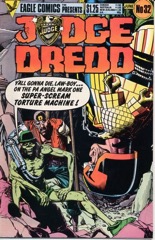
  • Judge Dredd #32Dredd has his showdown with the surviving Angel brothers. It’s an oddly incomplete story just because Walter has a silent but important role and Wagner and Grant never get around to resolving it. At least not in this collection of progs; maybe in the actual 2000 A.D. they got to it in a good amount of time.
    There’s some more silly stuff–the rat going to get Dredd at the Hall of Justice–but the showdown is good. Wagner and Grant pace it out well and Ezqerra’s energy is good. The final resolution for the Judge Child is fine; pointless, but fine.

    Unfortunately, the second story–with nice, if too comedic, art by Jose Casanovas Jr.–is idiotic. Wagner and Grant try too much for social commentary. And they don’t even have anything to say, they’re often clearly padding out the exposition.

    But they do reference the Apocalypse War well.

    CREDITS

    Writers, John Wagner and Alan Grant; artists, Carlos Ezquerra and Jose Casanovas Jr.; colorist, John Burns; letterer, Tom Frame; editor, Nick Landau; publisher, Eagle Comics.

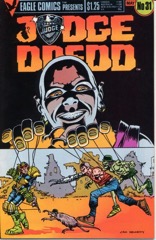
  • Judge Dredd #31Besides having some very odd angles from Ezqerra, this issue does pretty well. Even if Wagner and Grant have a really, really silly setup.

    The Judge Child, across the galaxy, is able to control minds back on Earth. And I think read minds too. He wrecks havoc as he plots against Dredd. Part of that plot is releasing Fink Angel, the creepiest of them–the one with the pet rat who wears a hat–and that part of the issue works out well.

    Unfortunately, then the Judge Child raises Mean Machine from the dead. So he can control minds across the galaxy and resurrect people. It’s silly.

    Dredd has a good encounter with Fink; what Ezqerra doesn’t do in detail, he at least breaks out well into panels.

    Besides the goofy elements and some wonky art, it’s a rather good issue. Wagner and Grant keep the storytelling precise and brisk.

    CREDITS

    Writers, John Wagner and Alan Grant; artist, Carlos Ezquerra; colorist, John Burns; letterer, Tom Frame; editor, Nick Landau; publisher, Eagle Comics.

  • Bitch Planet 2 (January 2015)

    Bitch Planet #2This issue of Bitch Planet, as far as DeConnick’s technical writing goes, is amazing. It’s the best plotted, best constructed comic I’ve read in a long time. The balance of talking heads to action sequences, how DeConnick and De Landro work those action sequences out, it’s phenomenal.

    But I still don’t care.

    DeConnick reveals the future is a little bit Hunger Games, little bit Rollerball, little bit Running Man, all mixed in with a seventies exploitation film. The characters are amusing–oh, wait, the bad guy is even a Mr. Big-type villain–but the cast in the prison is amusing.

    The best thing Bitch Planet has going for it is DeConnick’s script, which makes wonderful connections and is very gradual, very careful with how it leads the reader through the narrative. The rest of the comic is the MacGuffin. Would it be nice if it all connected?

    Eh.

    Maybe?

    CREDITS

    Writer, Kelly Sue DeConnick; artist, Valentine De Landro; colorist, Cris Peters; letterer, Clayton Cowles; editor, Lauren Sankovitch; publisher, Image Comics.