Category: 1995
-

It didn’t occur to me to chart writers when I started this “Frasier” rewatch but then I naturally did it anyway. Writers, directors, guest callers. Joe Keenan writes this one, which has Shannon Tweed guest-starring a pop psychologist who loves Kelsey Grammer’s work—and even more, reads David Hyde Pierce’s, which is an aside but more…
-

My sitcom nostalgias date me but still aren’t bad ones. For instance, the Nathan Lane cameo in this episode of “Frasier,” back when having a Nathan Lane cameo was awesome. Lane shows up in the last act of the episode, which has Frasier (Kelsey Grammer) scrambling to recover his belongings and his good name after…
-

New writing team (Elias Davis and David Pollock)—albeit one working together since the 1960s—and a new director (Alan Myerson) but it’s a close to quintessential “Frasier.” Though more in the “good jackass Kelsey Grammer” column than the “good exemplar episode” one, even though it’s not exactly Grammer’s episode. Or at least it shouldn’t be. It…
-

It’s writers Chuck Ranberg and Anne Flett-Giordano’s second episode this season. They sort of established the show in the first season, so it’s nice to see them back. Even if this episode doesn’t age well. Some of the jokes are great and the performances are fantastic, but the situations associated with said jokes and performances…
-

Let’s see how long it takes me to describe Teknophage. Our reality is just one of an infinite (I think) number of realities, a multiverse woven together through the will of one single creature—the Teknophage, or Mister Henry Phage. He’s a giant dinosaur. On his planet, through mutation, he became hyper-intelligent and then discovered how…
-
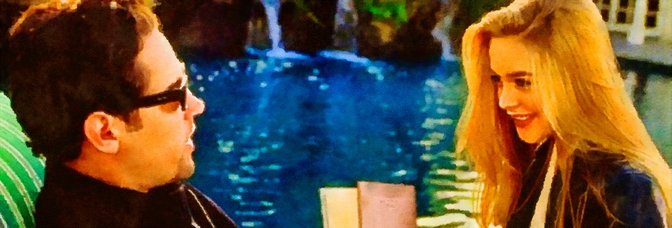
I really didn’t want to bag on Clueless when I watched it this time, the first time since the theater, almost twenty-four years ago. It got good reviews on release, which I fully disagreed with—I’d forgotten how much audiences in the eighties and nineties liked farcical sitcom-level characterizations. Particularly in the nineties with the lusterless,…
-

At the end of Congo, after the heroes have found the lost expedition, the lost city, and the laser-pure diamonds but also run afoul of said lost city’s super-ape protectors and happened to find this place during a volcanic eruption, some of the super-apes jump into the lava flow. It’s a somewhat lengthy sequence, which…
-

Weird Melvin #5 is a flashback issue. Only, not really. There’s clearly some publication history trivia to the series; the cover says this issue has the first two Weird Melvin comics in it, previously unpublished. They present a new origin story for both Melvin and the Kid, who have much different histories in the first…
-
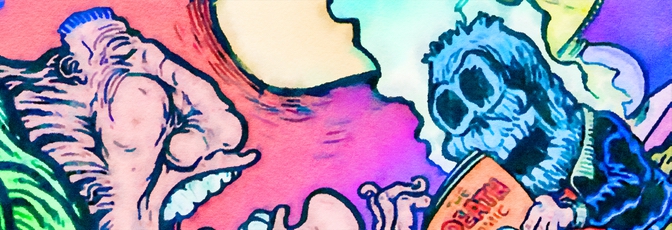
There is a very good chance Weird Melvin might gross me out next issue. Hansen gets pretty close in the cliffhanger, which features two lady monsters (a mother and daughter) pregnant with half-mutated giant insects, half-monsters. What’s most surprising is the grossness isn’t in Hansen’s detail but in the action and implications of the action.…
-

Hansen introduces a whole new character—or two, actually—but one with history with Weird Melvin; his sidekick, reformed monster Shag. Shag hangs out in Weird Melvin’s abandoned headquarters. Seems like he’s been there a while… but he’s finally ready to walk out. But Shag doesn’t come into the comic until the third-ish act. I’m not sure…
-

Leave it to Hansen to make it weirder. The issue starts with a bookend—Melvin’s still unnamed comic fan sidekick is berating Weird Melvin for not stopped Monster Fanboy (who owns every comic every published and hordes them in an underground lair and is, actually, a monster when it comes to collecting)—and then goes into flashback.…
-

Weird Melvin is a gloriously weird comic. Creator Marc Hansen brings the weird to the art—not just the muscle-bound grotesques (Melvin and, later, a regular human) but also Melvin’s cyclops nemesis, Sy Cyclops. The comic starts from Sy’s perspective, as he nitrous ups his car and hits Weird Melvin full speed. Good thing Melvin’s almost…
-

The first half of Grumpier Old Men is such an improvement over the original, it could be a paragon of sequels. Director Deutch knows how to showcase the actors amid all the physical comedy. There’s a lot of physical comedy and sight gags in Grumpier. There’s Walter Matthau doing the Saturday Night Fever strut while…
-

Restoration is two parts period drama, one part character study, one part comedy. It’s often tragic, both because of events occurring and because it takes place in 1665 England and 1665 wasn’t a great time to be alive given the state of medical knowledge versus, you know, disease. Or mental health. The general complete misunderstanding…
-

Pitch black comedy about TV media personality-obsessed, burgeoning sociopath Nicole Kidman’s rise to fame and the damage she wreaks along the way. Director Van Sant and screenwriter Buck Henry (adapted the Joyce Maynard novel) embrace the story’s lack of potential for not-uneasy laughs and go for every awkward, creepy laugh they can get. Great performances,…
-
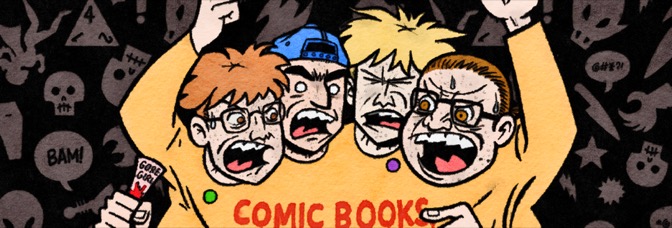
Either Evan Dorkin’s got the Eltingville TV rights back or whoever has them is a complete numbskull because the book’s so relevant you could subtitle it “An Incel Fable” and it’d be totally appropriate, narratively speaking. But it’d be somewhat intellectually dishonest, as Dorkin started The Eltingville Club long before the incels had a self-identity…
-
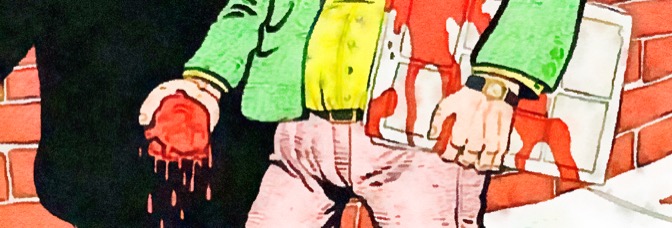
On the inside front cover, there’s an announcement Love and Rockets #49 is the penultimate issue. Both Bros embrace it, but very, very differently. Beto has this exceedingly disturbing and self-loathing series of short strips, usually starring himself (or an obvious analog). There’s some great art and some rather good storytelling–like the one where he…
-

Two issues to go, but no countdown clock other than Beto promising a last visit to Palomar in #50. Now, he got me once before with that Farewell, My Palomar story so I’m not sure I’d have believed him back in 1995. Because the Jaime story, despite dealing with Maggie trying to tie up the…
-

It’s an outstanding issue. Los Bros each contribute a story and each story does very different things. Beto’s first. He’s finally bringing Luba’s daughters into contact with their previously unknown grandmother, while also doing a Gorgo story. There are flashbacks for Gorgo and Maria–including Maria’s (previously unrevealed, I think) involvement in Eduardo’s death (which happened…
-

Halloween: The Curse of Michael Myers doesn’t even run ninety minutes and gets boring fast; the last twenty minutes are completely mind-numbing. Nothing makes sense, characters act without motive, cults cult without purpose, it just goes on and on. At least Donald Pleasence is lucky enough to get knocked out for a bunch of it.…
-

Until the tacked on finish, Die Hard with a Vengeance can do little wrong. It doesn’t aim particularly high, just high enough–it’s a symphony of action movie action (and violence) set in New York City; the city’s geography (at least movie familiar geography) plays less and less of a part as the runtime progresses, but…
-

In the Bleak Midwinter is a sweet movie. It’s kind of a Christmas movie–it takes place at Christmas–and it’s this gentle, thoughtful, sweet but never saccharine or even really acknowledging its sweetness sweet movie. Writer and director Branagh puts a lot of work into the plotting of the film, without ever appearing to be putting…
-

Devil in a Blue Dress is almost so much better. Director Franklin gets easily distracted and follows tangents, both in the script and the directing. The latter makes sense–he’s always too enthuastic about the (excellent) production design, recreating late 1940s Black Los Angeles. With Tak Fujimoto’s warm but vibrant photography, the “regular life” part of…
-

The Bridges of Madison County is many things, but it’s definitely an adaptation of a best-selling novel. Thanks to director Eastwood, it’s not a cheap adaptation of a best-selling novel, but it’s still an adaptation. There’s still a frame. No matter how much Eastwood deglamorizes it, no matter how well Richard LaGravenese writes most of…
-

Kiss of Death takes place over four years, has eight to ten significant characters, and runs an hour and forty minutes. It skips ahead three years at the forty-five minute mark. And the last twenty minutes could have their own movie, as David Caruso returns to the city to face Nicolas Cage, who knows Caruso…
-

The Mangler is terrible. One hopes the rumor producer Anant Singh replaced director Hooper is true because the film’s bad enough and desperate enough, you occasionally want to cut it some slack. You can’t, because it’s terrible, but you still kind of wish you could. Here’s the movie. Small town in Maine (it’s a Stephen…
-

Seven is a gorgeous film. It’s often a really stupid film, but it’s a gorgeous film. Even when it’s being stupid, it’s usually gorgeous. Director Fincher has a beautiful precision to his composition; he works great with photographer Darius Khondji, editor Richard Francis-Bruce and composer Howard Shore (about half the time with Shore). Seven is…
-
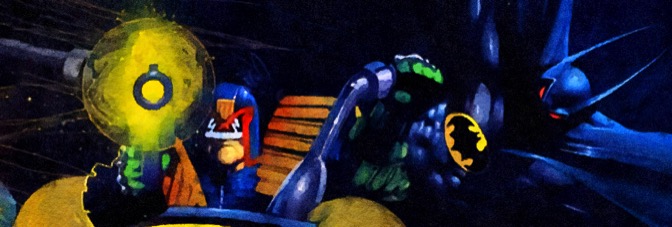
Batman. Judge Dredd. They ought to be an interesting team-up, right? Judge Dredd is the law, Batman isn’t. There’s a lot of gristle for competing philosophies, if one wanted to do a story with a lot of gristle. The Batman/Judge Dredd Files consists of three one-shots and a two-parter. It took DC eight years to…
-

Godzilla vs. Destoroyah does a lot. It mixes an Aliens rip-off into a Godzilla movie, then tries new things for the giant monster fight, all while finishing off the series. Destoroyah is meant to close off the franchise, giving director Okawara plenty of opportunities to tug at heart strings. Okawara’s attempts at homage and reference…
-

There’s a gentle quality about Get Shorty, an invitation from screenwriter Scott Frank and director Sonnenfeld to dwell. One can also not dwell on the film’s little moments, because it’s got awesome big moments as well. Except Shorty doesn’t have much in the way of set pieces; Sonnenfeld does whatever he can to reduce action…
 The Stop Button