Category: 1957
-
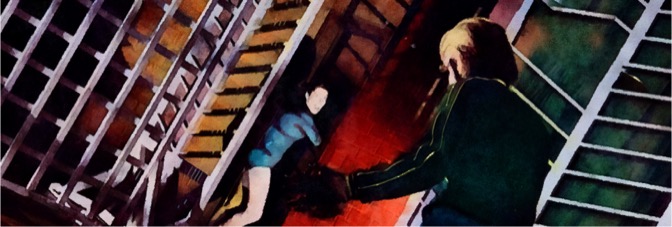
I Was a Teenage Werewolf opens with a reasonably impressive—for 1957–schoolyard fight. Throughout the film, director Fowler will have these entirely competent low-budget action sequences, with much thought put into them by Fowler and his uncredited editor. It’s not because they’ve got ambition with Werewolf; they’re just trying to pad the runtime. To its seventy-six…
-
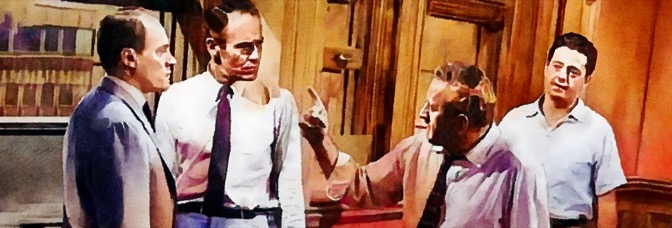
Director Lumet wrote at length about his compositional decisions for 12 Angry Men in his book about filmmaking, aptly titled Making Movies. The camera starts up high, looking down at the jury room and its jurors, then gradually moves down and in; by the third act, it’s in tight, low-angle close-ups. It’s beautiful, sublime work…
-
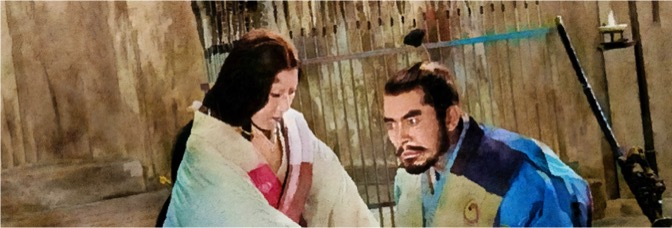
Co-producer, co-writer, director, and editor Kurosawa loves himself some Macbeth. Throne of Blood is Macbeth in feudal Japan, with Mifune Toshiro and Yamada Isuzu as the doomed couple. Kurosawa and his co-writers structure the film as a historical war epic, with modern-day bookends, and then fit Mifune and Yamada’s Macbeth into the war epic. But…
-
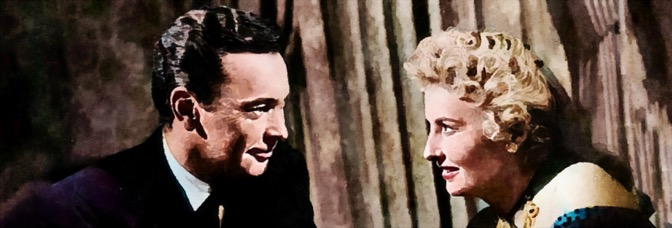
Forty Guns occupies that rare position of simultaneously playing like a parody of itself without being any campy fun. It’s a perfect storm of budget, cast, story, era, technology, earnestness, and director Fuller. Oh, and it’s a singing cowboy Western. Well, singing bathhouse owner. Men’s only, which leads to a couple weird scenes where Fuller…
-

Given its micro-budget and absurdity, The Brain from Planet Arous is often surprisingly okay. Director Juran was so embarrassed he took his name off the final product (using his middle name, Hertz, as his surname on the credits), and the movie does get goofy, but its biggest problem isn’t the budget in the end. Instead,…
-

Monster from Green Hell is impressively boring. Despite running a theoretically spry seventy minutes, the film Hell’s a slog from minute five. The film opens with unlikely scientist Jim Davis and sidekick Robert Griffin sending rockets into space to test cosmic rays on animals. Their launch site? A very recognizable, very wanting composite still of…
-

Despite Dana Andrews and Peggy Cummins being perfectly serviceable leads, Night of the Demon never really comes to life without antagonist Niall MacGinnis around. MacGinnis is a Satanic cult leader who conjures forth demons from Hell—hence the title—to deal with his enemies and—while he never explicitly confesses to his enemies… he takes a delight in…
-

The Incredible Shrinking Man is an enormous feat. It succeeds thanks to director Arnold, writer Richard Matheson, and star Grant Williams. Arnold’s arguably got the greatest successes; he carefully lays the groundwork for the film’s eventual startling visuals. To get to the startling ones, Arnold’s got to get through some absurd ones. Only the first…
-

The Defender is exquisite. It’s a two-part courtroom drama from “Studio One,” so Reginald Rose’s teleplay has some major constraints. There’s budget, there’s content, there’s plotting, there’s pacing. Not to mention it’s two separate broadcasts. No matter how well the two parts of The Defender sit alongside, the reality of its broadcast has to figure…
-

Despite being an adaptation of a stage play and having one main set, Desk Set shouldn’t be stagy. The single main location–and its importance–ought to be able to outweigh the staginess. Desk Set does not, however, succeed in not being stagy. It puts off being stagy for quite a while, but not forever, which is…
-

The Seventh Sin has three problems. The first is the third act; it’s too rushed. Given the constraints of the film production–a shot-in-Hollywood production about a cholera outbreak in a rural Chinese town–there’s not so much to be done about it. The film has a limited cast, especially once the action moves from Hong Kong…
-

Wild Strawberries is about a septuagenarian doctor (Victor Sjöström) being awarded an honorary degree. Sjöström’s narration sets it up in the first scene, before the opening titles. Director Bergman’s script, through the narration, lays out the entire ground situation before the titles, in fact. Sjöström is a widower, he has an adult son, he has…
-

Peyton Place takes over a year and a half starting in 1941. Director Robson has a really slick way of getting the date into the ground situation. Robson and cinematographer William C. Mellor go a little wild with Peyton Place–there’s a lot of location shooting and Robson tries hard to make the viewer feel enveloped.…
-

The Seventh Seal has a lot of striking imagery. Gunnar Fischer’s cinematography is peerless, but it’s more–it’s how the photography works with the shot composition, how the shots work with one another (Lennart Wallén’s editing is simultaneously amiable and stunning). And then there’s how it all works with Erik Nordgren’s music. Bergman’s going for theatrics…
-
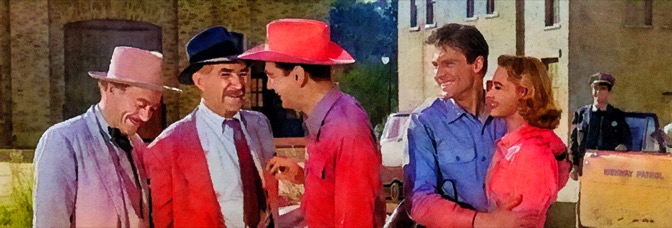
Against the odds, The Monolith Monsters almost comes together in the finale. The special effects are good, there’s a lot of tension, none of the acting is too bad. And then the end flops. I want to blame director Sherwood, maybe screenwriters Norman Jolley and Robert M. Fresco, maybe editor Patrick McCormack, maybe producer Howard…
-
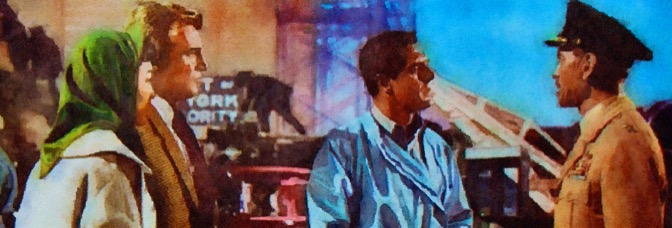
The best directed parts of The Deadly Mantis are when the film is propaganda for the military. Director Juran–and editor Chester W. Schaeffer–show more enthusiasm when putting together those brief expository segments than they do anywhere else in the film. Given it’s about a giant praying mantis thawed out from the Artic who eats people,…
-

Lizzie is about lead Eleanor Parker’s struggle with multiple personality disorder. More accurately perhaps, Lizzie is about Parker’s multiple personality disorder. As a protagonist, Parker disappears fairly quickly into the film’s eighty minute runtime. She doesn’t even get to open the film; it introduces her through other characters’ expository conversation. Screenwriter Mel Dinelli, quite unfortunately,…
-

Paths of Glory takes place over four days, runs just under ninety minutes and has thirteen or so significant characters. It’s hard to identify the most significant character–Kirk Douglas’s protagonist the viewer’s way into the film, but he’s not the most significant. The film opens with George Macready (who, along with Wayne Morris, is my…
-
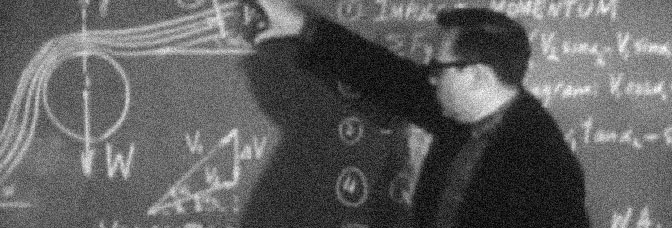
Decade for Decision isn’t the best documentary short subject. It’s a collection of shots of colleges with narration. The information, however, is (historically) outstanding. For example, Decision opens talking about how American students are years behind their foreign (in this case, the Soviets) counterparts. A little later, there’s talk about how no one would want…
-

The Mischief Makers is undeniably well-made, with great photography from Jean Malige (if lousy editing by Cécile Decugis) and Truffaut’s deliberate and panoramic composition. It’s an adaptation of a short story, about a group of adolescent boys who playfully torment a young woman they’re crushing on. While it’s got a couple awkward moment or two,…
-

The Story of Anyburg U.S.A. is an odd one. A small town decides to sue cars–personified here as cute, the windshields as big eyes–for all the auto accidents. Sadly, Anyburg opens with a lot more energy–the narrator goes on and on about homicides on the highway and such and it doesn’t seem Disney at all.…
-

Birds Anonymous should be really good. Its failings so how tied animation technique and writing are when it comes to a cartoon. The narrative, down to the scenic plotting, is fine. But the animation is bad so Birds flops. The most startling problem is the backgrounds. A more generous person might call them stylishly spare.…
-

The Land Unknown has it all—a guy in a Tyrannosaurus Rex suit (the dinosaur’s roar is suspiciously similar to Godzilla’s), lizards standing in for dinosaurs, awful rear screen projection of those lizards to make them seem large, CinemaScope, misogyny, torture, a homicidal rapist being portrayed as a sympathetic character and a cute little tarsier. The…
-

N.Y., N.Y. is, ostensibly, a day in the city. It opens in the early morning, features a man waking for work, movies through a series of daytime shots, finally finishing with shots of night in the city and nighttime activities. However, Thompson has no narrative. He uses special kaleidoscope lenses to shoot the city and…
-
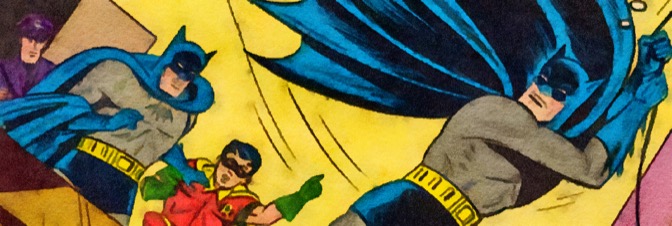
So this issue has three Batman stories, two comic strips and a one page text story. That level of content is a lot different from today. The art’s fine… I suppose Dick Sprang, drawing ancient Rome in the second story, has the best panels (but just because of subject matter). As far as writing… it’s…
-

The Oklahoman is–well, I don’t want to sell it short because its discussion of racism and prejudice are rather straightforward and singular for pictures of its era–but at its core, the film’s a love triangle between fifty-two year-old Joel McCrea, thirty-five year-old Barbara Hale and twenty-six year-old Gloria Talbott. Talbott’s supposed to be playing an…
-
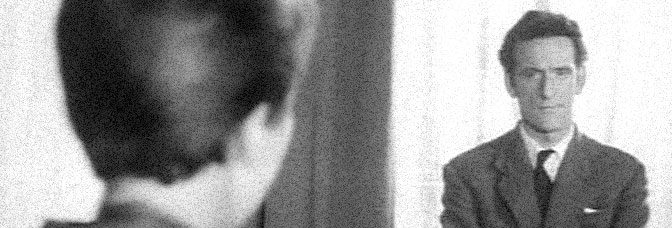
Seeing as how I’ve actually written a scholarly paper on the British film industry (not of Suspended Alibi‘s era, but the early silents… and the observations, unfortunately, still hold), it’s sort of nice to be able to put some of the experience to use. As a country, Britain has produced a wealth of fine actors…
-

If only it weren’t for Bill Travers… his performance drags the film into the realm of absurdity. It isn’t just his inability to act, it’s also his utter lack of charisma. It’s unbelievable anyone could like Travers the movie star (I’m thinking there must be or have been Victor Mature fans and George Raft fans,…
-
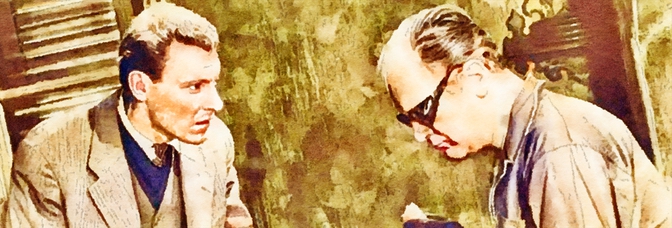
Gérard Séty runs a failing psychiatric hospital and agrees to hide mysterious Curd Jürgens (for a fee). The hospital is then overrun by spies from both East and West, complicating things. All the acting is good; Séty is excellent. Very complex script, superiorly navigated by Clouzot’s direction. DVD (R2).Continue reading →
 The Stop Button