Category: 1945
-
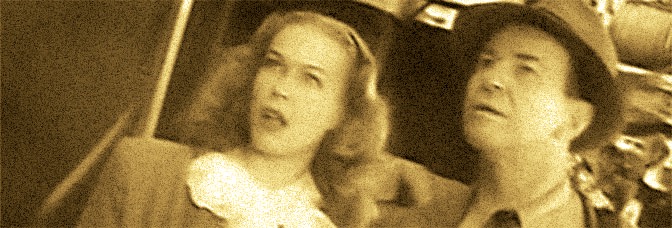
Brenda Starr, Reporter is all action. Sure, there’s some scenes of lead Joan Woodbury sitting at her desk, but she’s just waiting to hear about more action. The chapter starts with a building on fire. Woodbury and her photographer, Syd Saylor, drive out from the newspaper office, racing to get there faster than the cops.…
-
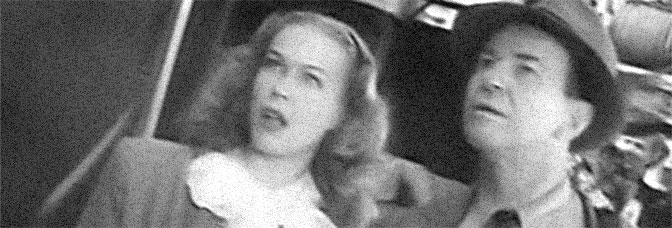
Brenda Starr, Reporter is all action. Sure, there’s some scenes of lead Joan Woodbury sitting at her desk, but she’s just waiting to hear about more action. The chapter starts with a building on fire. Woodbury and her photographer, Syd Saylor, drive out from the newspaper office, racing to get there faster than the cops.…
-

Pride of the Marines is a disappointment. It never gets particularly good, but it does have a lot of potential–at least from its cast–so when it starts getting better and then slips, it’s a disappointment. The film starts before Pearl Harbor with John Garfield’s would-be bachelor falling for Eleanor Parker. Garfield’s reasoning for wanting to…
-
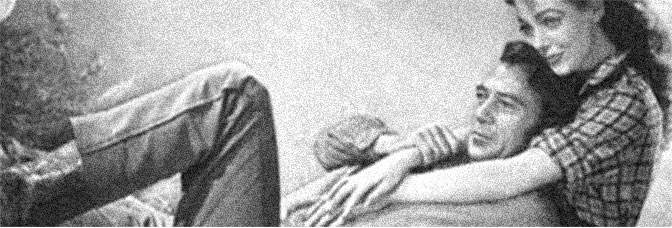
Along Came Jones gets by on its gimmick and its charm–it’s got a lot of charm, both from the cast and Nunnally Johnson’s screenplay, which is good as director Heisler doesn’t bring any. Jones is a lower budget Western, lots of rear screen projection, lots of boring setups from Heisler. He prefers medium long shots,…
-

House of Dracula is immediately disappointing. The film opens on man of science Onslow Stevens as Dracula (played by a boring John Carradine) comes visiting, hoping for some cure to vampirism. Will Carradine try to seduce Martha O’Driscoll’s fetching nurse? Will something go wrong with Stevens’s cure for Carradine? Unfortunately, yes to both. Director Kenton…
-

The Thin Man Goes Home is very genial. It would be hard for it not to be genial given some of the supporting cast is around just to be genial–familiar character actors like Edward Brophy, Donald Meek and Harry Davenport are around to be likable. And why shouldn’t William Powell and Myrna Loy heading to…
-

While a lot of The Brighton Strangler meanders, there are some rather effective moments in the film. It's a B picture, with John Loder as an actor suffering from amnesia who imagines himself his latest role–a murderer. The film's set in London, with blackouts and air raids–not to mention service people–all part of the setting…
-

Detour should be episodic, but it's not. The film chronicles the misadventures of Tom Neal's night club pianist, who's stuck not being good enough for Carnegie Hall and having a fickle fiancée (Claudia Drake) from the outset. When he does decide to follow her out to her dreams in California, instead of saving bus fare,…
-
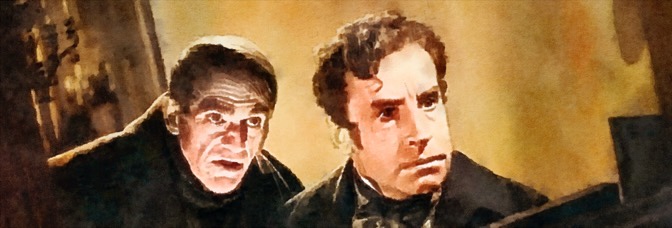
The Body Snatcher has half an excellent foundation. Nineteenth century medical genius Henry Daniell can’t escape his past associations with a shady cabman (Boris Karloff). These past associations being of the grave robbing variety. There’s also Daniell’s romance with his maid (Edith Atwater), which humanizes the character throughout the first half, since Daniell’s supposed to…
-

The Greek anti-defamation league, if it existed, mustn’t have had much power when Isle of the Dead came out. It’s a quarantine drama, a genre I’m unfamiliar with but certainly has a lot of potential, set on a small Greek island. There’s nothing on the island besides an amateur Swiss archeologist (Jason Robards Sr.) and…
-

The Spiral Staircase opens with this lovely homage to silent cinema. Director Siodmak takes great care with the setting in time–Nicholas Musuraca’s sumptuous cinematography helps–and then Spiral becomes a waiting game. Certainly if Siodmak took such great care with one sequence, he’ll return to that level of care again…. However, he does not. The rest…
-

The Vampire is a nature short. It opens with exquisitely photographed sea creatures, moves into a discussion of the popular vampire–with Nosferatu clips–and then gets to its point. The titular vampire in question is the South American vampire bat and director Painlevé has one in captivity and photographs it. He also throws a guinea pig…
-

Embarrassingly, I didn’t understand Hare Conditioned‘s title until I looked it up online. No, I won’t tell you. The cartoon is an enthusiastic chase through a department store, with star window attraction Bugs Bunny about to be shipped off the to taxidermy department. Bugs is likable here, partially because he’s opposite a heinous villain, the…
-

Fresh Airedale opens without titles and I’m a little surprised to see it’s Chuck Jones. The animation is rather weak for the most part and, while there’s inventiveness, it’s chaste. The cartoon has either a mixed message or just a depressing one. It’s all about a sociopathic, Machiavellian airedale who does whatever he can to…
-

Much of Dangerous Partners‘s excellence comes from the script. Edmund L. Hartmann adapted Eleanor Perry’s story, which Marion Parsonnet then from wrote the screenplay from–in other words, it’s hard to know who’s responsible for the script’s brilliance. Partners has a complex, unpredictable plot–it constantly forces the viewer to reevaluate characters and situations. Added to that…
-

Star in the Night opens with cowboys, but it’s not a cowboy story. It’s a nativity told at a roadside motel. The dialogue for the cowboys is so bad, one has to wonder if they’re just cowboy impersonators and that detail got cut. The film proper begins when J. Carrol Naish meets up with angel-in-disguise…
-

For the majority of Brief Encounter, I had very little opinion of Lean’s direction. It’s incredibly dispassionate and functional, but very solid. I think I assumed it’d be innovative (along the lines of the Archers) but it’s not. Very realistic, very British. Until the second to last scene, when Lean has to essay the most…
-

They Were Expendable has a gradual pace. Not knowing the film’s subject matter–just genre–going in, it all unfolded quite deliberately in front of me. The opening is a PT boat exercise. The film’s special effects are spectacular; it’s impossible to tell what’s an effect and what’s an actual boat in the water. These scenes–there are…
-

Mildly amusing horror anthology. The characters are too thin, the stories aren’t really uncanny enough, and the bridging sequence is a big time narrative cheat. Basil Radford and Naunton Wayne appear in one of the segments as non-copyright infringing analogues to their LADY VANISHES characters. DVD.Continue reading →
 The Stop Button