The Stop Button
blogging by Andrew Wickliffe
Category: 1925
-
Boys Will Be Joys is a strange Our Gang outing, simply because the story doesn’t belong to the Gang. Instead, sixty year-old industrialist Paul Weigel has grown bored being a successful grown-up and just wants to goof off. Luckily, he happens to be developing a plot of land the Gang has built an incredible amateur…
-

Super-Hooper-Dyne Lizzies explores the dangers of electric cars. Basically, they can be taken over by radio waves and made to do crazy things. If it weren’t for the gasoline dealer (John J. Richardson) being the villain, one could almost see it as twenties gas company propaganda. The short is a special effects extravaganza and director…
-
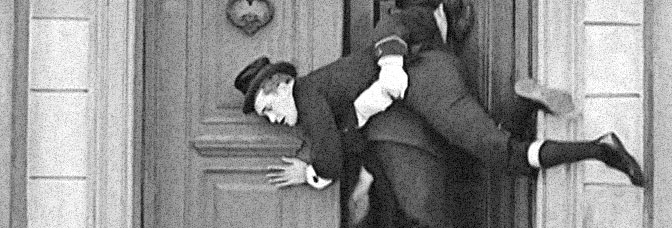
There’s got to be something good about Pie-Eyed. I just can’t think of it. I suppose directors Pembroke and Rock do show some competence; they save the stupidest gag for last. Stan Laurel falls seven stories without injury. If there’s never any danger to him, why be interested? But that complement is a sarcastic one.…
-

I wonder how His Marriage Wow would play without Vernon Dent. His character is an inexplicably omnipresent professor who counsels leading man Harry Langdon as to his future wife’s murderous intentions. Of course, Marriage is never scary and never tries to be scary, so the whole groom in danger aspect is just a waste of…
-
The animation is a strange mix of great and mediocre in Alice Cans the Cannibals. The principals, whether it’s Julius (the titular Alice’s sidekick), the variety of animals they encounter or the cannibals presumably out to eat Alice (though why they’re chasing Julius, a cat, is never explained), all move with grace and attention. They…
-

What The Iron Mule lacks in plotting, it makes up for in exuberance. Unfortunately, the exuberance isn’t omnipresent. It’s like directors Arbuckle and Jones felt the need for gags, which don’t work, but had modern fun with the physical comedy. Almost all of the physical comedy is in long shot. It doesn’t seem like a…
-

The Freshman has one of the most peculiar approaches to storytelling I’ve seen. It has very little establishing exposition–a few lines on a title card about maybe four of those exposition title cards throughout–and its scenes are gag-centered and the film is these gags strung together. Maybe the approach isn’t so peculiar (arguably, it’s the…
-

Fairly standard slapstick adaptation of L. Frank Baum dumps the Yellow Brick Road, the witches, and any recognizable version of the Wizard (but does have an awesome tornado scene) and instead is a political thriller. The slapstick’s well choreographed enough and there are other working parts–Dorothy (Dorothy Dwan) is good in Kansas until she gets…
 The Stop Button