Man of Steel opens with a good scene for Kirk Alyn, as both Clark Kent and Superman, as he has to decide if he’s going to reveal his secret identity. He’s trying to convince scientist Forrest Taylor to destroy kryptonite.
Unfortunately, Taylor’s got an assistant who’s more interested in personal profit than the well-being of the Man of Steel, which brings Carol Forman’s Spider Lady into the mix.
But not for Alyn. After the opening, he gives up the chapter to Noel Neill. For a few minutes, anyway, before she gets kidnapped. She and Tommy Bond do get a good scene together–visiting a stool pigeon, Neill has to school young Bond in proper reporting.
Once she’s kidnapped and off to Forman’s lair, Man of Steel starts to get its familiar drag. Forman’s performance isn’t good; her character is stupid too. Spencer Gordon Bennet and Thomas Carr have Neill ostensibly in danger the whole time, yet when she gets to have the cliffhanger, it’s like they just remembered to do something with her. Before the cliffhanger, it’s all Forman doing expository.
Bennet and Carr’s lack of urgency hurts Man of Steel. Alyn, Neill, and Bond are all good, but the finale gives none of them anything to do. Just Forman. And she wastes anything she gets to do. It’s not entirely her fault. Spider Lady’s a weak character
The Reducer Ray drags. It opens with an okay, not great, cliffhanger resolution–with the best use of the animated Superman action so far in Superman. The resolution’s truncated so the action can get back to the Daily Planet so Noel Neill can meet Kirk Alyn (as Clark Kent). She already met Superman, but just for a moment and it has no apparent effect on her.
There’s a promising hint of Alyn and Neill bickering, then the chapter moves ahead an indeterminate period. There’s a newspaper headline montage of all Superman’s feats.
When the montage ends, Reducer Ray introduces villain Carol Forman and her stooges. Forman is “The Spider Lady.” She wears a black gown and an eye mask. She also has a giant silvery spider web in her foyer. It’s unclear why she’s such a powerful villain, but her stooges do her bidding. Including when it gets them killed, like here.
Turns out the U.S. government has a job for Superman. There’s a lot of action–and The Reducer Ray–before it’s back to Metropolis for Alyn as Clark Kent. A meteor is expected to land nearby and they’re supposed to get the story. Can he and Neill work together?
Or will she strand him on the side of the road.
Neill’s good. Alyn’s better as Kent. Especially during the bickering scenes with Neill, Tommy Bond, and Pierre Watkin. The script just doesn’t take any time with them.
Lots of Superman cartoon flying “effects.” Never too bad, but never good. If Superman’s got to fly as a cartoon, they ought to still be excited about the cartoon.
It feels long–there are a lot of people standing around in Reducer Ray, most of them new characters, most of them probably just here for the one chapter. It’s a lot to get through.
The cliffhanger involving Kryptonite is at least a shocker.
Also–Neill gets screen time but nothing to do as a reporter. Her part is to actively dislike Alyn, amusingly so, but zilch else.
The Reducer Ray drags. It opens with an okay, not great, cliffhanger resolution–with the best use of the animated Superman action so far in Superman. The resolution’s truncated so the action can get back to the Daily Planet so Noel Neill can meet Kirk Alyn (as Clark Kent). She already met Superman, but just for a moment and it has no apparent effect on her.
There’s a promising hint of Alyn and Neill bickering, then the chapter moves ahead an indeterminate period. There’s a newspaper headline montage of all Superman’s feats.
When the montage ends, Reducer Ray introduces villain Carol Forman and her stooges. Forman is “The Spider Lady.” She wears a black gown and an eye mask. She also has a giant silvery spider web in her foyer. It’s unclear why she’s such a powerful villain, but her stooges do her bidding. Including when it gets them killed, like here.
Turns out the U.S. government has a job for Superman. There’s a lot of action–and The Reducer Ray–before it’s back to Metropolis for Alyn as Clark Kent. A meteor is expected to land nearby and they’re supposed to get the story. Can he and Neill work together?
Or will she strand him on the side of the road.
Neill’s good. Alyn’s better as Kent. Especially during the bickering scenes with Neill, Tommy Bond, and Pierre Watkin. The script just doesn’t take any time with them.
Lots of Superman cartoon flying “effects.” Never too bad, but never good. If Superman’s got to fly as a cartoon, they ought to still be excited about the cartoon.
It feels long–there are a lot of people standing around in Reducer Ray, most of them new characters, most of them probably just here for the one chapter. It’s a lot to get through.
The cliffhanger involving Kryptonite is at least a shocker.
Also–Neill gets screen time but nothing to do as a reporter. Her part is to actively dislike Alyn, amusingly so, but zilch else.
Depths of the Earth opens with Superman saving a train. Only on a budget. Yet everyone acts like it’s the second coming, from Noel Neill’s Lois Lane to the stunned rail worker. All the rail worker saw was Kirk Alyn run out of the bushes in his Superman costume and kneel next to the train tracks. But it’s enough to wow the rail worker. He can’t even form sentences to tell people what he saw, which is good since Alyn’s not really good with the secret identity thing. Clark Kent runs into the bushes (three times this chapter) and Superman runs out.
After Neill and Tommy Bond file a story about the rail incident, they head off to a mine disaster. Alyn heads to Metropolis to get a job. But first he’s got another rescue to do as Superman, his first time flying. A mob of citizens tries to chase him down after the rescue, but Alyn gets away. He’s too adept at hiding in bushes.
Alyn heads to the Daily Planet, where editor Pierre Watkin tells him if he can scoop Neill and Bond he’s got a job. So off Alyn goes to the mine disaster, which is further away than his hometown. But he gets there quick.
Not in time to save Neill from her bad instincts; she follows an old codger to get into the mine and ends up trapped.
Watkin is rather good in his scene with Alyn. He does angry newspaper editor well. Neill and Bond are good too. Alyn’s fine so far. He hasn’t really had a scene with anyone yet–his rescue was unconscious so there’s no interaction.
The cartoon flying Superman is still a little weird, but nowhere near as weird as Alyn going to cover the story of a mine disaster without helping as Superman.
The cliffhanger’s weird too. Directors Bennet and Carr are having a lot of problems with building tension. Hopefully they improve.
Depths of the Earth opens with Superman saving a train. Only on a budget. Yet everyone acts like it’s the second coming, from Noel Neill’s Lois Lane to the stunned rail worker. All the rail worker saw was Kirk Alyn run out of the bushes in his Superman costume and kneel next to the train tracks. But it’s enough to wow the rail worker. He can’t even form sentences to tell people what he saw, which is good since Alyn’s not really good with the secret identity thing. Clark Kent runs into the bushes (three times this chapter) and Superman runs out.
After Neill and Tommy Bond file a story about the rail incident, they head off to a mine disaster. Alyn heads to Metropolis to get a job. But first he’s got another rescue to do as Superman, his first time flying. A mob of citizens tries to chase him down after the rescue, but Alyn gets away. He’s too adept at hiding in bushes.
Alyn heads to the Daily Planet, where editor Pierre Watkin tells him if he can scoop Neill and Bond he’s got a job. So off Alyn goes to the mine disaster, which is further away than his hometown. But he gets there quick.
Not in time to save Neill from her bad instincts; she follows an old codger to get into the mine and ends up trapped.
Watkin is rather good in his scene with Alyn. He does angry newspaper editor well. Neill and Bond are good too. Alyn’s fine so far. He hasn’t really had a scene with anyone yet–his rescue was unconscious so there’s no interaction.
The cartoon flying Superman is still a little weird, but nowhere near as weird as Alyn going to cover the story of a mine disaster without helping as Superman.
The cliffhanger’s weird too. Directors Bennet and Carr are having a lot of problems with building tension. Hopefully they improve.
Superman Comes to Earth starts on the rocky, barren planet of Krypton. Which has just experienced a tidal wave, according to the narrator. There’s a little incongruity between the narration and the dialogue. It ceases to be an issue once Krypton’s elders start heckling Nelson Leigh for telling them the planet is going to explode. They even accuse him of staging earthquakes–kryptonquakes?–to further his point.
The Kryptonian costumes look like stylish bathrobes and it’s sometimes difficult to take the elders seriously. Leigh manages to make it through though. No matter how silly the scene or his costume, Leigh has a good presence.
Except he’s Jor-El so he’s not long for Comes to Earth.
Once the action moves to Earth, Ed Cassidy takes over for a bit as Pa Kent, then Virginia Carroll as… you know, Martha. Cassidy seems entirely out of place with the rocket landing on Earth scene, but he’s better once young Clark Kent (Ralph Hodges) is saving him from a tornado.
But then it’s time for Clark to grow up and become Kirk Alyn. Who inexplicably wears glasses before he decides to have a secret identity. Then Cassidy and Carroll die (off screen) and Alyn leaves the farm.
Except he can’t because there’s a train in danger. Not just any train–though Alyn doesn’t know it–but one with ace reporter Lois Lane (Noel Neill) and girl-crazy photographer Jimmy Olsen (Tommy Bond) on-board. The track is broken. No one can stop the train. What’s Alyn going to do?
Run into the bushes and change into his longjohns. Then it’s time for the cliffhanger.
Everyone who makes an impression in Comes to Earth is dead by the end of the chapter. Superman regulars Alyn, Neill, and Bond barely have any screen time, though Neill and Bond make more impression than Alyn.
Spencer Gordon Bennet and Thomas Carr’s direction is all right. Nothing amazing, nothing terrible. The tornado sequence is fantastic. The cartoon objects superimposed for flying–just the rocket ship here–are a little disjointing. If Superman embraced them a little more, played with having animation a part of the serial, maybe they’d work better. So far no.
Comes to Earth gets the job done. Alyn’s definitely on Earth by the end. He’s definitely Superman–something Bennet and Carr have no interest in showcasing. Alyn changes into the outfit and immediately gets to work. And the cape gets in the way right off.
It’s an okay start, reasonably well-produced. Krypton is a little boring, but Leigh makes it work. Luana Walters has nothing to do as Leigh’s wife except look terrified, which she does well; Earl Turner’s editing is solid throughout and exquisite when it comes to Walters. Superman’s entertaining enough. The cliffhanger–before any Superman does any super-heroics–comes way too fast.
Coming to America collects six issues of New Super-Man. Three different two-parters. Coming to America is the middle one. No idea why they’d have picked it other than Eddie Murphy movie. It’s not the best of the two-parters. Might be the worst. Certainly does have the worst faces. Billy Tan pencils most of the issues, first and third arcs. Regular artist Viktor Bogdanovic does America and it’s lazy faces. No one has any personality in those issues. The expressions aren’t as bad as the lack of detail, but they’re not good. They made me–shudder–miss Tan (thinking he was Bogdanovic because I didn’t want New Super-Man to have art problems).
The middle story is also heavy on DC Rebirth continuity, which is a terribly mean thing to do. I want to avoid that nonsense like the plague. So having Lex and Superman Rebirth guest star doesn’t really do much for the comic. It’s kind of filler, just because writer Gene Luen Yang true desire seems to be introducing the New, Chinese Flash. And also because the relationship between Superman Rebirth and New Super-Man? There’s nothing special about it. It has no personality coming from either of them. Superman Rebirth is patient as Christ, New Super-Man is awestruck. Yawn.
But that brand crossover aside, everything else in Coming to America is a success for Yang. He doesn’t just build New Super-Man–Kenan–he also builds the other members of the JL China. Bat-Man and Wonder-Woman. They get this great arc together involving Bat-Man’s little sister and a nemesis. Excellent stuff. Yang seems to do better in pairs–Bat-Man and Wonder-Woman, then New Super-Man and New Flash.
The finale, which ends–quite frustratingly for a collection–on a big cliffhanger, has New Super-Man Zero returning. He’s the first attempt at a Chinese Super-Man and he’s far more powerful than Kenan. The real overarching story of this collection isn’t the Lex Luthor-funded trip to Metropolis, but Kenan’s relationship with his new mentor as he tries to unlock his superpowers. He’s got all the Superman powers, he just has a blocked qi. Once he’s able to unblock and properly channel his qi, Kenan gets some of the regular powers.
It seems like way too much of a plot device–which the artists integrate into the panels too, showing actual qi meters–but it always works out. Despite his obtuse arrogance, Kenan’s a great protagonist. His heart’s never too far away from the right place and the supporting cast ably brings him around.
Hopefully the art issues get resolved. Someone needs to tell Bogdanovic to slow down and take his time. Because, as distinct as Bogdanovic can be, the mood can be easily duplicated. Tan easily takes over the visuals on the comic. He’s more balanced than Bogdanovic, even if he’s bland. He’s consistent. Consistency is important.
Yang’s got a good pace throughout, he’s got a fantastic attention to character detail, he writes good action scenes. New Super-Man has it all.
CREDITS
Writer, Gene Luen Yang; pencillers, Billy Tan and Viktor Bogdanovic; inkers, Yanqiu Li, Haining, Jonathan Glapion, and Bogdanovic, and Tako Zhang; colorists, Yangfen Guo, Gadson, Michael Spicer, and Ying Zhan; letterer, Dave Sharpe; editors, Paul Kaminski and Eddie Berganza; publisher, DC Comics.
New Super-Man is a lot of fun. Writer Gene Luen Yang approaches it like a serious spoof and artists Viktor Bogdanovic and Richard Friend are very much in on the joke.
There’s a secret Chinese agency developing “The Justice League of China.” They need a “Superman” and pick Kong Kenan. Kenan is a high school bully who ends up on TV because of an uncontrollable urge to help people. Yang doesn’t look at that uncontrollable urge, but later in Made in China, Yang does give Kenan some redemption. His bullying, while bad, has its origins in his unresolved pain. He’s deep.
Luckily, Yang concentrates more on the fun than the hints at depth. There are a lot of big reveals in the second half of the book and everytime you have a reveal, it screws with depth. Yang tries, with one of the biggest reveals, to compensate with backstory, but it’s not enough. New Super-Man doesn’t have the wherewithal to do serious political comedy. Instead, it does a reasonable facisimile version. With bickering superhero teams. Because bickering superhero teams are fun.
Young superheroes in trouble.Kenan has sidekicks in “Wonder Woman” and “Batman.” They both have not as memorable real names. Batman doesn’t like Kenan, which is simultaneously obvious and ingenious. By the finish, when the team is hanging out in their civilian clothes, Yang has completed China’s deftest character arcs. He’s building a strong superhero comic supporting cast, but he avoids obvious bonding moments. It’s cool. The relationships between all three, particularly “Superman” and “Wonder Woman,” are great.
The stuff with Kenan and his dad, which turns out to be extremely important not just for reveals and epical plotting and so on… well, it could be better. The dad’s a little too mysterious, too disinterested. Yang waits too long to work on the relationship. It starts as C plot and waits a real long time before rushing to join the A plot.
New Super-Man is so Justice League there are Chinese knockoff Starro.Bogdanovic and Friend’s art is good. They handle the action and just the general energy of the book. Kenan’s always antsy, physically impulse, even before he has superpowers. There’s a fine visual continuity to the characters as China goes on. Bogdanovic has an excellent sense of composition. There’s not as much detail as there could be, especially on faces, but the comic’s breezy enough it doesn’t register.
New Super-Man is a good time. Yang, Bogdanovic, and Friend build a solid character, solid pitch, with Made in China. Hopefully they keep Super-Man flying.
CREDITS
Writer, Gene Luen Yang; penciller, Viktor Bogdanovic; inker, Richard Friend; colorist, Hi-Fi Colour Design; letterer, Dave Sharpe; editors, Paul Kaminski, Eddie Berganza, and Bob Harras; publisher, DC Comics.
Dave Gibbons does the most art on World’s Funnest. It’s not exactly the standard Dave Gibbons art, either, it’s Dave Gibbons doing Silver Age and it’s awesome. What writer Evan Dorkin taps into with World’s Funnest is the experience of being a Batman and Superman fan in the late eighties and early nineties; it’s practically a companion piece for those Greatest [insert DC character here] Stories Ever Told. The hardcover ones with beautiful reprints of the old stories, which weren’t cool in any modern sense, but you had to do the work to appreciate them because you want to be a good fan. You want to understand. And Dorkin’s trip through the DC multiverse is all about understanding, both the multiverse and the way it presents to the reader. Even though the first eighteen or so pages are all set in the Silver Age, Dorkin’s observations about the tropes make it all very modern. It never feels wrong to the characters, but it’s rather self-aware, from injured villains to Robin’s constant need for approval; Dorkin could’ve stopped World’s Funnest with a Silver Age riff and done something awesome, but then he keeps going.
Mxy and Bat-Mite battle for Infinite Earths; art by Dave Gibbons.I didn’t know what to expect from World’s Funnest. I missed it when it first came out, but I definitely wasn’t expecting to open it to discover an impressive list of creators. Unfortunately, it’s an alphabetical list of creators. So I sorted them out in order of their contributions.
First up after Gibbons is Mike Allred, who also comes first alphabetically, so he’s a terrible example. Oh, wait, I probably need to at least acknowledge the premise of the comic, which I wasn’t familiar with either. Mr. Mxyzptlk and Bat-Mite battle across the DC multiverse and its various time periods and dimensions within universes. Dorkin doesn’t get into the science, which is both awesome and surprising. I can’t believe they got away with some of this stuff.
Allred handles the Phantom Zone, but an Earth–2 Phantom Zone? Like pre-Crisis Earth–2 Phantom Zone. Or maybe just a Silver Age Phantom Zone. Again, Dorkin’s not interested in the locations for narrative purposes, just for homage. It’s a violent, pseudo-cynical homage, but it’s never mean-spirited. World’s Funnest is enamored with the comics it comments on. With the possible exception of some nineties references.
Mxy isn’t sure what to make of the Marvel Family, art by Jaime Hernandez.Then Sheldon Moldoff handles the actual Earth-Two visit, Stuart Immomen and Joe Giella on Earth-Three. Frank Cho’s got some lovely art for the Quality Comics universe. Jaime Hernandez does Captain Marvel’s universe, which is a hilarious visit for the battling imps. Dorkin never directly contrasts the different universes, but lining them up and inspecting each does reveal a lot of amusing details. Scott Shaw gets Captain Carrot, Stephen DeStefano does some fumetti, then Jim Woodring gets to do the trip to the Fifth Dimension.
Now, it’s hard to imagine not being familiar with Mr. Mxyzptlk and Bat-Mite as a DC Comics reader, but it gets more possible with each passing year and each rebranding and each reboot. Dorkin approaches the story with just the right mix of nostalgia and commentary; there isn’t time for introducing the various worlds though–which might actually make World’s Funnest a great primer for DC Comics history. There’s a familiarity curve to the comic book. A daunting one.
Not even Darkseid can keep a straight face during WORLD’S FUNNEST; art by David Mazzucchelli!After Woodring, David Mazzucchelli does an amazing Jack Kirby trip to Apokolips. I didn’t think it was Mazzucchelli when I was reading it. I’m even more impressed now and I was rather impressed while reading it. Dorkin and Mazzucchelli match Kirby’s enthusiasm and outlandishness without letting it go absurd. Darkseid’s one of the best supporting players in the comic.
Jay Stephens does “Super Friends,” Glen Murakami and Bruce Timm do a storyboard for the animated series, then along comes Frank Miller to do a Dark Knight bit. It’s freaking amazing. And really good art from Frank too; I think the good art from Frank Miller in 2000 was what surprised me the most about it. Doug Mahnke and Norm Rapmund do the nineties flashback, which is the closest the comic gets towards being nasty about its reference points. Then Phil Jimenez does an awesome Crisis section, very Perez. Ty Templeton does a few pages of general universe transporting before the Alex Ross finale. It’s only a few pages, a few panels, but it’s awesome to see what a “Batman: The TV Show” Bat-Mite would’ve looked like (albeit in superior lighting to the show).
It’s Bat-Mite by Alex Ross. Really.
And it’s funny. All of it’s really funny and really smart about how it’s being funny. Dorkin doesn’t have one joke not connect, even the handful I might not have fully appreciated. It’s a lovely tribute to a lot of comics and a lot of comic creators. I’m embarrassed not to have read it until now.
CREDITS
Last Imp Standing!; writer, Evan Dorkin; artists, Dave Gibbons, Mike Allred, Sheldon Moldoff, Frank Cho, Jaime Hernandez, Scott Shaw, Stephen DeStefano, Jim Woodring, David Mazzucchelli, Jay Stephens, Frank Miller, Phil Jimenez, Ty Templeton and Alex Ross; pencillers, Stuart Immomen, Glen Murakami and Doug Mahnke; inkers, Joe Giella, Bruce Timm and Norm Rapmund; colorist, Chris Chuckry and Mazzucchelli; letterer, Tom Orzechowski; editor, Joey Cavalieri; publisher, DC Comics.
Newell figures out how to manage the issue better this time–there’s still the informative scenes, a particularly one where Lois goes to a home for runaways–but they feel more natural. The plotting of the comic, which is somewhat confusing just because Lois isn’t a rational protagonist, is fantastic.
There are a lot of subplots–Lucy, Lana, the detective, the rest of the staff at the Planet. While Lois doesn’t have time for them (about the only place where the issue falters is when Lois realizes how isolated she’s become), Newell takes the time. She shows how they’re reacting not just to the distance from Lois, but from their proximity to the events she’s covering.
And then there’s Clark. While a Superman “family” comic, there’s no Superman (something Newell undoubtedly wanted, given the seriousness of the story), but she still gets in the complicated relationship between Lois and Clark.
It’s excellent work.
A-
CREDITS
When It Rains, God is Crying; writer, Mindy Newell; artist, Gray Morrow; colorist, Joe Orlando; letterer, Agustin Mas; editor, Robert Greenberger; publisher, DC Comics.
 Coming to America collects six issues of New Super-Man. Three different two-parters. Coming to America is the middle one. No idea why they’d have picked it other than Eddie Murphy movie. It’s not the best of the two-parters. Might be the worst. Certainly does have the worst faces. Billy Tan pencils most of the issues, first and third arcs. Regular artist Viktor Bogdanovic does America and it’s lazy faces. No one has any personality in those issues. The expressions aren’t as bad as the lack of detail, but they’re not good. They made me–shudder–miss Tan (thinking he was Bogdanovic because I didn’t want New Super-Man to have art problems).
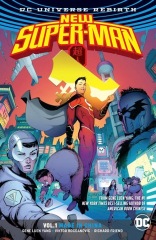 New Super-Man is a lot of fun. Writer Gene Luen Yang approaches it like a serious spoof and artists Viktor Bogdanovic and Richard Friend are very much in on the joke.

 Dave Gibbons does the most art on World’s Funnest. It’s not exactly the standard Dave Gibbons art, either, it’s Dave Gibbons doing Silver Age and it’s awesome. What writer Evan Dorkin taps into with World’s Funnest is the experience of being a Batman and Superman fan in the late eighties and early nineties; it’s practically a companion piece for those Greatest [insert DC character here] Stories Ever Told. The hardcover ones with beautiful reprints of the old stories, which weren’t cool in any modern sense, but you had to do the work to appreciate them because you want to be a good fan. You want to understand. And Dorkin’s trip through the DC multiverse is all about understanding, both the multiverse and the way it presents to the reader. Even though the first eighteen or so pages are all set in the Silver Age, Dorkin’s observations about the tropes make it all very modern. It never feels wrong to the characters, but it’s rather self-aware, from injured villains to Robin’s constant need for approval; Dorkin could’ve stopped World’s Funnest with a Silver Age riff and done something awesome, but then he keeps going.


 Newell figures out how to manage the issue better this time–there’s still the informative scenes, a particularly one where Lois goes to a home for runaways–but they feel more natural. The plotting of the comic, which is somewhat confusing just because Lois isn’t a rational protagonist, is fantastic.