Lazarus (2013) #23

Lazarus  23

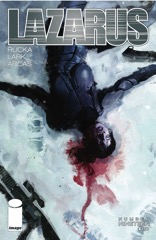
Rucka employs a lot of structure for this issue of Lazarus. There’s a framing device, then a flashback, then a reveal about the framing device. Only that reveal has absolutely nothing to do with what happened in the flashback and it doesn’t really change the initial frame, it’s just there for Rucka and Lark to do something else cool. There’s a sword fight. Lark does a really, really good job with it. He paces it out perfectly–you can hear the swords clanging looking at his panels–and then when Rucka gets around to the reveal on it? Turns out Rucka’s got some really great ideas too. It’s just a perfect thing in the comic.

It also has nothing to do with the main story. It’s like a glorified subplot, only specially rendered. And, wait, there is something else with some returning characters–maybe this arc is going to go a little bit differently in terms of narrative approach? i.e. Forever won’t be the lead. Something the flashback does address. Lazarus is just an expertly executed book at this point. Rucka and Lark have a phenomenal rhythm.

The flashback, which involves the Carlyle family and their sci-fi soap opera (I mean it in a very good way), has some twists and turns of its own. Rucka’s setting up the arc but he’s also making sure to reward the reader’s patience.

And there’s gorgeous Lark art.

Lazarus 23 (July 2016)

Lazarus #23Rucka employs a lot of structure for this issue of Lazarus. There’s a framing device, then a flashback, then a reveal about the framing device. Only that reveal has absolutely nothing to do with what happened in the flashback and it doesn’t really change the initial frame, it’s just there for Rucka and Lark to do something else cool. There’s a sword fight. Lark does a really, really good job with it. He paces it out perfectly–you can hear the swords clanging looking at his panels–and then when Rucka gets around to the reveal on it? Turns out Rucka’s got some really great ideas too. It’s just a perfect thing in the comic.

It also has nothing to do with the main story. It’s like a glorified subplot, only specially rendered. And, wait, there is something else with some returning characters–maybe this arc is going to go a little bit differently in terms of narrative approach? i.e. Forever won’t be the lead. Something the flashback does address. Lazarus is just an expertly executed book at this point. Rucka and Lark have a phenomenal rhythm.

The flashback, which involves the Carlyle family and their sci-fi soap opera (I mean it in a very good way), has some twists and turns of its own. Rucka’s setting up the arc but he’s also making sure to reward the reader’s patience.

And there’s gorgeous Lark art.

CREDITS

Cull, Part Two; writer, Greg Rucka; penciller, Michael Lark; inkers, Lark and Tyler Boss; colorist, Santiago Arcas; letterer, Jodi Wynne; editor, David Brothers; publisher, Image Comics.

Lazarus (2013) #22

Lazarus  22

Forever is out of commission this issue of Lazarus, giving Rucka time to develop Johanna further. The supporting cast of Lazarus is always something of a prickly situation as they know more than the protagonist and than the reader. It makes it hard to be sympathetic towards them, hard to trust them. Actively hiding something from Forever feels like actively hiding it from the reader. It’s hostile.

For instance, the little Forever Carlyle clone. She’s adorable. She has snowball fights. She’s probably going to either kill a bunch of people or get killed. It’s going to be tragic. And Johanna is aware of it and unfeeling about it. The most important thing Rucka’s done with his “world building” is make the characters of Lazaraus acceptably soapy. It’s the main suspension of disbelief. You have to believe the machinations.

This issue gives Johanna enough character–though Rucka does go a little far with the father issues. But Johanna does have enough character to function now. She’s rounded enough.

Now, all of this story stuff comes during what’s essentially an action issue. Lark gets to do two major battle scenes. With flying soldier guys. It’s awesome.

So nice to have another Lazarus.

Lazarus 22 (June 2016)

Lazarus #22Forever is out of commission this issue of Lazarus, giving Rucka time to develop Johanna further. The supporting cast of Lazarus is always something of a prickly situation as they know more than the protagonist and than the reader. It makes it hard to be sympathetic towards them, hard to trust them. Actively hiding something from Forever feels like actively hiding it from the reader. It’s hostile.

For instance, the little Forever Carlyle clone. She’s adorable. She has snowball fights. She’s probably going to either kill a bunch of people or get killed. It’s going to be tragic. And Johanna is aware of it and unfeeling about it. The most important thing Rucka’s done with his “world building” is make the characters of Lazaraus acceptably soapy. It’s the main suspension of disbelief. You have to believe the machinations.

This issue gives Johanna enough character–though Rucka does go a little far with the father issues. But Johanna does have enough character to function now. She’s rounded enough.

Now, all of this story stuff comes during what’s essentially an action issue. Lark gets to do two major battle scenes. With flying soldier guys. It’s awesome.

So nice to have another Lazarus.

CREDITS

Cull, Part One; writer, Greg Rucka; penciller, Michael Lark; inkers, Lark and Tyler Boss; colorist, Santiago Arcas; letterer, Jodi Wynne; editor, David Brothers; publisher, Image Comics.

Lazarus (2013) #21

Lazarus  21

Rucka gets so much done this issue, so many plot threads tied up–while introducing a great new one in the soft cliffhanger–I can’t even remember them all. It’s an extra-sized issue, which helps, because there’s a lot going on besides the war comic.

This issue, with Forever and her unit attacking the enemy’s position? It’s a war comic. It’s Michael Lark doing a war comic; sort of future-y, but not really. It’s also Lark doing an action comic. Forever’s in an action movie version of a war; she’s Chuck Norris. It’s awesome, because Rucka maintains the tone, maintains the seriousness. He, Lark and co-inker Tyler Boss are as restrained and careful as ever.

The rest of the comic has the family working on a cure for the patriarch while one of the daughters has to take over for the “in charge” brother because he can’t hack it. It’s almost like an episode of “Dallas,” only with a bunch of military stuff going on. But it’s all off-panel; it creates a lot of tension for Forever.

Lazarus continues to be a fantastic book.

Lazarus 21 (December 2015)

Lazarus #21Rucka gets so much done this issue, so many plot threads tied up–while introducing a great new one in the soft cliffhanger–I can’t even remember them all. It’s an extra-sized issue, which helps, because there’s a lot going on besides the war comic.

This issue, with Forever and her unit attacking the enemy’s position? It’s a war comic. It’s Michael Lark doing a war comic; sort of future-y, but not really. It’s also Lark doing an action comic. Forever’s in an action movie version of a war; she’s Chuck Norris. It’s awesome, because Rucka maintains the tone, maintains the seriousness. He, Lark and co-inker Tyler Boss are as restrained and careful as ever.

The rest of the comic has the family working on a cure for the patriarch while one of the daughters has to take over for the “in charge” brother because he can’t hack it. It’s almost like an episode of “Dallas,” only with a bunch of military stuff going on. But it’s all off-panel; it creates a lot of tension for Forever.

Lazarus continues to be a fantastic book.

CREDITS

Poison, Part Five; writer, Greg Rucka; penciller, Michael Lark; inkers, Lark and Tyler Boss; colorist, Santiago Arcas; letterer, Jodi Wynne; editor, David Brothers; publisher, Image Comics.

Lazarus (2013) #20

Lazarus  20

It’s been too long since I last read Lazarus. The comic’s bimonthly and has been for a while. Maybe forever (no pun intended). But, with Lazarus’s big cliffhangers of late, I guess I expected Rucka to be more sensational with this issue. Instead, he’s reserved. He’s not showing off.

This issue is the first one where I decided I’d read Lazarus again. I probably would have made that decision, but not for a while. With this issue, however… I want to go back immediately following its conclusion. Because Rucka’s pacing is strange. It’s deliberate, it’s distracting, but Rucka’s able to maintain an intense ambition to his storytelling.

And Lark gets to do a bunch this issue. A military combat sequence–beautifully constructed–and a nice little hand-to-hand fight. And some nearly noir machinations scenes. Lark’s not the artist to do the fantastical, which helps make Lazarus’s dystopian future realistic, but Lark is the artist who does the work. So it’s fantastical Lark, which seems an oxymoron, but isn’t.

Really good stuff. I hope the next issue comes out sooner than two months.

Lazarus 20 (November 2015)

Lazarus #20It’s been too long since I last read Lazarus. The comic’s bimonthly and has been for a while. Maybe forever (no pun intended). But, with Lazarus’s big cliffhangers of late, I guess I expected Rucka to be more sensational with this issue. Instead, he’s reserved. He’s not showing off.

This issue is the first one where I decided I’d read Lazarus again. I probably would have made that decision, but not for a while. With this issue, however… I want to go back immediately following its conclusion. Because Rucka’s pacing is strange. It’s deliberate, it’s distracting, but Rucka’s able to maintain an intense ambition to his storytelling.

And Lark gets to do a bunch this issue. A military combat sequence–beautifully constructed–and a nice little hand-to-hand fight. And some nearly noir machinations scenes. Lark’s not the artist to do the fantastical, which helps make Lazarus’s dystopian future realistic, but Lark is the artist who does the work. So it’s fantastical Lark, which seems an oxymoron, but isn’t.

Really good stuff. I hope the next issue comes out sooner than two months.

CREDITS

Poison, Part Four; writer, Greg Rucka; penciller, Michael Lark; inkers, Lark and Tyler Boss; colorist, Santiago Arcas; letterer, Jodi Wynne; editor, David Brothers; publisher, Image Comics.

Lazarus (2013) #19

Lazarus  19

It’s so good. Do I always start a Lazarus response with that statement? “It’s so good.” Like every time I read the comic, I’m surprised by how good Rucka and Lark do on the comic. It’s always a surprise too. Rucka hits a new ceiling. He integrates Lark and his abilities in an entirely predictable but entirely unexpected way. It’s great stuff.

Lark’s art is real strong this issue overall. He’s got really varied storylines going on, each needing distinct, immediate visuals. Lark finds a tone for each. What’s really cool–and something Rucka did carefully–was get someone likable into every storyline. Or someone comically unlikable (the evil, incestuous sister). It brings a soap opera element into it. And then Lark and Rucka deliver an action sequence.

Lazarus, very, very discreetly, mixes genres. And Rucka does it really well. It might be why the first arc didn’t connect–it was setting up the situation to allow Rucka all the freedom. The painful exposition about the dystopian future, for example, set up the second storyline, which is where Lazarus started to get good. And now it’s one of my favorite comics.

Awesome last sequence too; just awesome.

Lazarus 19 (September 2015)

Lazarus #19It’s so good. Do I always start a Lazarus response with that statement? “It’s so good.” Like every time I read the comic, I’m surprised by how good Rucka and Lark do on the comic. It’s always a surprise too. Rucka hits a new ceiling. He integrates Lark and his abilities in an entirely predictable but entirely unexpected way. It’s great stuff.

Lark’s art is real strong this issue overall. He’s got really varied storylines going on, each needing distinct, immediate visuals. Lark finds a tone for each. What’s really cool–and something Rucka did carefully–was get someone likable into every storyline. Or someone comically unlikable (the evil, incestuous sister). It brings a soap opera element into it. And then Lark and Rucka deliver an action sequence.

Lazarus, very, very discreetly, mixes genres. And Rucka does it really well. It might be why the first arc didn’t connect–it was setting up the situation to allow Rucka all the freedom. The painful exposition about the dystopian future, for example, set up the second storyline, which is where Lazarus started to get good. And now it’s one of my favorite comics.

Awesome last sequence too; just awesome.

CREDITS

Poison, Part Three; writer, Greg Rucka; penciller, Michael Lark; inkers, Lark and Tyler Boss; colorist, Santiago Arcas; letterer, Jodi Wynne; editor, David Brothers; publisher, Image Comics.