Category: ★★½
-

John Wayne gets first billing in The Long Voyage Home, but the picture really belongs to Thomas Mitchell, Ward Bond and Ian Hunter. The film’s a combination slash adaptation of four one-act plays–which is somewhat clear from the rather lengthy sequences tied together with shorter joining scenes–and while Wayne gets one of his own, it’s…
-
I wonder if the U.S. Army would like to get a movie like Tank out today. The movie’s politics are… well, they’re not hilarious, but they’re so blatant, it’s stunning. It’s a pro-Army film and an intensely anti-Georgia film. It likes Tennessee though. From Tank, a future cultural historian could surmise the residents of Georgia…
-
The chase scene in Killer’s Kiss, which occupies almost the entire third act, is a marvel. From the moment Jamie Smith jumps out the window and hits the pavement, the film leaps beyond the potential Kubrick has instilled it with until that point. Before, there’s a lot of great low budget filmmaking, there’s a lot…
-
Take the Money and Run kind of dangles on a line. It’s occasionally a screwball comedy–something the Marx Brothers would have done–and alternately a thought-out spoof of documentaries. The breeze moves the film’s direction and it’s hard to know where it’ll go next. Allen has a significant problem with the film’s structure, however, with the…
-

Bolivia didn’t do Butch and Sundance any favors and it doesn’t do Che any either. Che: Part Two isn’t just a downer for Del Toro’s franchising revolutionary (he’s bringing the revolution to Bolivia, whether they want it or not), but it’s an entirely depressing film too. There’s probably not a positive way to tell this…
-
It’s not just Janet Leigh being in the film or all the trouble–visibly–starting when Jamie Lee Curtis arrives in town, it’s everything about The Fog–it’s an aware Hitchcock homage. The list can continue with the setting, the reference to The Birds, but it’s even more. There’s a definite feel to the film; Carpenter seemingly (he…
-

For a film with pioneering use of widescreen composition–the shot with the cars moving past Natalie Wood–and one of the better film performances (James Dean), Rebel Without a Cause is a curious failure. It’s loaded with content–there’s the stuff with Dean and his parents, the stuff with Wood and her father, the gang, Sal Mineo,…
-
For Valkyrie to work, Bryan Singer needs to get–give or take–five minutes when the viewer isn’t entirely sure Adolf Hitler wasn’t assassinated. The entire premise of watching a film, a historically-based film, where the conclusion is well-known and suspending disbelief… he needs five minutes. Maybe the trick is casting Tom Cruise as a German. By…
-

Constantly problematic and constantly great big screen comic book movie with fantastic direction from Burton, wonderful score (from Danny Elfman), a good (against type) performance from Michael Keaton in the title role, and spell-binding production design. The minuses include leading lady Kim Basinger, who’s often quite bad, some clunky plotting, and a disinterested (albeit not…
-

JCVD might be the ultimate vanity project. I’m not sure if there’s any intention in Van Damme trying to rehabilitate his image–his fans will be his fans no matter what, something the film touches on–but it’s kind of spectacular in its purity. Van Damme’s a well-known punch line, a leftover from the 1990s, and he…
-
The intrepid reporter genre has almost entirely disappeared. These are the films–around since the 1930s, when newspapers became American cinema’s ideal breeding ground for protagonists (many screenwriters, new to talkies, were former journalists)–where the reporter is investigating a murder or series of murders, ones the police can’t quite seem to solve (the police might even…
-
All due respect to Rick Baker, but Rob Bottin’s werewolf transformation in The Howling is superior. The transformation lasts so long it’s no longer shocking, just interesting. It’s so deliberate, it got me wondering what the werewolf would do if he needed to change in a pinch… if he didn’t have three or four minutes…
-

I can understand why Chris Carter and company made X-Files: I Want to Believe (though not the title), but I can’t understand why Fox produced it. The film was a significant bomb, even if it didn’t cost very much, and some critics dismissed it as an episode turned into a feature. It’s anything but… instead,…
-

Ground Zero opens with a title card attesting to the film’s historical relevance. The intended effect is apparently to convince the viewer of the film’s authenticity and plausibility. So, for a film featuring a cameraman who can outfight spies, Ground Zero is completely plausible until the helicopter shows up. Not the first helicopter, but the…
-

The sub-ninety minute indie film is practically becoming a genre (I’m assuming these short lengths have a lot to do with sales to commercial cable–ninety minutes fits perfectly into a two hour slot on TNT). Birds of America is both a part of this burgeoning genre and the post-Little Miss Sunshine indie dysfunctional family comedy…
-

As we waited for Religulous to start–my wife had confiscated my iPod touch for her own purposes–I read an article in The Onion about the coming election. The sixty million people voting for one candidate will not talk to any of the sixty million people who are voting for the other candidate. That–along with a…
-

Choke working at all is kind of something special. The film’s got a major twist at the end, but it’s a silly one and isn’t, with any thought on the matter, particularly feasible. The film’s got a major plot point for Sam Rockwell–his mother’s diary reports he’s the half-clone of Jesus–and, eventually, he believes it…
-

One Sunday Afternoon suffers from some of the standard play-to-film problems. The scenes go on too long, especially in the first half, which only contains three real scenes. The opening, which is a lengthy, seemingly direct adaptation from the play, features Gary Cooper and Roscoe Karns talking to each other as way of establishing the…
-

Colossus is a pre-disaster movie, in the Irwin Allen sense. It has a lot in common with films like The Andromeda Strain and The Satan Bug. The problem is established and then the film’s story is an attempt to resolve it. It’s a little less character-oriented than the Allen disaster formula–Colosuss doesn’t have much lead-in,…
-
People really started noticing Tommy Lee Jones fifteen years ago, with The Fugitive. He was recognizable, given his long career to that point, but it was after The Fugitive, people started talking. Since then, Jones has done some good work and some bad work. He’s not usually bad in that bad work, but come on……
-

If I recall correctly, Mike Mignola never had Hellboy and Selma Blair’s firestarter get together (romantically) in the comics, even though Hellboy is flame resistant. That filmic development was all Guillermo del Toro’s. del Toro is responsible for everything successful in Hellboy and, subsequently, everything unsuccessful. Hellboy works, which is probably the film’s greatest achievement–it’s…
-

The biggest development, in terms of script, in Indiana Jones and the Kingdom of the Crystal Skull might actually be George Lucas’s fingerprints. Between Last Crusade and this sequel, Lucas created the “Young Indiana Jones Chronicles” television series and introduced the idea of canon to the series. As an example, in Crystal Skull, Harrison Ford…
-
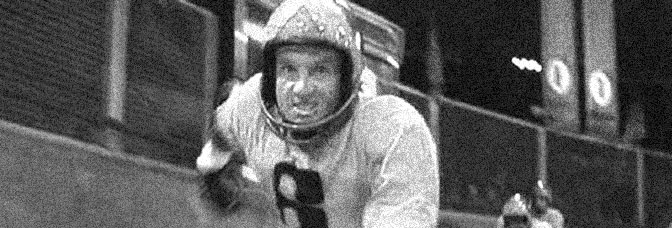
Somehow, it’s impossible to find an actual Tarkovsky quote regarding 2001 online, just tidbits about Solaris being his humanist response to that film. Damn. I wanted to open with a comment about Norman Jewison sharing the opinion about the science fiction genre. Rollerball‘s a technical masterpiece. Jewison’s sense of composition and editing have never been…
-

Harry and the Hendersons has to be one of the most emotionally manipulative movies ever made. Amblin produced it (though Spielberg’s name isn’t on the credits anywhere) and it comes off as the finale part of the E.T. and Gremlins trilogy. Except in this one, it isn’t about a boy and his Bigfoot, it’s about…
-

Here’s a surprising one. I was ready to say director Langenegger was a music video director who learned how to calm it down for a theatrical, but it appears he’s just a commercial director. For most of Deception, I was just letting myself enjoy the technical. Langenegger’s composition, Dante Spinotti’s photography and Ramin Djawadi’s music…
-

What Peter Hyams does at the end of Outland–cutting away from Sean Connery to a shot of the mining station with a superimposed message from the character to his wife–ought to be a crime. Hyams gets one of Connery’s better performances out of him and then cheats both Connery and the viewer from giving the…
-

Even with the overbearing music and the strange lighting for emphasis (play-like, it dims to concentrate attention on an object or person), lots of Mary of Scotland is rather well done. Ford’s got some excellent shots and, at times, creates anxious scenes. It’s hard to get particularly excited during most of the film because, while…
-

True Believer is never quite anything it sets out for (story-wise)–it’s not the story of a lost man finding his way, it’s not a legal drama, it’s not the story of a young lawyer spurning riches for morals. Instead, it’s a courtroom movie with corruption, chase scenes through metal shops, a great Brad Fiedel score…
-

Somehow Altman lets The Gingerbread Man get away from him. Never the direction, which holds up until the end–and seeing Robert Altman direct a fight scene is something to behold–but the plotting. The film starts high, thanks to the compelling plot and the performances, but then the plot gets more and more… not convoluted, but…
-

A lot of Strange Cargo is really good. Borzage isn’t the most dynamic director, but every time he has a startlingly mediocre shot, he follows it with a good one in the next few minutes. The film’s got lengthy first act–thirty minutes–and then moves from confined location to confined location. The first act is the…
 The Stop Button