Category: Foreign
-

There’s always something to be said for a new approach to a standard genre. The Silence is a murder mystery, kind of a cold case one, kind of not, kind of serial killer, kind of not. Director bo Odar tries really hard in the end to give the film a singular ending and he fails.…
-
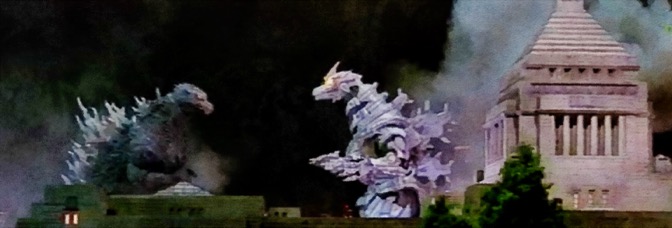
While it doesn’t make the film any better, one sort of has to have seen the original Mothra to truly appreciate Godzilla: Tokyo S.O.S.. Why? Because director Tezuka keeps that film’s weird Christian imagery. Pretty sure the living Barbie dolls who deliver messages for a giant moth isn’t Christian, but dang if it isn’t effective…
-

Even for a movie about a giant man-made robot fighting a giant monster, Godzilla Against Mechagodzilla is pretty stupid. The robot was this amazing weapon, capable of destroying Godzilla, yet its pilot always waits to use it. Obviously, there wouldn’t be a movie if she used it right away… but Against never explains why everyone’s…
-
Phantom tries hard not to have a narrative. On the surface, one could argue it really doesn’t–an unnamed woman and man talk. Director Soler has his actors recite their dialogue without much emotion. There are a couple really funny moments, but never do the characters seem to get tired. It is a narrative, of course–it…
-

Who would have thought a movie just called Drug War would be so amazing? The original Chinese title appears to be just as simple, director To and his amazing batch of writers–War is the probably the best four person scripted film ever–must have known they didn’t really need a flashy title. To’s direction is astoundingly…
-

Besides an utterly absurd title–and one nowhere near as clever as the film itself–A Werewolf Boy is something of a success. Jo proves one can successfully marry science fiction, werewolf romance, class bigotry and… I don’t know, ageless romantic melodrama. He doesn’t cop out at the end either, but turns the picture into some kind…
-
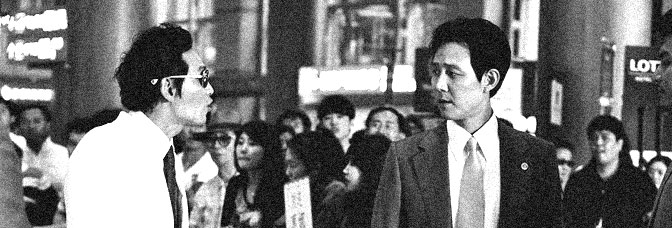
It never occurred to me there might still be significant mileage in the undercover cop melodrama. Or, for that matter, in the gangster melodrama. New World proves me uninformed on both points. Writer-director Park mixes both genres, somewhat unequally, and creates this unbelievably good film. I use the adjective “unbelievably” because, for the most part,…
-

With The Tower, director Kim redefines the possibilities of the fictional disaster genre. He maintains many genre standards, like the occasional laugh to relieve stress, a fair amount of melodrama, along with the greedy capitalists and the politicking city officials, while throwing in some gore and a breakneck action movie pace. But he mixes in…
-

Tai Chi Hero basks in its extravagance. Whether it’s the kung fu fighting, the battle scenes (these are different types of scenes) or just the imaginative steampunk gadgets, Hero always invites the viewer to enjoy what it’s creating. And when Fung has to come up with something different? He does. And he does a great…
-
Final Deadball is a strange little thing. At first I thought it would be incomprehensible without seeing Deadball–Final is a short spin-off semi-sequel for one of the supporting cast in Deadball–but halfway through there’s a big expository scene so one might be able to understand it without seeing the feature. I wish I had some…
-

No doubt, Deadball is a strange one. And not just because thirty-six year-old Sakaguchi Tak is playing a seventeen year-old and actress Hoshino Mari is playing his sixteen year-old male sidekick. I’m not even sure the suggestion conservative Japanese politicians are really in the pockets of Nazis is Deadball’s strangest feature. It’s just a messed…
-
Near as I can recall, Tormented is my first modern Japanese horror movie. Somehow, I’m still familiar enough with the genre to know this one’s highly derivative. The writers throw in something else ominous every few minutes just to keep the picture moving–and it’s only eighty minutes so they clearly didn’t have any initial story,…
-

About the only inventive thing in Bangkok Revenge–and I doubt writer-director Minéo uses it for this reason–is lead Jon Foo being unable to experience emotion. It means Foo doesn’t have to give a particularly good performance. He just has to deliver his lines and he does. He’s not a bad guy, of course, quite the…
-

The Great Magician is a madcap romp through rural early twentieth century China. It never says rural–Peking is mentioned a couple times–but it feels rural, where a somewhat dimwitted warlord (Lau Ching-wan) can still be powerful. The time period’s a little confusing too. Moviemaking plays a significant part in Magician and all the example films…
-

If you happened across The Samurai of Ayothaya and missed the terrible opening expository narration, you might think you found an awesome martial arts movie about a bunch of Thai Freddie Mercury impersonators in a Battle Royale situation. Sadly, you did not. You instead found a terrible mix of a military thriller and a martial…
-
The first half of The Girl Who Kicked the Hornet’s Nest falls victim to the Halloween II phenomenon. The main character–in this case Noomi Rapace–is in the hospital and out of commission. Hornet’s Nest is never comfortable giving insight into Rapace’s actions, which makes it a mildly pointless final entry. I mean, a Hollywood ending…
-

The Thieves doesn’t try to redefine the heist genre. Instead, it shows the genre’s possibilities. The film has the traditional flashbacks, double crosses, triple crosses and so on, but it also brings a tenderness. And it’s a sincere tenderness; the film resonates because of its characters, not its spectacles. However, director Choi does everything he…
-

Calling The Girl Who Played with Fire pointless is an insult to all the other pointless sequels out there. Fire–and I’m sure it’s a faithful adaptation of the source novel, which is undoubtedly pointless as well–is the worst kind of sequel. It has no new story, so it just goes back and forces one out…
-

An adaptation of something like Dangerous Liaisons–where the ending isn’t just assured, but probably familiar to the viewer–requires good actors and an interesting approach. This version of Liaisons has both. It takes place in 1931 China; the Japanese have started attacking and there’s unrest. Director Hur has a great sense of style for this era…
-

Presumably the Zero in Tai Chi Zero‘s title indicates a second installment is forthcoming, because this one ends on two cliffhangers. The film joyously embraces its artificiality–there’s no attempt at making the kung fu fighting seem realistic; instead, director Fung concentrates on making it look good and drawing attention to that effort. The opening titles…
-
Despite its opening–a training camp for turning kidnapped peasant children into killers–The Assassins is actually a manor drama. Sure, it’s a Chinese manor drama, but it’s a manor drama. The action principally takes place at Chow Yun-fat’s estate. There are all sorts of political machinations (none interesting) and some character development (mildly interesting). Chow looks…
-
Doomsday Book is three stories about the end of the world. There’s no connection between the stories except the directors; the tone changes wildly between all three. The first story is a zombie tale with some humor, some religious allegory and some gore. There are a lot of Romero references in it and also the…
-

Wu Dang is a mix of a martial arts competition picture and Indiana Jones. Director Leung never quite emphasizes the 1920s setting, partially because of the plot–the action moves quickly to a timeless temple–but also because everything in Dang looks so fake, if Leung doesn’t move fast, the CG shows. His direction has a lack…
-

Sector 7 is about twenty-two years late. It’s another “Alien with sea monsters;” 1989 had two and a half major entries in that genre. It does, however, add one interesting element. Wait, I guess it’s more Aliens with sea monsters. The female lead, Ha Ji-won, is more Ripley in tough mode. Anyway, the interesting element…
-

For a while during Suicide Forecast—in the first act and third—it seems like the film will be about protagonist Ryu Seung-beom discovering he doesn’t want to be a soulless business success and redeeming himself. But Forecast isn’t exactly about Ryu. A plot summary sounds like a perverse comedy—Ryu’s an insurance adjuster who discovers three people…
-

Painted Skin: The Resurrection is an unpleasant experience, straddling the fence between stupid and bad. The script, from Ran Ping and Ran Jia-nan, is the weakest link. This magnificent, grandiose melodrama set in Ancient China only has a handful of characters in it. The side characters populating an elaborately constructed–physically and digitally–fall away to concentrate…
-

Arahan has a couple big problems. One is just for me–I didn’t get the final joke. I wonder if it was something cultural. The other one has to do with mainstream Korean cinema. Arahan takes a lot from Western blockbusters (most obviously The Matrix… though there’s a nice Back to the Future homage) and marries…
-

Until about halfway through, I knew how to start talking Bedevilled. It was about a yuppie workaholic (Ji Seong-won) flipping out and going on a forced vacation. Only she goes to this remote island where she used to visit her grandfather as a kid. Instead of a vacation paradise (though the island is lovely), she…
-

Black Book is a film of convenience; whether it’s a negative to further the plot or a simple positive like there being a nonsensical chute to allow easy entry into a basement, the film keeps oiling its gears. It’s not predictable—in fact, it hinges on being unpredictable (Black Book owes a lot to the heist…
-

There’s enough story for three really good movies in The Girl with the Dragon Tattoo, maybe even four. The film opens with two of them, a good, old fashioned journalism movie, and then the very serious experiences of Noomi Rapace. There’s some crossover, but it’s all contrived. Then the film blossoms and has two more…
 The Stop Button