Category: Documentary
-
According to the opening titles, 20 Feet from Stardom will focus on background singers and session vocalists Darlene Love, Merry Clayton, Lisa Fischer, and Judith Hill. Love and Clayton started in the sixties, Fischer in the eighties, Hill in the aughts. If they’re the main cast, the supporting are Claudia Lennear and Tata Vega. The…
-

Wild Life has a “what if Douglas Sirk did an epic filmed over multiple years” feel to it. And Wild Life, though the film never acknowledges it, was filmed over multiple years. And not by directors Vasarhelyi and Chin. The subject of the film—Douglas Tompkins (the lead is his widow, Kris Tompkins, but it’s all…
-

The first half of George Carlin’s American Dream is a history lesson. Big history and little history; it’s the history of comedy in the second half of the twentieth century; it’s the story of Carlin and his family. It’s the story of his career and how success changed his life; how some things got better,…
-
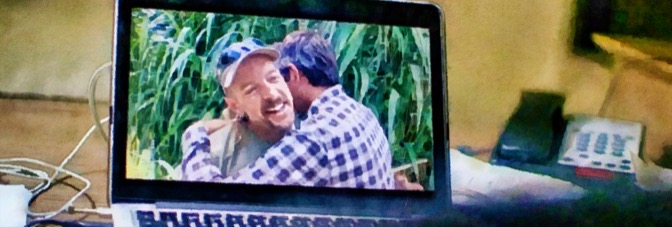
If its aloof and earnest host is to be believed, Louis Theroux: Shooting Joe Exotic was totally going to be about said host, Louis Theroux, journeying to Texas during the COVID-19 pandemic to do a new documentary about Joe Exotic. Exotic appeared on one of Theroux’s documentary specials ten years ago and, since being convicted…
-

If you told me Room 237 exists because someone wanted to test out how far the “Fair Use” part of copyright exception went… well, okay, I wouldn’t believe it because obviously there’s the other terrible stuff going on and you’d do it better if you were just trying to bring “Fair Use” to the Supreme…
-

The Bee Gees deserve a more comprehensive documentary thanHow Can You Mend a Broken Heart. The film skips over a lot of specifics in the early years, then ends its main narrative in the late 1970s with the Disco Demolition, which could have been a major turning point in the film as they’re talking about…
-

For its protracted 106 minute runtime, Vampira and Me is a combination of tragic, frustrating, annoying, and enthralling. The problem with the whole project is writer, producer, editor, director, and narrator Greene. Well, okay, the problem with any project about Vampira (Maila Nurmi) is the lack of extant footage of her television show, “The Vampira…
-

Overnight is occasionally amusing, often mortifying, never contextualized enough to be interesting, and always compelling. But it’s compelling only if you’re somewhat familiar with the subject of the film, Troy Duffy. Specifically, Duffy’s directorial debut, The Boondock Saints. In 1997, Harvey Weinstein bought the script for Duffy to direct at Miramax and less than a…
-

Often visually breathtaking documentary about rock climber Alex Honnold’s potentially suicidal attempt to “free solo” (climb alone without ropes or gear) Yosemite’s El Capitan, something never before accomplished. The filmmakers don’t have a strong narrative (or point, outside showcasing Honnold’s possibly brain abnormality related lack of self preservation and the great outdoors). Also hurts Honnold’s…
-

When documentary filmmaker Louis Theroux can’t get the Church of Scientology to participate in a film about the Church of Scientology, he enlists various ex-communicated Church members to help him cast actors as Church officials in an attempt to glean some insight into the mysterious organization. Sometimes funny, sometimes terrifying, always thoughtfully executed and constructed.…
-

Hail Satan? starts with a joke and ends with Satanic Temple spokesperson Lucien Greaves having to wear a kevlar vest to a rally because so many Pro-Life, Born Again Christians are making legitimate assassination threats. The opening joke is one of the first Satanic Temple rallies, when they’re goofing on Rick Scott. In the span…
-

De Palma is director Brian De Palma talking about his films. He’s talking to the directors, Baumbach and Paltrow, but without ever addressing them by name. De Palma’s filmmakers have zero presence in the film, until the epilogue. Matt Mayer and Lauren Minnerath’s editing is magnificent, especially how they’re usually able to keep De Palma…
-

The first half of 13th is didactic–well, except when the film makes fun of interviewee Grover Norquist. There are three or four capital C Conservatives interviewees; Norquist and Gingrich are present because they’re such trolls they think they’re convincing. Gingrich is during his Black Lives Matter phase (the documentary is pre–2016 election, but still very…
-

Even though the film’s called Colin Hay – Waiting For My Real Life, it’s not entirely clear what relationship the documentary is going to have with its subject. There are various people interviewed, ranging from Australian movie stars to record execs to sitcom stars to Mick Fleetwood. Directors Faulls and Gowtham do a fantastic job…
-

The Man Who Skied Down Everest is a peculiar film. It’s straight, methodical narrative non-fiction. In 1970, Miura Yûichirô set out to ski down Everest. His expedition included a film crew. The resulting film doesn’t tell Miura’s story outside the present action–through narrator Douglas Rain, Miura’s diary entries tell the story in the present tense.…
-

Every question director Bell raises in Sons of Ben–passively, because he never lets himself have a presence in the film; Sons of Ben isn’t an active documentary (which makes it all the more impressive)–Bell addresses all of those questions, even the difficult ones, even the somewhat off-topic ones. An example of the latter is the…
-

The best part of The American Dreamer is some of Warner E. Leighton and co-director Schiller’s editing, which only works thanks to Schiller and Carson’s filmmaking. They have this wonderful device where they film their subjects listening to recordings of their previous filming and then cut, often imperceptibly, between the subjects listening to themselves and…
-

According to William Shatner, in his capacity of host–in addition to hosting Chaos on the Bridge, he also conducts interviews, wrote and directed the documentary–he wants to know about the first few years of “Star Trek: The Next Generation,” because he’d always heard they were crazy. And they were. He brings out a bunch of…
-

Director Dunham’s thesis for Spirit of the Marathon is a little iffy. He clearly wants to show the differences and similarities between marathon runners–Dunham and the rest of the crew have zero presence in the documentary, which is fine (eventually). He goes from the people doing it for fun, to people doing it for personal…
-

The Galapagos Affair: Satan Came to Eden has way too long of a title. The subtitle is a reference to something the viewer will probably be unfamiliar with until the epilogue (it’s the title of a book by one of the documentary’s players), but at least it shows a certain engagement from the filmmakers. Their…
-

Director Jarecki tries to appear like he’s staying out of Capturing the Friedmans. His voice occasionally appears behind the camera when interviewing but these questions are usually for effect. Jarecki is deliberate in the construction of the documentary; he only lets it get away from him once. Capturing the Friedmans examines a sensational child abuse…
-

To Be Takei is unexpected, even though everything it presents about its subject’s life is somewhere between common knowledge and readily accessible knowledge. Even though director Kroot opens the film on a jovial note–George Takei (the titular Takei) and his husband, Brad Takei (sort of also the titular Takei), taking their morning walk and bickering…
-

Almost everyone interviewed in She Makes Comics does indeed make comics. The film never says what most of these interviewees made–I know what interviewee Heidi MacDonald edited because I remember (she’s identified for her current journalism), but I don’t remember what fellow Vertigo editor Shelly Bond edits. I know she edited things I read, but…
-

Tim’s Vermeer is simultaneously an intensely personal look at a guy–the titular Tim, Tim Jenison–and also not an intensely personal look at him. Jenison sums up his hypothesis in the first few minutes of the film–what if Vermeer (and some of his contemporaries) were less hippy dippy artists (my term) and more inventors? They were…
-

Watch In Heaven There Is No Beer with a notebook handy, because you’re going to want to write down some of the band names. A lot of them. And waiting for the end credits doesn’t help unless you’re quick with the pause button. Beer is the story of the Kiss or Kill “club,” which was…
-

The title, Paul Williams Still Alive, might be considered a spoiler if anyone except writer-director Kessler was sure Paul Williams wasn’t alive. The film chronicles Kessler’s rediscovery of Paul Williams–more as a seventies entertainer than Paul Williams the songwriter or singer. There’s a lot about Kessler in the picture, including a lengthy section where he’s…
-

Get Lamp is part history documentary, part modern examination, part something else. It changes throughout, which is only natural… director Sadofsky gives the viewer control of the documentary’s structure (but also offers a cruise controlled version). Lamp is an affectionate look at early computer games, specifically the text-based ones–so Zork, not King’s Quest. There’s a…
-

Watching The Business of Being Born, one has to wonder about the structure. It starts as an investigation into the way hospitals deliver babies in the United States (the responsibility is not entirely with the hospital, of course; the film opens discussing Manhattan mothers scheduling their cesarean sections). But the narrative changes course once director…
-

There’s no director or writer credited for You Will Believe and without a host, the “documentary” sort of ambles through the history of the Superman film series. Given the contentious history, it goes far in bringing everyone into it… but it doesn’t actually ask any questions. There’s only one moment when it directly refutes something…
-

I don’t write a lot of responses to documentaries on The Stop Button. There are many reasons for it, with the primary one being I’m not sure what constitutes a documentary film. But Good Hair is definitely the kind of documentary I respond to here on The Stop Button. I first heard about it on…
 The Stop Button