Category: Comedy
-

One of the best gags in Wet Hot American Summer is having the twenty and (some) thirty somethings play teenage summer camp counselors. One big problem? Not making the gag clear until the end of the movie. It would have gotten a lot more mileage throughout. Summer goes out on an awkward note–almost an homage…
-

To Rome with Love is sort of hostile to its viewer. Allen sets up three (or four, depending on how you want to count) plots and plays them all concurrently. However, these three (or four) plots don’t necessarily coexist in the same Rome, certainly not at the same time they linearly play out in the…
-

With The Big Chill, Kasdan tries to be profound, heart-warming and cynical. He doesn’t succeed. For a film so much about introspection, Kasdan is surprisingly unaware at the inherent artifice. The film’s cast of characters are–if they’re male–extraordinary. There’s some lip service to the women’s successes (doctor, lawyer) but the men are rich or famous.…
-

Ted has a number of successes; it’s a little hard to identify its most extraordinary one. Is the CG teddy bear, voiced by director MacFarlane, who seems entirely real throughout? Or is it the script, which makes it feasible for a magical, living teddy bear to exist in the real world? Or is it simpler–Ted…
-
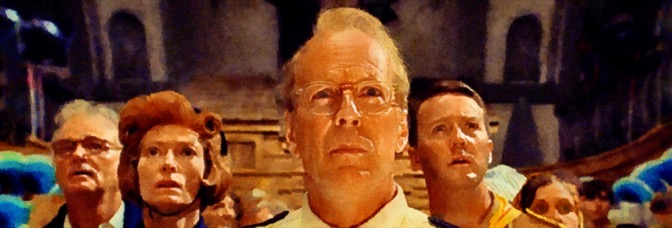
With Moonrise Kingdom, Wes Anderson has finally put his directing craft so far ahead of his narrative, the narrative doesn’t matter. Neither, in Moonrise‘s case, do the actors. There isn’t a single outstanding performance in the film… maybe because Anderson and co-writer Roman Coppola don’t write one. They’re to the point of using Jason Schwartzman…
-

It’s hard to say what’s worse in My Science Project, Beutel’s lame characters or his direction of the actors playing those roles. And I’m not counting Dennis Hopper, who plays an ex-hippie in the picture. While Hopper certainly has a poorly written character and Beutel’s direction of him is bad… it was Hopper’s decision to…
-

Man Trouble is a strange film, right from the start. It opens with then thirty-year-old Lauren Tom in old age makeup (well, her hair tinted grey). That casting choice–following the animated opening titles–establishes it as an oddity. It’s not a bad film, just a strangely detached one. The protagonist is Ellen Barkin, but since she’s…
-

With Dark Shadows, director Burton and screenwriter Seth Grahame-Smith find a great formula for humor in the film, which has a lot of inherent humor in just taking place in 1972 and having vampire running around. While it’s very much comedic, Burton infuses it with a surprisingly dark element. But Johnny Depp’s lead isn’t the…
-

Every shot in Manhattan, whether of the cityscape, the interiors or the actors, is so carefully and beautifully composed, it’s not surprising Allen lets the cast go a little loose. Gordon Willis’s black and white photography is luminous, giving the city an otherworldly, dreamlike feel. That feeling, thanks to Allen’s composition, carries over to some…
-

Crimes and Misdemeanors is not a particularly nice film. It juxtaposes two men in crisis–Martin Landau’s successful ophthalmologist has a girlfriend (Angelica Huston) who is threatening to tell his wife and Woody Allen’s failing filmmaker is crushing on the producer (Mia Farrow) of the his project. Allen’s only on the project, a biography of his…
-

Alda opens A New Life likes it’s going to juxtapose he and Ann-Margret’s lives immediately follow their divorce. For a while, it does. Alda’s got Hal Linden as a sidekick, Ann-Margret’s got Mary Kay Place. It’s all very even. She’s going back to school, he’s trying to figure out how to date. The beginning might…
-

Something unfortunate happens during the last third of State and Main… Mamet realizes he needs a story. He goes so long without traditional narrative elements—the film has, at best, a roaming protagonist and Mamet doesn’t do much establish the ground situation as hint at one for smiles. Mamet doesn’t go for belly laughs in the…
-

Despite all Danny DeVito’s vulgar innuendos–though there are a couple missed opportunities–Other People’s Money is a rather chaste film. Director Jewison’s model for it is a Hollywood classic, with exquisite gowns for DeVito’s love interest slash rival, Penelope Ann Miller, and hats for the men. With photography from Haskell Wexler and Alvin Sargent’s thoughtful, deliberate…
-

Apparently, Ivan Reitman didn’t think anyone would be familiar with Arnold Schwarzenegger and, therefore, Schwarzenegger would need a big introduction as a tough guy in a movie called Kindergarten Cop. So the first fifteen minutes are a terrible cop movie, wasting cinematographer Michael Chapman on something less realistic than a syndicated eighties cop show. Once…
-

Dirty Rotten Scoundrels manages to have a full, three act plot–with all the twists necessary for a confidence picture–but it also is constantly funny. Oz juggles his two leads but mostly relies on Steve Martin for the more immediate humor. With Michael Caine, Oz and the screenwriters tend to be a lot quieter… letting the…
-

A House in the Hills is, for the majority of its running time, pretty darn funny. It’s a romance novel run through a black comedy filter, with Helen Slater playing the lead. The film takes place in LA; Slater’s an actress and ends up being the one character the film never actually explains. It’s one…
-

City Slickers is a mid-life crisis comedy. I had forgotten about that aspect of it. All three principals–Billy Crystal, Bruno Kirby and Daniel Stern–start the movie in a funk. Well, actually only Crystal. The other two’s problems reveal themselves throughout. Especially Kirby. His backstory takes so long to reveal, it strains believability. It’s not believable…
-

In Switching Channels, Kotcheff attempts two styles he’s inept at directing—madcap and slapstick. He’s got Ned Beatty, who can act in both those styles, and Beatty does okay. He’s not any good, but one can’t hold the film’s failings against him. But for his other buffoon, Kotcheff uses Christopher Reeve. The audience is supposed to…
-

Serial Mom gets a lot of mileage out of its concept–Kathleen Turner’s June Cleaver as a serial killer (actually, spree killer)–before it runs out of gas. Sadly, once it does, all of the plot problems become clear. But then Waters brings it to court and Mom is reinvigorated. Turner’s not special during the first hour…
-
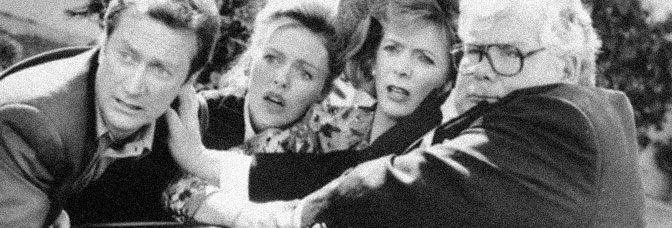
Herman opens Blame It on the Bellboy with his two weakest features—and the film’s full of weaknesses so to start with the worst ones? It’s sort of impressive he set it up to immediately stumble. First, Andreas Katsulas’s mobster. The film takes place in Venice and Katsulas plays the only Venetian. He plays the role…
-

There are some funny lines in Second Sight. Not many, but some. And they’re good, laugh out loud lines. It’d be hard for John Larroquette, reacting to Bronson Pinchot acting like an idiot, not to get some laughs. The whole thing feels like a “what I did on summer hiatus” for Larroquette and Pinchot. It’s…
-

In the listless younger man, experienced older woman genre, Meet Monica Velour is a painfully obvious modernization (the older woman is a former porn star, the younger man is an… avid fan). I use the ellipses because Meet Monica Velour’s protagonist is the finest example of the stalkers of the eighties growing up to be…
-
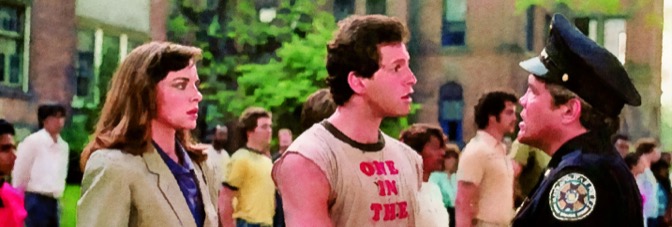
I forgot how loose eighties comedies are in terms of filmmaking and narrative. I don’t think Wilson has a single good shot in the film. The best ones are workmanlike at best and the worst… well, he has these absurdly weak low angle closeups on David Graf, either to make him look tall or crazy.…
-

Once upon a time, I read how what Apatow really does with Knocked Up is make a film about how men need to change to be acceptable for women. I think the article used stronger language. While that aspect of the film is present, it’s an extreme reading. It could just as well be about…
-

Oh, okay… it’s less than ninety minutes. I was wondering why The Naked Gun felt so fast. It’s because it’s short. That observation isn’t a negative one—the film is a constant delight, with Zucker, Abrahams, Zucker (and Pat Proft) coming up with a good laugh or gag every thirty to forty seconds. Someone should sit…
-

If it weren’t for the acting, Adventures in Babysitting would probably be more interesting as a cultural document than anything else. The way the film treats race is probably worth a couple sociology articles. Black people aren’t scary as much as foreign beyond belief. Space aliens would have more in common with the suburban kids…
-
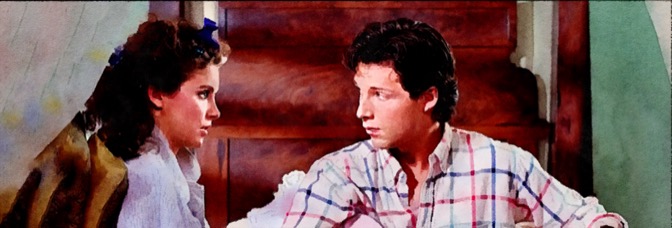
It Takes Two features a dream sequence set in protagonist George Newbern’s stomach. It looks cheaper than an antacid commercial. The movie’s filled with fake Southern accents–Newbern loses the accent after about fifteen minutes, right before he gets to the big city (Dallas) where he needs to buy an imitation Lamborghini from some seedy city…
-

It’s always a surprise when I remember Innerspace wasn’t a hit (it was also the first movie I ever saw as a letterboxed VHS–it was letterbox only). It’s easily Dante’s most populist work–I don’t think a single Dante “touch,” except for Dick Miller, shows up in the film until the appearance of Kevin McCarthy. Before,…
-

Until The 'burbs gets around to actually having to pay off on its premise–the strange new neighbors are really serial killers–it’s quite good. There’s no way the third act pay off can deliver and the film’s quality takes a number of hits in the last half hour or so. Olsen’s script is, technically, at fault……
-
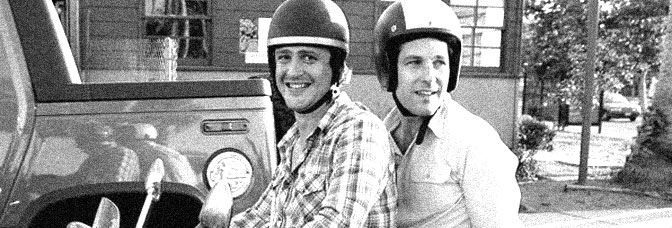
Could Paul Rudd make less of an impression in I Love You, Man? Even before Jason Segel shows up, Rudd is completely ineffectual. He’s supposed to be ineffectual, of course, but he’s also the protagonist of the movie. He doesn’t garner sympathy, he garners pity. But Hamburg’s whole approach is peculiar. He opens the movie…
 The Stop Button