
Paul Levitz (script)
Joe Staton (pencils)
Bob Layton (inks)
Elizabeth Safian (colors)
Joe Orlando (editor)
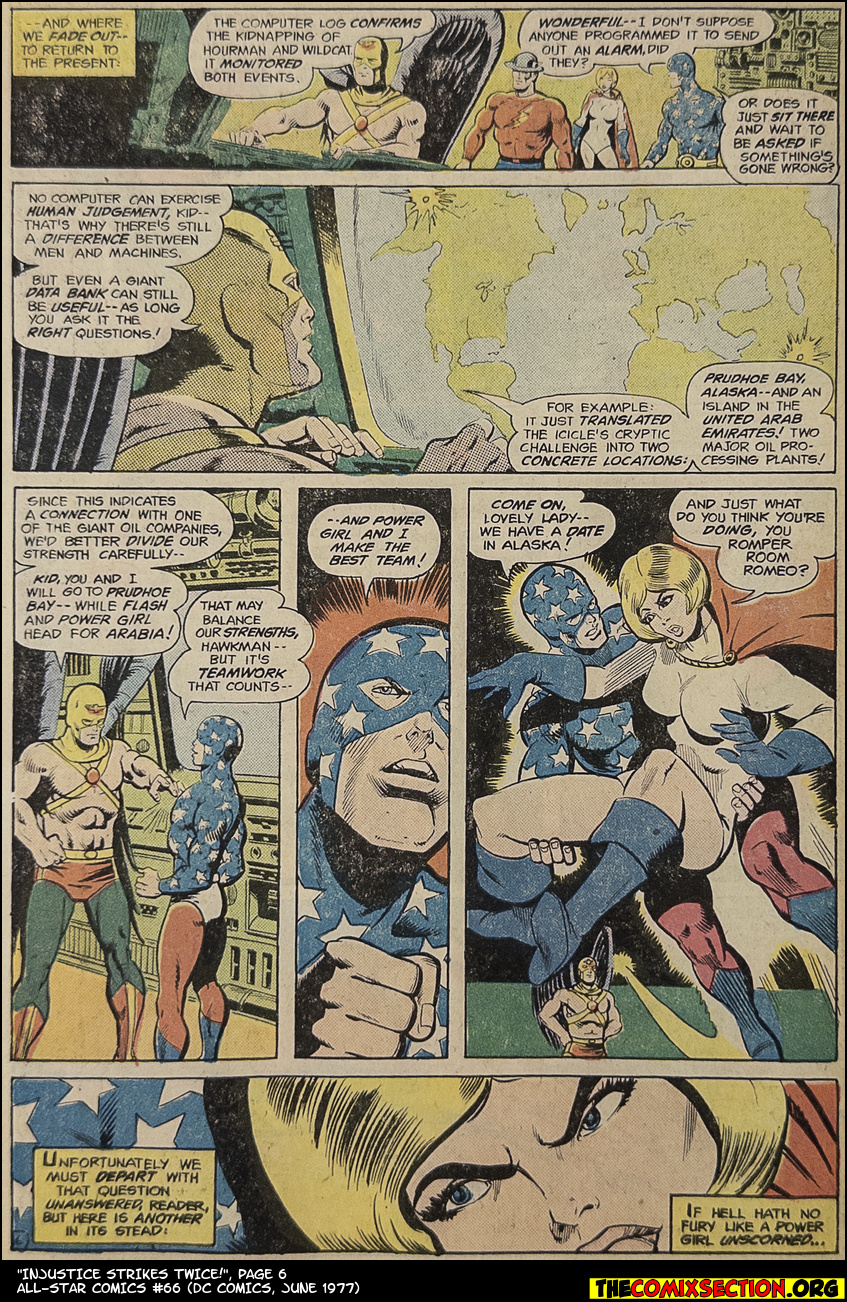
If I take back the things I said about Wally Wood being mid last issue, can he come back retroactively and save me from Joe Staton and Bob Layton? We can keep Paul Levitz finding his sexism towards Power Girl and embracing it: turns out he needed Star-Spangled Kid to creep on her like a lech.
But Levitz does get a couple points for Earth-Two (maybe not when Gerry Conway was writing the book, incidentally) no longer having an apartheid South Africa. The exposition also mentions superheroes started on Earth-Two in the forties, not the fifties; maybe the extra ten years ground out the fascist, racist trash.
Anyway. Back to Joe Staton and Bob Layton. Staton’s figures are often bewildering, and Layton inks into the “curve.” There are a handful of okay close-ups, including Bruce Wayne (who seems to be a character Levitz might actually want to write; time will tell), but the bodies—and especially the extremities—are bad; real bad.
Levitz opens the issue in a flash-forward so he can wrap up the cliffhanger from last time (no Shining Knight, again; his agent obviously told him to stay away from All-Star Comics), which basically means Superman going off on his own so he won’t just save the day. Before Superman leaves, Power Girl is not nice enough to him, and she regrets it. However, she does not regret whining there are too many male heroes for her to compete with.
These character moments are nowhere near the most unpleasant. Star-Spangled Kid gropes her and gets away with it, then at one point pervs on her instead of saving Wildcat. It’s a lot. Especially since Kid’s in the silly power belt (and also, the colorist at one point gives him white outside undies), he’s just a creep—and Levitz’s lead character on that plot line.
The story has the JSA trying to save Hourman and Wildcat; the reunited Injustice Society has captured them. Injustice Society’s been after the heroes for a few issues now, starting during Conway’s tenure, and one has to wonder if their motivations were always the same. Levitz hasn’t got a lot of time for them. They’re disposable, easy-to-defeat villains, especially once Dr. Fate comes back.
Levitz also seems to like writing Dr. Fate, who he characterizes as taking over the human host with no concern for its well-being, even having Mrs. Dr. Fate plead with Fate not to leave. It’s an all-right bit.
All things considered.
The ending sets up (adult) Robin coming back into the book–maybe—while Power Girl, Kid, and Wildcat (the book’s most obnoxious grouping, presumably worse now) going on an adventure together.
Swell.

 The Stop Button
Leave a reply to amycondit Cancel reply