The Plague of the Zombies opens at its lowest point—the film involves Haitian-style voodoo (not really, the movie’s version of Haitian-style voodoo) being practiced in a Cornish village, and the high priest has a trio of Black men drumming. Throughout the film, we’ll learn about the voodoo setup (though not a lot, including what they wanted women for after a year of killing dudes), and various participants in the voodoo rituals will have day jobs. Not the drummers, though. They apparently just stay in the ritual cave, slicked up in oil, waiting for the high priest to need accompaniment.
Otherwise, with some exceptions, usually for budget, sometimes for colonialism, and then poor Brook Williams’s acting, Plague’s a great time. After the opening voodoo sequence, the action heads to André Morell’s house, where he’s getting ready for his holiday. We’ll find out he’s a professor at a medical school in London. It’s 1860 (the film’s got a solid drinking game in “spot the anachronisms”). Williams is Morrell’s former star pupil who has set up a practice in our unnamed Cornish village. His wife, Jacqueline Pearce, happens to be Morell’s daughter’s best friend. Diane Clare plays the daughter. She’s a trooper.
Morell gets a weird letter from Williams about all the people who have died. Now, we’ll later learn it’s twelve over twelve months, minus the film’s present action fatalities, so it never makes sense why Williams waited so long to ask someone for help. Especially when we learn he’s not so much having a medical knowledge crisis as a political one—village squire John Carson won’t back Williams in investigating any of the deaths. No autopsies.
Clare convinces Morell they should go visit—and Morell can fish while they’re there. The lack of a fishing subplot is one of the film’s only real disappointments. I desperately wanted to watch Morell fish. He acts the heck out of Plague, always active, always evaluating, always calculating. The character’s a smart cookie, and Morell wants everyone to know how hard he works at it.
When they get to the village, Morell and Clare immediately discover multiple red flags. Carson’s houseguests—led by Alexander Davion—intentionally disrupt a funeral procession and get away with it. Carson de facto directs the local constabulary (run by delightful Michael Ripper), so there are no consequences. Then Pearce is so out of it she barely recognizes them (the audience has the benefit of knowing the voodoo cult is after her). And Williams is….
So, Williams’s character is drowning in the stress and liquoring his way through it. Williams’s performance is drowning in inability, and director Gilling is just making him do it all anyway. Clare’s always a strong character, but when she eventually has to play damsel, and Williams gets to play prince; definitely should’ve been reversed. Williams is so incapable he very quickly becomes sympathetic just for sticking with it. He’s a trooper in a different way than Clare, however. She has to navigate spoken and unspoken societal horrors for the lady folk; Williams just has to keep attempting and failing, over and over.
Besides Williams, all Plague’s acting is (well, okay, low) fine or better. But the better ranges up to Morell, who’s awesome—it’s a shame he and Clare didn’t do a Victorian supernatural sleuthing franchise—and Carson, who’s almost as awesome. Clare’s pretty good. The damsel stuff doesn’t do her any favors, dramatically speaking, but she’s ahead of the curve. Pearce is fine. And then Ripper’s such low-key fun when he shows up. He and Morell play great off one another.
Despite whatever mistakes he makes with Williams, director Gilling does a decent job. Especially considering how much of it’s bad day for night–cinematographer Arthur Grant doesn’t even try compensating, though there’s usually at least one bit of nice photography in every scene. Grant does much better indoors. The special effects have a wide quality range, but they’re always effective. Peter Bryan’s script emphasizes the characters, not the zombies; it might be a budgetary decision, but it’s also a successful one.
Plague of the Zombies is far better than it ought to be, all things considered, with that outstanding Morell performance anchoring it and then its handful of other significant pluses.
I wish there’d been a sequel.
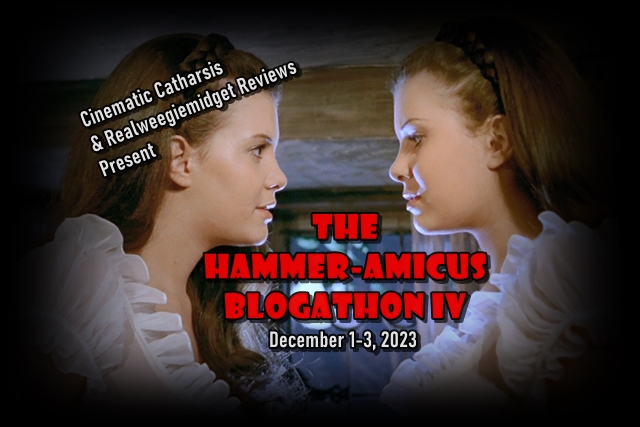
This post is part of the Hammer-Amicus Blogathon IV hosted by Barry of Cinematic Catharsis and Gill of Realweegiemidget Reviews.


 The Stop Button
Leave a Reply