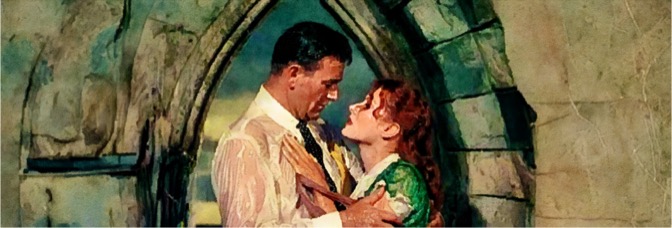
The Quiet Man starts as a loving postcard tour of the Irish countryside. It’s pastoral, romantic, funny, human. Son of Ireland-gone American John Wayne returns home and immediately falls in love with neighbor Maureen O’Hara. Unfortunately, despite O’Hara having similar inklings, her big brother is Wayne’s new nemesis, Victor McLaglen. It’s this exceptionally lush, tender, sexy comedy-drama for a while—it’s almost like director Ford got Wayne to agree to do the touchy-feely stuff by promising he’ll get to hulk out in the second half.
And hulk out Wayne does. It’s Ireland, after all, and McLaglen owns little sister O’Hara, and he’ll be damned if he’s letting Wayne have her. Except by this time, the whole town has cooked up a scheme to marry the kids (asterisk) off. They are not kids; when it comes time for town mascot Barry Fitzgerald to play matchmaker (officially) to Wayne and O’Hara, O’Hara’s official designation is spinster. Now, Quiet Man does not have many roles for women. There’s O’Hara, there’s Mildred Natwick as the town rich lady, and Eileen Crowe as the vicar’s wife. So we never see any of the other similar-aged wives–Quiet Man takes place at the pub a lot, so they’re not invited—but Man’s first big ask is pretending O’Hara’s not Maureen O’Hara.
In addition to McLaglen, she cooks and cleans for his farm crew, who all think she’s swell. They’re in a scene before McLaglen takes over. McLaglen’s a delight in the movie’s first half, and strangely absent in the second half. Quiet Man does this inestimable summary sequence with Wayne and O’Hara on the outs because she doesn’t want to get married without her dowry, and he doesn’t want to hear about money. There’s a scene where John Wayne talks to Protestant vicar Arthur Shields about how it triggers him. There’s also sports talk involved—pointless, inappropriate sports talk—so you know it’s still manly.
As for how O’Hara processes it… well, there aren’t any women for her to talk to, so she talks to Catholic priest Ward Bond about it when he’s fishing. It’s kind of funny because Bond does eventually pay attention to his parishioner and her problems, but they’re talking in Gaelic, so the audience can’t understand. Taking that moment away from O’Hara is what Quiet Man will do over and over in the second half. The moral of Quiet Man is to objectify your wife in the right way, John Wayne, not the wrong way. And don’t forget to hit her with a stick if she’s asking for it. You’re in Ireland, boyo.
I mean, yikes. However, O’Hara’s plot about the dowry is not without its issues either. She wants it because it’s all she’ll ever get; it’s about what the culture allows a woman to inherit from her foremothers. It should be devastating and give Wayne and O’Hara a killer resolution to that romantic comedy-drama. Quiet Man will eventually turn up the melodrama just a tad, and it’s when Wayne almost breaks the fourth wall to say he ain’t no softie.
Anyway, O’Hara’s asking him to treat her like dirt; that’s just how they are in Ireland.
Again.
Yikes.
It’s a gorgeous film. Ford, cinematographer Winton C. Hoch, and Technicolor consultant Francis Cugat film the heck out of the Irish countryside. Even when he’s stuck using soundstages for exteriors; there’s a great horse race on a beach, but all the setup is on set, which Ford uses to focus the audience’s attention on the dramatic undercurrents. Quiet Man will use technical constraints to its advantage almost every time. Hoch, editor Jack Murray, composer Victor Young; Quiet Man always plays great-looking and sounding.
Speaking of sound… there’s a lot of singing in The Quiet Man. The fellows of the town like to get together in the pub and sing some songs, usually led by the local IRA lads, Sean McClory and Charles B. Fitzsimons. There are plenty of John Ford Stock Company players about (look fast for Hank Worden; I knew that guy looked familiar), including Ken Curtis, who leads one of the songs. When the supporting cast is limited, the film has got a real likability quality. Not quite hanging out, but enjoying the shenanigans, singing and bullshitting. The film loses that quality in the late second act.
Luckily, it gets it back for the third. Eventually. Quiet Man’s got a few last-minute reprieves, a few because it intentionally calls back to previous highs.
Much of the film has Ford directing Wayne and O’Hara in fantastic performances. But it eventually hits a “what would anyone be able to do with this” period. The supporting cast helps in those spots, especially Bond. Bond’s just great. So’s pretty much everyone. Fitzgerald, McLaglen, Natwick (though her arc is bananas). O’Hara’s great; one kind of asterisk. Wayne’s good; another kind of asterisk.
It’s an astoundingly beautiful film, too. Ford, Hoch, Cugat—nothing quite looks like Quiet Man. That ethereal quality ought to help it through the troubles, but turning the movie into a fable about humiliating the woman you love in front of as many people as you can because you’re an Irish man, not a weak sister American… oddly, does not.
Quiet Man’s a bit of a bummer, but nowhere near the bummer it could’ve been.
This post is part of the Celluloid Road Trip Blogathon: International Edition hosted by Annette of Hometowns to Hollywood.


 The Stop Button
Leave a reply to Vernon W Cancel reply