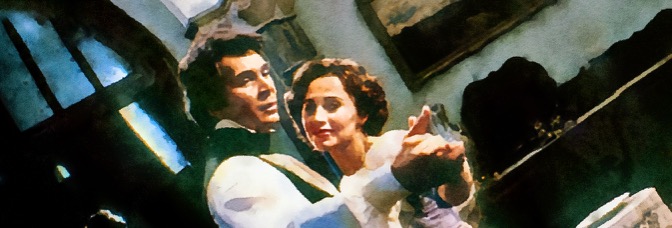
This Dracula adaptation takes place in 1913, which is only important so leading lady Kate Nelligan (battling and sometimes winning her English accent) can be a suffragette, and her beau, Trevor Eve, can drive a motorcar. So there can be a car chase. Or three.
The film begins already in England. A ship is having trouble at sea; the crew is trying to get a wooden crate overboard, but they’re too late, and a wolf attacks them. On land, Nelligan lives with her father, Donald Pleasence, who runs a mental institution. Her sickly friend Jan Francis is staying with them. Nelligan helps out in the institution, where the patients aren’t so much violent as profoundly tragic.
After the boat crashes, Francis goes down to the shore and discovers a lone survivor and apparently the ship’s only passenger, a Transylvanian count. We don’t get to see him for a while; Dracula, down to the John Williams score, is a late seventies studio blockbuster. The height of pre-ILM special effects, many smartly executed composite shots, exquisite matte paintings, and Superman: The Movie moments. Down to Laurence Olivier’s stunt cast as Van Helsing, who isn’t a vampire hunter, just a grieving father. Francis is his daughter, and she’s not long for the world. Or movie.
The film’s first hour is moving the pieces around so Langella and Nelligan can have a romance. They need to overcome hurdles, like her presumed engagement to Eve (apparently, they both were just fooling around) and Langella’s desire to create a vampire army to destroy the humans. Starting with Francis.
But since Nelligan disappears in the second half of the film—she’s the vampire’s victim, the fair maiden the men must protect—the film loses its romance angle. Langella hangs out to menace the good guys, but he also vanishes for a stretch. The third act misses them, particularly Nelligan, who never gets to sit with her burgeoning vampiric attributes.
Instead, it’s all about Olivier, Pleasence, and Eve teaming up, though in stages. Olivier and Pleasence get one set piece, then Olivier gets another, then Eve finally gets to team up for the car chases. Despite the good guy plot being Olivier’s movie, he makes room for his costars. He and Pleasence have a delightful rapport; before Olivier arrives to check on Francis, Pleasence is an absent-minded dad-type. He relies on Nelligan for a lot of the institution work, and he’s settled into fine country living when he’s off the clock. He doesn’t even remember how to help someone choking; it’s been so long since he’s practiced real medicine.
When Olivier arrives, Pleasence becomes his Watson. At least until the third act, when there’s not enough room for Pleasence anymore.
Director Badham is often ostentatious; despite the English shooting locations, Dracula’s very American—just listen to Langella’s accent (or lack thereof). Or, really, Nelligan’s English one. Olivier does a heavy accent, which is fine; his performance just doesn’t have any nuance. He doesn’t need it, I suppose. Francis’s accent’s terrible, though. It always sounds like she’s mumbling.
The film wraps up with a conflicted statement about Nelligan’s agency under the patriarchy—Langella’s offering her real power; she just has to eat people—but it’s a reasonably successful adaptation. Langella’s mesmerizing as a dashing Dracula, and he and Nelligan’s chemistry is good. Pleasence and Olivier are fun. Eve’s fine. Tony Haygarth’s a relatively harmless but still terrifying Renfield.
Lovely photography from Gilbert Taylor and good editing from John Bloom. The Williams score is just okay; he doesn’t have a good “Dracula theme,” which he needs.
Great costumes from Julie Harris and production design from Peter Murton. Dracula’s often sumptuous. It’s a little slow, but it’s all right.
This post is part of the Devilishly Delightful Donald Pleasence Blogathon hosted by Gill of Realweegiemidget Reviews and Barry of Cinematic Catharsis.


 The Stop Button
Leave a Reply