
Between 1932 and 1997, two-time Academy Award winner Luise Rainer—who was the first actor to win more than one Academy Award and the first to win two back-to-back— made a total of fifteen films. Approximately. Austrian Rainer made three German-language films in the early thirties before Hollywood—MGM, specifically—discovered her and brought her to the States under a three-year contract. Her first MGM film, Escapade, came out in 1935. The last, Dramatic School, came out in 1938. Despite that three year contract, Dramatic School was after Rainer had signed a subsequent seven-year contract renewal with the studio. But that film would be the last straw for Rainer, who’d spent the last year and previous four films battling with studio head Louis B. Mayer about roles.
Rainer would return to Hollywood in 1943 for Hostages, which was a Paramount picture, not MGM.

According to IMDb (but without any other mention in online databases), Rainer appeared in the 1954 West German teen comedy Der Erste Kuß (The First Kiss). It’s a teen romance comedy with a couple twin sisters getting into innocent mischief. Sadly not the source for the Parent Trap but whatever. Rainer’s recognized return came in 1997 (fifty-four years after Hostages) in the British film, The Gambler, about Dostoyevsky writing The Gambler. After another break (only six years this time), Rainer appeared in Poem: I Set My Foot Upon the Air and It Carried Me, where she (and eighteen other performers) read a variety of German poems.
Rainer died in 2014 at the age of 104.
I’d heard of Rainer, but never seen any of her films. So when I needed a subject for “The Marathon Stars Blogathon,” Rainer was near the top of my list. I’ve been sort of curious; wasn’t Good Earth some Oscar-winning, protracted sharecropping melodrama. Especially since I’ve seen plenty of movies from the thirties, plenty of MGM movies from the thirties, plenty of William Powell MGM movies from the thirties, it seemed a little odd I’d never seen one of Rainer’s. One of the blogathon requirements is watching five films (at least five films) with the subject. Five films is a time commitment and I didn’t want to be half-assed about it.
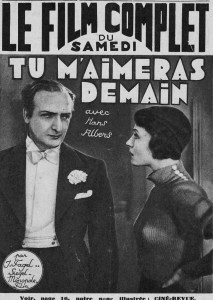
For example, watching Rainer’s three German films from the early thirties (regardless if they’re available), the 1997 cameo in The Gambler, then Poem… well, I wouldn’t have any idea what she did for the majority of her film career. So I wanted to schedule a nice mix. Rainer won her Oscars for The Great Ziegfeld and The Good Earth. Ziegfeld runs three hours, Earth almost two-and-a-half. I decided early on I’d only be able to do one of them, viewing schedule-wise. I went with Good Earth because it’s shorter.
The other four films I chose partially on availability, partially on relevance. I watched The Emperor’s Candlesticks, but would have rather watched the apparently nearly lost Escapade, which started Rainer’s Hollywood career and was her first pairing with William Powell. She appeared with Powell in Ziegfeld, then in Candlesticks. Dramatic School I picked because it seemed like a no-brainer—Rainer and fellow MGM contract actresses in an acting school. Toy Wife has Melvyn Douglas and a female screenwriter, why not. Hostages I tracked down because it’s her comeback picture. Plus, William Bendix.
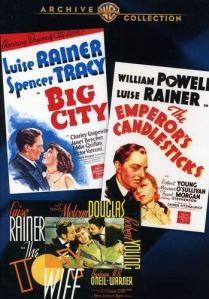
Rainer made Escapade, Great Ziegfeld, Good Earth, Emperor’s Candlesticks, Big City, Toy Wife, Great Waltz, and Dramatic School for MGM. I watched Good Earth, Emperor’s Candlesticks, Toy Wife, and Dramatic School; fifty percent of them. I assumed I’d put together a good representation of her filmography. Even after reading about the other films (Ziegfeld, Big City, and Great Waltz are all readily available, just Escapade missing), it sounds like I did.
But, wow, is it a troubled filmography. Rainer never got the chance to establish herself. She was generically European, but… rarely in parts requiring her to be generically European. It might have helped her with Good Earth, when she was playing a Chinese woman, but comes off as Francophobic in Toy Wife, when she’s a naive but slutty Louisiana Southern belle. It doesn’t matter in Candlesticks. Great, she’s Austrian and playing Russian, but distinctly not Polish guy William Powell’s perfectly fine as the Polish guy. The part doesn’t need that ingrained texture (though it says something Candlesticks has Rainer’s best performance of the five films and the only one with personality). Dramatic School she’s a naive but not slutty poor French girl. Other than Candlesticks, none of the parts are good. Good Earth has a lot of technical requirements—yellow-face for one, but also aging forty or so years as well—but the part’s not good.
I’ll go over each film briefly presently, but in case you were wondering if somehow Hostages was a great return to the screen? No. Not only is it bad, it’s a lousy part for Rainer (though probably better than some of the “A-list” ones at MGM).
Rainer had three films in 1937—she had Good Earth in January, Emperor’s Candlesticks in July, and Big City in September. Now, she won the Academy Award for 1936’s Great Ziegfeld in March, so between Good Earth and Candlesticks.
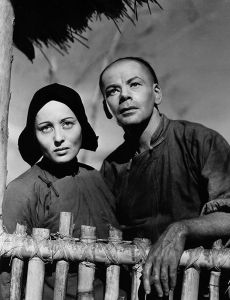
Good Earth. The Good Earth is the late 1930s Hollywood protracted sharecropping melodrama I was expecting, but I’d somehow forgotten about it being set in China. It’s a Classic Hollywood epic about a poor farmer in China getting rich at the beginning of the twentieth century. It stars a half dozen or more white actors in yellow-face, then some really supporting Asian actors later. Paul Muni is the lead. The movie starts with him marrying Rainer. They’ve never met before, he presumably buys her from the local great house, where she’s been a slave since childhood. Mark this point—slavery is bad in Good Earth and Rainer—even though she never gets to talk about it—hates even the mention of it. She never gets to talk about it because she rarely gets to talk. Muni talks all the time. Even after he stops talking all the time, Rainer barely gets any lines. It’s a bad part for so many reasons. Rainer’s best in the old age yellow-face, playing mom to grown sons, who are played by Asian men. Somehow, they make the scenes work, though maybe not succeed.
Good Earth is significant for showing how Classic Hollywood was willing to humanize non-whites, but only if whites could play them in complicated, “realistic” (i.e. not-blackface) make-up. Rainer gets a scene where she teaches her kids how to panhandle. You’re not going to see that sort of display if those kids were white. Ick but hmm sums up Good Earth.
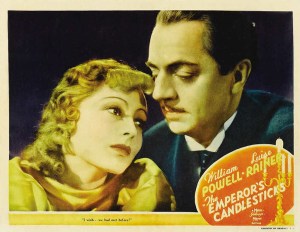
So then, two months later, Rainer wins the Oscar for Ziegfeld, going into Candlesticks reuniting with that film’s lead, William Powell. It’s a comedic thriller, set in the late 1800s, with Powell as a debonair Polish gentleman spy and Rainer as a Russian countess who spies too. They’re enemies, even if they don’t know it, but thrown into an adventure together. It’s kind of a road picture, but not on the budget to be on the road or in the European cities it visits. Lots of interiors, lots of montages, lots of chemistry. Candlesticks is a bunch of fun.
Big City is a drama, which means maybe I should’ve watched it instead of either Dramatic School or Toy Wife because they’re both lousy dramas and Big City might be good. It’s got Spencer Tracy after all, and it’s from before Rainer went to war with Mayer.
It’s also before she won Best Actress for Good Earth; she got that Oscar in March 1938, which was before any of her films came out that year. Rainer was off-screen from Big City in September 1937 until Toy Wife in June 1938. Nine months. And she won another Oscar in between, set Oscar records in between. So it’d be interesting to see how Toy Wife played after Big City.
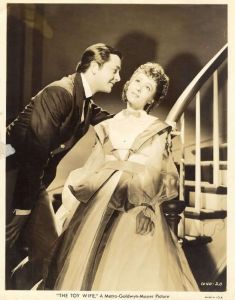
Because Toy Wife is a gross disaster. It’s all about Rainer—sixteen in the source play—seducing a dude away from her sister (Barbara O’Neil, who plays a character named Louise). They’re Southern belles. They have lots of slaves. Rainer loves having slaves. It’s one of those weird late thirties movies where all the white people love having slaves. It even becomes a plot point because Rainer is too nice to her slaves and they get lazy so her husband (Melvyn Douglas, the one she stole from O’Neil) has to bring O’Neil into the household to “run” the slaves. Meanwhile Rainer has a fling with Robert Young.
All the acting is bad. The writing is bad (screenwriter Zoë Akins added all the slavery stuff). Even 1938 audiences who were clamoring for that “slavery was awesome for white people” thing at the time didn’t like the movie.
Then November’s The Great Waltz, a Strauss biopic, did well (cost too much, but did well). So should I have watched Great Waltz to see how Rainer recovers from Toy Wife? Maybe I didn’t get a good look at her filmography, right?
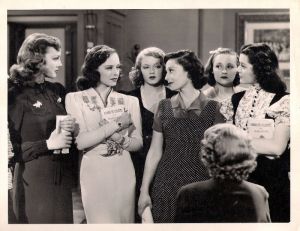
In December there was Dramatic School, costarring Paulette Goddard as Rainer’s slutty, rich, mean classmate. I guess Dramatic is sort of impressive for Rainer because she plays the part well, even though she’s supposed to be much younger and infinitely naive. The film—which opens quite wonderfully with Margaret Dumont—has so much potential. It could be all about Rainer acting these different famous parts and so on and so on. Rainer even plays a character named “Louise” in the picture. It has to mean something, right?
Nope. It’s this tedious rags-to-riches story with Rainer, who lies too much (because it gives her the opportunity to act all the time), and how she gets caught. Dumont’s only in two short scenes. Most of the film has Gale Sondergaard as the evil teacher who’s jealous of Rainer because Sondergaard is old and Rainer is young. Dramatic School manages to be tediously tedious.
So no surprise Rainer quit after doing it.
But why she wanted to come back for Hostages….
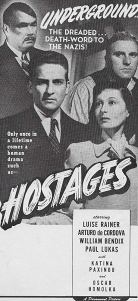
Hostages, released in October 1943, is a war picture. Czech underground fighters versus Nazis. Rainer had missed the start of the war, film-wise, and had returned in time for the propaganda picture. Starring William Bendix as a Czech freedom fighter. He’s godawful. Maybe if he weren’t so bad in the movie, the movie wouldn’t be so bad. But even if he were better (or, even better still, Bendix weren’t in the movie at all), the part for Rainer would still be too slight. Apparently she didn’t want to do an Oscar-bait picture or role, but Hostages isn’t just not Oscar-bait, it’s not a good project.
Top-billed Rainer gets overshadowed by romantic interest Arturo de Córdova, a Mexican actor on his brief, unsuccessful Hollywood tour.
A strong comeback picture, Hostages ain’t.
It also isn’t anything like Rainer’s MGM work. Especially not the better work.

Despite having seen over fifty percent (I have the math but don’t want to show my work) of Rainer’s Classic Hollywood output… I can only tentatively say I like her. She’s probably all right, maybe good, certainly not terrible and probably never inept. I don’t even know if seeing Big City, Great Waltz, or Great Ziegfeld will change that opinion. It might. But it also might not, given the erratic nature of Rainer’s output. Maybe Escapade is the one to see. Hopefully someday.
But, until then, I’m going to try to get to the three available MGM pictures sooner than later.
I’m still curious about Rainer’s career. More now I’ve started watching her films, which is another positive sign. Albeit a tentative one.

THIS POST IS PART OF THE SECOND MARATHON STARS BLOGATHON HOSTED BY VIRGINIE OF THE WONDERFUL WORLD OF CINEMA, CRYSTAL OF IN THE GOOD OLD DAYS OF CLASSIC HOLLYWOOD, AND SAMANTHA OF MUSINGS OF A CLASSIC FILM ADDICT.


 The Stop Button
Leave a reply to Andrew Wickliffe Cancel reply