Tag: Miramax Films
-

The Station Agent is not a character study. It does try, at almost exactly the one hour mark (it runs a breezy, but deliberate eighty-nine minutes), to become a character study, but it is not a character study. It is actually a perfect example of how to not make a character study. Writer-director McCarthy spends…
-

Cop Land either has a lot of story going on and not enough content or a lot of content going on and not enough story. Also you could do variations of those statements with “plot.” Writer and director Mangold toggles Cop Land between two plot lines. First is lead Sylvester Stallone. Second is this big…
-

The least violent part of Reservoir Dogs is the bloodiest. One of the characters is in a pool of blood, slipping on it as he delivers his dialogue. Director Tarantino finds a moment of Shakespearian tragedy and builds a film to it. He uses stylish ultra-violence, Dogs is visceral with the blood, but the action…
-

There Will Be Blood. I don’t know where to start. Daniel Day-Lewis’s performance is biggest thing in the film–it’s the film, after all. Without Day-Lewis, the film’s not possible. Director Anderson gives Day-Lewis some quiet at the beginning of the picture to establish himself; there’s nothing to do but stare as the music comes up,…
-

Bullets Over Broadway has a lot going for it. Between Chazz Palminteri, Jennifer Tilly and Dianne Wiest, there’s a lot of great acting and great moments. There are a decided lack of great scenes, however, thanks to director Allen’s choice of John Cusack as leading man. Cusack doesn’t so much give a performance as imitate…
-

As the dangerous mind in the title (Confessions of a Dangerous Mind), Sam Rockwell should be entirely unsympathetic. The film spends its first act mocking Rockwell and inviting the viewer to participate. With the exception of his chemistry with Drew Barrymore’s saintly character, there’s nothing redeeming about Rockwell’s character. Yet he’s tragically endearing. The film…
-

At ninety minutes and change, Blow Dry is too short. Given the complexities of the ground situation’s character relationships and then the character’s arcs throughout the picture, it could easily run two and a half hours. The concept, which at first blush seems sensational but turns out not to be, has Natasha Richardson and Rachel…
-

Maybe there’s a longer version of Blindness where they explain what happens to all the cast members who fall away from the film. Or what happens to them while the film’s busy on other stuff—like Danny Glover, who disappears for a large portion of the film, only to return in an integral part at the…
-

I suppose if someone wanted to think really hard about it, there’s something to be said about adapting short stories for Hollywood. Jeffrey Eugenides’s source short story was in The New Yorker. Is it ripe for mainstream Hollywood adaptation? Given the adaptation, The Switch, failed at the box office, one might say no. But then…
-

I unintentionally watched the Roger Ebert cut of Kate & Leopold. I originally saw it at a sneak preview with the plot intact. Ebert saw it around the same time and threatened to complain or whatever if they didn’t cut it. It works all right, but the original cut is available on DVD. I thought…
-

I hate Adventureland. I mean, it’s a rather good film, but I’m going to have to say nice things about Ryan Reynolds now and so I hate it. Reynolds has a small but significant role in the film and he’s fantastic, bringing humanity to what should be a common character. I cringed at his name…
-

There’s a good movie somewhere in the idea of Doubt (a nun suspects a priest of molesting a child, but it’s 1964 and the patriarchy of the Church isn’t going to listen to her). The film’s full of almost detective moments (and faux-auteur Shanley pulls out some Hitchcock angles after the big reveal), but the…
-
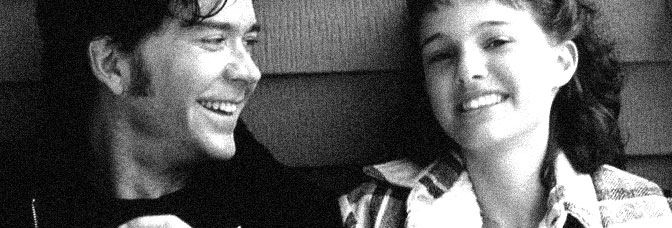
Of the principals, only Michael Rapaport is under thirty (Beautiful Girls hinges on a ten-year high school reunion) and much of the running time can be spent wondering how the viewer is supposed to believe Timothy Hutton isn’t thirty-five years old (he’s actually thirty-six). Hutton gives one of the film’s best performances, frequently transcending the…
-

Dead Man is not a strange film. I haven’t seen it in ten years and I’ve probably seen the majority of the Westerns I’ve seen in that interim. So the opening, as Johnny Depp watches the familiar Western trappings pass from a train window, probably didn’t resonate on my last viewing. What Jarmusch doesn’t get…
-

It’s hard to intelligently describe Smart People because the best way to describe it is quite simple. It’s a bunch of movie trailers for quirky family dramatic comedies strung together. Not five minutes goes by without two montages to songs (I’m shocked the soundtrack CD wasn’t available in the lobby) and one instrumental. There are…
-

Glibly, I can say the most amazing thing The Queen does is humanize Tony Blair, seeing as he’s been decency’s biggest quisling in recent memory. But seeing a sympathetic portrayal of politician–one still in power when a film is released–is uncommon. Michael Sheen really creates a Tony Blair, certainly a Tony Blair one wishes the…
-

At some point during Dirty Pretty Things, maybe the half-way point, I didn’t check, I realized the film’s non-traditional approach was holding it back. It’s ironic (or maybe not, I’m sure I’m using the word wrong) since the third act is the most predictable thing I’ve seen in recent memory. I sat and waited for…
-

Watching The Lookout, I never really wondered how Joseph Gordon-Levitt was going to do. I wondered about Jeff Daniels, for instance, since Daniels spent the late 1990s working up his number of excellent performances only to fade from things I watch. Gordon-Levitt… looking over his IMDb, I’m not sure the guy’s ever been bad. He…
-
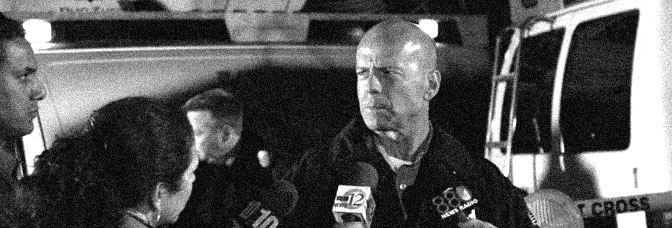
Hostage, towards the end, plays a little like a Die Hard movie, which isn’t surprising, since Doug Richardson did write it (he also wrote Die Hard 2) and Willis, who’s good in Hostage, is usually best in… well, Die Hard movies, actually. Like those films, Hostage lets him emote and he does a good job…
-

The first forty-five minutes of Flirting with Disaster play like Woody Allen mixed with a 1990s Miramax indie, which makes sense, since Flirting is a 1990s Miramax indie. That first half is real strong comedy of errors, then Josh Brolin’s bi (but married to fellow ATF agent Richard Jenkins, who’s phenomenal) old friend starts hitting…
 The Stop Button