• Adventure in Sahara (1938) D: D. Ross Lederman. S: Paul Kelly, C. Henry Gordon, Lorna Gray, Robert Fiske, Marc Lawrence, Dick Curtis, Stanley Brown. Solid enough quickie about American Kelly who up joins the French Legion. Abusive captain Gordon is terrorizing his troops–sometimes worse–and Kelly’s kid brother’s in his crosshairs. Nice production values, even if Lederman doesn’t bring much directing-wise. Kelly’s a sturdy lead, Gordon’s a great bastard; Gray’s good as the (unlikely) girlfriend. Way too short ending, though.

    Allan Quatermain and the Lost City of Gold (1986) D: Gary Nelson. S: Richard Chamberlain, Sharon Stone, James Earl Jones, Henry Silva, Robert Donner, Martin Rabbett, Aileen Marson. Better looking sequel has Chamberlain and Stone teaming up with Jones (who skillfully avoids embarrassing himself) and Hopper (a New Jersey white man in brown face as an Indian con artist holy man) to find long lost brother Rabbett. And a LOST CITY OF GOLD. Layers and layers of racism and sexism. Including Stone disappearing for the third act.

    Conan the Barbarian (1982) D: John Milius. S: Arnold Schwarzenegger, James Earl Jones, Max von Sydow, Sandahl Bergman, Cassandra Gava, Gerry Lopez, Mako. Overlong but well-mounted adaptation of the Robert E. Howard character. Jones kills Schwarzenegger’s parents, setting him on a lifelong revenge arc. Along the way he makes friends and enemies, with warrior woman Bergman his love interest. Milius’s direction quickly finds its limits and not having a lead who can deliver dialogue regularly hurts. Very good special effects, though.

    Conan the Destroyer (1984) D: Richard Fleischer. S: Arnold Schwarzenegger, Grace Jones, Wilt Chamberlain, Mako, Tracey Walter, Sarah Douglas, Olivia d’Abo. Unnecessarily problematic sequel has Arnold escorting (yes, intentionally) Lolita princess d’Abo on a quest. Way too cartoony, with director Fleischer indifferent to the performances. The action has its moments, but the special effects disappoint. Jones and Mako give solid performances. No one else, though Arnold’s at least game. It’s just a silly production. Oh, and Walter’s godawful.

    The Congress (2013) D: Ari Folman. S: Robin Wright, Harvey Keitel, Jon Hamm, Danny Huston, Paul Giamatti, Kodi Smit-McPhee, Sami Gayle. Despite some strong sequences and a fantastic performance from Wright (playing an alternate, Penn-less version of herself), this adaptation of a Stanislaw Lem novel sputters. Mainly because more than half the movie is (albeit nicely) animated, and Wright’s not a particularly distinct voice actor. Plus, it consistently and uncritically positions the ostensible protagonist, Wright, in the male gaze.

    Cool Breeze (1972) D: Barry Pollack. S: Thalmus Rasulala, Judy Pace, Lincoln Kilpatrick, Sam Laws, Margaret Avery, Pam Grier, Paula Kelly. Blaxploitation (scripted and directed by white guy Pollack) adaptation of THE ASPHALT JUNGLE keeps the “criminals are scum” messaging and proceeds to make all the Black characters… criminals. And the racist cops are heroes. Despite those big yikes (and the rampant misogyny), there’s some excellent acting, and Andrew Davis’s photography is often strong. Bad directing and editing don’t help.

    Fight or Flight (2025) D: James Madigan. S: Josh Hartnett, Charithra Chandran, Marko Zaror, JuJu Chan, Julian Kostov, Sanjeev Kohli, Katee Sackhoff. Perfectly serviceable ultra-violent action picture about disgraced Secret Service agent and certified badass Hartnett trying to apprehend an infamous global terrorist on a plane full of his enemies. Certain aspects (production and narrative) are a little cheap, but some great action. Hartnett and his flight attendant sidekick Chandran are solid; shadowy spy boss Sackhoff not so much.

    Heist (2001) D: David Mamet. S: Gene Hackman, Danny DeVito, Delroy Lindo, Sam Rockwell, Rebecca Pidgeon, Ricky Jay, Patti LuPone. Mamet overdoes Mamet with Hackman as a master thief, Lindo as his right-hand, Jay as the funny man, and Pidgeon as the wife. He’s got to do one last job for DeVito, who throws nephew Rockwell into the mix. Far from the most original caper (or plot twists), but beautifully acted and produced. Hackman, Rockwell, and Lindo excel.

    Hercules (1983) D: Luigi Cozzi. S: Lou Ferrigno, Sybil Danning, Brad Harris, Rossana Podestà, Ingrid Anderson, Mirella D’Angelo, William Berger. Cannon production of an Italian sword, sandals, and sorcery has dubbed Ferrigno as the mythical demigod, trying to save humanity from the gods. Bewilderingly imaginative in its combination of rip-offs and elaborate (and bad) special effects. The dubbing acting is mostly bad, but Ferrigno looks right and does well with his dialogue delivery faces. Danning’s especially trying, however.

    Homefront (2013) D: Gary Fleder. S: Jason Statham, James Franco, Izabela Vidovic, Winona Ryder, Rachelle Lefevre, Kate Bosworth, Clancy Brown. Widower and ex-DEA badass Statham just wants to settle down in rural but scenic Louisiana and ride horses with daughter Vidovic. Except then she gets into it at school, pissing off meth head mamma bear Bosworth, who sics meth dealer brother Franco on Statham. Good Statham lead, righteous action, and some (manipulative) thrills. Ryder’s comically atrocious.

    King Solomon’s Mines (1985) D: J. Lee Thompson. S: Richard Chamberlain, Sharon Stone, Herbert Lom, John Rhys-Davies, Ken Gampu, June Buthelezi, Sam Williams. Terrible colonizers’ adventure in Africa (yes, they still call it “darkest” in 1985) is packed with action but none of it’s good. Chamberlain’s version of camp is mostly just being a jackass. Stone’s his client; they’re trying to find her dad, but not her impressively consistently disappearing shorts. Rhys-Davies and Lom are the baddies. Embarrassing Jerry Goldsmith score.

    KPop Demon Hunters (2025) D: Maggie Kang. S: Arden Cho, May Hong, Ji-young Yoo, Ahn Hyo-seop, Yunjin Kim, Ken Jeong, Lee Byung-hun. Beautifully animated supernatural action comedy musical about a K-pop group who are also hunting demons. The leader, Cho, has some secrets, which threaten the group and the fate of the known universe. Some solid laughs, great action, good songs, and likable performances. Ahn is particularly good as the bad boy (demon) who vexes Cho. Delightful stuff.

    Mechanic: Resurrection (2016) D: Dennis Gansel. S: Jason Statham, Jessica Alba, Tommy Lee Jones, Michelle Yeoh, Sam Hazeldine, John Cenatiempo, Toby Eddington. Ostensible sequel has Statham doing a James Bond, John Wick, MACGYVER, HITMAN video game adaptation. He’s trying to stay out of the assassinating life but childhood enemy Hazeldine. Alba’s appealing as the love interest, Yeoh’s fun in a quick part. Jones is not. Okay for a violent but not bloody programmer, though the finale misfires.

    Mickey 17 (2025) D: Bong Joon Ho. S: Robert Pattinson, Naomi Ackie, Steven Yeun, Mark Ruffalo, Toni Collette, Anamaria Vartolomei, Patsy Ferran. Supremely human sci-fi black comedy epic about “Expendable” Pattinson, who gets reprinted (cloned) with memories after he dies in one various dangerous situation (or experiment). He’s on a colony ship run by evangelical numbskull grifter Ruffalo and his devoted, psychotic wife Collette. Ackie’s Pattinson’s girl, but also the film’s action lead. Great performances. More singular work from Bong.

    Minority Report (2002) D: Steven Spielberg. S: Tom Cruise, Samantha Morton, Colin Farrell, Max von Sydow, Lois Smith, Tim Blake Nelson, Peter Stormare. Frankly embarrassing Spielberg near future sci-fi outing has Cruise on the run for a murder he hasn’t (yet) committed. Spielberg bellyflops as a cyberpunk Hitchcock, somehow directing live action CGI composite stuff worse than pure CGI. Cruise’s barely okay, Farrell’s bad (but eventually gets a little traction). Lois Smith’s got an awesome cameo; Morton’s (as ever) phenomenal. Adapted from a Philip K. Dick short story and originally intended to be a TOTAL RECALL sequel, which would’ve been preferable.

    Night Alarm (1934) D: Spencer Gordon Bennet. S: Bruce Cabot, Judith Allen, H.B. Warner, Sam Hardy, Betty Blythe, Tom Hanlon, Harry Holman. Low budget, occasionally amateurish quickie about reporter Cabot being stuck on the gardening beat when he really wants to track an arsonist. Allen’s the girl with a secret who wants his job. Hardy (reuniting with Cabot from KONG) is the editor; he’s great. Warner’s good as the pissy businessman, too. The fire fighting sequences are the highlights.

    Poison for the Fairies (1986) D: Carlos Enrique Taboada. S: Ana Patricia Rojo, Elsa Maria Gutierrez. New girl Gutiérrez starts hanging out with troubled orphan Rojo, who’s decided she’d really like to be a witch. And if she’s got to bully Gutiérrez into helping her under threat of violence… well, we don’t know because writer-director Taboada avoids character development. Great performances, and Taboada has some moments, but the affected stylizing is too much.

    Scarecrow (1973) D: Jerry Schatzberg. S: Gene Hackman, Al Pacino, Dorothy Tristan, Ann Wedgeworth, Richard Lynch, Eileen Brennan, Penelope Allen. Beautifully done character study of drifters (with a purpose) Hackman and Pacino. Hackman’s an ex-con with a dream, Pacino’s just out of the Navy with a kid he’s never met. They start in California and head east, running into various misadventures (usually caused by Hackman’s temper). Great performances, wondrous Vilmos Zsigmond photography. It’s a slow, rending burn.

    Superman (2025) D: James Gunn. S: David Corenswet, Rachel Brosnahan, Nicholas Hoult, Edi Gathegi, Nathan Fillion, Skyler Gisondo, Pruitt Taylor Vince. Successfully crowd-pleasing start to writer-director Gunn’s DC movie universe hinges entirely on Corenswet’s winning performance as the Man of Steel. Gathegi’s also essential to hold up the non-Superman stuff, with Brosnahan just scrapping by as Lois. Hoult (eventually) does okay as Lex. Surprisingly good special effects, terrible flat characterization (though Gunn weaponizes against ladies). Awful music.

    Trouble Man (1972) D: Ivan Dixon. S: Robert Hooks, William Smithers, Paul Winfield, Ralph Waite, Paula Kelly, Jeannie Bell, Julius Harris. Cool, tough, good guy (and master pool player) Hooks deals with racists, cops, and crooks as he tries to suss out his latest job gone wrong. Beautiful L.A. location shooting, a truly delightful supporting cast, and a nice hard-boiled plot–all surrounding Hooks’s confident, charismatic lead–helps TROUBLE deliver. Lots of great 1970s supporting actors show up throughout.

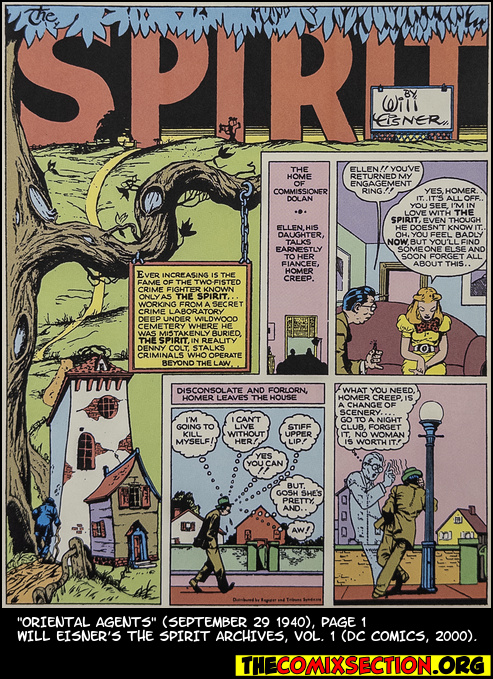
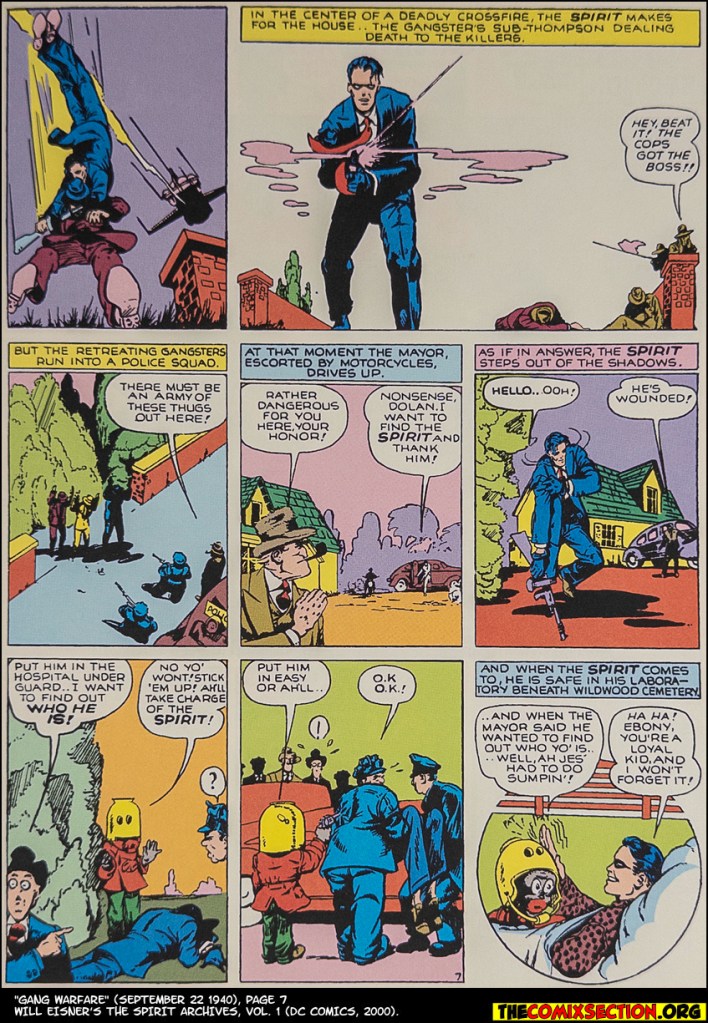
  • The Spirit (September 22, 1940) “Gang Warfare”

    Will Eisner (editor, script, pencils, inks)

    Joe Kubert (colors)

    Sam Rosen (letters)

    The entire strip seems to be just a way to do a panel of Spirit with a Tommy gun taking out the mob. It’s a striking visual, and the strip itself is solid, but Gang Warfare is more like Gang Meddling.

    The strip opens with the Spirit saving a gangster from getting rubbed out. Spirit helps him get away—to meet later in Wildwood Cemetery—and deals with the other crooks, then running himself to escape the police because he’s a wanted man (something the strip doesn’t exactly remember as much as not address).
    The crook meeting the Spirit in Wildwood is just a way for the Spirit to meet the crime boss, who will then turn out to be the head of an anti-crime society organization. So, eventually, it’ll all be about Spirit trying to take out a corrupt businessman.

    One with friends in city hall, which means Commissioner Dolan’s working both sides of the street. The mayor is sure his pal isn’t a crook, Dolan’s sure the Spirit wouldn’t steer them wrong.

    Eventually, it leads to limited gang-busting action sequences, with more emphasis on Spirit (and Dolan) uncovering the boss’s guilt.

    Ebony will have a fairly significant role in the resolution, since he’s the only friend the Spirit’s got (as Dolan can’t take too active a part; Spirit’s still wanted for murder, after all). It’s another of those strange “Ebony’s a cute character but looks like Confederate propaganda” vibes. The racism hurts the comedic sidekick potential.

    There’s also a very strange sequence—entirely done in extreme long shot—where the Spirit pulls a gun on the crime boss in public, presumably to force a confession, only to immediately give it up when someone tells him such behavior’s illegal. For a thin strip, strung together between set pieces, Warfare does all right.

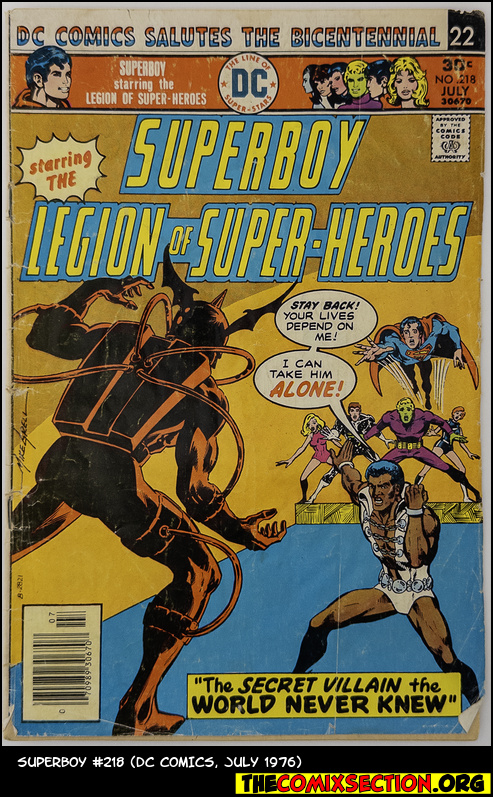
  • Superboy (1949) #218

    Cary Bates (script)

    Mike Grell (artist)

    Jack C. Harris (assistant editor)

    Murray Boltinoff (editor)

    This issue features Tyroc’s formal admission to the Legion, which will be handled entirely in long shot. Given it’s the ostensible point of the whole issue—the story’s about Tyroc’s last test before membership—the abrupt finish is a little disconcerting. Except it shouldn’t be unexpected considering the rest of the issue; writer Cary Bates aims the reader’s attention at some very specific scenes and details, all meant to distract from the subterfuges going on (or to emphasize them).

    Of course, more on Tyroc might not be better. Bates has the Legion discussing their new member—a being from a “Black race” they discovered somewhere on Earth—who thinks the Legion’s a tad white. Bates makes sure the white Legionnaires explain to one another (certainly not Tyroc) how they can’t possibly be racist because they have blue-skinned aliens on the team or whatever. It’s trash, and the less of it, the better.

    The issue opens with some Legion rejects leaving headquarters dejected once again. Is it important? You know it. Bates seemingly is using it as a way to introduce Tyroc to the story; he’s flying away. A scene later, he will teleport himself back to headquarters and say he’s doing it from the shuttle parking lot. All of the action in the issue relates to the Legionnaire’s individual powers, and Bates is showcasing them, but these showcases aren’t… good. Or compelling. They’re not even the most visual. Like everything else in the issue, they’re perfunctory.

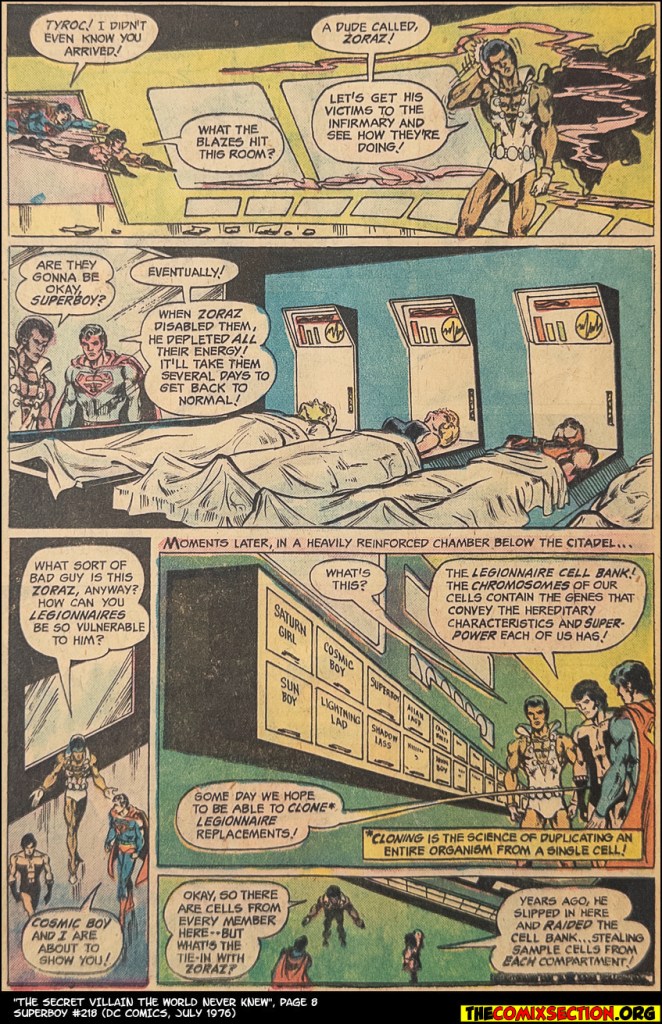
    Tyroc has brought all his gear to move into Legion headquarters, but his admission ceremony gets interrupted by secret supervillain Zoraz. Zoraz has all the Legionnaires’ DNA, so he can counter their powers. He can hide out in the HVAC system in headquarters, and they can’t find him.

    Because Legion defenses are only as good as the story requires.

    After taking out all the Legionnaires around Tyroc, Superboy and Sun Boy show up to fill him in on the villain’s backstory, then explain since he’s the newest member and his DNA isn’t on file, Tyroc will have to take down Zoraz.

    The reason the Legion has DNA is so they can clone Legionnaires after the Legionnaire has been killed. It’s a throwaway line, but… maybe deserves some attention. Not in this comic, of course.

    We’ll get some filler—mainly with the Legionnaires watching their teammates canoodle on the closed-circuit video cameras, which can’t pick up the villain in the ducts anywhere. Then it’s Tyroc’s turn for some action.

    Then, it’s time for some more action after a reveal or two.

    The action’s not good, the characterization’s not good, Mike Grell’s art isn’t good (at times it seems downright unfinished). The comic could be worse but there’s certainly nothing to recommend it.

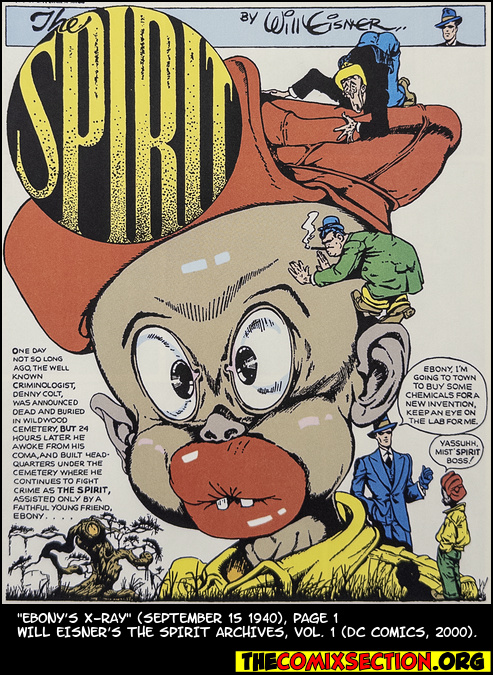
  • The Spirit (September 15, 1940) “Ebony’s X-Ray Eyes”

    Will Eisner (editor, script, pencils, inks)

    Joe Kubert (colors)

    Sam Rosen (letters)

    Ebony’s X-Ray Eyes show the problem with caricature, racist and otherwise. At the start of the strip, Ebony gets some of the Spirit’s x-ray juice in his eyes and can see through things. He quickly happens across some crooks who’ve decided to go into the crooked optometry racket. Once they meet Ebony and get a load of his peepers, however, they decide to become bank robbers.

    Spirit discovers the lair in a mess (assuming Ebony’s been kidnapped and didn’t just have a damaging reaction to the x-ray juice) and starts tracking Ebony down. Now, Spirit’s not going to learn exactly what happened until the last page or so—and it might be more implied than explicit—so he’s just going to luck into conclusions and discoveries. He’s assuming Ebony’s been kidnapped along with the x-ray juice—the x-ray juice being the prize here.

    Ebony will have some ups and downs with the first set of crooks, who will pass him off to a second set pretty quickly. It’s about young Ebony being moved from one traumatizing situation or another. Eisner and studio address that situation in the writing, albeit with more humor than angst, but the reader’s clearly supposed to be sympathetic to Ebony’s plight. Except then he’s rendered as usual, in a racist caricature one wouldn’t want to describe objectively in polite company.

    Once Ebony realizes the Spirit is trying to stop the crooks, he takes (some) matters into his own hands, with the rest working out in payroll (i.e. criminals being a superstitious and cowardly lot and not ready for the Spirit). Ebony’s got agency, eventually, even though his clumsiness is a principal characteristic.

    Outside being horrifically visually racist, it’s a good strip. It’s well-paced and the comic relief (one of the crooks) is good; Spirit is proving it can scale big action to small and stay nimble with its genres.

  • All-Star Comics (1976) #60

    Gerry Conway (editor, script)

    Keith Giffen (layouts)

    Wally Wood (pencils, inks)

    Al Sirois (inks)

    Ben Oda (letters)

    Paul Levitz (assistant editor)

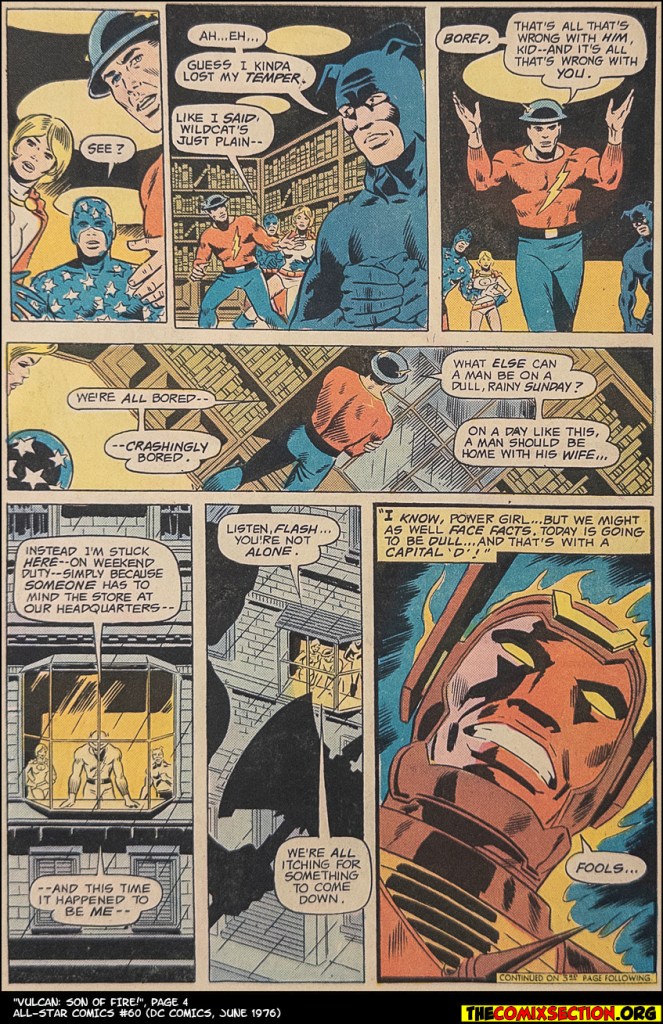
    It’s a few weeks after last issue (and adventure) and the doldrums of being a superhero have sunk in. The issue opens on a rainy day at the JSA brownstone, with Power Girl challenging the Flash to a race. Wildcat’s busy having anger management issues about television while Star-Spangled Kid wonders what’s wrong with him.

    Flash will excuse away Wildcat’s behavior (again). It’s annoying as if writer Gerry Conway had to include some nonsense excusing of it, which just makes Flash seem like he’s full of it, too.

    But they won’t be bored long, because new villain Vulcan attacks them. Vulcan looks a little like a Jack Kirby character; he’s got a New God headband, for instance. The art this issue is Keith Giffen and Wally Wood; Giffen doesn’t change Power Girl’s outfit or anything, but he doesn’t emphasize her, well, bare flesh the way Ric Estrada did the last couple issues. It’s a welcome change.

    Even if Conway’s dialogue for Power Girl constantly has her making remarks about women’s liberation, usually in reference to some dude not being into it. Conway’s also the editor on this book, so clearly, he’s not getting the guidance he actually needs. Particularly given the tangents the comic goes on.

    So, the new villain is attacking the brownstone. Then we cut to Green Lantern’s  office woes (his newspaper’s running out of money). Dr. Fate shows up—in civvies just to drag it out a few more panels—to collect Green Lantern so they can go to a top-secret Army briefing.

    About Vulcan.

    There’s a flashback about Vulcan; he’s a JSA-worshipping astronaut who cracked under the pressure of actual space travel, killing his crew mates, then becoming a fire creature. It’s simultaneously a little and a lot.

    Then Green Lantern and Dr. Fate go to confront the bad guy, and the comic’s over. It’s so oddly plotted, especially since the Army briefing scene was mostly connecting the dots to the first scene with Vulcan. It might’ve made more sense if… the JSA headquarters had some kind of alarm system to alert the other members of the attack.

    As far as characterizations go, Power Girl and Dr. Fate stand out the most. Wildcat’s played for (bewilderingly targeted) laughs, Star Spangled Kid is bland, Jay Garrick’s full of shit, and Green Lantern’s a buzzkill and a half. Power Girl’s at least sympathetic—even if Conway’s not convinced she’s experiencing misogyny at every turn, he’s still writing it for her to experience—and Dr. Fate’s flat but competent.

    Who knew competent superheroes were so much to ask for?

    Not much better than the previous outings, but a little.

  • The Spirit (September 8, 1940) “The Return of Orang, The Ape That Is Human”

    Will Eisner (editor, script, pencils, inks)

    Joe Kubert (colors)

    Sam Rosen (letters)

    Despite the immediate follow-up to last strip, we still don’t get a big Spirit versus Orang scene. Spirit will track Orang to the ends of the Earth (well, Sumatra), but they never have a real, intellectual or physical showdown. Instead, they’re still in slightly different stories; ships passing in the night.

    The strip opens with Spirit recounting last week’s conclusion—Orang is apparently dead, at his own hand. No real mention of him killing his creator, which is important since after Orang drags himself out of the river and to a doctor, he’s ready to be released on his own recognizance. His suicide attempt last strip came after he killed his creator, but he’s forgotten that guilt. And no one’s looking for the mad scientist.

    Or at least not Commissioner Dolan, who goes to the doctor’s to see the talking ape. Dolan can’t come up with a reason to hold Orang, so instead, he offers him a place to crash while Dolan tries to find a law Orang’s existence violates.

    Bored of waiting and seeing an opportunity after Ellen Dolan comes in and passes out at the sight of him, Orang kidnaps her and heads back to the jungle to rule among the lower apes.

    All of these events occur in the first four pages of the strip (including the splash page); the remainder is the Spirit tracking Ellen and Orang through the Sumatran jungle and getting involved in the politics of Orang’s found tribe. Now, those politics involve fights to the death and the Spirit tied to a stake, but they’re just political squabbles. Spirit and Ellen are in a riff on a Tarzan story, complete with swinging on vines and (unlikely) punch outs with orangutans.

    Then the finale—weeks and weeks after the start of the strip—gives Ellen and Spirit their first private moment (despite implying, you know, weeks and weeks of them).

    Orang remains a very sympathetic villain and shirtless Spirit hacking through the jungle is definitely a vibe, so it all works out quite well. It’s just too bad Orang and Spirit never got to talk philosophy.

  • The Spirit (September 1, 1940) “Orang, The Ape-Man”

    Will Eisner (editor, script, pencils, inks)

    Joe Kubert (colors)

    Sam Rosen (letters)

    Orang is a Frankenstein story from the monster’s perspective. The Spirit is still around, but he doesn’t have anything to do with the actual action of the strip. Instead, it’s the sad tale of Orang, an orangutan, turned into a being with human-level intelligence thanks to a mad scientist.

    Eisner and studio do a fabulous job setting up the story. There’s a scientist arriving from war-torn Europe, escaped and ready to reunite with his daughter, Elsa, in his friend’s care. Little does Elsa’s father know his friend is a fiend and has used parts of Elsa’s brain to make Orang smarter. He has left Elsa a savage.

    So we get a cave girl and an orangutan in a suit for the action here. There ought to be more tripping on tropes, but somehow there isn’t. Eisner avoids sentimentality, even as horrifying tragedies unfold, even as Orang comes to the realization he does not want the burden of reason, and begs his creator for mercy.

    There’s some excellent art. Lots of establishing panels this strip, setting the stage, but also giving Eisner a chance to summarize in long shot. The strip’s rapidly paced; once Orang decides he wants to devolve, it’s pretty much all action. Fight, chase, fight, tragic finish, with the Spirit only arriving to provide commentary on the sad situation.

    Without ever having met Orang himself.

    The Spirit’s subplot is very moody. He gets drawn into Elsa’s father’s troubles, having gone to meet the scientist to ask about some experiments. Long shadows as he enters and exits through balconies and so on. The father’s anguish gets some attention, too. Not verbalized like Orang’s will be, but very carefully visualized. Orang’s got its Frankenstein ambitions and whatnot, but the strip excels because of the craft on display, where Eisner and studio flex, where they do not. It’s tragic. And lovely. Just excellent work all around.

  • DC Super Stars (1976) #3

    Jim Shooter (script, layouts)


    Curt Swan (pencils)


    George Klein (inks)


    Milt Snapinn (letters)


    Mort Weisinger (original editor)


    E. Nelson Bridwell (editor)

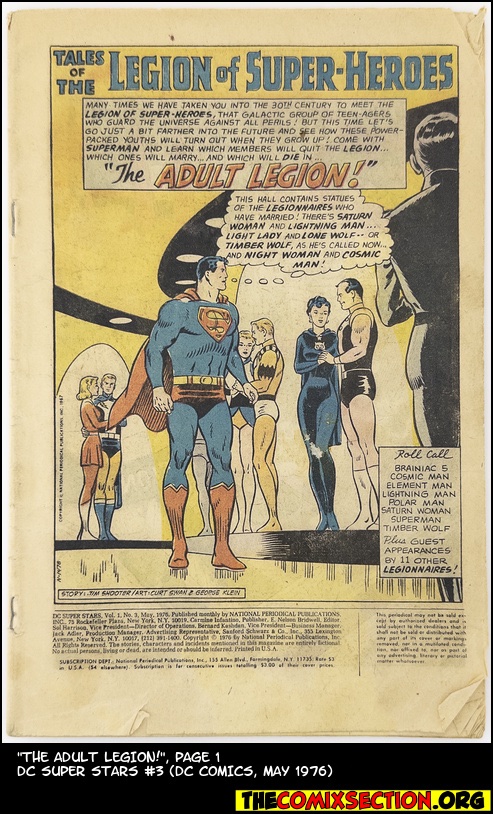
    This issue of Super Stars reprints an eight-year-old Adventure Comics two-parter about Superman visiting the Legion a little further in the future, so they’re all adults. The script is one of those infamous teenage Jim Shooter scripts, and, you know, it’s not bad. I mean, it’s heavy on exposition, but the story’s mostly a tour of the future for Superman.

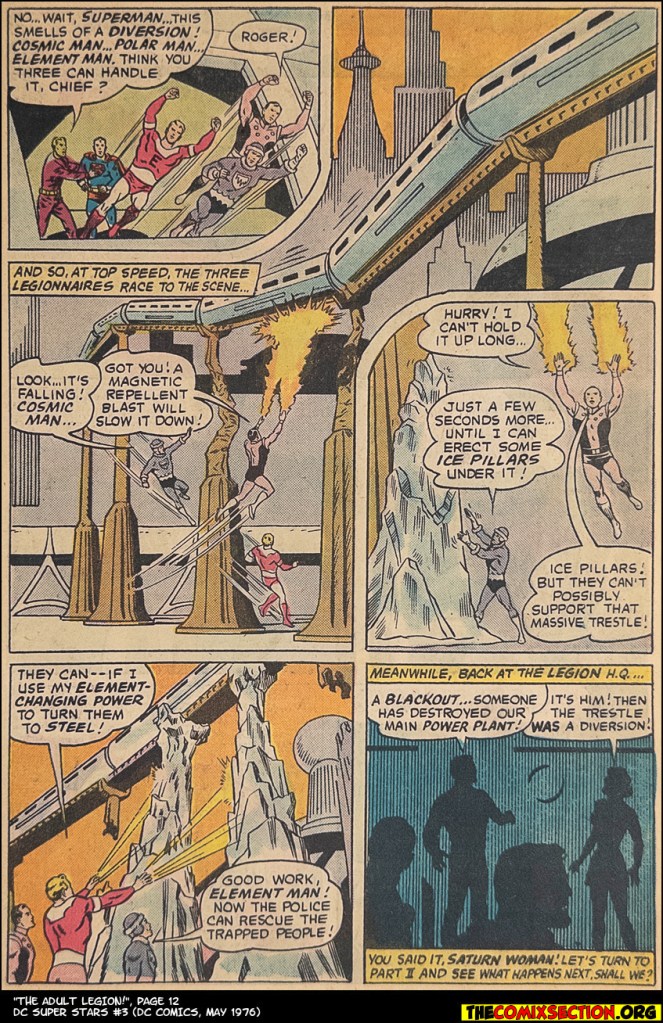
    Eventually, after the rest of the Legion assembles, we find out someone is wrecking Legion property, and Brainiac-5 can’t figure out how it could be happening. Thank goodness Superman’s there to remember a factoid to reveal the whole story, something Brainiac-5 presumably should’ve known.

    Superman’s tour is all quite genial and pleasant. The art from Curt Swan and George Klein is charming and energetic. Swan’s always at least solid, with some fantastic panels on occasion.

    The second part of the story reveals the returning villains who engineered all the drama the first time around. Superman, however, doesn’t get to participate. Instead, various adult Legionnaires go to remote destinations to fight supervillains in order to free a fellow Legionnaire. Shooter does all the math on the hero and villain’s superpowers, somehow canceling one another, or maybe something in the environment. It’s thoughtful and thorough without being particularly entertaining or creative.

    But there’s also the Swan artwork to keep things moving smoothly. Shooter doesn’t have a single bump in the issue. Not even the bewildering finish, which features the adult Legionnaires needing help and getting it from an unlikely pair of guest stars. Presumably, there’s a story behind the cameos.

    Overall, it’s an entertaining read. It gets a little long at times—even if you’re curious about adult Legionnaires, they’re rarely in it for more than a panel or two. Those cameos never add up; at least in the second half, the story’s got some urgency. Despite part one’s villain being more dangerous than anyone in the second half, the future tour sets a relaxed pace. Superman solving the mystery is very relaxed, too. Shooter keeps multiple details from the reader in these stories, just to surprise in a couple of pages. It’s lazy, but… Swan mostly covers it. And at least those abbreviated scenes move a little faster.

    The stories are decent enough Silver Age DC Comics. Not Swan’s best work (and I’ll never know on Shooter’s) but it’s a successful enough, engaging enough two-parter.

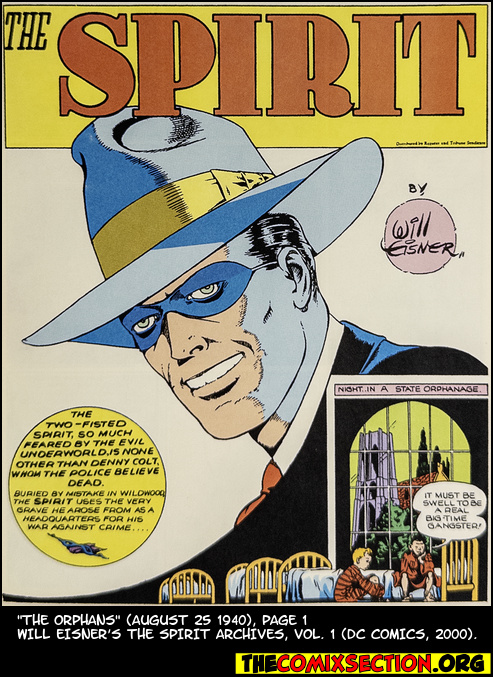
  • The Spirit (August 25, 1940) “The Orphans”

    Will Eisner (editor, script, pencils, inks)

    Joe Kubert (colors)

    Sam Rosen (letters)

    Orphans is about the Spirit taking a young orphan, Billy, slumming in the underworld. Spirit comes across Billy and his friend, Barney, in the cemetery smoking cigars and getting sick from it. Barney’s trying to convince Billy to join a gang with him. Spirit interrupts; Billy thinks Spirit’s swell, Barney thinks “crimefighters” stink.

    After Barney heads off to join the gang, Spirit takes Billy back to the crypt lair to get some information on Barney’s future mob boss. Once they’ve got that information, they head out, with the Spirit busting heads until they get to the big boss.

    The “boss fight,” which barely involves the boss, has Spirit fighting a dozen opponents. It’s a beautifully choreographed punch-out, starting with Spirit escaping his restraints and knocking heads. The Spirit moves between panels gracefully, almost patiently, working his way through one thug or four. It’s a beautiful sequence. And then it keeps going. And keeps going again. It’s an incredibly long, absolutely fantastic action scene. Eisner keeps coming up with something new; even some of the familiar poses, with Spirit’s sockless ankles visible, are fresh; Eisner’s figured out how to string the visuals together, finding the rhythm of the scene, and it’s sublime. Orphans has some of the best art in the strip so far, even if the splash page is an almost hokey picture of the Spirit, looking like the cover of a country western album. It’s a combination of the concept, the pose, and some very stiff lines.

    Then, the art of the boys is very expressive and fun. Eisner and studio exaggerate their expressions, particularly when sick from cigar smoke, giving the strip some extra pizzazz.

    Until the mega fight starts, Orphans is just Spirit lecturing Billy about how crime doesn’t pay. He shows him some examples, but they’re exaggerated ones involving comic strip gangsters. Billy’s eventual reckoning doesn’t even involve any “organized” crime. It’ll be an emotional reaction, which is weird. But it’s also a very thin message—kids always need to remember to tell other kids: crime doesn’t pay.

    It’s a gorgeous strip, with some solid writing on the kids (Barney’s a fun little shit), and the didactic stuff can’t overwhelm the strong comics.

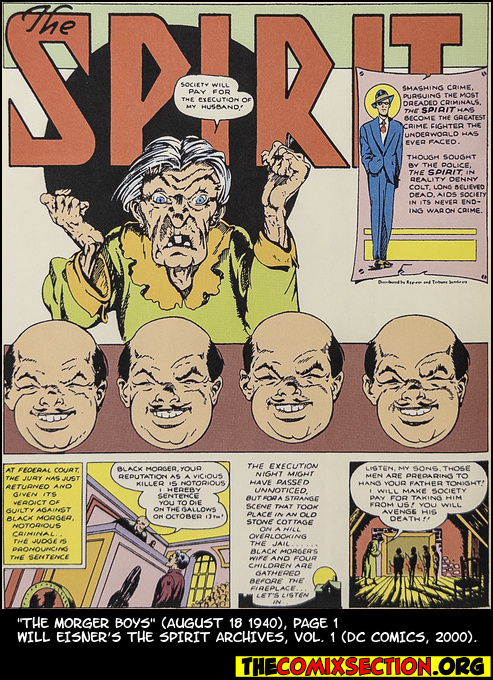
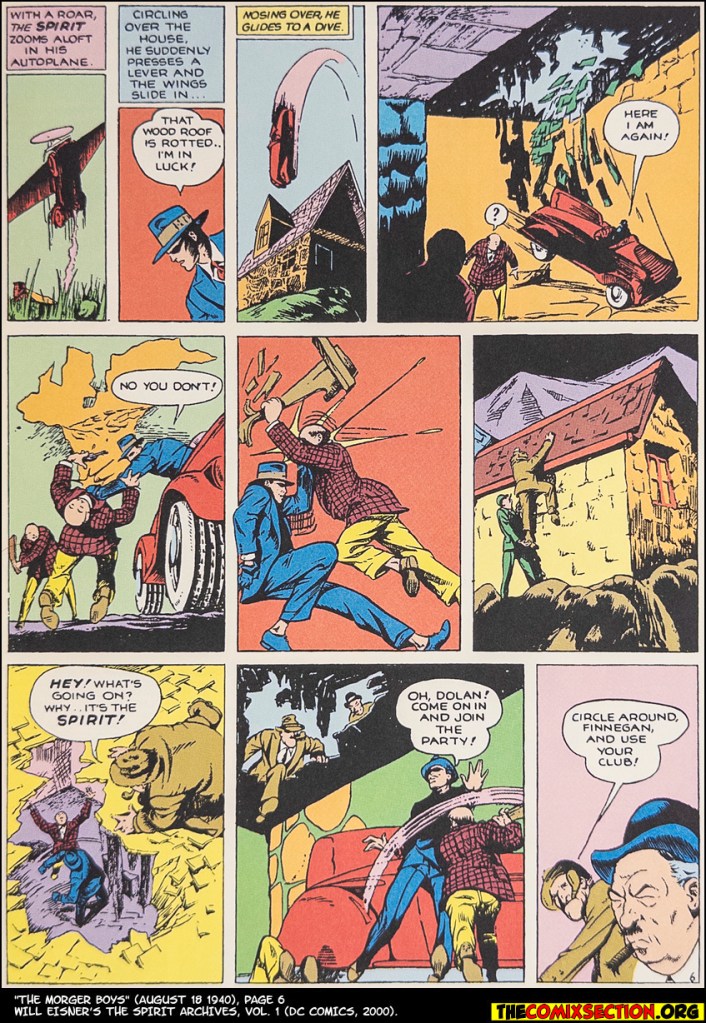
  • The Spirit (August 18, 1940) “The Morger Boys”

    Will Eisner (editor, script, pencils, inks)

    Joe Kubert (colors)

    Sam Rosen (letters)

    Morger Boys has maybe one bad moment, some missed opportunities, a peculiar finish, and fantastic action. The strip opens twenty-five years ago—so, you know, 1915–with the execution of a notorious murderer, Morger. Mrs. Morger makes their four sons promise to avenge Papa’s death twenty-five years later.

    The story jumps ahead, revealing the Morger Boys all look alike—kind of jovial so their murderous ways contrast—and are ready to execute their plan. One of them reveals the targets, and the brothers get to work. Never explained are their preparations for this plan. Nor if they’re all dressed the same as a bit or because it’s just a good visual idea (for Eisner).

    The brothers only drive the strip for the first few pages, then one of their targets hires the Spirit as a bodyguard. The Morger brothers are ready for Spirit, who is very much not ready for them. After the quick fisticuffs, Spirit is knocked out.
    Luckily, from his criminology studies—which did not include clearing a room, based on this strip—Spirit remembers the Morger family had a weird old stone cabin near the jail and it’d be the perfect place to execute your enemies.

    The contrived eureka moment gives way to Spirit busting into the house just in time to save hostages and kick ass. There are some startling panels this strip; sublime work, with the lines getting more and more assured. Spirit is coming into its own, visually, week by week.

    Eventually, Dolan will arrive and follow up on one of his own related leads. Dolan and Spirit don’t talk about the Spirit being wanted for murder, instead they kick the Morger Boys’ asses. I think it’s the first time Dolan ever starts busting heads in the strip.

    The finale is bizarre, involving what could possibly be considered character development for Spirit but also maybe isn’t; it’s notable primarily because it tries to leverage the “grateful dame” trope.

    Maybe only in the funny pages.

    It’s a solid strip, with that bad moment—pointlessly flexing supernatural—sailing past for another fine action thriller for the Spirit.

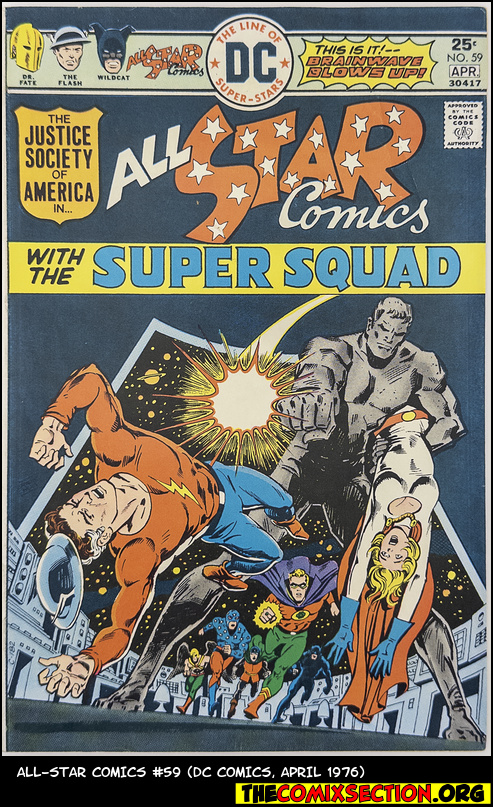
  • All-Star Comics (1976) #59

    Gerry Conway (editor, script)

    Paul Levitz (assistant editor, plot assist)

    Ric Estrada (pencils)

    Wally Wood, Al Sirois (inks)

    Ben Oda (letters)

    All-Star slightly improves from last time, mainly because Wildcat has fewer opportunities to be a sexist prick. There’s a huge one at the beginning, so much of one the Flash comments on it (internally) and assumes his friend is upset about the disasters threatening the world when it’s just because a Power Girl is stronger than him.

    But Wildcat, Flash, and Power Girl are away most of the issue, on a rocket to intercept Brainwave’s spaceship.

    Instead, the action checks in with the other heroes—Robin, Green Lantern, and Dr. Fate; they get their scene, which reveals the villain is hypnotizing the heroes into believing regular people are his evil henchmen. In the very next scene, Hawkman, Dr. Mid-Nite, and Star Spangled Kid beat the ever-loving shit out of a bunch of henchmen. So either the bad guy had some real henchmen and some fake henchmen, which seems like a lot of extra work, or our heroes beat up a bunch of civilians.

    Because despite writer Gerry Conway’s inability to stop with the superhero worship thought balloons of most of the characters—and then the general exposition, too—he underwrites the book’s action. But still somehow paces it really well. The issue’s nowhere near a success, but it’s got some good art (Ric Estrada and Wally Wood again).

    It’s also got some not-good art, and it’s still weird how Estrada contorts Power Girl’s cleavage and gams into every panel. Even when she’s saving the world. Conway’s going on and on about how it’s so much more heroic because she’s not Supergirl of Earth-One, and Estrada’s drooling on the page.

    Then there’s the villain, Brainwave. He’s got googly eyes. Googly eyes had been a craze by the time this comic came out; the creators must’ve known, yet still, they did googly eyes.

    Much of the issue is spent with Brainwave. We get his recent backstory, just how it pertains to the current event, and then he’s around a lot. When the action gets to him after the hero check-ins, it stays with him, which makes Conway’s plotting even more successful.

    The finale’s way too purple in the exposition, but it’s dramatic enough. It’s mostly Dr. Fate talking, and Conway doesn’t give Fate any personality, which makes him likable because everyone with personality seems like a dick.

    Of course, Estrada and Wood have problems with Fate’s helmet.

    Baby steps.

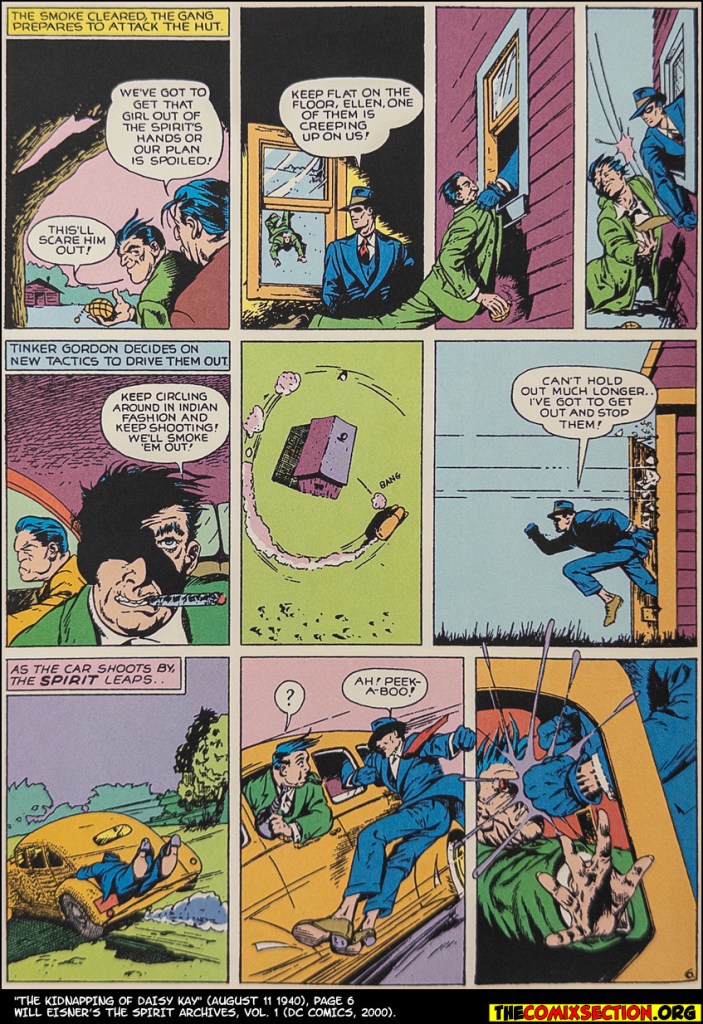
  • The Spirit (August 11, 1940) “The Kidnapping of Daisy Kay”

    Will Eisner (editor, script, pencils, inks)

    Joe Kubert (colors)

    Sam Rosen (letters)

    Daisy Kay’s kidnapping involves a lot more action than the setup will imply. The strip opens with Homer Creep (renamed from the previous, presumably French spelling, Creap) bursting into the Spirit’s crypt lair with a pistol at the ready. Spirit handily disarms Homer and invites him into the lower portion of the lair—the living quarters and laboratories.

    Homer even asks about the renovations.

    Since we last saw Homer in the second Spirit strip, his fiancée has left him. The fiancée is Commissioner Dylan’s daughter, Ellen, who the Spirit gussied up at the end of that strip in a profound act of misogyny. He and Homer discussing it here explicitly objectifies the character again, and Ellen has clearly internalized it. She’s no longer interested in criminal psychology, she’s going to be a chorus girl.

    The Spirit has a plan, however. He’s going to kidnap Ellen and then Homer will come and save her. She’ll think Homer’s a hero, Spirit’s a sap, and everything will be jake.

    Except Ellen is working for a gangster. But that gangster—who’s producing her show on Broadway—doesn’t know about it until opening night, when one of his flunkies recognizes her. She’s there under a pseudonym—Daisy Kay. There’s a quick scene to establish Dolan’s worry that she’ll ruin his reputation as police commissioner, which is precisely the gangster’s plan. Reveal her true identity, humiliate the commissioner, get the mayor to fire him for having a low-class kid.

    So the gangsters don’t like it when Spirit swings down onto the stage and grabs Ellen, running off with her over his shoulder. They give chase, which results in a fantastic series of action sequences. First there’s an autoplane bit, then there’s a Spirit fighting guys in a car bit, then there’s Ellen and Spirit under siege in a remote cabin with gangsters circling them firing on the cabin bit. It’s all glorious, it’s all beautifully visualized, even if the interludes are just Spirit being a mega-jerk to Ellen for Homer to capitalize on eventually.

    Will Homer save the day and get the girl? Or are things more complicated in love and war?

    More importantly, what happened with the last big action panel—despite all the two-fisted fisticuffs, Eisner and the studio can’t render the slightest dodge?

    Maybe they just didn’t have the space. Doesn’t matter; it’s an excellent strip. Minus the active and passive misogyny, of course.

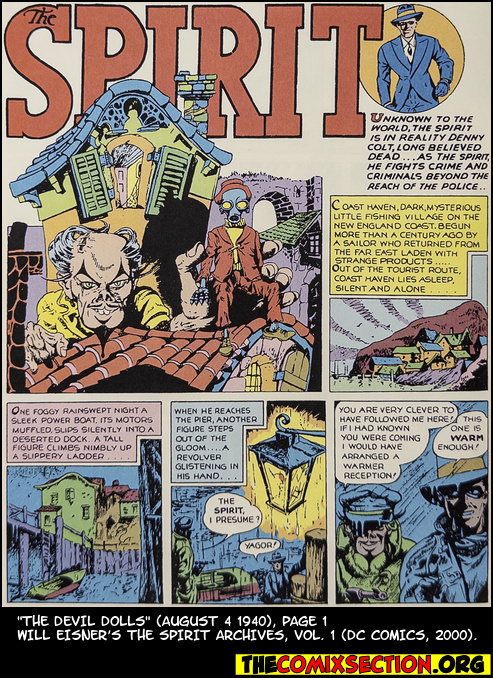
  • The Spirit (August 4, 1940) “The Devil Dolls”

    Will Eisner (editor, script, pencils, inks)

    Joe Kubert (colors)

    Sam Rosen (letters)

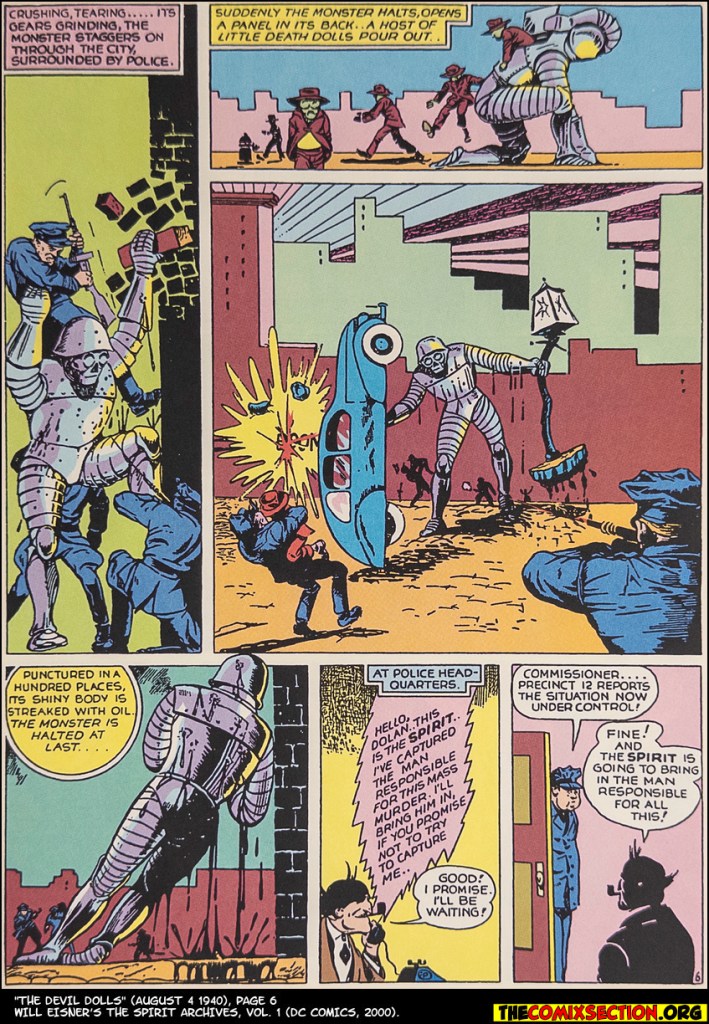
    While The Death Dolls do play a part, the most impressive element of this strip is the proto-Nazi killer robot. “Proto” because Eisner wasn’t willing to be too explicit in 1940. But there will be a robot shaped like a German soldier (the helmet is the giveaway) who tries to destroy New York.

    But that raid is in the last couple pages….

    The strip begins with the Spirit tracking evil munitions engineer Yagor to a small New England coast town. The overly verbose—but finding its charm—introductory exposition has the Spirit arriving by boat, giving the town an isolated vibe. The isolation is just to provide the moody setup. And possibly just some Spirit showing off with his motorboat pursuit.

    He’s tracked Yagor from the city, the obvious culprit in the murder of another weapons engineer. Yagor stole his plans to sell to a German guy. Again, the strip’s not explicit—the guy just happens to be named Emil Kampf, but he could be representing any global superpower with a name like Emil Kampf in 1940.

    Instead of just shooting the Spirit on the spot, Yagor lets Spirit douse him with some exposition about the murder case in the city, which involves Spirit catching wind of the deal with Kampf. So Spirit’s going to hang around and watch the deal, thereby witnessing Yagor selling secrets to a foreign power, which is just good business when you think about it.

    Except Kampf thinks the robot Nazi is a bad product (he shoots it a couple times, causing oil leaks), and storms out. Then Yagor unleashes the death doll, which tracks Kampf back to his hotel in New York City—walking across New England, which totally means Spirit could’ve driven—and detonates when it reaches Kampf.

    Spirit tries to stop Yagor, but the robot is still functional and it kicks his ass. As Yagor and the robot leave to start their reign of destruction on the world for refusing to buy his stolen arms (why was a U.S. company making robot Nazis… oh, never mind, Spirit takes place in a reality close to ours), he leaves a death doll to take care of Spirit.

    Obviously, the Spirit will foil the doll, escape, and save the day. However, when the robot hits the city, it’s fighting an army of cops, forecasting a fifties sci-fi monster gone amuck. Spirit concentrates on Yagor, and negotiating a temporary truce with Dolan.

    It’s another great strip, with a few pages of sublime lines, and a fun finish after some phenomenal action; the studio just can’t unlearn the reliance on dotting for inking fast enough.

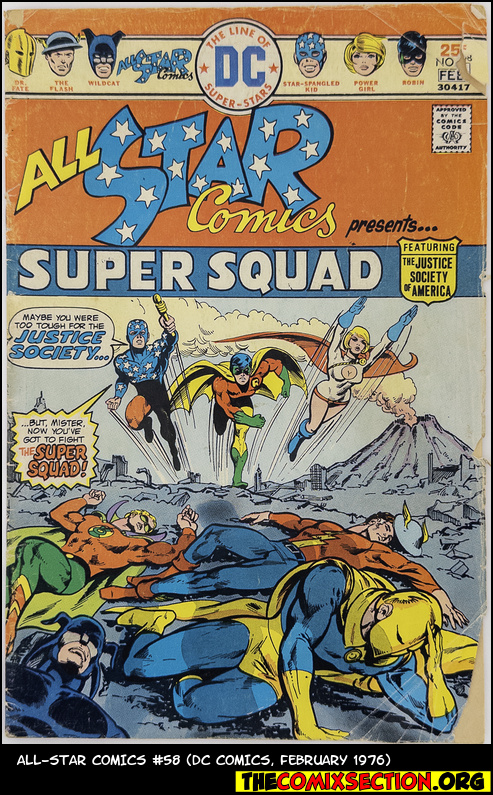
  • All-Star Comics (1976) #58

    Gerry Conway (editor, script)

    Ric Estrada (pencils)

    Wally Wood, Al Sirois (inks)

    Ben Oda (letters)

    Paul Levitz (assistant editor)

    The issue opens with the JSA reading their email—no joke—and an anonymous sender telling them there will be disasters in three major cities: Seattle, Capetown, and Peking. The heroes split into pairs to investigate.

    Seattle is Dr. Mid-Nite and Hawkman, except the action there begins with Star-Spangled Kid foiling a bank robbery. Once we get a bunch of Kid’s thought balloons about his cosmic rod (literally a cosmic rod, not his… anyway), it’s time for an earthquake. Hawkman and Dr. Mid-Nite see him trying to save people from above; Hawkman wants to help, but as Kid’s psychiatrist, Mid-Nite, says if they help, it’ll give Kid a complex.

    So they just watch as maybe people die because one superhero isn’t enough for an earthquake.

    In Capetown, Dick Grayson—oh, right, JSA is Earth-Two, which means everyone’s older… kind of like they’d kept aging after WWII but not really because Dick Grayson’s in his twenties, not his late forties—Dick Grayson’s a UN envoy and he’s there when a gas attack occurs. Dr. Fate and Green Lantern show up and do most of the work, with Green Lantern whining the whole time about how he’s not very smart and he wishes he were smart.

    Finally, in Peking, we get Flash and Wildcat arriving just in time to stop a newly appeared volcano. Power Girl gets there after a page, sealing up the volcano and explaining the conceit of the comic to the heroes—writer Gerry Conway has already laid it out at least once for the reader, so he’s really hammering it in with Power Girl’s exposition. What if there were three disasters and three young heroes who really did all the work while the JSA was powerless? Wouldn’t that make a great concept for a comic?

    Having read the comic, no, not really. Especially not since Conway’s wordy exposition oscillates between vapid superhero worship and redundant griping. Wildcat, for instance, spends most of the comic throwing in some asinine remark. But the rest of the heroes are still at least a little pissy about… being superheroes. Maybe some of the disconnect is all of them ostensibly being grown-ass men in at least their forties, yet still utterly feckless. Or Conway just doesn’t have a comic so much as an idea for one.

    Ric Estrada and Wally Wood are on art. Lots of weird body poses, particularly with the flying (and not just Power Girl, who Estrada makes sure to get her cleavage and her leggy legs in every panel), but it’s such a rushed story, it doesn’t really matter.

    All-Star Comics—returning after a twenty-five-year hiatus (sort of)—is off to a soggy start.

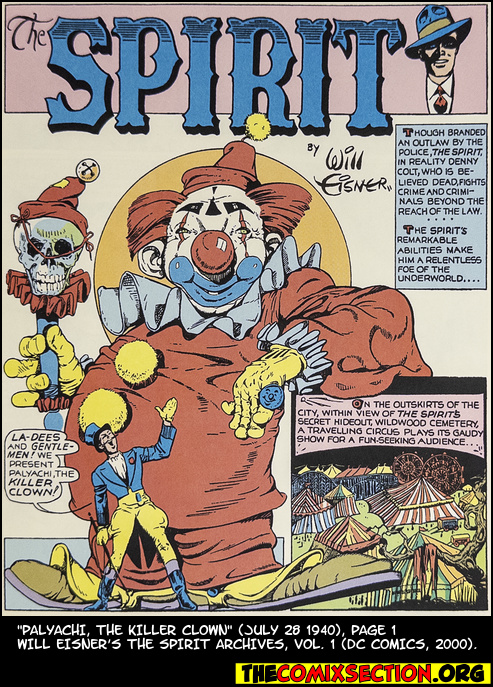
  • The Spirit (July 28, 1940) “Palyachi, The Killer Clown”

    Will Eisner (editor, script, pencils, inks)

    Joe Kubert (colors)

    Sam Rosen (letters)

    Since the last strip, when the Spirit confessed to a murder he did not commit to save Commissioner Dolan’s reputation and career, he’s apparently been taking it easy. The strip opens with a gorgeous, gigantic splash of the title character–Palyachi, introduced by a ringmaster as “a killer clown.”

    We get Palyachi’s story—he gets laughs at the circus, but Marka—the maybe belly dancer (it’s never established)—still won’t return his affections. Maybe if he’d kill for her she would, starting with one of the trapeze acrobats. Palyachi’s reluctant, but once he gets going with his criminal ways, he can’t stop himself, going on a rampage around the city.

    Despite the first panel after the splash establishing the circus is right near Spirit’s hideout in Wildwood Cemetery, he and Ebony have no idea it’s there. Days into Palyachi’s crime spree (he’s trying for a million bucks to sway Marka), Ebony brings a recent crime to Spirit’s attention in the newspaper.

    Spirit immediately deduces it involves a circus, and to their surprise, there’s a circus out the window (of the crypt) they hadn’t noticed for days on end. It’s a little thin, even for a comic strip, but once Spirit gets to the circus—where Marka is going to literally strip down to seduce him, very risqué—it turns into an excellent action strip, and the occasional bumps don’t matter.

    The Spirit goes into the situation entirely clueless as to what he’s uncovering and lets Marka convince him Palyachi’s the mastermind. Well, maybe. Spirit definitely plays along with Marka (who gets naked waiting for Spirit to return after dealing with Palyachi), but when he starts suspecting her involvement isn’t clear despite him finding her in possession of all the loot from Palyachi’s heists.

    The fight scene has the two running around a circus, including trapeze action, and even a killer gorilla. Lots of beautiful panels, with phenomenal flow, even as the inking is uneven. Someone in Eisner’s studio still thought dots were going to win over lines.

    The finale involves the police, who are after Spirit (the opening origin blurb even includes Spirit being an outlaw now) and don’t care he’s trying to solve a crime spree for him.

    It’s rather good, even with the occasional thin plotting, or, in the case of the ending, thin sentiment.

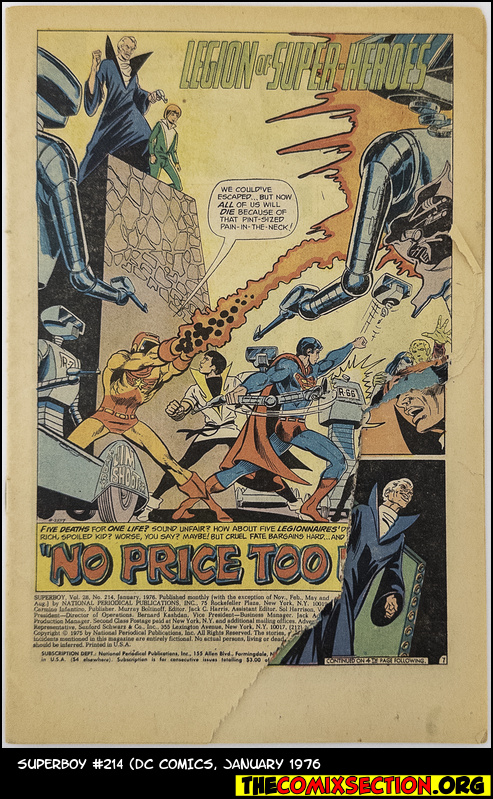
  • Superboy (1949) #214

    Jim Shooter 1, Cary Bates 2 (script)

    Mike Grell (artist 1, pencils 2)

    Bill Draut (inks 2)

    Ben Oda 1, Joe Letterese 2 (letters

    Jack C. Harris (assistant editor)

    Murray Boltinoff (editor)

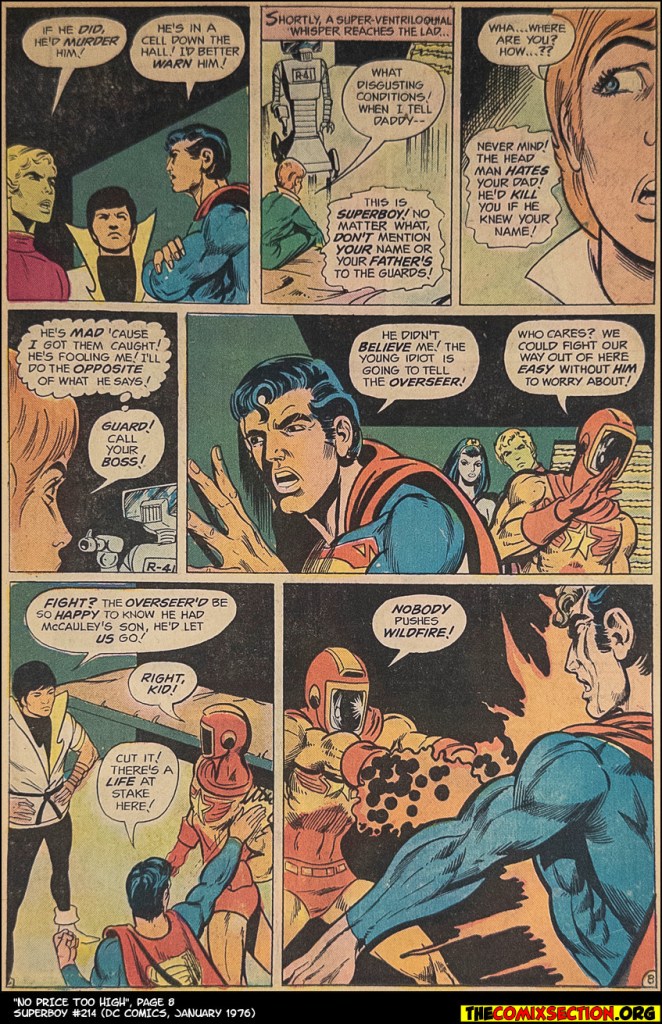
    Ah, yes, the valiant superheroes of the future… who are willing to sacrifice a little kid’s life because they don’t like him. Well, not all of them, but definitely Wildfire and maybe Karate Kid. Thank goodness Superboy (with his forty-five-year-old Grell features) is there to remind them they’re not supposed to let innocent people die just because they’re unpleasant.

    The Legion’s on an automated factory planet. The planet’s been attacking ships trying to land, including one after the Legion arrives. Superboy saves the ship’s pilot before the planet’s lasers zap it. Turns out the pilot is an obnoxious little kid (who barely seems aware of the Legion, which ought to be interesting but isn’t), son of the planet’s owner.

    Too bad the villain turns out to be a fired overseer who hates the planet’s owner and would kill the kid at the first opportunity. So Superboy does his best to try to keep the kid safe, even as the kid thinks the heroes are just trying to cramp his style. Wildfire takes a different approach—let the kid die so the Legion can escape.

    Maybe if writer Jim Shooter had a better moral compass, the story would read better; as is, the reader’s supposed to identify with Wildfire but eventually agree with Superboy, who’s actually not showing all his cards. So… the needs of the few only outweigh the needs of the many when you’re playing with marked cards.

    At the very least, there are a couple okay big action splashes from Mike Grell. They’re usually cushioned with some strangely distorted human faces or whatever’s going on with Wildfire’s helmet, but there are at least a couple okay visual moments.

    The backup—Grell on pencils, Cary Bates writing, Bill Draut on inks—is about Brainiac-5 trying to help Shrinking Violet with a mental health issue. She’s just had a nasty near accident with another Legionnaire in the gym—she almost got stomped on—and now she can’t shrink any more. Brainy ignores Saturn Girl’s “professional” psychiatric advice on how to deal with it and pushes forward with an extreme treatment.

    It’s a terribly plotted story—the first few pages are all talking heads about Violet’s problems (talking about her, she’s not conscious for it because she’s so near her mental breaking point), then there’s some setup of Brainy’s treatment idea. But then the actual action of the story is barely a page and a half, and it’s… about getting stuck in a big ball of wire.

    Once again, Brainiac-5 doesn’t seem very smart at all.

    Overall, however, the issue’s nowhere near as bad as its creators can get. Unless, of course, you want your superheroes helping people instead of pushing them under busses.

  • The Spirit (July 21, 1940) “Eldas Thayer”

    Will Eisner (editor, script, pencils, inks)

    Joe Kubert (colors)

    Sam Rosen (letters)

    Eldas Thayer is the name of a miserly old rich guy who’s refusing to pay for his niece’s medical treatment. Thayer’s doctor has just given him the bad news—he’s got a day to live. The Spirit shows up just after, pleading for the niece’s life. Thayer doesn’t appreciate the Spirit’s tone, especially since Spirit heard the doctor’s report.

    “No,” says Thayer. “I’d kill you,” says Spirit, “but morale code blah blah.”

    Thayer then concocts a Rube Goldberg contraption to kill himself and blame Spirit because screw that guy. Thayer’s not just a bad guy, he’s visually unpleasant. Thayer will have some fantastic action sequences, strip-best dialogue, and—I believe—the first significant Spirit character development. But the art’s rough at open. Dots instead of lines. So Thayer’s, like, repugnant in his close-up.

    He successfully frames Spirit for his murder, Spirit goes to visit Commissioner Dolan, unaware he’s wanted for murder, the mayor just happens to be there, tells Dolan to arrest Spirit, Dolan pleads with Spirit to proclaim innocence and Dolan’ll quit the force for him to fight for truth.

    Upon hearing his only confidante’s pledge, Spirit decides he cannot deprive fair Gotham of her police commissioner and says, “No, I killed him.”

    So then begins the chase portion of the story, which—remember—is called Eldas Thayer–cops are after Spirit, Spirit is trying to save the dying niece. Thank goodness someone remembered her.

    Panel after panel, there’s great art and brisk storytelling. The art’s never quite sublime in terms of line work (except the splash page), but the composition and the writing establish a beautiful rhythm. Tiny panels composed like classic Hollywood montage shots; the panels get downright exquisite for the last few pages. At nine panels a page. It’s some genuinely exceptional art this week.

    And then the writing.

    Having to deceive Dolan (for his own good) immediately opens up a whole new layer to Spirit. He’s gone from white knight to dark knight. I did check: Gordon did appear in Detective before Spirit… but, based on a cursory look, that work marriage wasn’t anywhere near this far along yet.

    Spirit makes the move fearlessly, the Spirit announcing (addressed to Dolan but for the reader) they’ve got to break up so Spirit won’t drag him down. But don’t worry, if the forces of evil should rise again, to cast a shadow on the heart of the city, the Spirit will be there. Just as an outlaw.

    It’s a gorgeous finish, too. Extreme long shots, clean lines, sublime composition.

    Easy strip best to this point.

  • The Spirit (July 14, 1940) “Mr. Midnight”

    Will Eisner (editor, script, pencils, inks)

    Joe Kubert (colors)

    Sam Rosen (letters)

    There’s a lack of consistency to Mr. Midnight. After a gorgeous splash page, featuring the dramatically posed new villain, with the intro text recapping the Spirit’s origin segueing naturally into the exposition’s start, the art seems to go from Eisner’s drafting table to someone else’s in the studio.

    Many other someones, in fact. Midnight barely maintains style between panels, much less pages. The lines go from busy and erratic to clean to busy. There are some ingenious panels throughout, like when Spirit is facing off against Midnight and they’re both just little stick figures in the distance.

    Even at its worst, the art only ever seems way too rushed, never bad enough to slow the pace of the story.

    The story involves Mr. Midnight taunting the Spirit with a perfect crime. Midnight’s going to murder someone in front of Spirit and Commissioner Dolan and they’re going to let him go. I could also mention here Mr. Midnight is Smurf blue, which is barely a plot point and seems like something just done for the visuals… or another of the seeming miscommunications between writers and artists—pin in that one.

    Eisner ratchets the suspense during this sequence, having Dolan, Spirit, and Midnight having to wait around for Midnight’s victim to arrive. So there are two full story beats before Spirit even has anything to do on his own. And even when does something, it’s not a lot. He just follows Mr. Midnight home, and, thanks to his autoplane, gets there before Midnight.

    Some villain monologuing and sinister chess playing ensue; it’ll eventually get around to fisticuffs and high action.

    Eisner (and Spirit) save the mystery resolution for the last few panels after the action has been resolved. It’s an engaging ride, even if Midnight’s not a good villain (he’s just Smurf blue), and Spirit and Dolan kind of let him kill that guy in the first scene. They sure didn’t try to stop him.

    And that sequence—with Midnight taunting everyone before (ostensibly) committing a murder—is where the strip gets confused on details. The script says there should’ve been a visual tell, but there’s no visual tell when you go back.

    It’s an odd, uneven, entertaining outing. And that gorgeous splash page is gorgeous.

  • The Gilded Age (2022) s03e01 “Who Is in Charge Here?” [2025] D: Michael Engler. S: Carrie Coon, Morgan Spector, Louisa Jacobson, Denée Benton, Taissa Farmiga, Cynthia Nixon, Christine Baranski. Reliably excellent season opener focuses on changes since last season for Nixon and Baranski, as Nixon’s now the one with the money. Meanwhile, Coon keeps trying to queen-make daughter Farmiga, with everyone hoping Spector gets home in time to stop her. Plus, developments in the standing subplots. Staggeringly good acting from Nixon and Coon in particular.

    Poker Face (2023) s02e07 “One Last Job” [2025] D: Adam Arkin. S: Natasha Lyonne, Sam Richardson, Corey Hawkins, James Ransone. Kevin Smith-esque heist homage episode has HEAT DIE HARD (wokka wokka) Richardson finding himself in his own crime thriller, costarring Ransone as a new scuzbag pal. Meanwhile, Lyonne finds herself in a romcom, which the episode intentionally devalues as a genre to serve the masculine. But Ransone’s a singular actor, and Lyonne and Hawkins are very cute together.

    Poker Face (2023) s02e08 “The Sleazy Georgian” [2025] D: Mimi Cave. S: Natasha Lyonne, Melanie Lynskey, GaTa, John Cho, Brendan Sexton III, Eric Satterberg, Joel Marsh Garland. Probably series-best episode has Lyonne falling in with con man Cho and his crew, which the audience has already seen maybe fleece nice lady Lynskey. At what point does the con become too dangerous? Great performances all around (Lynskey has a strong spotlight). Cave’s direction and the script (credited to Megan Amram) are stellar as well. It’s sublime.

    Poker Face (2023) s02e09 “A New Lease on Death” [2025] D: Adamma Ebo. S: Natasha Lyonne, Awkwafina, Lauren Tom, Alia Shawkat. Well-acted but otherwise strangely light episode has Lyonne trying to suss out what’s going on with new pal Awkwafina’s grandma Tom’s new girlfriend, Shawkat. Shawkat’s great, but there’s nothing to the part. Tom and Awkwafina have an awesome family vibe, it’s just not part of the episode. Maybe it’s just the lackluster finish.

    Resident Alien (2021) s04e01 “Prisoners” [2025] D: Alan Tudyk. S: Alan Tudyk, Sara Tomko, Corey Reynolds, Alice Wetterlund, Levi Fiehler, Elizabeth Bowen, Meredith Garretson. Pretty good (and, more importantly, successful) season premiere has Tudyk wearing three hats–acting twice, plus directing. The directing shows he knows the cast’s strengths, even as they’re however many years older since the show last filmed. Some very solid laughs and an awesome Tudyk episode. Reynolds is great, too. But there are just too many characters.

    Resident Alien (2021) s04e02 “The Lonely Man” [2025] D: Alan Tudyk. S: Alan Tudyk, Sara Tomko, Corey Reynolds, Alice Wetterlund, Levi Fiehler, Elizabeth Bowen, Meredith Garretson. Solid enough episode gives Tudyk some great showcases while trying to sort through the dozen or so characters it’s juggling. Lots of back and forth to keep the subplots going while getting one of the guest stars out of the picture. Again, solid, with hints at the season to come. Great episode for Reynolds and Bowen, too.

    Resident Alien (2021) s04e03 “Ties That Bind” [2025] D: Brennan Shroff. S: Alan Tudyk, Sara Tomko, Corey Reynolds, Alice Wetterlund, Levi Fiehler, Elizabeth Bowen, Meredith Garretson. Based on returning guest star Linda Hamilton’s subplot, it sure looks like ALIEN is going to safely wind everything down this season. Hamilton gets her series best episode as she discovers it’s not so easy to change the past (oddly no TERMINATOR jokes). Otherwise, lots going on, with Gracelyn Awad Rinke and Reynolds getting some great material.

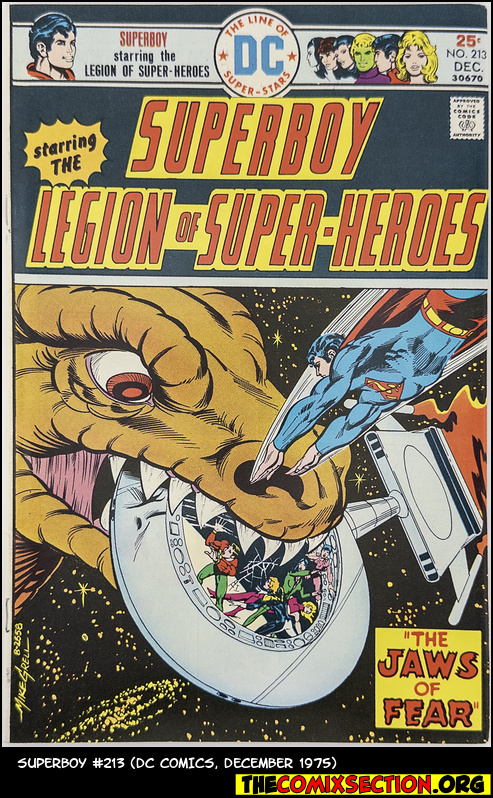
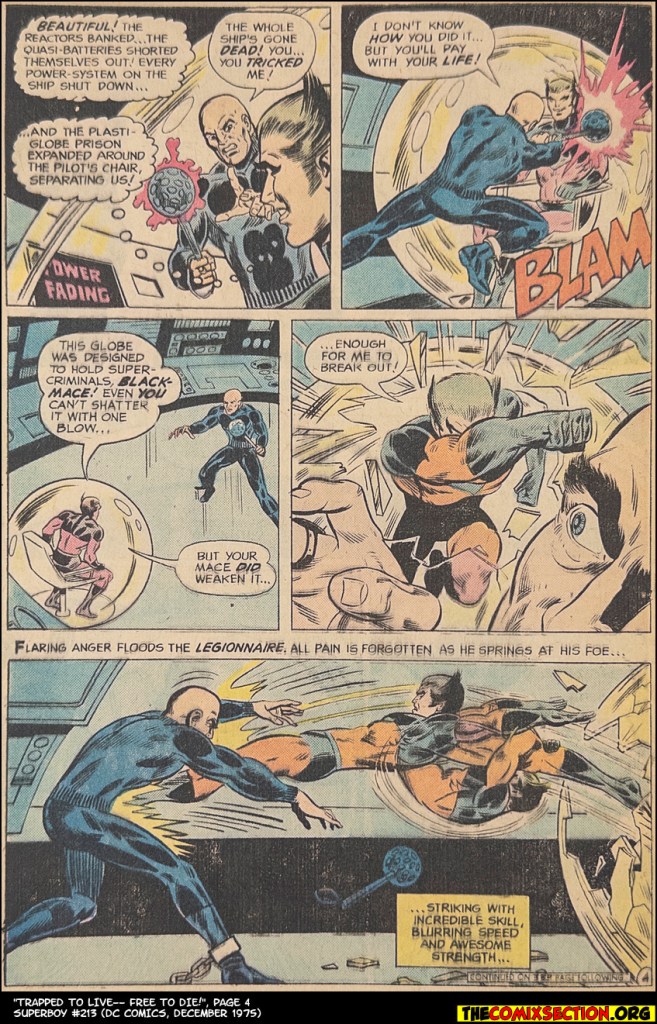
  • Superboy (1949) #213

    Jim Shooter (script)

    Mike Grell (artist 1, pencils 2)

    Bill Draut (inks 2)

    Jack C. Harris (assistant editor)

    Murray Boltinoff (editor)

    Despite a poor opening, the feature’s not terrible. I mean, Mike Grell’s mid-forties-looking Superboy is always a thing, but otherwise—besides the incessant bickering between the Legionnaires—it’s an okay story. Once you get past Superboy’s introduction to the story, which is thankfully the worst Jim Shooter exposition we get in the whole story.

    The introduction promises Ultra Boy cracking under the pressures of being a superhero, but it’s actually something tied to a very specific trauma for Ultra Boy. The resolution to it entirely invalidates the introduction teaser, but whatever. It could be much worse.

    The Legion’s hanging out at headquarters when someone breaks in, getting past all their advanced defenses. It’s the best thief in the galaxy; come to tell the Legion he’s going to steal their miracle machine. Brainiac-5 accuses the thief of being a liar because Brainy’s never heard of him.

    The thief points out he’s never been arrested or caught because he’s the best, so how would Brainiac-5 have heard of him? Brainiac-5, being written by a Jim Shooter-level intelligence, has no rejoinder.

    The thief transports out or whatever, promising to return, and the Legion has a fit about what to do next. They take a vote on destroying the machine, only to discover they can’t destroy it anyway; it’s too well-built. So they up the defenses and stand guard.

    We still haven’t had Ultra Boy cracking under pressure, by the way. We’ve got to wait for them to try to track the thief down, running into a space dinosaur instead, and Ultra Boy hates space dinosaurs. Good thing the comic’s called Superboy and Superboy can see across the universe.

    There’s nothing particularly good about the story, but there’s also nothing particularly bad—Shooter made it through a whole story without any sexism—and while Grell’s going to Grell, maybe it’s worn me down by now.

    The backup’s similarly indistinctly “not terrible.” Also not at all good. Shooter scripts, Grell’s on art with Bill Draut. Is Grell better with someone else inking? Not really. Draut makes the lines bolder, which isn’t really Grell’s problem. None of the body work is improved.

    On a solo mission, Timber Wolf answers a distress call, but something else may be going on. To survive, Timber Wolf will have to use his smarts and knowledge of the Legion policy and procedure handbook.

    So many thought balloons from Timber Wolf. None of them thoughtful, but also none of them filled with the character’s usually sexism.

    The comic’s not so much not bad as inoffensive. It’s still not anything good, but inoffensive is a good start.

  • The Spirit (July 7, 1940) “The Black Queen’s Army”

    Will Eisner (editor, script, pencils, inks)

    Joe Kubert (colors)

    Sam Rosen (letters)

    Eisner and studio tell one heck of a full story in these eight pages. The splash panel gives the Spirit origin and shows Wildwood Cemetery very close to New York City proper, with an airplane below the cemetery. But the story of The Black Queen’s Army begins with a stool pigeon getting shot dead and the cops unable to make an arrest. Even though gangsters from all over the country have been coming to Manhattan, no one can figure out what they’ve got planned.

    Well, they’re going to rob the Federal Reserve Bank (or something) of a million dollars in gold bullion. And they’re doing it for that notorious female mouthpiece The Black Queen. Since her last appearance, she’s gone full Bond villain—note, the Spirit should’ve known she was the gangland mastermind but missed that one—and has a straightforward plan. Block the bridges, take the police headquarters hostage, and parachute hundreds of gangsters with Tommy guns into the city.

    The visual execution of the mega-heist is sublime. Eisner doesn’t deal with the large-scale assault, instead zooms in on Commissioner Dolan’s losing fight for headquarters and the police radio’s message reaching the Spirit and Ebony. Also sublime this strip is the art. Eisner and the studio have gotten their line work down. They’re still a little sharp, but there are fewer of them and they’re doing more work. There’s some excellent detail in this one.

    Including—awkwardly as ever—on Ebony’s caricature features.

    Ebony’s a full sidekick this strip but doesn’t get anything to do except give the Spirit a conversation partner. He doesn’t even appear as the third act action takes over—oh, forgot—Spirit is putting together his flying car this strip. Thanks to the car he can get to Manhattan to save the day. The flying car stuff is ridiculous, but the rendering of it is so gorgeous it doesn’t matter. Eisner’s packing this strip. Dolan gets whole kidnap and rescue scenes, Spirit takes out multiple bands of crooks; it’s a full-on action comic. And it’s fantastic.

    Eisner showcases the strip’s ability to do exciting—all in eight pages—and it’s glorious.

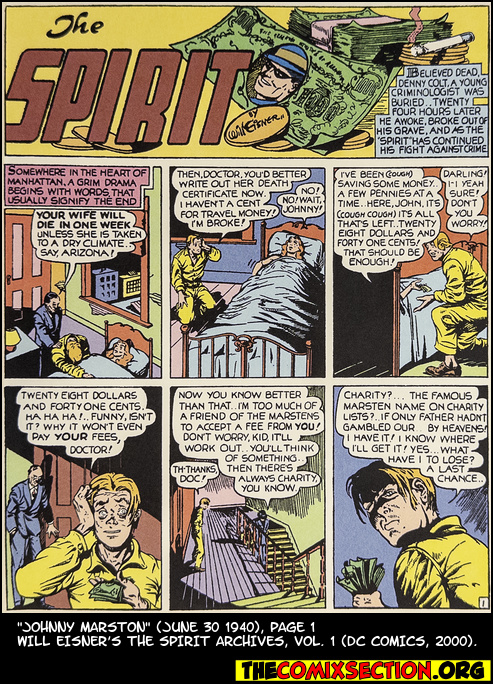
  • The Spirit (June 30, 1940) “Johnny Marston”

    Will Eisner (editor, script, pencils, inks)

    Joe Kubert (colors)

    Sam Rosen (letters)

    Johnny Marston’s splash panel has a short blurb explaining the Spirit’s origin—of note because it’s a strip standard from now on. It’s also the first strip where the Spirit stumbles into an ongoing adventure.

    Johnny Marston is a blue-blood fallen on hard times. Dad gambled away all the money, now Johnny’s wife is deathly ill and he can’t afford to get her out west, where the dry air will save her. With their last thirty bucks (not even), he goes gambling. Successes don’t turn out to matter because the gangster running the joint isn’t going to let Johnny cash out.

    The gangster’s muscle beats Johnny close to death and they dump the corpse-to-be in Wildwood Cemetery. Luckily, the Spirit happens to be on a walk when he sees the body being dumped and can gather enough information to try to take down the gambling establishments. Ever opaque about the Spirit’s actual skills, Eisner and studio do not explain how someone can have a whirlwind night at the casinos without ever losing. Maybe it’s the Spirit’s blue top hat, which he dons for the outing.

    There’s some great art. Not much in the way of fisticuffs, with gambling antics and a big car chase sequence providing the action this time around. There are still some fisticuffs, of course, but not only fisticuffs. The panel layouts with the Spirit getting interested in taking down the gambling dens and the car chase are particular standouts.

    There’s also the Spirit getting mad at Dolan for the police department not coming through right, which is an interesting detail if a throwaway. And the last sequence, with a postal delivery person having to go to Wildwood Cemetery, is cute.

    Outside the dumb luck factor—tying Johnny and the Spirit—being a tad slight (Eisner spends so much time on Johnny’s setup, he doesn’t have the space to tie them better), it’s a good strip. Sympathetic characters, determined Spirit, it works out.

    And we get to see a little more of Spirit’s crypt lair. He’s at least got a bed down there.

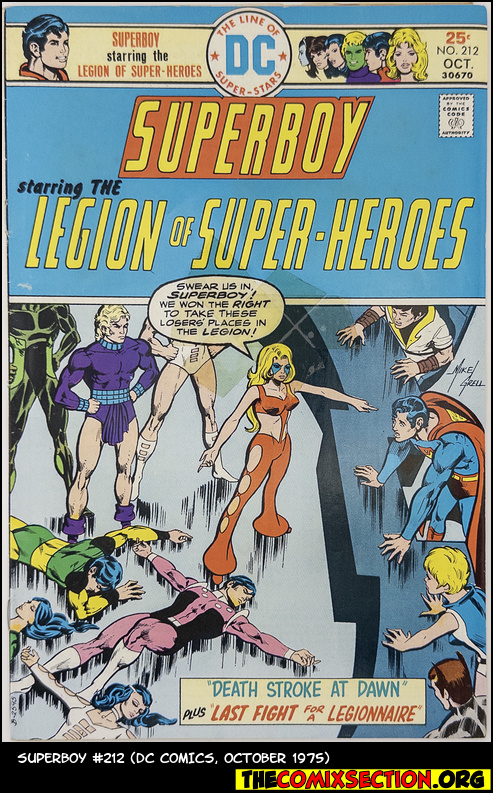
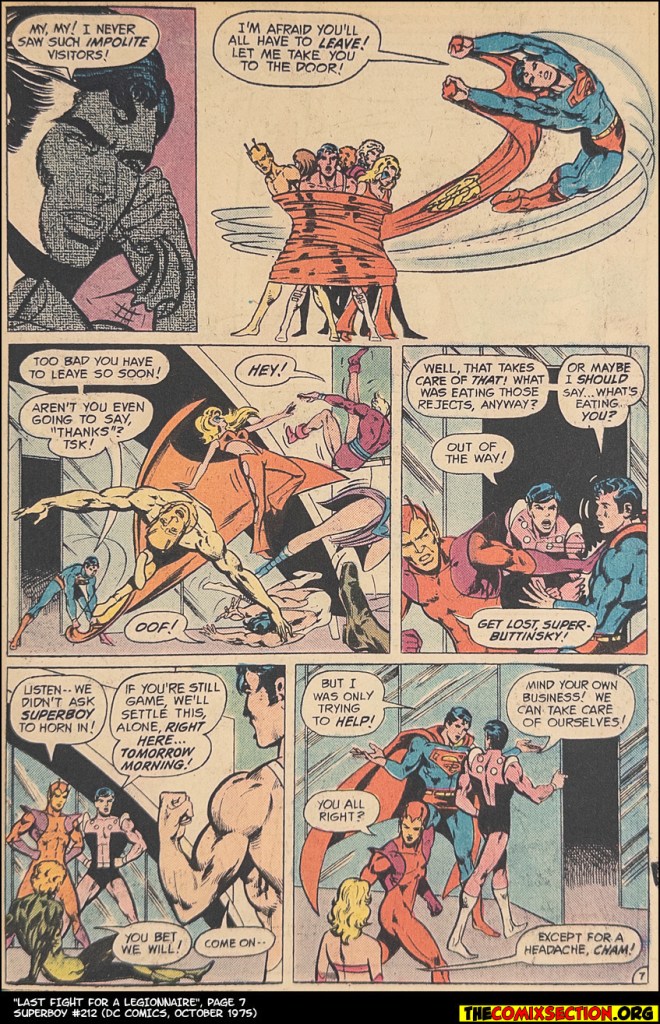
  • Superboy (1949) #212

    Jim Shooter (script)

    Mike Grell (artist)

    Ben Oda (letters)

    Jack C. Harris (assistant editor)

    Murray Boltinoff (editor)

    Jim Shooter and Mike Grell contribute both stories this issue and offer little quarter. Grell’s art is slightly better than usual (or at least not as obviously deficient), and I guess Shooter could be worse.

    The first story is about a bunch of Legion rejects busting into the Legion headquarters and kicking the Legion’s butt. Each of the rejects is from the same planet as their opponent and uses those same powers to overwhelm the Legionnaire. It’s not until Superboy shows up the fight ends.

    Except then his teammates are mad at him for stopping them from getting their brains beat in. So they challenge the rejects to a rematch the next day. Little do the rejects realize the Legionnaires have a plan, and that plan is teamwork. You can beat the crap out of lots of people if you plan on how you’re going to do it.

    Not really sure Superboy is a morally virtuous comic book.

    Anyway, the rejects once again pair off against their opposites, with a different result this time.

    There’s also a nonsense subplot about some cop coming to take away one of the Legionaries. He’s got a surprise (at least what Shooter considers a surprise) reason.

    It’s a bad story about a bunch of teenagers trying to beat up a bunch of other teenagers.

    The backup is about Legion of Substitute Heroes member Night Girl trying to take down a common criminal gang; only the common criminals know her weakness-she doesn’t have any powers in light. Thank goodness Shadow Lass comes along at the right time to save her, but they’re still not powerful enough together to take out the regular human criminals with guns.

    I don’t think the crooks make any remarks about the heroes being girls and, therefore, lesser (though the first story does so), but Night Girl’s boyfriend, Cosmic Boy, will make fun of her for being a girl superhero. He dumps her for it only to discover his replacement date is wanting.

    Too bad the crooks decided to start killing Legionnaires—him first so he doesn’t get mad at them for taking out Night Girl. Action, misogyny, and resolution ensue.

    It’s another unpleasant issue. Even when Grell may have an interesting idea for the panel composition, his detail work is bad. Not as bad as some of his figure work, however; in Grell’s future, no one has rib cages when they fly. Or their rib cages are as high as their pectorals.

    Doesn’t matter; bad comic.

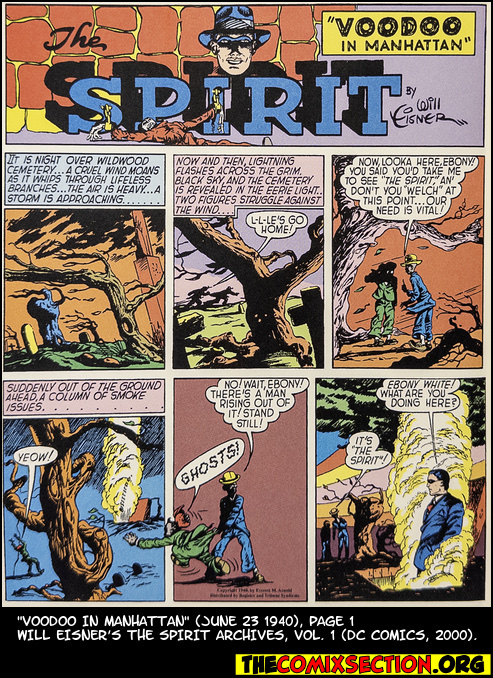
  • The Spirit (June 23, 1940) “Voodoo in Manhattan”

    Will Eisner (editor, script, pencils, inks)

    Joe Kubert (colors)

    Sam Rosen (letters)

    The strip opens with Ebony and a lodge brother in Wildwood Cemetery looking for the Spirit. They find him, appearing out of smoke, and request his assistance–their lodge building seems to be haunted, can Spirit investigate? After some whinging, the Spirit agrees. The scene reveals some of the Spirit’s setup at his underground crypt lair. Just stairs and a chemical lab, but it’s something.

    The Spirit misses the lodge meeting and arrives afterwards so he can investigate without anyone around. The lodge meeting—a secret society supporting Black orphans, which makes no sense—isn’t great—lots of racist caricatures.

    The Spirit showing up to investigate works much better, even with the panels leading up to it. He spirits (no pun) Ebony away from a lodge brother, which leads to a “running away” gag. Eisner and studio open with scary cemetery stuff, move into “comedy” with lodge meeting, and then into an action strip.

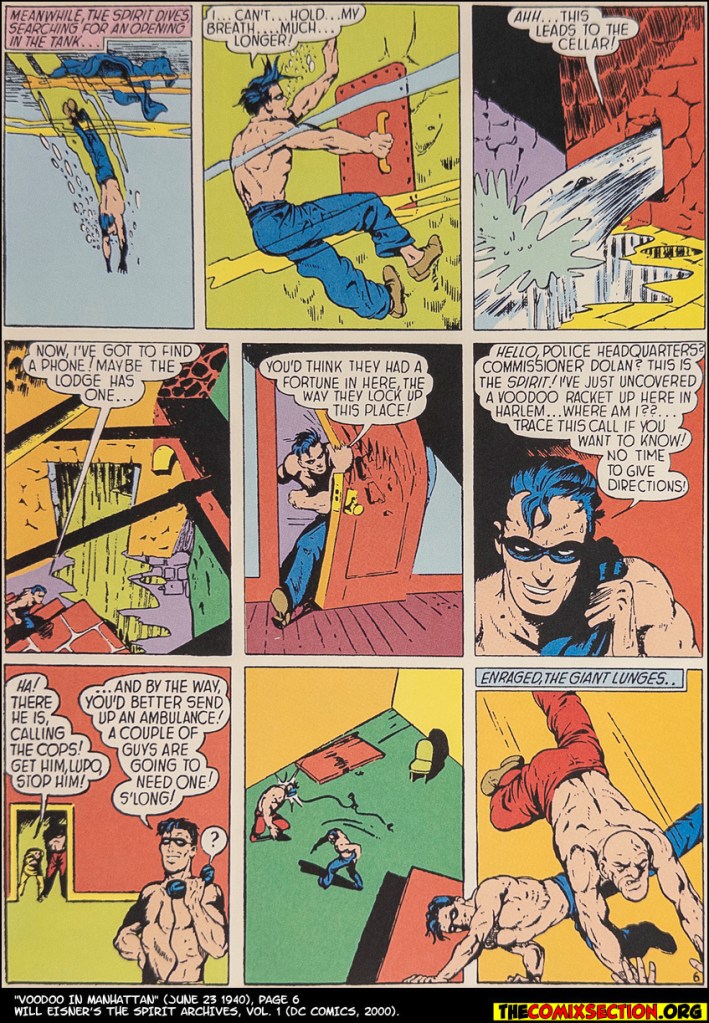
    It doesn’t take much investigating for the Spirit to uncover the culprits. Spirit’s got to punch his way out of a couple tough situations, finding the Harlem mansion full of secret rooms and underground water tanks.

    The water tank’s especially important because we get the Spirit out of his shirt for the last few pages of the strip, showcasing the beefcake (which, it turns out, is a very cold way to go around).

    The exposition is a little purpler than last time; it’s mostly for mood and works. The action is pretty contained, some fisticuffs, breaking through walls and floors in the mansion, plus the water tank sequence.

    The resolution with the villain leaves some questions unanswered. Spirit has his theory of the case, and nothing exactly contradicts him, but because it’s so rushed, motive questions go unanswered.

    Given the constraints of setting and scope, the strip does an excellent job showing how The Spirit can do big things in a small story.

  • Superboy (1949) #209

    Jim Shooter 1, Cary Bates 2 (script)

    Mike Grell (artist)

    Ben Oda 1, Joe Letterese 2 (letters)

    Murray Boltinoff (editor)

    The first story, from Jim Shooter and Mike Grell, opens with Princess Projectra’s shuttle crashing as she attempts to land at Legion headquarters. Timber Wolf is there to save the day, complaining about “women drivers” the whole time. Karate Kid shows up in time for the Princess to stumble out of the shuttle and fall unconscious. They’re sweethearts, so he’s very concerned.

    Turns out Projectra has a rare “pain plague,” which causes terrible pain for a number of hours then passes. It’s technically not fatal, except the pain kills you, so who cares if the disease doesn’t. The Legion comes up with a solution—each Legionnaire will take an hour of the pain so it doesn’t kill anyone, and Projectra will be spared.

    They immediately find out the pain intensifies as the illness develops (so hour two’s pain is worse than hour one’s). They also discover the Legionnaire who takes the pain will lose control of their powers (and mind), attacking everyone around them. So it’s all very dangerous. Good thing Superboy is flying across the galaxy at warp speed to get there for the final hour.

    Even if it weren’t poorly written and poorly illustrated, the story’s also poorly plotted. A deus ex machina resolves everything, with every page bringing some immediately resolved problem to keep the story going. Shooter’s sexism might be the move of a dick writer, but the rest of the story is just the moves of a bad one.

    Cary Bates handles writing chores for the backup (with Grell returning and arguably much worse). Some tween has won a contest to spend the day with the Legion, complete with his own flight ring. Pay attention to the flight ring thing; it’ll be “important.”

    First up on the tour is getting the mail, except this time someone has sent the Legion a “witch wolf,” the most dangerous animal in the solar system (our solar system?) because it emits poison radiation and mind controls people’s powers to backfire on them.

    One by one, the Legion goes into the room with the witch wolf, and, one by one, it reverses their powers and knocks them out. Will the guest star tween somehow figure out what’s going on, something the professional superheroes just can’t intuit on their own? Most definitely.

    And will he be rewarded at the end with the promise of sexual contact from the female Legionaries, their male colleagues cheering the lad on? Also, most definitely.

    The comic starts and ends icky from the sexism. In between is bad writing from two different writers and tepid (and worse) art.

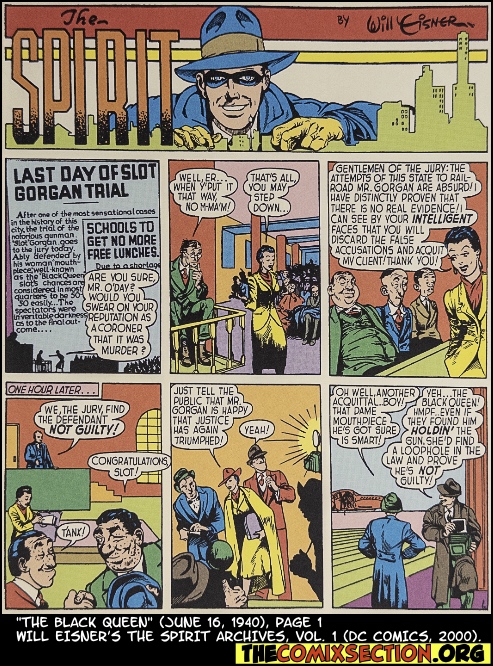
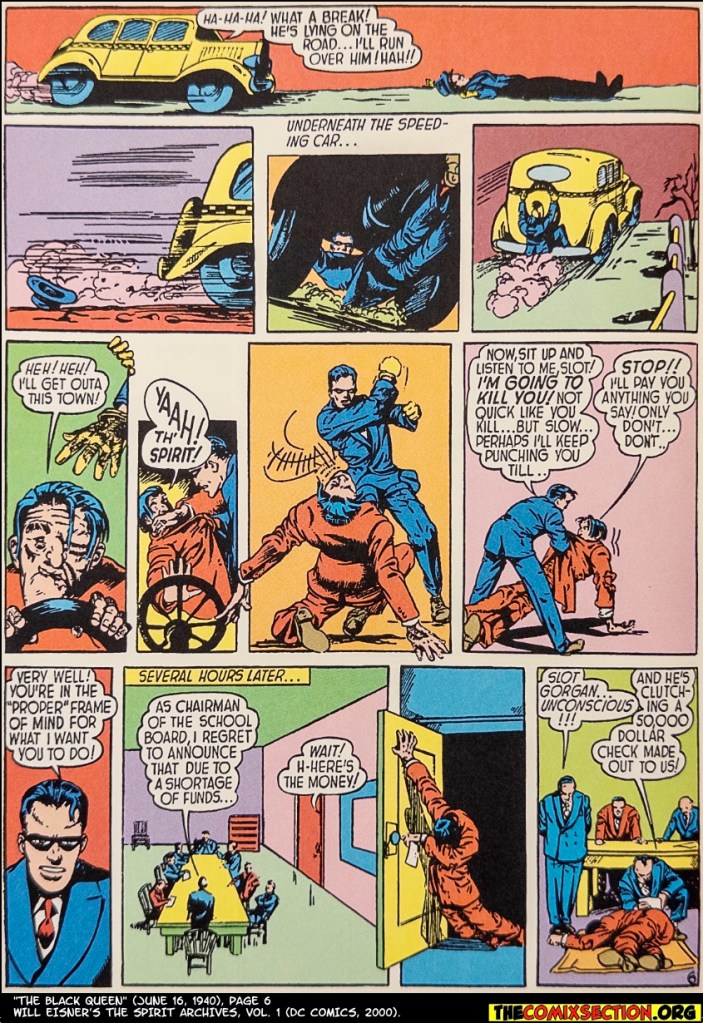
  • The Spirit (June 16, 1940) “The Black Queen”

    Will Eisner (editor, script, pencils, inks)

    Joe Kubert (colors)

    Zoltan Szenics (letters)

    The first panel sets up everything in the strip (save formal cast additions)—mobster Grogan on trial for murder, defended by “The Black Queen,” his lawyer, and a side item about the school district running out of money for lunches.

    Grogan gets off (with implications of a fixed jury), and Spirit drops by to ask him for a donation to the school lunches. Now, Spirit has just interrupted Grogan and Black Queen talking business… she’s more than his lawyer, it’s her mob and he’s her proxy. Spirit either just missed that disclosure upon sneaking in, or he was too distracted, or he didn’t think it warranted comment.

    He will go out of his way to get a look at Black Queen in her undergarments because the strip’s got a lot of implied misogyny. Can’t trust dame lawyers.

    Also, let’s get this one done, too—Ebony gets his full name and hired on as Spirit’s sidekick. His assignment goes from being a cabbie to holding a gun on the coroner, the district attorney, Grogan, and Black Queen. For a criminologist, Spirit has a profoundly confusing understanding of the criminal justice system. Perhaps they’re in a universe without double jeopardy, in which case Spirit’s plan isn’t to torture and extort Grogan, or they are in a universe with double jeopardy and it is Spirit’s plan to torture and extort him.

    It’s strange either way, and the action all seems toned down. Lots of longer scenes to get out dialogue, normal length chase scenes. There’s still some lovely composition, but it plays like the opening newspaper headings exposition device is the strip’s most significant success and, upon making the hit, Eisner and studio coasted a bit.

    The last panel has Spirit and Ebony heading to the Wildwood Cemetery—where Denny Colt was buried in the first strip and Spirit’s been hiding out since (doesn’t he miss plumbing?)—and the moment’s from Ebony’s perspective. They have a little banter and… well, the Spirit’s a weird dude.

    Maybe on purpose, maybe not. Even as the dialogue and exposition improve this strip—Eisner (or whoever) realized the art doesn’t need a lot of words slowing it down—the Spirit gets a little more distant. Eisner hasn’t decided how to position the reader with the Spirit yet. This strip tries some things, but doesn’t have room to evaluate them.

  • The Spirit (June 9, 1940) “The Return of Dr. Cobra”

    Will Eisner (editor, script, pencils, inks)

    Joe Kubert (colors)

    Zoltan Szenics (letters)

    The strip opens with Spirit dropping into Ebony’s cab. Literally, from a tree. Spirit then pulls a gun on Ebony, demanding a ride to town, while the passengers—Homer Creap and Ellen Dolan—sit terrified.

    Ellen’s in town to visit her dad, the regular cast member Commissioner Dolan, and to introduce him to her fiancé, Homer.

    Homer Creap.

    They’re both nerds in glasses and Homer’s got buck teeth. Eisner’s not being subtle for the cheap seats. Is it worse than Ebony? No. Even with discovering the Easter egg of unconscious Ellen’s side booby at some point, no, still not worse than Ebony in his handful of panels.

    Ellen’s also going to help returning villain Dr. Cobra escape because she’s got book smarts not street smarts. She’s a psychology major and Dolan lets her tour the ward. Cobra knows a couple marks when he sees them and convinces them to help him get out. He then takes them hostage, which sets Spirit on his trail.

    We get Spirit’s tombstone calling cards again. While the cops do big action sequences in small, beautiful panels, Spirit goes undercover on the street and passes them out. The cards say he’s going to kill Dr. Cobra at midnight.

    Action cuts to Dr. Cobra’s at midnight, Spirit shows up to kick ass. At that point the strip becomes a glorious chase sequence through the city, with Cobra and Spirit pausing occasionally for a beautifully rendered action beat.

    After that creative high, the strip needs to bring things back down to Earth for the finale, which has Spirit taking off Ellen’s “ugly” glasses, letting her hair down, and revealing her to be a hot chick. He and Homer then fight over who gets to kiss her first (Spirit as reward for saving her, Homer with the buck teeth because she’s finally on that social capital level).

    Might not have been the best time to be a lady. Just saying. Because, remember, this one’s in the newspaper so the target readership includes the ladies.

    If you can subtract the 1940, it’s sublime. And—shudder—the 1940… could be worse.

  • Superboy (1949) #204

    Cary Bates (script)

    Mike Grell (artist)

    Ben Oda (letters)

    Murray Boltinoff (editor)

    What a strange comic book. Cary Bates and Mike Grell contribute both parts, feature and backup, though “feature” is a bit of a stretch.

    The lead story is a retcon. In the farther-flung future than the Legion of Superheroes, future Earthlings are obsessed with watching the past through time travel television or something. Except then the kid’s time TV is broken and is changing history instead of just observing it. The device has somehow changed Superboy’s trials for Legion membership, and now he’s not a member anymore, and the fate of reality is at stake.

    Oddly, however, the story doesn’t show how Superboy failed the trials. Neither is the future kid’s resolution—Anti-Lad is his only moniker, the one he takes when he travels back in time to join the Legion to get history back on track. Bates also doesn’t do anything with the future repercussions of Superboy not joining the Legion. It’s easier to identify all the things Bates doesn’t do with the story than the things he does.

    So the comic promises the secret story of Anti-Lad, the Legionnaire no one remembers (because he wiped their memories). It delivers some time travel banter, lots of talking about Superboy but no real Superboy in his own book, Anti-Lad besting the Legionnaires during his membership trial, and Brainiac-5 deducing something’s off about the new prospect.

    Not much of a story. Grell’s art also leaves a lot to be desired.

    The backup, however, is incredible. Incredibly creepy and bad but still incredible.

    It’s all about Brainiac-5 being really tired, and, wouldn’t you know it, he’s really tired because he’s made himself a fully functioning Supergirl android. He misses his 20th-century gal, you see, so he makes a new version of her.

    Except he doesn’t know he’s made the android version, so there’s a bunch of bait and switch to get to the big reveal. It’s utter nonsense in terms of plotting—it’s hard to tell if Bates is trying to be inventive and not clearing the bar or if the comic thinks so little of its readership—and then Grell’s art… doesn’t help. There are even panels where Grell’s art goes from hot to cold as they’re read, drawing attention to the deficiencies.

    The first story’s pointless and bad, and the second story’s pointless, bad, and icky.

    Though I did just realize Bates doesn’t address whether Brainiac-5 admits to his teammates he’s using Legion resources for his sex toys.

  • The Spirit (June 2, 1940) “The Origin of the Spirit”

    Will Eisner (editor, script, pencils, inks)

    Joe Kubert (colors)

    Zoltan Szenics (letters)

    The Spirit ends his first adventure leaving three burning questions unanswered. First, why is he remaining officially dead—we’ll loop back—second, why doesn’t he think everyone will recognize his blue suit, and, third, how does he have those little tombstone calling cards carved already.

    The strip—Spirit dropped as a weekly newspaper special—has thirties illustration sensibilities, almost PG-13 dialogue (as newspaper audiences include more teens and adults than a regular comic book), and sublime stage direction. Eisner doesn’t waste any panels, big or small (the Spirit’s resurrection is in extreme long shot in a small panel), but also saves some composition wows for the third act. Sure, Spirit is fighting escaped criminally insane Eastern European mad scientists with racist caricature henchmen, but the visuals of the showdown are pure noir (Technicolor noir?) fisticuffs. It’s hard boiled hero stuff, even as the Spirit—despite being in it, at this point, for the money and not having to pay taxes—is a bit of a lug, especially for a vigilante.

    This first strip introduces the Spirit (Denny Colt before death, just “The Spirit” after), police commissioner Dolan (who knows the Spirit’s identity and approves of that plan to be a vigilante), and, in a one panel cameo, Spirit’s future sidekick, Ebony White. Ebony’s a cabbie; he doesn’t get a name here. Ebony’s a young Black man. The caricature is horrific. The villain—Dr. Cobra—has the Asian bruiser sidekick and it’s a bit. Ebony’s a lot.

    And it’s just a panel (albeit observed with foreknowledge). But imagine how big a panel on the newsprint. Spirit’s greatest boon—being read with more potential detail—also can spotlight its unfortunates.

    Bad, worse, good, mid, sublime, inspired, and genius—The Spirit has them all. Eisner (and his studio) deliver a visually compelling, narratively engaging comic spectacle. The exposition ranges from flat to purple, but the movement—and the movement’s framing—is truly exceptional work.

    Even if the exposition doesn’t help, there are smarts to the plotting. For example, the two best visual sequences are Spirit’s showdowns with Cobra. He’s either had a jovial or moody setup for the showdown, then Eisner delivers the action goods. Vats of chemicals, henchmen, escape boats in the backgrounds and foregrounds, big and small parts of the action, and full of deeper implication. It’s mood implication, though, not exposited.

    Anyway.

    The Spirit’s off to a great start. Just hold onto your (blue) hat on the proverbial cab ride.

  • Gilda (1946) D: Charles Vidor. S: Rita Hayworth, Glenn Ford, George Macready, Joseph Calleia, Steven Geray, Joe Sawyer, Gerald Mohr. Too long, impressively moody noir does well on an obviously limited budget. Ford’s a gambler down on his luck in Argentina, Macready’s a megalomaniac looking for a pal, Hayworth’s the dame who drives them both literally mad. As in criminally insane. Macready does that creep well; Ford does not. Hayworth’s dynamite, however, and Calleia’s fantastic as a laconic cop.

    Napoleon (1927) D: Abel Gance. S: Albert Dieudonné, Vladimir Roudenko, Edmond van Daële, Gina Manès, Nicolas Koline, Annabella, Philippe Hériat. Singular achievement from Gance, recounting Napoleon (Roudenko then Dieudonné) from childhood to the start of the Italian campaign. Lots of time on the Revolution, the Terror, Toulon, and romancing Joséphine (Manès). Sometimes, Gance balances the messianic framing with the horrors of war or the dangers of megalomaniacs. But mostly, it’s just messianic. And transfixing. Peerless filmmaking, fabulous acting. A couple restorations exist: the COPPOLA (Francis Ford) and the BROWNLOW. See the latter if at all possible.

    Night Key (1937) D: Lloyd Corrigan. S: Boris Karloff, Warren Hull, Jean Rogers, Alan Baxter, Hobart Cavanaugh, Samuel S. Hinds, David Oliver. Uneven crime thriller about unscrupulous alarm company owner Hinds taking advantage of wizened genius Karloff one too many times. Karloff breaks bad a little, using a gadget (the NIGHT KEY) to sabotage Hinds’s service, drawing the attention of gangster Baxter. Karloff’s great, Rogers is earnest as his daughter, and Baxter’s okay. Otherwise, recast it. Tepid direction doesn’t help.

    One More Time (1970) D: Jerry Lewis. S: Sammy Davis Jr., Peter Lawford, John Wood, Dudley Sutton, Maggie Wright, Ester Anderson, Percy Herbert. Just okay sequel has London club owners Davis and Lawford heading to the country and getting involved in an intrigue concerning Lawford’s just revealed twin brother, South African thugs, and various mistaken identities. Davis and Lawford spend way too much time apart. The third act’s way too tinkered. Director Lewis’s comedy direction’s (at most) middling, but he’s got moments.

    The Raven (1935) D: Lew Landers. S: Boris Karloff, Bela Lugosi, Lester Matthews, Irene Ware, Samuel S. Hinds, Spencer Charters, Inez Courtney. Moody but unsuccessful “adaptation” about brilliant, misanthropic, Poe fanatic neurosurgeon Lugosi coming out of retirement to save Ware’s life. He then falls in love with her and starts creeping on her. She eggs him on (to the point her father, Hinds, gets involved). Little does anyone expect Lugosi’s plan to involve Karloff, blackmail, and torture. The short runtime helps.

    Salt & Pepper (1968) D: Richard Donner. S: Sammy Davis Jr., Peter Lawford, Michael Bates, Ilona Rodgers, John Le Mesurier, Graham Stark, Ernest Clark. Frequently problematic, cartoonish outing for Davis and Lawford. They’re club owners in swinging London and get involved with espionage. Occasionally delightful, usually diverting. Donner’s got a few strong moments but he doesn’t show any flare for the fight scenes, and–appropriately–even less for the madcap. The cast is game, and the leads do have great timing. And wardrobe.

    Snitch (2013) D: Ric Roman Waugh. S: Dwayne Johnson, Barry Pepper, Susan Sarandon, Michael Kenneth Williams, Melina Kanakaredes, Nadine Velazquez, Jon Bernthal. Badly done crime thriller about regular guy Dwayne “The Rock” Johnson going undercover to get his son a deal with the DEA. Johnson and de facto second lead Bernthal spend most of the movie talking to each other about the plot. The script’s talky and tedious and utterly absent character development. Not incompetent just boring and bland.people