• Kill or Be Killed (2016) #10

    Kbk10

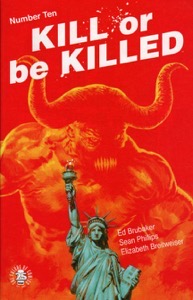
    Okay, so I don’t think I was expecting more from this comic, but I wasn’t expecting writer Ed Brubaker to take care of so much old business at once. Because even if he does an at best middling job of it, there’s all that middling at once. Like a greatest hits of tepid songs.

    This issue brings back the lady cop—just to say she’ll be important later, but let’s watch all the dudes treat her like a moron—catches Dylan up with Kira after her issue, including the medication reveal (which makes Dylan’s narration exceptionally unreliable since he’s just told his reader about his anxiety attacks not his schizophrenia diagnosis), and then Dylan also finally sees that painting of the demon.

    The painting the comic showed us after four or five issues. The painting in a box Dylan has been looking through for almost the entire present action of the comic. He’s just come across it in an exceptionally contrived manner.

    Kill or Be Killed has definitely improved—outside the Kira issue, which is the series highlight, Brubaker’s at least raised the floor for the Dylan stuff—but with not everything being bad, it makes the wrong moves more noticeable. It’s better but always at a disadvantage.

    Daisy shows up for a few pages; she’s going to be a disposable girlfriend, it looks like; nothing more than Dylan’s rebound from Kira. There aren’t not optics to Daisy being Black and the comic treating her like shit. Though, I guess when she did get scenes, they were better than Kira’s.

    Artist Sean Phillips still can’t keep the lady cop’s facial features consistent. Her name’s not important. For better or worse, Brubaker didn’t turn Kill or Be Killed into a police procedural, after all. Phillips does better with Dylan’s weirdly sized head for most of the issue, but there are a couple of the odd-sized head panels. It stands out more than when Phillips is doing it the whole issue. It’ll never not be weird.

    We also meet Dylan’s mom, who’s got no character whatsoever. She exists for Dylan to exploit her and lie to her. Cool.

    I think I’ve changed my mind on it needing an editor; any good editor would just tell Brubaker to–being nice—put it in a drawer until he’s got better ideas for it or—being honest—tell him to nuke it from orbit.

    It’s the only way to be sure.

  • Tomb of Dracula (1972) #7

    Tod7

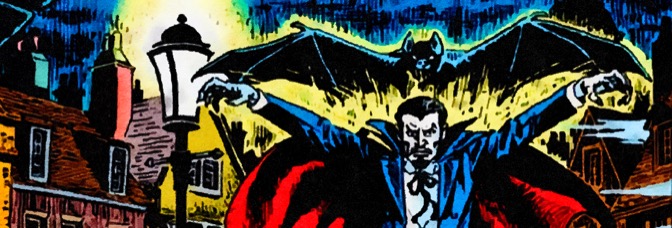
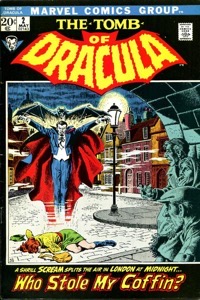
    Writer Marv Wolfman arrives with a bang… or a howl. Wokka wokka.

    The difference is immediate. Wolfman’s got his purply exposition, but it’s purposeful. There are lots of nice echoes between lines; the style’s right for the book, which has Dracula returning to London, going out for a snack, and surprised to discover his intended victim already knows him.

    While it’ll soon make sense why his intended victim, Edith Parker, knows him, it doesn’t make as much sense why he doesn’t know her. Edith is a new major supporting player, daughter to vampire hunter Quincy Harker (son of Stoker novel “heroes” Mina and Jonathon). Wolfman’s most prominent development in his first issue is their introduction; Quincy’s the moneyed mastermind behind Rachel Van Helsing’s operation, and he calls them back to London. When Quincy gives Frank Drake a tour of his estate, showing off vampire hunting gadgets (put a pin in them) and giving Dracula’s history. Tomb of Dracula is now in Stoker’s novel continuity.

    Until Dracula knows Quincy, who was born after the novel’s end. So not in Stoker continuity. Wolfman couldn’t even keep it going for an issue.

    It’s a bewildering writing fumble, but then so are the gadgets. The vampire hunters do indeed go a-hunting, but they don’t bring any of the fancy gadgets. After Quincy tells Frank it’s not as simple as driving a stake through Dracula’s heart, all they do is try to drive a stake through Dracula’s heart. It’s hard to feel bad for them falling right into Dracula’s trap.

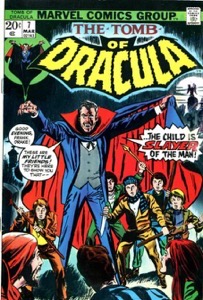
    Wolfman does an excellent job with the plotting too. The twists are actual surprises, only requiring a single, easily explainable plot reveal. Though the cover says it all—Dracula’s plan involves hypnotizing children into unstoppable killing machines. The vampire hunters aren’t going to kill a bunch of kids, right?

    Not all of Wolfman’s takes are great—Clifton Graves is obnoxiously simpering at this point but also utterly inept. Dracula’s so unimpressed with his performance, he comes up with the killer kids plan. But then Wolfman also doesn’t do the “Frank’s low and high-key racist or ableist to Taj” thing. Instead, Frank’s nice to Taj. What an idea.

    The art’s great. Wolfman’s script and Gene Colan’s pencils tell the same story, and Tom Palmer’s inks are gorgeous. Finally, Tomb of Dracula has arrived. I knew Wolfman and Colan do one of comics’ great uninterrupted runs on the title, but I didn’t realize it would take six issues to get there. Even with the slightly grating continuity gaffes—seriously, there’s a lot of talking in the comic, Quincy could’ve mentioned Dracula waking up in the twenties for a bit–it’s a great read.

    While the vampire hunters are a little too overconfident, Wolfman’s got Dracula mocking them for it and starting to show personality as a villain. Wolfman’s ability to hit the ground running is impressive.

    Though he does scape-rodent rats a little much. No rat slander!

  • Superboy and the Legion of Super-Heroes (1977) #242

    Slsh242

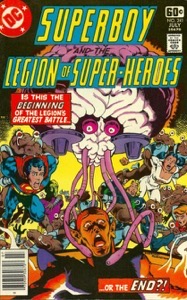
    The feature opens with Legion leader Wildfire yelling at the “camera” about war. He’s actually yelling at the probably corrupt officials sabotaging a diplomatic conference, and Wildfire’s team is picking up the pieces after terror attacks. The last issue ended with Brainiac 5, off on another mission, saying war on Earth was imminent. They’re not talking about the same war. It’s a quick, sensational red herring before the Legionnaires storm off to drop some exposition about what’s going on, specifically the probably corrupt officials.

    It quickly turns into Ultra Boy making a suggestion and Wildfire dismissing him for talking out of turn. No one can question Legion leader Wildfire, which sycophant mercenary Dawnstar backs up. It’s a hell of a flex from Wildfire and Dawnstar, considering Wildfire’s never right, and most stories involve the rest of the cast having to prove him wrong before he’ll actually help. Ultra Boy blows up at Dawnstar about that very situation, which is welcome self-awareness from writer Paul Levitz.

    I’m ready for anything with Legion of Super-Heroes, but “teens can’t work together, actually” was not on my bingo card.

    Especially since Ultra Boy immediately proves his point in the argument, stopping another terror attack, which just casts more suspicion on the adults.

    The action then cuts to Earth, where the other Legion team has arrived to fight the space war. Lots and lots of great superhero action art from James Sherman and Bob McLeod. The feature story’s art is spectacular, page and panel after page and panel.

    Levitz does a good job rushing through the space battle so he can get to a more containable storyline. Superboy’s going to lead a team to the invaders’ home planet to try to stop the attack. The Khurds are attacking; they’ll turn out to be humans who look like punks. Wildfire’s diplomatic mission involves the Dominators, who still don’t make an appearance; it’s more about the adult Earthlings conspiring to attack them while they’re unprepared. Probably. Levitz has to amp up the suspicious behavior while delaying the resolution.

    Coincidentally, it turns out Superboy and company’s mission relates to Wildfire and company’s mission. Who’d have thunk?

    There’s also some more “teens can’t work together” when Brainiac 5 decides he should be in charge because he’s the smartest. Unfortunately, he doesn’t have Dawnstar along to parrot him, so everyone quickly dismisses his idea. I thought he might go on to a subplot about that science cop who showed up with a message last issue, which Brainy ignored because girls can’t have important messages, but no… if it’s going to come back, it’s not going to be in this issue.

    The art’s really, really good, and the story’s fairly engaging. So any contrived plot machinations are worth it for the art.

    Then the backup’s a lot better than I was expecting. It’s too long at fourteen pages, especially since they’re panel-packed pages, but it’s better than scripter Paul Kupperberg’s previous entry. Levitz gets the story credit; Arvell Jones and Danny Bulandi are on the art. They can’t compare to the feature, but they clearly put in the work on this one.

    It’s a Silver Age story done Bronze Age. Female Legionnaires Dream Girl, Light Lass, Princess Projectra, and Shadow Lass are having a girls’ night out (the story’s title, too), and their dinner gets interrupted by some bad guys. The bad guys hold everyone hostage while other bad guys pull off a series of heists around the city. Will the Legionnaires be able to outsmart them?

    The plot’s predictable and loses momentum after the Legionnaires split up for their individual adventures, but it’s not bad. But there’s something off about Superboy and the Legion’s feature and backup balance; maybe if the backup needs more room, it should get it instead of Jones cramming every page.

  • The Staircase (2022) s01e06 – Red in Tooth and Claw

    If someone wanted to take the time—and I’m not suggesting it—analyzing “The Staircase” ’s moving thesis about subject Michael Peterson (Colin Firth in his future Emmy-winning performance, not undeservedly) as the series progresses might be interesting. This episode’s where the show wants viewers to feel bad for ever thinking Firth could’ve killed Toni Collette, even as it continues to reveal his petty, malicious parenting style, particularly to his adopted daughters. Just because Firth’s an asshole doesn’t make him a murderer; also, we spent four episodes trying real hard to convince you not to trust him.

    This episode might be the first where no one calls Firth a liar, though son Dale DeHaan does talk about his untrustworthy nature. He and Patrick Schwarzenegger are having a chat in flashback about Firth cheating on first mom Trini Alvarado (who was delightful and isn’t back) with Collette, then hitting Alvarado up for money ever since. We also find out he wanted to give away one of the adopted daughters for having panic attacks.

    Of course, since the show’s now through Juliette Binoche’s intrepid documentary editor turned freedom fighter’s perspective, Firth’s a tragic hero. It’s tonally all over the place; the show missed an opportunity to style Binoche after Joan of Arc, as she gives up her own life to save Firth’s while his family’s off doing their things. Lots of reveals in the various family visits to Firth in prison, with that part of the story taking place just after he’s lost his third appeal.

    And it turns out Michael Stuhlbarg, in a competent but utterly phoned-in performance (it’s also the writing), wasn’t willing to do a lot of old-age makeup, so I think part of his beard gets grayer. Not sure he’s committed enough for an Emmy.

    The main plot is Binoche and neighbor Joel McKinnon Miller coming up with the most likely, although most absurd sounding, explanation for Collette’s death. It’s a “stranger than fiction” solution and reasonably well-executed, but once they introduce the idea, it’s obvious it will pan out. Moreover, the close-to-present material—Firth about to plead manslaughter and get out on time served in 2017—heavily implies it.

    Though, given it’s “The Staircase,” I suppose it could be another red herring. I’m not sure how they’re going to get another two episodes out of the story. I guess I could Google, but no.

    The episode’s script credit is Emily Kaczmarek, who co-wrote one of the better previous episodes, so I’m guessing it’s her co-writer. Leigh Janiak directs. At least it’s not Antonio Campos. The most amusing manipulation bit this episode, other than the entire 2017 framing, is how the show wants to demonize Schwarzenegger and DeHaan simultaneously to juxtapose redemptions, but it’s set five years apart. DeHaan used to be a cheater but got his act together after dad Firth went to prison. Schwarzenegger… used to be a more functional alcoholic than after his dad went to prison and is now struggling.

    Collette gets a slightly demonizing flashback subplot about being shitty to sister Rosemarie DeWitt on Thanksgiving. It’s notable primarily because it’s the only time the show’s been disparaging of Collette’s character, but also because I’d forgotten DeWitt was even on the show, she’s so immaterial to it. It’d be nice if prestige shows cared about the finished product as much as the casting announcements.

  • Tomb of Dracula (1972) #6

    Tod6

    If I remembered this issue closely resembles an early Swamp Thing comic in the Wein and Wrightson era, I’d forgotten. Except Swamp Thing #4 went on sale over three months after this issue of Tomb, so that Swamp Thing resembles this issue, not the other way around.

    No spoilers, but it involves the guest monster and the English moors it occupies. Though here in Tomb, “monster” gets quotes. It’s just some guy with horrific medical things going on.

    Gardner Fox contributes this issue’s script, and it’s much better than last time. It’s not good, but it’s much better. And there’s never any wonkiness to Gene Colan and Tom Palmer’s art—they’re cooking with gas from page one—making the entire experience relatively smooth. Fox is also more comfortable writing the comic; characters aren’t expounding half their dialogue. The dialogue’s not great, but it’s got some unintentional moments. For example, I’m hoping Fox intended Dracula to come off a wee sexist when describing vampire hunter Rachel Van Helsing and wasn’t just being verbose. And then it’s the best anyone has written erstwhile protagonist Frank Drake. He keeps his mouth shut instead of blabbering.

    Well, he blabbers a little—everyone does in the book; Fox hates panels without word balloons or something. But nowhere near before.

    Okay, so, the story.

    Dracula and Lenore, who he luckily happened upon in the past, come back to the future, only not in the mansion where Dracula started his time travel adventure. Instead, they’re somewhere on the moors; this twist basically breaks the black mirror rules but whatever. They’re back, they’re hungry, and they need to find a place to sleep.

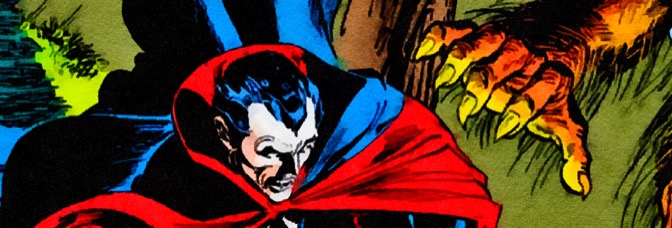
    Someone ought to do a montage of Colan panels where Dracula’s ambushing some village girl walking home through the countryside. This issue’s got the third (at least) such scene in the series.

    The vampire hunters go back to the castle from their mirror and find Scotland Yard waiting with a hot assignment. Suspected vampire victim on the moors, where there’s also a bog monster, but no one thinks it’s the bog monster.

    At first, it seemed like the issue had a rocky plot in the second half until I realized Tomb of Dracula is a chase scene as ongoing comic. They can only catch Dracula once; he can escape them every twenty pages. Entirely changes how the third act sits.

    Albeit still with Fox overwriting the dialogue, but it’s more suited for the (out of nowhere) soapy romance he finds in a literal pit. And the art’s superb this issue. Might be the series best, just in terms of quality and effect. Colan and Palmer are on it.

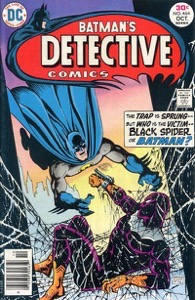
  • Detective Comics (1937) #465

    Dc465

    I’ve never heard of writer David Vern before, but I hope it’s a while before I read another of his comics. The Batman feature’s not the worst thing in the world, but it’s pretty annoying thanks to the Ernie Chan and Frank Giacola art.

    Also, the story’s written like a Hostess Fruit Pie advertisement, like they’re targeting the eight-year-olds, which is about as old as you can get without the art grating.

    The story’s about Commissioner Gordon and Batman’s plan for when hoods kidnap Gordon and demand to know Batman’s identity. There’s a flashback explaining Batman gave Gordon the name to say, which would then trigger a response from the Caped Crusader. It’s a delayed response, but it’s pre-smart phones; what can you do?

    In the present, a mysterious man visits the offices of this red herring, which then triggers a video call to Wayne Tower, where Bruce and Alfred watch agog. Bruce immediately realizes it also means Gordon’s been kidnapped and gets into his long johns. Only he’s got to do some investigating to figure out who’s got Gordon, which means going to “The Boards.” At first, I thought Vern was going to do a Sherlock Holmes and the Baker Street Irregulars thing, but it’s just a throwaway device to get Batman on the right track.

    And for the only Black guy in the comic to try to mug a white lady. Cool.

    After starting with an emphasis on the detective work, the story quickly just becomes a series of poorly illustrated fight scenes, with accompanying bad exposition and dialogue. When Chan’s clearly penciled some atrocious physiology, it’s obvious what’s wrong with the art. The rest of the time, there’s just something off-putting about it, which might be “thanks” to Giacola’s inks.

    The backup’s another in the Calculator series, written by Bob Rozakis (no Laurie helping him here), with pencils from Chan and inks from Terry Austin. There’s a good panel in the story. A good panel. A reaction shot of Sue Dibney (Calculator is messing with Elongated Man this time). With better art—and maybe more pages—the story ought to work; Calculator makes Elongated Man’s elongating powers contagious, just as Ralph goes to a Comic-Con with a bunch of cosplayers. So it’s these various not-heroes dressed as DC heroes elongating and mad about it.

    It’s a bad story, but what else would it be in this comic? And that one panel’s good. I didn’t think there’d be one in the comic when I saw Chan was on the backup too. But I was wrong.

    There’s one.

  • Tomb of Dracula (1972) #5

    Tod5

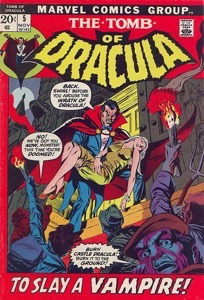
    Oh, good grief. When I complained ad nauseam about Archie Goodwin’s writing, it didn’t occur to me Marvel would’ve found someone worse to do an issue. Gardner Fox scripts this issue, and, yikes, is it a bad script. While not every line of dialogue has fifty percent exposition—Frank Drake mentions Dracula’s ancestor every time he says Dracula, someone mentioning Taj is mute, some kind of call back to the last issue—many of them do. It’s a jumping-on issue with nothing to induce anyone to keep reading Tomb of Dracula. Except, obviously, the art.

    Though Fox doesn’t do the obnoxious second-person narration. He does a profoundly purple, mostly adjective instead; if there were more of it, I’d say the second-person’s better, but it’s relatively sparse. Rather, the terrible dialogue’s endless. There’s no winning.

    The issue begins with Dracula and Taj going into a netherworld where demons attack them. Dracula’s pretty sure it’s a Satanic dimension—he tries invoking Satan’s name to send the demons away—but he has to fight them anyway. Plus, he realizes he can’t feed on them, so he’s got to keep Taj alive.

    Meanwhile, back in 616, Rachel Van Helsing and Frank realize what’s happened and set out following into the black mirror. Now, when I say “realize what’s happening,” I mean they figure out the exact events from last issue on a series of baseless guesses. What’s even more inexplicable is how it all works out. Dracula got the code for the time-traveling, interdimensional mirror from Ilsa, who intentionally didn’t tell him how to get anyway, just into the mirror and the demon dimension. Dracula then finds his way through another mirror, which takes him back to Transylvania just after Bram Stoker’s novel. He’s dead; Van Helsing is out of town. Dracula wants to off him, so he’s got to wait around.

    So, Ilsa initially tried selling her deal on Dracula being able to go to his own past, and he said, hell, no, I won’t go. Rachel and Frank immediately assume he’s going to the past Transylvania, which is a big assumption.

    When Dracula gets to the past, he locks up Taj, who he didn’t need to save, as it turns out, and heads to his castle. There he’s got a female vampire locked in a bottle. He’ll release her before the end of the issue so she can attack the vampire hunters while he’s busy doing other things. Not the point. The point is the time-traveling. He doesn’t find his own body in the castle, where it should be, and the lady vampire in the bottle isn’t there in the present either.

    The story would make more sense if Fox’s job was to lay this asinine plot out on Gene Colan and Tom Palmer’s existing art. For instance, Abraham Van Helsing has a one-panel cameo; if they were doing a big-time travel story, shouldn’t he be in it more? There’s nothing about time travel in the visuals, just the mirror transporting people. Sure, the castle’s destroyed in the present, but it’d make more sense if it wasn’t Dracula’s castle, wouldn’t it?

    Or maybe Fox’s writing is just terrible. The disconnection between the art and the writing is real, though; there’s a story. There’s got to be.

    The first few pages with the demon dimension are surprisingly iffy art. Not sure I believe Palmer was inking Colan on those pages because pretty soon, it looks great again. Even if it’s rushed and ill-suited for the story.

    Such a strange book. Writing-wise, it keeps falling on its face while the art’s consistently fantastic.

  • The Boys (2019) s03e02 – The Only Man in the Sky

    Everyone gets a consequential arc this episode. Well, every one of the Boys. Chance Crawford’s dopey Aquaman is relegated to an in-world TV commercial for a Lifetime movie (equivalent) as setup for Antony Starr’s arc for the episode. It’s Starr’s birthday, which means the media empire aligns to promote him; only this year, everyone remembers he was dating a Nazi last year, and no one cares much about celebrating.

    Starr gets an arc, with Erin Moriarty bouncing between that one and Jack Quaid’s. Then Jessie T. Usher’s arc about embracing his African roots is basically a comedy subplot. Or the closest thing to a comedy subplot in the episode, which starts with Karl Urban getting irritated by little super-kid Cameron Crovetti being a kid and therefore irritating; Urban’s then got a character development arc as well as a superhero investigation arc.

    Urban and Quaid are both investigating separately—Urban tracking down a former sidekick (an unrecognizable Sean Patrick Flannery) who works the gun show circuit and Quaid trying to uncover boss Claudia Doumit’s secret superpowered past. Moriarty’s supposed to be helping Quaid, but Starr’s being an asshole during his birthday show rehearsals to annoy her.

    Tomer Capone and Karen Fukuhara are also on assignment, going to an amusement park where Flannery’s former teammate, Laurie Holden, does stage shows. It’s a great arc for Fukuhara, who’s trying to recapture a lost childhood; Capone is along but not enjoying any of the commercialized pleasantries.

    Then Laz Alonso spends the day with daughter Liyou Abere, only getting more and more obsessed with what he knows about Urban’s investigation.

    It’s an exceedingly well-balanced episode, script credit to David Reed, especially as a side event has major repercussions for everyone’s day (and the series going forward).

    There’s the usual acting spotlight for Starr, whose psychotic Superman analog gets a couple amazing scenes. Urban’s also got a great arc as he weighs juicing up on superhero serum, even temporarily. Quaid gets some excellent comic timing material, even if the results aren’t laughs. He and Moriarty are a fantastic team when they get to Nick and Nora together.

    What makes “The Boys” so special isn’t its gory, black comedy but the humanity it brings to its characters and how carefully the show emphasizes that humanity. Real good direction from Philip Sgriccia again. Especially on Starr and Urban’s big acting scenes. Then that cliffhanger. It’s a petrifying humdinger but also an entirely soft cliffhanger. There are no heads ready to roll, just a terrifying future with connotations across the cast.

    The episode also waits until near the end for the significant gore scene. There are a few big splats and smooshes throughout, but the biggest ick comes late.

    “The Boys” is, as usual, superb.

  • The Staircase (2022) s01e05 – The Beating Heart

    So, the present action of “The Staircase”—minus Colin Firth flashing back to being a kid with a shitty dad so he could grow into a shitty dad himself—starts in fall 2001 and goes to 2017. This episode begins in 2004 when Firth’s character has been in prison for six months. Meaning the trial took more than a year. The show did a terrible job with the passage of time on it; it’s possibly the worst thing the show’s done, and it’s had some lows.

    Amusingly, the kids get together in this episode and talk about the awkward passage of time; how it hasn’t been so long. Sophie Turner once again has to acknowledge neither Patrick Schwarzenegger nor Dane DeHaan care that Toni Collette is dead; the real question is, are Firth and sons sociopaths or just narcissists. If it were a better show, I’d say the time acknowledgment was intentional.

    It is not a better show.

    Though this episode’s definitely one of the stronger ones, again with a script credit to Craig Shilowich, whose episodes have been much better than show creator Antonio Campos. Who also doesn’t direct (he did the previous episodes); instead, it’s Leigh Janiak. So maybe less Campos means better “Staircase.”

    Besides the kids selling off the house to pay for Firth’s appeals, the documentarians are the significant subplot. Producer Frank Feys wants the documentary to accurately represent the trial from the jury’s perspective; editor Juliette Binoche (who’s having her letter-writing friendship with Firth now) and director Vincent Vermignon want to emphasize Firth’s possible innocence. As a result, there are numerous pointless scenes about it, setting up Feys as an asshole.

    Not sure a show entirely based on manipulative storytelling should get meta about manipulative storytelling.

    Firth in prison is the main “present-day” plot. He’s in somewhat constant danger and more sympathetic than ever, since he’s got Neo-Nazi meth heads out to kill him. He also confirms he voted for Gore (meaning he’s not racist), which they could’ve established earlier.

    Speaking of elections and manipulative storytelling, the episode reveals Firth lost his mayoral election in a landslide, making the first episode’s implication the establishment framed him because he was pushing them out a little much. Never look back, I guess.

    In that vein, Toni Collette’s flashbacks are all about Firth being a piece of shit to Turner and nothing about the bats. They have a dinner party scene where he’s a controlling prick, but more interesting, it introduces friends who never appear again.

    It’s scary this episode’s so much better than usual. It’s also got the least Michael Stuhlbarg; correlation doesn’t mean causation, but… it’s got the least Stuhlbarg.

    Probably Firth’s best acting in the series. He’s outstanding.

    And DeHaan finally gets some material, and he’s not very good; not sure why I was expecting him to be any good. But, then again, the material’s wanting.

    Whatever.

  • Luba (1998) #9

    L10

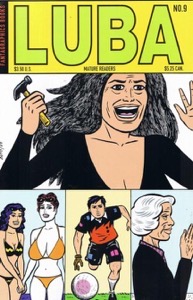
    What an issue.

    Creator Beto Hernandez outdoes himself, starting the issue with a series of one-page strips, catching up with the cast. Though they’re occasionally part of longer stories; for example, the first story is about Ofelia and Doralis visiting Socorro at her genius school. The first page is them getting ready to go, establishing Ofelia and Luba are still fighting, the second page is catching up with Socorro, and the third page is Luba and Ofelia. Connected but separate, which is how Beto’s treated this whole series as an anthology.

    The following single-page strip, which has Marciela meeting Khamo at a fire, echoes right back to the Luba and Ofelia portion of the opening three pages, but also Socorro (Maricela’s sister) and the contrasting relationships with mom Luba. It’s so good and quick; Beto then aims it forward with Marciela talking to her girlfriend about the experience.

    There are three longer stories, though the first feels a little like an extended single-page strip. It’s Pipo and Fritz, now dating, talking about how they need to dump their (male) lovers. Pipo and Fritz’s romance gets the most page time in this issue, with the third long story almost entirely focused on it and its fallout for the cast. But that first strip feels like a moody, dreamy Beto piece rather than the inciting incident.

    Beto then flexes again with Venus and Hector thinking their way through a one-pager about Petra’s first kickboxing match. It’s cute and in no way forecasts the next time Hector and Venus get a strip in the issue, which is the final one and the gut punch.

    There’s then a Fortunato story, which is actually an Ofelia story, but with the reveal she too has bedded the seductive merman. Also, all of Luba’s daughters. It’s a beautiful story and probably where Beto winds up for the final punch so much. Much like earlier, there’s then a “separate” but intricately related postscript strip with Luba and Khamo.

    The Fritz and Pipo story about them breaking up with their lovers runs eight pages, with Beto still employing the one-page strip device. Everyone in the supporting cast from this storyline gets an appearance, with Guadalupe getting a surprising subplot. Even though the series has been very much about Pipo, Guadalupe’s Luba’s low-key protagonist. It ends on one kicker, as Petra gets more and more exhausted hearing about Pipo’s abusive behavior from Fritz before going into the “things will never be the same” finish.

    If the penultimate story ends on a kick to the shins, the last one knocks the reader down and pummels them, with the teaser for the next issue and the color back page pinup the final hits. It’s devastating.

    Hell of a comic. Need to stop thinking about it before I cry.

    Beto’s so damn good.

  • Tomb of Dracula (1972) #4

    Tod4

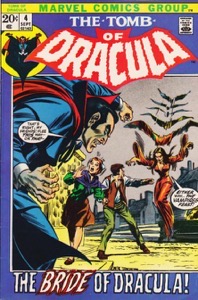
    I was so ready to cut Archie Goodwin some slack on this issue’s script. Not just at the beginning, but even halfway through when the dialogue’s at least terse, so not overly wordy. Only then Goodwin starts leaning in on the second-person narration, not for human protagonist Frank Drake. No, Goodwin does the second-person narration for Dracula, and, wow, is it bad. It goes from bad to worse, with Goodwin taking it up a notch (or down) like more bad will work better than less.

    Dracula’s not in the lead-up to the cliffhanger; instead, it’s Rachel Van Helsing talking to his latest regretful victim, and—even though there’s way too much misogyny—the missing narration device helps. Plus, it’s setting up what ends up being a reasonably good cliffhanger. And Gene Colan and Tom Palmer’s art is phenomenal; their talking heads scenes are superb, with lots of personality to the characters’ faces, but also to how they deliver the dialogue. But, of course, since it’s Marvel Style, the kudos go to Goodwin for the dialogue.

    The issue begins with Dracula and the lady who bought his old castle, Ilsa. She used to be a fashion model, but now she’s old. She purchased the castle hoping Dracula would come looking for her and she’d be able to convince him to turn her into a vampire so she can be young again. Like it says in the Bram Stoker book. This issue breaks a little with the established series continuity. Or the implied series continuity; now it’s a direct sequel to the novel before there was some loosey-goosey with the timeline.

    Dracula agrees—she’s going to give him a magic mirror in return, even though he doesn’t want it for the reason she thinks (it’s a time-traveling mirror, and she assumes he wants back to the nineteenth century, which he doesn’t). Unfortunately, Drake, Rachel, and Taj are all in pursuit; Dracula beat up Ilsa’s butler, and he called the cops, who called Scotland Yard, who called the vampire hunters. They’ve got special, super-modern (for 1972) vampire hunting technology, which surprises Dracula and suggests Goodwin got plot inspiration from “Batman: The TV Show” merchandise.

    Thanks to Colan and Palmer, the gadgets do visualize well; art over silly.

    There’s some more of Drake being shitty to Taj—is he just ableist this issue or racist, too, can’t remember. But it’s quick, and the vampire hunting action sticks more to Rachel. Or the cops who are helping them out. So less opportunity for Frank to be a dick.

    The issue’s an improvement over the previous; the plot’s better, the guest star more interesting, and so on. However, that second-person narration from Goodwin is an unmitigated disaster, and I’m dreading any more of it.

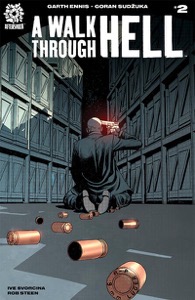
  • A Walk Through Hell (2018) #3

    Wth3

    If it weren’t for the Goran Sudžuka art, you could probably convince me I was reading a Warren Ellis Avatar comic from the early aughts. It’s a time-warped FBI procedural with a supernatural but not ghost element. I keep waiting to see when it will feel like a Garth Ennis comic, and there’s nothing.

    It feels, actually, like Garth Ennis trying to convince someone he can write a Netflix show. Like a supernatural “Mindhunter”-type deal. It’s thorough and competent, writing-wise, but it’s also desperately dull. It takes until the last page for anyone to show any enthusiasm in the dialogue; I had to reread the word balloon three times. It’s not even good dialogue; it’s just got oomph.

    Or more oomph than the rest.

    Though Ennis introduces the tough-as-nails FBI boss lady, who our heroes both admire, it’s weird how woke dude McGregor genders it. Beyoncé’s everyone’s Beyoncé, bro.

    The issue opens with McGregor and Shaw still trapped in the weird warehouse of horrors, talking about what they’re going to do next, arguing. They talk around last issue’s cliffhanger, which had Shaw getting a terrifying message about someone they both know—a suspect, presumably, in their child abduction cases.

    It takes this issue about half its pages to give the name of said person, which is not a particularly exciting name. He gets introduced right at the end of the issue for the cliffhanger. The flashbacks are pretty good police procedural; the lady boss is fighting with the beancounters, giving briefings, and if Garth Ennis wants to write “Criminal Minds: Dublin” or whatever, they’d be lucky to have him.

    The warehouse back and forth is less engaging. It’s a lot of padded, mysterious exposition as Ennis tries to drag this series out to twelve issues. It’s early days, though. It’s not impossible Ennis will surprise me. When he flops, it’s usually after a strong start, not a tepid one.

    The book also might click more if Sudžuka got to draw something besides a cop procedural. He’s real good at it; we got it. Now, something else, please.

    There’s also a horrific gross-out thing going on (a la Se7en), and it’s entirely pointless. Again, feels like an aughts Avatar, just without the blood and guts.

    I wish Ennis would find something to get excited about other than making the plot points run on time. Unfortunately, he’s not just wasting his own time or the readers’ time; he’s also wasting Sudžuka’s.

  • Tomb of Dracula (1972) #3

    Tod3

    This issue has Tom Palmer inking Gene Colan, so there’s very little one can actually complain about. Just observe. Archie Goodwin’s the writer; he employs the second-person narration to lesser effect than the previous writers. His dialogue’s overwrought even for a seventies Marvel comic, and then his exposition suggests he had a thesaurus on hand. The text is a tedious read.

    The art more than makes up for it. The way the foggy London looks with the Colan pencils, the precise Palmer inks, then whoever colored it (they went uncredited in the issue), is genuinely spectacular. It’s beyond good-looking; I knew it was just a matter of time before Colan got his Palmer inks on the series, but I’d forgotten how perfectly they sync.

    The story starts with Frank Drake bereft over killing his vampire fiancée Jeanie and about to throw himself in the river. Luckily, better timed than Clarence the angel, Rachel Van Helsing, and her sidekick, Taj, show up just in time to save him. Frank’s not happy about it and says something racist about Taj, who’s mute, but then Rachel explains she’s Abraham’s great-granddaughter, he’s Dracula’s great-great-great-grandson or whatever, and they should team-up. Frank agrees. It’s all done with Goodwin’s charmless dialogue but Colan and Palmer’s gorgeous art. Art covers script.

    At the same time, Frank’s duplicitous pal Clifton Graves is out getting drunk because Frank’s dumped him. Dracula needs a modern Renfield, so he hypnotizes Clifton, and the two go about getting ahold of Dracula’s coffin.

    Frank’s taking his new friends to the coffin as well, and there’s a way too constrained fight between vampire hunters, vampire, and vampire lackey. I really hope Colan someday gets to do a Tomb fight scene where the actors are in a confined space; last time, it was a hotel room, this time, it’s an auxiliary storeroom. Fight settings in this comic would be better suited to a Marx Brothers bit than a battle against the undead.

    Anyway.

    Goodwin then overwrites and under-delivers Scotland Yard getting involved, leading to the vampire hunters getting de facto deputized. I wonder if someone else would’ve handled it better.

    The cliffhanger has Dracula tracking down the person who bought his ruined castle, a fashion model aged out of the industry and is now using the supernatural to regain her looks. Paper-thin (even for this script), probably going to be problematic characterizations aside, the art’s wonderful.

  • The Boys (2019) s03e01 – Payback

    “The Boys” get back at it a year after last season. Much of this episode is setting that new ground situation. Jack Quaid is working for Claudia Doumit at the Department of Meta-Human affairs or whatever, unaware she’s an evil super-powered lady; Quaid’s happily dating Erin Moriarty. She brings him along to her superhero society functions, leading to very award interactions for Quaid and his previous superhero nemeses like Antony Starr and Jessie T. Usher.

    Meanwhile, Karl Urban, Tomer Capone, and Karen Fukuhara are all now working for Quaid, The Boys becoming a government surveillance team. It’s working out okay, with Urban keeping himself in check so as not to jeopardize his relationship with his dead wife’s super-kid (as a result of Starr raping her). In addition, Laila Robins has a quick appearance, establishing she’s babysitting the super-kid, hidden away from Starr.

    Laz Alonso has retired from superhero hunting; it takes a while for the episode to get to him; I was bummed he’d left the show, but no, it’s just another seventy-minute streaming episode, and there’s lots and lots of time.

    On the superhero front, Starr’s still mad he didn’t get to take over the world with Nazi girlfriend Aya Cash, and his damage control media campaign still hasn’t gotten his numbers back up. Moriarty’s got the best image, making superhero pharmaceutical company CEO Giancarlo Esposito much happier with her than Starr.

    Usher and Chance Crawford both get check-in scenes, sucking up to Starr, mostly. Dominique McElligott has almost nothing—she’s at the movie premiere at the beginning, then disappears for a while, only to come back in a significant plot development for the season. But as far as the supes go, it’s Starr’s episode, and he’s just as mesmerizingly evil as ever.

    The episode opens with a cute uncredited cameo but turns the dial up to eleven in intensity and icky. I expected them to go balls to the wall the whole episode, but they tone it down pretty quickly as they get into the character stuff. Quaid’s got jealousy problems with Moriarty at home (she’s working with an ex, who’s a supe), and then at work, there’s something going on with Doumit, but he’s not sure what.

    The narrative sticks to Quaid and Starr for most of the episode, then shifts to Urban for the last act, establishing he’s still the man, even if he doesn’t have as much to do this episode. Big things will be happening; we just haven’t gotten to them yet. Lots of promises for the season to come.

    It’s an outstanding episode. “Boys” doesn’t rest on its laurels or give itself time for a self-congratulatory victory lap outside the opening sequence. Once it’s back at it, it never slows down.

    Esposito’s particularly good this episode, too; he’s supporting the other plot lines but with a whole bunch of personality.

    I wasn’t worried about “The Boys,” but I didn’t expect them to get season three going with such a strong start. Craig Rosenberg’s got the script credit, it’s real good, and Philip Sgriccia’s direction is solid. In addition, the production design for this episode (Arvinder Greywal and Jeffrey Mossa) is superb.

    I can’t wait to see what they’re doing next; besides some great gory gross-outs, those are inevitable.

  • The Staircase (2022) s01e04 – Common Sense

    The episode begins in the near present with Colin Firth and presumably new wife Juliette Binoche headed off to court. “Staircase” isn’t ready to tell us what Firth’s up to in 2017, so the documentarians take Binoche aside for an interview on this momentous day. Throughout the episode, her monologuing for the interview about justice, fate, and the whole damn thing relevantly accompany various scenes, usually to good effect.

    I’m about to trash this episode, but outside the profoundly deceptive plotting, the script’s probably the series’s strongest (credited to Emily Kaczmarek and Craig Shilowich).

    The episode’s the trial episode, where we discover every single red herring the show’s been dangling about the case is bupkis. At best, it’s a fantastic example of what reasonable doubt means. Except there’s not much best to it.

    It’s also the episode where Michael Stuhlbarg is clearly bad casting. He’s not bad. But he’s just doing a Ron Silver in Reversal of Fortune bit. Or a Dennis Boutsikaris in a Ron Silver part. The show’s already got a bunch of workhorse actors who never get to flex outside the lines—Tim Guinee, for example, though Parker Posey’s bigot isn’t any deeper—and Stuhlbarg’s just one too many. He’s never anywhere near bad; he’s just entirely pointless.

    He does get to participate in the episode’s “misogyny’s okay if you think the lady’s bad” moment, which is just another disappointment for the list.

    There’s very little Toni Collette this episode; the bat problem’s unresolved (Firth’s still not interested), and then she’s got a scene telling step-son Dale Dehaan he’s a screw-up. Dehaan’s yet another disappointment. Not bad, but I wasn’t expecting Patrick Schwarzenegger to act loops around him. “Staircase” isn’t paying off for its supporting cast like I’d assumed. They’re just in it for the prestige value, not because their parts need acting.

    HBO gonna HBO, I guess. But, in this case, it’s even more appropriate it’s HBO Max because they’re not getting anything.

    Collette and Firth do get a long take acting marathon to get through; Dog Day it ain’t, but they’re able to do it. Wish they were in a better project together.

    Also in the background is Odessa Young getting more suspicious of dad Firth and Firth giving her every reason to keep getting suspicious and everyone else pretending he’s not. Eventually, her sister sister Sophie Turner starts down the suspicion path, but it might just be because she’s biphobic. Still, it lets Turner show a little more personality. Finally.

    Then the final reveal is another humdinger of “you’ve been hiding this detail for the halfway point to manipulate.” It’d be nice for one of these shows to have confidence in their actual dramatic writing and not just their Shyamalan-lite twist reveals.

    The show still hasn’t Westworlded, so I guess I should be happy.

    It is, however, the most sympathetic Firth’s ever been on the show. Outside when he’s bullying and gaslighting.

  • The Staircase (2022) s01e03 – The Great Dissembler

    This episode’s mostly about Colin Firth’s sex life. Assistant district attorney Parker Posey’s determined to expose Firth as a practicing bisexual, pursuing past partners, and so on. But it’s not just Posey’s even too bigot-y for 2001 North Carolina investigation; the episode focuses on it from Firth’s perspective too. While wife Toni Collette is stressing out from work or whatever, Firth is setting up rendezvouses. He gets her a massage, then heads to the adult video arcade, bringing home a DVD from Blockbuster when he’s done.

    I’m curious about the accuracy of the rental format.

    But the episode’s also about daughter Odessa Young having a girlfriend at college and not wanting to tell the family. Finally, it’s about Patrick Schwarzenegger, maybe possibly liking guys, with director Antonio Campos going overboard on the visual innuendo. Lots of love, lust, and sex on display in this episode. Lawyer Michael Stuhlbarg even addresses it, telling Firth he’s got marriage problems.

    The episode does a bunch of stops and starts—this person’s testifying, wait, they’re not, this person’s coming out, wait, they’re not, over and over again. Credited to Campos, the script is just one red herring after another. Sometimes something’s suspicious because it lacks historical context, sometimes it’s because of the presentation, sometimes it’s suspicious. There’s an actually engaging scene where Tim Guinee, playing Firth’s brother, confronts him about his sexual indiscretions, calling Firth on the lies.

    Even though Firth’s doing a lot this episode—with a whole lot of people—he’s playing an avatar, not a person. He’s a function of “The Staircase,” nothing more. There’s good acting, to be sure, but it’s disingenuous stuff.

    Collette’s momentarily got a suspicion plot point, but then it turns out to be nothing. Just like when she heard the creepy noises upstairs last episode. They’re just bats. It’s a big problem, and it’s just going to worsen. Firth’s not concerned about it, though, because sons Schwarzenegger and Dale Dehaan (who doesn’t appear in this episode, just gets the mention) need money. Ex-wife Trini Alvarado doesn’t want to get another mortgage to help them out. Firth can’t do it because, despite his bravado, Collette signs the checks, and she’s almost out of a job.

    Or not. Collette’s work subplot isn’t actually important. It’s a bummer she’s in this show so little.

    There’s a big plot twist in the last twenty minutes—all these episodes run just over an hour; I guess streaming shows are just embracing possibly unadvisable verbosity—and they do a bunch to set it up for next time.

    Alvarado’s great, it’s some of Guinee’s best acting on the show, and the kids are good. Schwarzenegger’s a controlling asshole, mimicking how dad Firth and lawyer Stuhlbarg strong-arm the girls, Young and Sophie Turner, but it’s far from unrealistic. The bullying is effortlessly authentic.

    The episode’s got its moments, but they’re rarities amongst the red herrings swimming in circles.

  • The Staircase (2022) s01e02 – Chiroptera

    So the person who looks the most like Rosemarie DeWitt but can’t be Rosemarie DeWitt is Sophie Turner. I then thought Maria Dizzia was Rosemarie DeWitt, but no, also not Rosemarie DeWitt. This episode of “The Staircase” has opening titles, which the first episode did not, and they’re a who’s who of actors I hadn’t recognized. At least, you know, Rosemarie DeWitt (she’s got blonde hair, sorry).

    Also, apparently, Trini Alvarado’s going to be in the show. I think I know who she’s playing in this episode, but I also could be wrong. I’ll find out next time, which seems to be the theme.

    DeWitt and Dizzia play Toni Collette’s sisters, who district attorneys Cullen Moss and Parker Posey pretty quickly convince was murdered. By husband Colin Firth, who says things like, “we’ve got to keep everyone’s story straight,” and totally innocent stuff along those lines. They’re not in the episode much because they’re avoiding him, obviously, as Moss tries to shave off family member support. It’s not hard; he and Posey are going to release Collette’s autopsy photos (they’re public domain, nothing to be done about it) and give wary family members the heads up. In this episode, they’re going after daughter Olivia DeJonge, who’s Collette’s biological daughter. The show still hasn’t laid out whatever Brady Bunch plus adopting orphans situation is going on, but DeJonge’s getting suspicious and sick of step-brother Patrick Schwarzenegger’s weak excuses for Firth’s exceptionally suspicious story.

    DeWitt gets the really big “eureka” moment at the end, though.

    This episode drops another giant truth bomb—Firth’s bisexual and having an affair (which he lies to everyone about after the murder) with some guy we haven’t met yet. He leaves it up to brother Tim Guinee to tell his kids he’s gay, raising the “is he guilty or just socially awkward” question. Complicating matters… did Collette know he was bi? He says, yes, and she was fine with it, while everyone else is kind of like, we’re North Carolina white Republicans, no way she was fine with it. When Posey’s pressing people, no one argues with her assessment: Collette would’ve been mortified. So Firth might be the bad guy, but he’s being vilified for bigot reasons.

    And the evidence he smashed Collette’s head into a wall over and over, which defense attorney Michael Stuhlbarg’s team can only explain if Collette took a tumble down the stairs and slipped and slid in her blood for a long time. It’s an exceptionally rough sequence, punctuated by the team acknowledging they left out a bunch of other wounds she couldn’t have gotten except from someone attacking her.

    Firth’s also being really suspicious with defense attorney Stuhlbarg, who shares a lot of knowing looks with his team. Even more alarming is when the French documentarians who come to town to tell his story can’t get him not to act incredibly guilty in interviews.

    Collette—in the flashbacks, obviously—gets a lot more to do this episode and is excellent. Firth’s entirely suspicious now (and sometimes for the wrong reasons), which seems like it will limit his potential. DeJonge’s pretty good as the current canary in the coal mine, but the episode heavily implies her siblings are starting to question Firth too. Again, not for great reasons.

    “Staircase” is compelling (manipulatively—I wonder how the show would play if they laid it out start to finish instead of the time jumps for effect) and well-acted.

  • The Staircase (2022) s01e01 – 911

    I don't know anything about the actual "Staircase" case. My wife offered to tell me, and I said I'll wait until after the show; the only information I did get was the parents at the center of the story—Colin Firth and Toni Collette—adopted orphaned neighbor kids, which doesn't seem to matter yet. This episode quickly introduces the family—two parents, five kids, no pets—in an Ordinary People-esque montage where we find out son Dane DeHaan has a troubled history they don't talk about, and daughter Olivia DeJonge is jealous of at least one of her (presumably adoptive) siblings.

    The episode—and presumably the series—uses a fractured narrative device to reveal various things about the case and the family, including how 9/11 will figure into the story. While the episode starts with old man makeup Firth putting on a tie nearer the present (2017), the main action occurs in fall 2001. Firth and Collette are sending youngest daughter Odessa Young off to college (here's where DeJonge's jealous), then later—after multiple flash aheads—Collette hurts herself at their empty nesters' party. Instead of being worried about her at the hospital, Firth mansplains 9/11 to her.

    Because it's based on a true story, "The Staircase" is about whether Firth killed Collette one night in December 2001 or if she really did just get drunk and fall down a treacherous staircase in their Durham, North Carolina home. Shockingly good Patrick Schwarzenegger gets home from a Christmas party to find the cops all over and Firth freaking out. Schwarzenegger immediately believes Firth's story, though the cops are already talking about how Collette'd been long dead before Firth's 911 call (hence the episode title), where he says she's still alive.

    The episode will then be Firth acting exceptionally mysterious and guilty, even before the episode reveals he's having an affair, even before we find out he lied in a mayoral campaign about getting a Purple Heart in Vietnam. There's the additional problem Firth's playing a Southern white guy and is immediately believable as a wife-killer. Hell, his lawyer brother Tim Guinee seems like he could've killed his wife, ditto district attorney with a vendetta (writer Firth is nasty to the cops in his newspaper column) Cullen Moss, ditto Firth's own defense attorney Michael Stuhlbarg, who's a Yankee transplant.

    But Firth's excellent. Collette's really good too, but she doesn't get anywhere near as much, which is why I was really hoping she wouldn't be the victim. Instead, it's all about Firth straddling awkward and murderous.

    The supporting cast is all good, with Parker Posey coming in at the end to knock it out of the park as a member of the D.A.'s team. Guinee's rote but okay; he's mostly just there for exposition dumps about how it's got to be a witch-hunt and to introduce Stuhlbarg to the plot.

    The direction from Antonio Campos is fine. The draw's the large cast, who seem like they'll all eventually get more to do as the series progresses.

  • The Orville (2017) s03e01 – Electric Sheep

    “The Orville”’s back, with a bewildering addition of a subtitle: “New Horizons.” First, why? Second, it’s the show’s presumed final season; adding “New” to the title suggests they’re trying to get more people watching, so again, why? Finally, this episode’s a direct sequel to events in the previous season; not the season finale either, it’s about resentments stewing amongst the crew since halfway through the second season.

    The new title has zero impact on the show (the opening titles are the same otherwise), it’s just odd.

    The show also started as a Fox TV broadcast program and becomes a Hulu streaming show this season; there are the telltale commercial break fades to black, which are the only time the episode’s ever clunks. Because, holy cow, is “The Orville” back.

    It’s a long episode—seventy minutes, so basically a two parter combined, subplots subtracted—written and directed by show creator Seth MacFarlane. Based on the space action sequences set to Kevin Kaska’s music, Disney ought to at least let MacFarlane direct a Star War, if not write it as well. While “Orville”’s much more like “Star Trek” in its approach to characters, humanism, and quality, the action sequences this episode—thanks to Kaska's score—feel like they’re out of Return of the Jedi or even Empire. Always in very good ways.

    The episode opens an action sequence flashback to an alien battle, ending with ship’s doctor’s son, BJ Tanner, remembering how his mom’s alien robot ex-boyfriend and their family friend, Mark Jackson, betrayed everyone. Jackson’s race of alien robots tried to destroy humanity last season, resulting in thousands of dead Federation officers—sorry, sorry, Union—before he changed his mind and saved the day. The action then cuts to new cast member Anne Winters being cruel to an unemotionally unconfused Jackson in the mess hall.

    The entire episode’s going to be about how the crew is dealing with Jackson being back on board, back on the bridge, when there’s so much unresolved, justified animus.

    It’s an enormous swing from MacFarlane—as writer and director, as top-billed captain of the Orville he gives himself almost nothing to do—and it’s a resounding success. MacFarlene leverages “Orville”’s secret weapon, ship’s doctor Penny Johnson Jerald. While the episode starts focusing on Tanner and Winters being angry about Jackson, it gracefully becomes Jerald’s episode for a while, with significant functional contributions from J. Lee.

    Besides Winters joining the cast—she’s the new helmsman, since Jackson’s buddies destroyed her last ship and killed almost everyone onboard, including her best friend—the other big subplot is the Orville getting a zippy fighter jet version of a shuttlecraft, giving MacFarlene another chance to flex the space action.

    MacFarlene also leans in on the “Kirk looking at the Enterprise for forty-five minutes” trope, with multiple lovely, lengthy sequences of the ship in space flight. Given how much effort they put into the episode, I’m kind of surprised they didn’t think to fix the commercial breaks.

    It’s an outstanding episode, with the long run time breaking the traditional act structure for a forty-five minute show and allowing for numerous deeply emotional beats. Winters gets a layered arc, Jerald gets one starting fifteen minutes in or whatever, Tanner, J. Lee, lots of great arcs throughout. Maybe next time they’ll get to the “New Horizons” (or just ended with the subtitle reveal), but “Orville”’s off to an incredibly strong, surprisingly ambitious start.

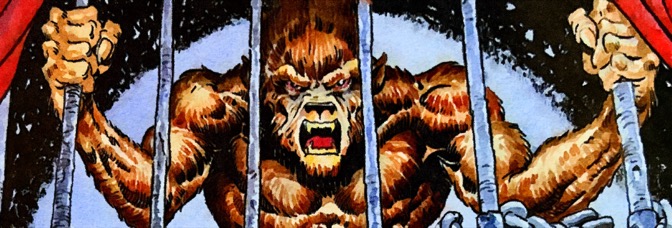
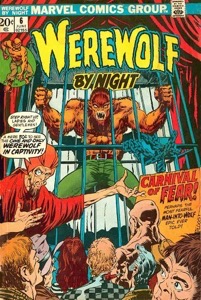
  • Werewolf by Night (1972) #6

    Wbn6

    Frank Bolle’s not the best inker for Mike Ploog’s pencils, but he’s far from the worst. This issue’s got some fantastic panels, even with Bolle muting the Ploog faces. Most of the art’s at least good, if not better, with only one wanting page when writer Len Wein introduces the cop who’s figured out there’s a werewolf on the loose. But the cop’s only a tease for later. Instead, the issue’s all about an evil circus swami kidnapping Jack so the show can have a real, live werewolf.

    The issue starts with an unrelated action sequence; Wolfman Jack versus truckers (back when they were unionized). It’s a bit of a page killer, something to get the werewolf in Werewolf by Night as soon as possible. There’s no connection to last issue—other than when the cops talk about the events—but when Jack’s sister, Lissa, shows up, she’s apparently forgotten she found out her brother was a werewolf and she’d be turning someday too.

    However, she at least isn’t paired off romantically with Jack’s roommate and bestie Buck Cowan, who’s in his forties at least. Lissa’s not yet eighteen. I’m just waiting for that icky to hit.

    After the opening werewolf action, set on the last night of the full moon, Wein jumps ahead to the next one, though Jack isn’t preparing for it because, if he did, there couldn’t be a comic book. He’s always got to be taken vaguely by surprise the moon gets full every month.

    He, Lissa, and Buck are on a day trip to San Diego, where they come across the circus. The swami immediately hypnotizes Jack to make him docile enough for kidnapping. Lissa and Buck disappear from the story at this point, with Buck telling Lissa her brother probably just hitched back to L.A. out of boredom. The cop scene’s next and seems like it’d be a missing persons report.

    Nope.

    There’s a little introduction to Jack and the circus; the second tier bad guy is the dwarf lion tamer who resents having a werewolf around; the good guy is a gentle giant who doesn’t let the lion tamer abuse hypnotized Jack. But once the full moon rises, there’s no way to keep the werewolf under control, and the whole circus has to get in on the fight.

    The beginning’s a little rocky, with the art carrying the water, but the eventual roaming circus chase and fight is good. Wein doesn’t overwrite the narration as much previous writer Gerry Conway did.

    It’s fine. For a seventies Marvel horror book, it’s totally fine.

  • Miss Meadows (2014, Karen Leigh Hopkins)

    There are so many things wrong with Miss Meadows, it’s hard to know where to start. There are easy pickings, like Jeff Cardoni’s music. There are complicated pickings, like the film’s suburban mama bear fascist “everywhere you look there’s a pedophile no one will take care of, check that pizza shop basement” message. There’s the acting. Wow, is there the acting. But with the acting, much has to do with director Hopkins, her script, and Joan Sobel’s editing.

    Because Miss Meadows isn’t just tedious; it’s exasperating.

    The film opens with Hopkins’s best moment. Lead Katie Holmes walks down a suburban street where she gets accosted by a guy in a pickup truck, who threatens her with a gun if she doesn’t get in. So she shoots him dead. But before that interaction, she does a tap dance number. Hopkins cuts from Holmes walking to close-up on the tap-dancing feet, so it seems like it’s not Holmes (it’s probably not), but then they cut to Holmes tap dancing. She can do it, after all.

    Best directing in the movie.

    It’s like two minutes in, and Miss Meadows runs eighty-nine minutes. The story peaks in the first act, as Holmes meets local sheriff James Badge Dale, and they have a whirlwind romance. She’s a prim and proper substitute teacher (who threatens school administrators to keep the position, which the film drops right after introducing it), who also just happens to be a vigilante of the Charles Bronson Death Wish variety. Wherever she goes, she just happens across sexual predators or spree killers, and only Holmes can save the day.

    Worse yet, they’re releasing a couple thousand felons early because of overcrowding, and it’s all the violent pedophile ones. For a while, the movie’s so on the nose you think it’s going to be about Holmes realizing Black and brown people get banged up for all sorts of bullshit by the corrupt criminal justice system and having to reexamine her hobby. But, nope. Miss Meadows does not, to its “credit,” villainize Black or brown men. There’s one Black guy—Dale’s sidekick, Stephen Bishop—otherwise, all white people. Holmes talks shit on the phone about the school she’s teaching at with all these poor kids. The Catholic Church is (not wrongly) demonized, but Holmes’s a good Christian girl who can’t stop talking about God. Apparently, the cops don’t do enough, including Dale, so it’s up to ladies like Holmes to keep the streets safe.

    Of course, the one time Holmes really needs to be keeping someone safe, that person’s only a target because of Holmes’s shortsighted bravado.

    It’s a messy, dull script with really long, really boring scenes, where Hopkins points the camera at actors and runs them to the ground. It’s worst with the kids in Holmes’s class; Hopkins isn’t good at writing the kids, but she’s worse at directing them. It’s excruciating, with Holmes not helping. When it seems like Holmes is in on the joke, she’s potentially charming. But there’s no joke; Meadows is just an ostensibly quirky Death Wish clone, and Holmes’s charmless in it. Especially once Dale becomes convinced she’s the vigilante. When Holmes has to act opposite suspicious Dale, Meadows crashes through the floor, plummeting towards the next new bottom.

    Barry Markowitz’s photography is surprisingly good, and Jennifer Klide’s production design is solid. Otherwise, Miss Meadows is a complete waste of time. Including Jean Smart’s cameo; it’s definitely not her fault it’s pointless—it’s Hopkins’s fault; I didn’t even realize you could waste Jean Smart like Hopkins does.

    At least it’s not eighty-nine and a half minutes. Or, heaven forbid–ninety.

  • El Topo (1970, Alejandro Jodorowsky)

    El Topo means “The Mole.” There’s some opening text explaining it, but it’s not until the film's second half where the title really makes sense. There are some earlier nods—the nameless protagonist (played by director Jodorowsky) starts the film telling his son to bury his childhood. Then later, Jodorowsky will magically find just what he needs by digging in the desert.

    At the beginning of the film, Jodorowsky rides around the desert with his naked son; Jodorowsky’s a gunslinger, dressed in all black, teaching his son the trade. They come across a mission where everyone—people and animals—have been disemboweled. It’s actually the least intense El Topo ever gets because everything’s already dead. The subsequent intense scenes, while less gruesome, always have live, suffering victims. El Topo’s big on showing the suffering.

    Well, after an almost comic introduction to three bandits—including Alfonso Arau; I spent the next fifty million years and hour and fifty minutes of runtime wondering why Jodorowsky didn’t cast the clearly more charismatic Arau in the lead.

    I didn’t know Jodorowsky was the lead until the end credits.

    Anyway.

    After Jodorowsky and his son dispense with the bandits, they head to another mission where the murderers are encamped, tormenting the neighboring people, raping the priests, and so on. It takes Jodorowsky’s character forever to save anyone. Jodorowsky, the director, has a lot of fun methodically showcasing the violence and terror and the utter buffoonery of those committing it.

    Until the second half, when the film time jumps and showcases cruelty and evil—and so long as you skip the rapey stuff–El Topo’s best as an object lesson in how surrealism and farce, with the right sound effects, are indistinguishable.

    Jodorowsky’s character will soon abandon his son at the mission once he meets a woman, Mara Lorenzio.

    Lorenzio and Jodorowsky will fall in love—according to the dialogue—which he will express by raping her, and she will express by demanding he go kill the four best gunfighters in the desert. Raping her gives her magic powers too, which is never important but does mean it's not all bad, right? Also, Jodorowsky’s character is a Jesus analog, so, you know, there you go.

    The film will follow the pair on this quest, quickly adding Paula Romo to the group. Romo’s also a gunfighter, and while Jodorowsky determines how to kill these rivals who’ve all basically given up gunfights, Romo’s out to seduce Lorenzio. Because even though Jodorowsky, the director, likes to male gaze the sapphic, the film goes heavy on the general misogyny too. It’s lower-key on the homophobia, but women are enthusiastically evil. When they’re the worst of the worst, the film dubs them with gruff male voices. Romo’s one of the awful ones.

    The quest to defeat the other gunfights eventually drives Jodorowsky’s character to a mental disconnect—he’s basically murdered quirky pacifists—and Romo sees her chance to best him, both in pistols and ladies.

    Dramatic resolution and time jump, and now Jodorowsky’s character lives in a hollowed-out mountain, comatose for at least ten years. When he wakes—in a comic scene, but it’s unclear it’s humorous because it’s also the revised ground situation establishing—he discovers he’s living with exiled people with congenital disabilities. The nearby town is big into incest, and whenever a baby comes out with problems, they dump it in the mountain.

    Jacqueline Luis plays Jodorowsky’s caretaker—when he was in the coma—who becomes his friend, partner, and lover. As a director, Jodorowsky doesn’t ask much of his actors; if they’re in the movie for a while, it’s be hideous then die; if they’re barely in the movie, it’s usually just suffer and die. Even when someone’s in the film for a sustained period—like new town priest Robert John—they’re still barely in the movie. Medium or long shots, absurdist reaction shots. Not a lot of heavy acting lifting. Especially since everyone’s dubbed anyway.

    But Luis is great. As El Topo drags and drags and drags through the second half, Luis is always great. And Jodorowsky, director Jodorowsky, seems to know it and showcases her performance as much as possible.

    They’re going to dig a tunnel into the mountain—there was once a tunnel, but the townsfolk closed it—but they need to go into town and do clown shows for money. They have some success; Jodorowsky’s not an untalented physical comedian, and Luis is a little person; the townsfolk eat up their performances. The town’s led by the good Christian ladies of the decency league, who make their slaves fight and then execute them for more laughs. It opens with a branding scene. It's a whole new level of unpleasantness for El Topo and it's a relentless one.

    And for a half-hour so, the movie is just the townsfolk being shitty or murderous. Then, the new priest, John, shows up, and the story gets moving again to its inevitable, despondent conclusion.

    El Topo’s an unpleasant experience but not really a difficult one. When the Jesus metaphors come through, they come through with a, “Oh, JFC, he’s Jesus!” Every single time. It’s tedious. Jodorowsky’s self-indulgent with the violence, which plays like a commentary on Westerns in the first half, but not the second. There’s a funny spoof of a Spaghetti Western stand-off at the beginning, before El Topo’s too far in, and the spoofing stops for more violence, more absurdity, more cruelty.

    If it added up, who knows? It doesn’t add up, though. Pretty photography from Rafael Corkidi. Some of Jodorowsky’s direction is good. It’s never bad—surrealism, like farce, defines its own bar. But there’s nothing to it; you can get pretty landscapes, misogyny, queerphobia, and Jesus analogies in better, shorter movies.


    This post is part of the Foreign Western Blogathon hosted by Debbie of Moon in Gemini.

  • Tomb of Dracula (1972) #2

    Tod2

    It’s another exquisite issue, thanks to Gene Colan’s pencils. He’s got Vince Colletta inking, but it doesn’t detract. Colan’s so good he even makes the last issue recap page work well, as protagonist Frank Drake (anglicized from Dracula) remembers how he got into his current predicament. This issue follows Drake from Transylvania back to England; in between, he manages to sell off the now destroyed castle and its lands and rescue ostensible best friend Clifton. Dracula threw Clifton into a pit for later snacking last issue, and, surprisingly, he survives to return this issue.

    Frank’s plan involves stealing Dracula’s coffin and taking it from Transylvania, while the Count is more concerned with improving his appearance. Luckily, the village doctor used to be a boy in the vampire’s employ and can now do some kind of—off-page—skin therapy to make the Count appear human. However, they still color him shock white, so only Dracula’s fellow comic book characters can see the difference, not the reader. In expository dialogue with the doctor, writer Gerry Conway reveals a little more of Tomb’s timeline; Dracula was “killed” when the doctor was a boy, so within living memory. The doctor’s old now but still capable. Doesn’t seem like Tomb’s going off Bram Stoker’s Dracula continuity or timeline (which the first issue implied but didn’t make definite).

    Dracula doesn’t stay in Transylvania either; he follows Frank and Clifton to London, bringing along new vampire Jeanie. Jeanie’s Frank’s fiancée turned vampire (last issue at the very end) who used to date Clifton; Clifton lies to Frank about his role in releasing Dracula. He also fails to reveal he was planning on screwing Frank out of the castle and reclaiming Jeanie. While Frank’s not taken with her new vampiric form, Clifton’s not so picky, and Jeanie’s sure she’ll be able to turn him against Frank.t

    Meanwhile, Dracula’s off sampling the seventies London nightlife, including the ladies. There’s a weird throwaway moment where Dracula remembers last issue’s barmaid who he killed and complained was too slutty; here, he remembers and then chastises himself for romanticizing a loose woman. It was a bad detail last issue, so it coming back is strange; maybe it’s just a Marvel Style problem; Colan thought one thing, Conway thought another.

    Eventually, the vampires team up against their amateur hunters, and there’s a big fight scene with some excellent Colan art. He does horror, he does “reality” settings, he does fight scenes in mundane hotel rooms; he’s, no punning, a marvel.

    Conway does the same overwriting as last time on some of Frank’s scenes; it’s wordy, second-person narration. Luckily, once Frank rescues Clifton, Conway doesn’t use the device (at least not noticeably) the rest of the issue; there’s just too much going on without Frank.

    The last issue felt like a done-in-one, and this issue resolves some of its outstanding strands; Tomb of Dracula isn’t quite set up yet, but it’s definitely getting there. And Colan makes reading that set up a rare delight.

  • Kill or Be Killed (2016) #9

    Kbk9

    It’s an all-action issue, which works out strangely well. Dylan’s drug dealer, Rex, who has been selling him fake antipsychotics—why Dylan’s not just getting real meds, given he’s got a trust fund, is left unexplained—is used as bait by the Russians. They’re after Dylan for something he did early in the series; they got a lead on him because of a Russian cab driver a couple issues ago.

    Now, when that scene happened, the narration told the reader it would be essential, and they would forget (like Dylan would forget). I mean, I guess if you aren’t paying attention. It didn’t happen like a dozen issues ago. It’s like two, maybe three issues. Writer Ed Brubaker should have some confidence in his readers; whether he does or not—Dylan’s recounting is incredibly forced—he’s broadcasting he does not, which is a strange move. But, like, Kill or Be Killed isn’t tricky. If you’re going to worry about your readers having a problem, it’s probably going to be artist Sean Phillip’s weird head sizes, not the straightforward story.

    Anyway.

    This issue has a Russian tough guy ambushing Dylan, who’s got the demon in him, so he can fight back; drug dealer Rex gets caught in the crossfire, putting Dylan in one desperate situation after another.

    It’s too early to say, but I’m wondering if Brubaker will acknowledge Dylan’s no longer anywhere near a reliable narrator. He’s been on shaky ground the entire series—demons and all—only now Brubaker’s revealed he’s got an untreated mental illness thing. Dylan’s sympathetic in a pitying way now; it helps his targets are comic book criminals, so at least he’s not like hurting nice people.

    The pacing’s excellent—Phillips’s head sizes aside (it’s got to be intentional, it’s just got to be), he does a wonderful job with the art. Dylan goes speeds around New York and New Jersey, trying to unravel this latest knot, and it looks great. Not the detail—there’s no time for it—but the action. It’s moody in just the right ways.

    Obviously, Brubaker’s got a couple swords of Damocles hanging over the book, waiting to drop—we haven’t seen the lady cop he set up as a co-protagonist a few issues ago since her first appearance, and Kira’s been missing since her issue too.

    Being entirely disinterested in how the comic turns out helps reading it way too much.

  • Downton Abbey: A New Era (2022, Simon Curtis)

    Downton Abbey, the film franchise, has some singular traits (they’re not all problems); most of them related to it being an immediate sequel to a television show, but also the television show’s viewer demographics. Thanks to those demographics, A New Era can get away with a slightly disingenuous subtitle—it’s more of a “sure, maybe, come next to see if anything’s changed”—and lazy title design. When the end credits come up, they’ve got a title card any capable intern wouldn’t have shipped, but it doesn’t matter. Another of the franchise’s traits is the low bar they have to clear. The film’s got a cast of thirty capable actors; so long as Julian Fellowes’s script keeps their material interesting and the plotting straightforward, New Era can never be particularly bad.

    Obviously, relying on competent writing and acting will limit its potential as well, which doesn’t even get into whether or not A New Era’s going to be comprehensible to viewers who haven’t seen the previous sixty hours of content. Spoiler, it’s not. Thanks to the acting, some of Fellowes’s callbacks would probably work without context, but New Era’s not interested in being a jumping-on point.

    New Era takes place a year after the last film and has a profoundly requisite morbid plot line. The previous film set up Maggie Smith’s character, the family matriarch, not returning for the next film (this film). Because Smith was eighty-five and they didn’t want to recast if she passed away before the next movie. So, already unpleasant. Well, she didn’t pass away, so they’ve got an entire subplot about her waiting around to die. It “works,” with Smith getting in some great scenes, but it’s… a lot. They handle it well, probably franchise trailblazing; it’s just inherently somber, the character and the actor’s fate so entwined.

    Of course, Smith’s not the only actor they’ve got to worry about aging. There are a couple dozen others the film’s tracking. The opening titles, listing actor after actor (in alphabetical order), play over a montage—Allen Leech is marrying Tuppence Middleton, following up on their romance from the previous movie. The montage skips around the cast, establishing who’s got a baby now, who doesn’t, who’s married, and who still isn’t. A New Era feels like two episodes of the show smooshed together, with a very special conclusion tacked on to the end; the opening, however, feels like the end of another episode, one we haven’t seen.

    The film’s going to take a while to get going, too, checking in and establishing the various subplots—principally, assistant cook Sophie McShera’s complicated home life, which involves her and her husband Michael Fox living with her dead first husband’s father, Paul Copley. Their subplot is the only one entirely disengaged from the rest of the film’s goings-on. Penelope Wilton’s got a tiny subplot where she’s going through Smith’s estate to get it ready for her passing, but nothing of her own; Elizabeth McGovern’s subplot (the only ill-advised one in the film) starts tacked on to Wilton’s before branching out in the late second act. Everything’s wrapped up together, which Fellowes’s script handles with startling ease.

    Everything else has to do with or spins out of one of the main plots. First, there’s Smith inheriting a French villa; she can’t make the trip to meet with the angry soon-to-be-former owners, Jonathan Zaccaï and Nathalie Baye, so a large contingent on the regular cast will go on that mission in her stead. Then, at the Abbey itself, persistent money problems have led Michelle Dockery to rent the property to a film production crew led by director Hugh Dancy. New Era dabbles with the two layers of filmmaking, the film within a film and New Era itself, but it’s like Fellowes knew director Curtis wouldn’t be able to pull it off. But there are a couple excellent moments where one informs the other.

    The French away team is Hugh Bonneville, McGovern, Leech, Middleton, Laura Carmichael, Harry Hadden-Paton, Jim Carter, Brendan Coyle, Raquel Cassidy, and Imelda Staunton. So ten regular cast, plus Zaccaï and Baye. Zaccaï’s the son of the recently deceased, who’s convinced there’s some story behind why his dad left the villa to Smith, who knew his father for a week decades before. Baye’s the justifiably unhappy about it widow. Their arc will be the film’s most complex because they’re not main cast, so they can’t get too much time, but Fellowes isn’t going to half-ass it either.

    There are some excellent comedic scenes for Carter, the proper English butler literally drafted for the mission (by wife Phyllis Logan to get him out of the estate for the film crew), with some lovely character moments for everyone else. The trip provides the opportunity for the downstairs characters—Carter, Coyle, Cassidy—to interact outside the norms, in addition to some mixing with the upstairs cast. It’s okay but dramatically inert; it’s all set up for Bonneville’s understated aristocrat fretting arc and McGovern’s subplot.

    The filming at Downton plot is the clear A plot, particularly since it gets the special guest stars—Dancy, Dominic West, and Laura Haddock. Again, Dancy’s the director, West and Haddock are his stars; they’re making a silent movie just when sound is taking the cinema by storm. Dockery and Dancy quickly become partners, first logistically, then more conceptually, as Dockery gets involved in filmmaking. She won’t be the only one—lovable Kevin Doyle will have a significant part in the production as well. Meanwhile, West shows what appears to be a sincere interest in Robert James-Collier, whose boyfriend from the last movie married a woman for cover in between films.

    The moviemaking subplot also has starstruck McShera and Joanne Froggatt learning screen idol Haddock’s a lot more complicated in real life—though West’s nice to everyone; it’s a fantastic performance and just what the film needs to offset Haddock’s additional drama (she’s got a Cockney accent, which doesn’t match her glamorous screen persona) and Dancy mooning over Dockery.

    Dockery’s got offscreen husband troubles; another problem with doing a movie sequel to your TV show… what if you can’t get all the actors you need back?

    The film production plot works out well, resolving just in time for the film’s big swing finale.

    At various points throughout the film, one has to wonder how New Era would play if director Curtis were concerned with anything but aggrandizing a TV show for the big screen. The film takes every advantage of its wide, Panavision aspect ratio, which would be more groundbreaking if TV shows (including “Downton Abbey”) weren’t already widescreen. Still, Curtis and cinematographer Andrew Dunn make sure every frame’s chockfull. Doesn’t quite make up for Curtis not having any personality, but he’s got a pragmatic job here.

    The two plots even out—partially due to that iffy McGovern subplot—with the finale as the film’s make-or-break. They succeed with it, bringing New Era about as closer to standalone than previously imaginable. It’s a particular accomplishment for the actors, who bring the gravitas.

    I do hope they figure out a better subtitle for the next entry.

    But, otherwise, Downton—thanks to Fellowes and the cast—remains in fine shape.

  • Tomb of Dracula (1972) #1

    Tod1

    I’m sure there’s a difference between a Gene Colan comic book and a Gene Colan art portfolio but damned if they don’t seem identical. Gerry Conway scripts this issue (from a Roy Thomas plot–according to Thomas), and there’s just the right amount of moody in the text to go with the Colan art. It’s perfect and terrifying and a done-in-one. It’s a first issue, but one without any setup for the series, other than Dracula (and his descendant, one Frank Drake of America).
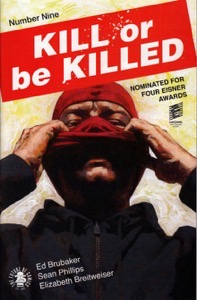
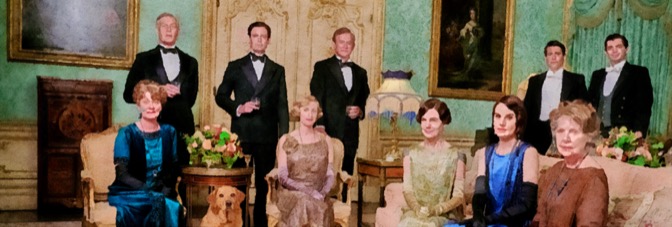
    Set in the present, the issue recounts down-on-his-luck blue blood Drake deciding the only way to get rich with what he’s got is turning his old family castle into a tourist location. Luckily, it’s Castle Dracula, so folks might want to pay for that trip. So along with his girlfriend, Jean, and his ostensible pal, Clifton, Frank heads to Transylvania and the castle.

    The comic opens with the trio having car trouble, which forces them into town, where they meet villagers as superstitious as Jonathan Harker came across eighty-plus years before. After some guffawing, a villager agrees to take them out to the castle—for ten dollars American (eighty bucks today), bankrupting them—where they explore, Frank feeling a strange familial connection, Jean being miserable she tagged along, and Clifton scheming to get Frank out of the way both in business and romance. Clifton used to date Jean, but she threw him over for fellow richie Frank.

    It’d be soapy if it weren’t for Colan’s truly breathtaking horror art. There’s impending doom in every panel; it’s magnificent.

    And, credit where it’s due, Conway’s script is a fine accompaniment. He overwrites, but the wordy exposition means longer attention on each panel, which leads to Colan’s foreboding making more of an impression. There’s some backstory, too, with Frank reading an old family diary to fill everyone—reader, Frank, and Clifton—in on how Dracula works in Tomb of Dracula.

    And once the Count arrives, he’s mesmerizing. There’s a lot of vampire horror action, Frank’s constantly defending with whatever baubles work, Dracula’s out to get Jean (the barmaid he feeds on is a little too low class), and Clifton’s pretty sure it’s all an elaborate gag to mess with the villagers.

    The comic goes on longer than expected, running twenty-five pages, which Colan and Conway put to good use. Colan’s art is so good, Conway padding out the action doesn’t matter; you just want more panels. The wrap-up’s haunting as well, as everyone—visitors and villagers—start to understand how the world is all of a sudden very different than before.

    It’s a great comic, entirely self-contained, and absolutely gorgeous. I can’t wait for the second issue, even though the first doesn’t make any promises of what it’ll contain.

    Well, other than Dracula, presumably.

  • Superboy and the Legion of Super-Heroes (1977) #241

    Slsh241

    Writer Paul Levitz’s A, B, and C plot structuring from Legion of Super-Heroes is famously good, so I’m really hoping what he’s doing in this issue is figuring that system out. The feature story starts with one plot—Mon-El and Wildfire leading a diplomatic mission—switches over to another with Brainiac 5 and Superboy—while both teams ignore a female science police trying to give them an important message.

    Why do they ignore her? Well, because if it was important, they’d have sent a man, wouldn’t they?

    That exceptional sexism comes from Brainiac 5 (having Brainiac 5 be a twelfth-level intellect who’s also a misogynist is unfortunate) and isn’t even the first jerk store move from the Legion in the story. It starts with Wildfire ignoring the science cop’s flying car and almost causing her to crash. Mon-El goes to save her, thinking about Wildfire’s infinite jerkiness but doesn’t hear the science cop try to give him her message. Apparently, Daxamite super-hearing isn’t as good as Kryptonian.

    Mon-El then returns to space, where Wildfire blames the accident he caused on the science cop. At least he doesn’t make a lady drivers joke.

    The science cop then goes to Legion headquarters, where an emergency calls them away (here’s where Brainy says the lady cop isn’t important enough to have a real message).

    Mon-El’s team’s story is about doing security on a diplomacy planet. After an attack, the Legionnaires start suspecting there might be an inside job component to the attack, and then the story cuts away to Superboy’s team never to return. Starting a plot and putting it on pause isn’t the same as back burnering. Though, one last thing on that plot: Dawnstar. They established her as an elitist mercenary last issue, but she’s naive about corruption in this issue. Levitz only plotted that issue, didn’t script, but still, it’s incongruous and seems like it’s just there for Wildfire to be a justified dick to Dawnstar.

    I mean, at least there’s some effort in the justifying.

    The Superboy and company plot is about some space raiders they’re fighting and exposing the vacuum of space. Eventually, Chameleon Boy gets captured and interrogated by the floating brain thing on the cover. It’s a rather effective scene, maybe because Chameleon Boy’s entirely sympathetic. But, unfortunately, it seems like everyone else comes with a caveat this issue or is just such an ass they’re not sympathetic at all.

    So the feature’s got three cliffhangers—the science cop’s urgent message, Mon-El’s diplomatic intrigue, Brainiac 5 uncovering an imminent attack on Earth (the story’s called Prologue to Earthwar. It’s entirely unclear if the imminent attack has anything to do with the first two cliffhangers; it may and would technically utilize Levitz’s plotting system, but it’d be in the cheapest possible way.

    All those problems aside, however, the art’s by James Sherman and Bob McLeod and is gorgeous. They’ve got similar faces for everyone in close-up, but they’re good, expressive faces and more than the story needs. The action scenes are where the art excels; the movement and figure work are phenomenal. For superhero art, Sherman and McLeod are unstoppable. And more than enough to cover the iffy aspects of Levitz’s script.

    Unfortunately, the art in the back-up’s nowhere near good enough to cover the script. It’s a Levitz plot, Paul Kupperberg script, Arvell Jones on pencils, Danny Bulanadi on inks. Jones and Bulanadi put in the work, especially on the sci-fi setting, but I don’t think even Sherman and McLeod could make the story palatable. It’s an endless twelve pages about Timber Wolf and Light Lass going to her home planet to help recapture her criminal brother, Lightning Lord, and it’s an excruciating bore.

    There’s still some sexism to round out the experience between stories, with Light Lass a helpless damsel as her macho boyfriend, Timber Wolf (I’m not understanding the Legion’s policy on marriage now if all the Legionaries date amongst themselves), does all the work. Including strong-arming the local law enforcement into letting him destroy the planet and assault civilians. Seemingly innocent ones, as it turns out.

    Kupperberg fills the pages with the exposition, all of it bad. It’s a grueling read.

    I’m sure some Legionaries aren’t complete assholes, but apparently, Levitz never wants to do stories about them.

  • Detective Comics (1937) #464

    Dc464

    I went into this issue expecting the back-up—Black Canary versus the Calculator, continuing writer Bob Rozakis’s back-up from last issue—to be better than the feature, which wraps up guest star vigilante the Black Spider’s first appearance. I was wrong. While the feature is not good at all, the back-up is even worse.

    The feature starts with writer Gerry Conway resolving the last issue’s cliffhanger, which had Batman about to be run over by a passenger jet. Luckily, the jet didn’t run him over; tres exciting. After some quick fisticuffs with the Black Spider, ending with Black Spider beating Batman once again—without the “gunshot wound to the shoulder” excuse because Black Spider takes him out with a kick to the knee—Batman has to figure out where the vigilante will strike next.

    Luckily, Batman has some streetwalkers he can ask. The story’s take on the informant is simultaneously objectifying and moralizing. Most amusing, when she tells Batman giving him information will result in her death, he’s okay with it, continuing Conway writing Batman as a dick. In his one scene with Alfred and two with Commissioner Gordon, Batman’s more concerned with the problem of vigilantism than being rude to them this issue, however. There’s lots of soapboxing from Bats about why vigilantes are dangerous, but deputy policemen like him are jim-dandy.

    The thread is a strange attempt from Conway to give the comic some heft. Apparently, the editors and Conway didn’t realize they could just as well not address it, but the reveals on Black Spider aren’t enough to fill pages. Frank Castle Jr., he ain’t. Black Spider is, as predicted, a Black man; he had a friend who got hooked on junk and went from one tragedy to another.

    There’s a moment where Batman’s confused at junkies having other qualities to hammer in more moralizing. Again, Conway could’ve skipped the moment—he had that ability—but instead, he just reinforces the problems with the story.

    Ernie Chan and Frank McLaughlin’s art isn’t as bad as last time, but only because Batman doesn’t have as many action sequences. Conway’s finale for the issue seems more appropriate for a Spider-Man, though Black Spider doesn’t have any webs. It’s a slight, severely undercooked story.

    And leagues better than the back-up, which is six pages of atrocious dialogue and storytelling. It starts with Black Canary blowing off the Atom reporting on last issue’s adventures because she’s got better things to do. Except then, the Calculator immediately ambushes her, and she realizes she should’ve paid attention.

    The Rozakises (Bob got an assist from wife Laurie) write Black Canary like an asshole but then have Calculator be a sexist piece of shit to her. His supervillain plan for this story’s goofy but also barely explained. Instead, there’s just fighting and misogyny.

    The art, from Mike Grell and Terry Austin, is good… way better than the script deserves. It ends, like last time, with Calculator plotting his next move from a jail cell; presumably, they won’t explain the prison escape next time either.

    Besides the Grell and Austin art, the issue’s the pits.

  • The Sixth Sense (1999, M. Night Shyamalan)

    Setting aside the twists and reveals, The Sixth Sense is about three character relationships. There’s child psychologist Bruce Willis and troubled youth Haley Joel Osment, there’s Osment and mom Toni Collette, there’s Willis and wife Olivia Williams. The film opens with Willis and Williams celebrating him receiving an award for his work, which she thinks is more important than him, as he’s been neglecting her to do that work. They get past the unpleasantness to some awards night amorousness, only for a home invasion to interrupt them.

    One of Willis’s former patients, now grown up, has broken in to let the award-winner know he doesn’t help all the kids and shoots Willis for his trouble. Donnie Wahlberg plays the intruder; it’s basically a cameo but very effective.

    Fast forward a few months, and Willis is still recovering from the assault. He can’t keep track of time anymore, including his first appointment with Osment. Osment has a similar case file to Wahlberg, and Willis sees helping Osment as a chance to redeem himself. Except Osment’s not willing to trust Willis with his secrets, including explaining his strange behavior at home and school to Willis. Instead, Osment just scares Collette, who’s overwhelmed and trying to stay afloat since her husband walked out on them.

    Meanwhile, Willis’s emphasis on his work has led to further distance from Williams, who ignores his tepid attempts at apologies and explanations.

    Obviously, the film’s twists factor in, but not in how the characters experience the events or how the actors essay their roles. There are four layers of Sixth Sense: Willis’s experience, Osment’s experience, Williams and Collette’s experience (they’re just girls, after all), and then writer and director Shyamalan’s actuality. What’s impressive about the film isn’t how everything comes together in the third act—the third act is a series of stumbles, in fact—but how well Shyamalan paces Osment and Willis’s relationship. It takes time for Willis to earn Osment’s trust, for Willis to separate Osment from his professional expectations from Osment; once Osment trusts Willis enough to tell him the truth about what’s going on, the film’s well into the second act. Everything in the film changes at that point, with Shyamalan now showing Osment’s experiences instead of showing everyone else observing Osment’s experiences.

    It’s good enough to make up for multiple fizzles of the third act, where Shyamalan whiffs on resolving every single one of the character relationship resolves. The one for Willis and Osment is the best and only stumbles because Willis’s getting relationship advice from a little kid, and it’s not great relationship advice. It works rather conveniently within the boundaries of the film’s twists, but it’s far from a eureka moment. Then Osment and Collette’s resolution is too little, too late, too contrived. In particular, it’s too bad for Collette, who the film wrests through emotions without reward.

    The resolve for Williams and Willis is the big one and… Unfortunately, Shyamalan overestimates the chemistry between the actors. Especially since they only have the one big scene together at the beginning, then everything else is detached. Given all Shyamalan’s constraints, it’s reasonably effective but not good.

    Osment’s the film’s obvious standout. Until his trite resolution—which Shyamalan drops in like an afterthought—everything Osment does is phenomenal, whether he’s dealing with the usual—school bullies, sad mom—or the abnormal, like crusading therapist Willis, not to mention once the supernatural comes into play. Thanks to the film’s structure, Osment’s the only actor who’s got to maintain a performance through big reveals, and he ably does so. Without Osment, there’s no movie.

    Willis is fine. Shyamalan over-directs Willis’s pensive reflection scenes, which works out thanks to Tak Fujimoto’s gorgeous, muted but lush photography, and James Newton Howard’s score. Willis rarely gets to do his charm offensives (Osment shuts them down), and, given the twists and turns, it’s not much of a role in the end.

    Similarly, Collette’s got snippets of great scenes, but since she’s usually only seen from Osment’s perspective, there are some hard limits on her part.

    Williams is even more limited. She’s not bad, especially since Shyamalan writes her as selfish. There’s also her unaddressed age difference with Willis, which has a lot of connotations thanks to how Shyamalan fills in their backstory with flashback devices; those connotations then inform her behavior in the present action, at the beginning of the film, and not complimentarily.

    The film’s got some rocky stretches and some silly stretches—not to mention Shyamalan writes Willis as incapable of handling kids with real problems (it’s like a PG-13 story set in a PG world)—but the core relationship between troubled kid Osment and caring doctor Willis gets it through. That third act’s a mess, though.

  • A Walk Through Hell (2018) #2

    Wth2

    It’s a better issue. There’s character work, not development because it’s flashback, but now MacGregor is a white gay man FBI agent who doesn’t understand he works with a bunch of bigots and, in flashback, is worried about the 2016 election. In the present, election’s already happened. We find out the white lady partner, Shaw, doesn’t vote, knows white guys are bigots and doesn’t complain about anything. They have these conversations while investigating missing children cases, which are taking place around the Southwest, but centered in L.A.

    The investigation figures into the present day, starting with MacGregor and Shaw waking up in a warehouse without any pulses. They then discover one of their fellow agents is similarly without a pulse but has had a different experience—and reaction—than they’ve had. The entire present action takes place in the warehouse, lights out, mysterious figures and noises down the aisles, the partners finding themselves without pulses, then finding their colleague. At the end of the issue, there are some crossovers between the two storylines, which writer Garth Ennis toggles between.

    As a comic, manipulative content concerns aside, it’s a technical success. Ennis and artist Goran Sudžuka do a good job with it. The flashbacks are visually without dread, but there’s foreboding on a couple fronts. First, the looming election, second, the criminal investigation. Even without knowing it might figure into the present, the investigation in the past is slightly uncanny. It’s not supernatural, but it’s discomforting as the agents expound on it, and the incongruities stick out. Again, good writing from Ennis. Like, he does the work to get the right effect.

    To what end? We’ll have to wait until next time because Ennis finishes the issue ends with a revelation cliffhanger, one the agents know about, but the reader doesn’t. Yet, presumably.

    I’d be really impressed if Ennis doesn’t address it.

    While I’m still not enthusiastic about A Walk Through Hell, it does appear Ennis knows how to do what he’s doing. And Sudžuka’s art is excellent. Wish he was doing a different book—heck, wish he and Ennis were doing a better book together. The plotting with the reveals is a little off; the series runs twelve, and I’m guessing I’ll be griping it didn’t just run eight by the finale. This issue is stretched out to delay the plot from fully starting, which means there will be at least three issues before Ennis establishes the ground situation. Trade-write much?

    But whatever. It’s an improvement I wasn’t expecting.