• The Mice Templar Volume II: Destiny 3 (September 2009)

    The Mice Templar Volume II: Destiny #3There’s some awesome art from Santos this issue. He gets to do not just the regular action, but also the flashbacks detailing the origins of the world. Glass has been doing a lot with the supernatural angle of the series and, for the first time, it feels like Mice Templar might not even take place on Earth. It’s way too soon to tell–and it might not even matter; this issue has a myth about two suns and one going out.

    It’s also got that amazing action with a battle against a bee and a chase sequence involving the zombie cat. Or dog.

    Glass sends his two mouse heroes into the daylight world and it invigorates their story. The interaction with the daytime creatures is fantastic.

    The secondary plot, with the mouse captives escaping their cell, is less effective due to space constraints. It’s complex, which the primary isn’t (so far).

    B 

    CREDITS

    The Bright Realm; writer, Bryan J.L. Glass; artist, Victor Santos; colorist, Veronica Gandini; letterer, James H. Glass; editor, Judy Glass; publisher, Image Comics.

  • Southern Bastards 3 (July 2014)

    Southern Bastards #3I’m really hoping Earl isn’t leaving voicemails for his dead wife. I’m sort of hoping he’s leaving them for his dude. If Earl were an old gay guy who kicks ass, it might give Southern Bastards an edge. The series already has an edge, but it’s a predictable edge. I think I said it before–Bastards is prime option material for any actor from the Expendables series.

    But it’s also got Latour and he’s bringing enough edge to make up for the rest. The comic is visually unexpected, between Latour’s composition choices and just the way he paces out action scenes. It’s a delight to read. It’s just not a delight to dwell on.

    Aaron goes for the cheapest cliffhanger he can–young ally in trouble–and one has to wonder if the comic wouldn’t have read better longer, so the cliffhangers could be less forced.

    Still, Latour covers it.

    B 

    CREDITS

    Here Was a Man, Part Three; writer, Jason Aaron; artist and colorist, Jason Latour; letterer, Jared K. Fletcher; editor, Sebastian Girner; publisher, Image Comics.

  • The Flash #302I was hoping Bates would keep Flash running smoothly after the previous issue, but this one doesn’t bode well for the series keeping up. Even more than usual, Barry–and the Flash–are less characters in the comic than they are movable pieces for Bates’s plot. There’s not even the attempt at showing the Flash’s fantastic powers. Instead, Bates shows him doing what equates to a grade school science project without the traditional verbose, fantastic explanation.

    This issue has Flash apparently falling for the Golden Glider. Now, I’m not sure about her family situation, but she doesn’t remember Flash messing with her brother a few issues ago. I guess they aren’t in touch. SO why’s she important–do they have some deep, repressed attraction for one another? Nope, it’s all for Bates’s evil dad plot.

    It’s lame.

    The Firestorm backup isn’t much better. Again, fine composition from Cowans, weak detail. And rushed writing.

    C+ 

    CREDITS

    Lisa Starts with L and That Stands for Lethal; writer, Cary Bates; penciller, Carmine Infantino; inker, Bob Smith; colorist, Gene D’Angelo. Firestorm, Invitation to Revelation; writer, Gerry Conway; penciller, Denys Cowan; inker, Rodin Rodriguez; colorist, Jerry Serpe. Letterer, Ben Oda; editor, Len Wein; publisher, DC Comics.

  • The Field 3 (July 2014)

    The Field #3This issue feels incomplete. Not just because of Brisson’s plotting, but also because of the lack of grandiose art. While Roy gets to go crazy a few times, it’s always reserved in terms of space. For instance, the decapitations don’t get the page time they deserve.

    Brisson saves himself time for the big revelation and it’s fine enough. It’s an easy one, just because it sounds vaguely plausible but it’s a familiar enough trope. It’s effective too. Easy and effective, but it takes Brisson page after page to get all the exposition done. Those pages are talking heads and who wants talking heads when Roy’s more than capable of going fully nuts on the art.

    And, given certain aspects of the revelation, it seems like it’s coming a little late. In the third of four issues, there’s only so much time left for Brisson to play.

    The issue’s too slight.

    B- 

    CREDITS

    Writer and letterer, Ed Brisson; artist, Simon Roy; colorist, Simon Gough; publisher, Image Comics.

  • The Mice Templar Volume II: Destiny 2 (August 2009)

    The Mice Templar Volume II: Destiny #2There’s a lot of material this issue. Plot developments, character developments, but Glass still tries to deliver a somewhat action-packed narrative. The opening–the A plot–has the heroes held captive by moles; there’s humor from Cassius who mocks the moles, a fair amount of suspense (the moles are apparently under siege) and then some payoff on that suspense.

    This opening is fairly big in terms of adventure. It certainly seems like Glass could carry the whole issue with it; instead, he goes over to the capital for the B and C plots. B plot is Kirac’s friends and family, C plot is political intrigue. There’s more to it–and Santos does a great job with making these machinations scenes particularly dramatic–but it has its own cast. Glass moves these plots together beautifully, but it’s still hard to transition from the protagonists to them.

    Destiny is confidently, quietly and steadily building itself up.

    B 

    CREDITS

    In the Bowels of the Earth; writer, Bryan J.L. Glass; artist, Victor Santos; colorist, Veronica Gandini; letterer, James H. Glass; editor, Judy Glass; publisher, Image Comics.

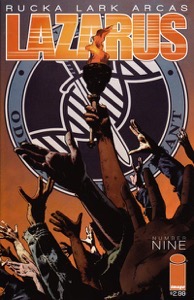
  • Lazarus (2013) #9

    Lazarus  9

    You know, I can’t remember the last time I’ve liked a comic plot–along with how things turn out for the characters–but not liked the comic itself. Until today.

    Rucka has been making leaps and bounds improvements with Lazarus and they sort of culminate here… at least in terms of character development. The lousy narrative structure of this issue? It’s a regression. It’s practically an all action issue, but not really. Rucka opens with a sword duel flashback and it’s pretty art from Lark but it’s not worth the pages. Those pages would have been better spent towards the end in the present action, making the action scenes there resonate better.

    There’s also the missed opportunity to better bring together the arc’s various characters.

    Again, it’s a fulfilling issue for a reader in terms of narrative progression, it’s just a mess of a comic. Very awkward to talk about.

  • Brass Sun 2 (June 2014)

    Brass Sun #2Culbard’s art continues to be a problem when it comes to people. I spent half the issue wondering about the evil old maid lady who turned out to be some guy. Worse, there’s not enough of the scenery for Culbard’s strengths to make up for his weaknesses.

    But this issue of Brass Sun reveals more problems than just the art. Once again, the format–a collection of previously anthologized short pieces–is severely hampering the narrative flow. It starts and stops all throughout and, by the end of the comic, which has maybe one page in thirty-some where Edginton spends any time on character development, it’s just too thin.

    The concept isn’t particularly original; it’s not steampunk because it’s too grandiose with a mechanized solar system. However to describe it, Edginton isn’t spending time in the right places–like on his protagonists.

    Sun is dwindling by the end here.

    C 

    CREDITS

    Writer, Ian Edginton; artist, I.N.J. Culbard; letterer, Ellie De Ville; editor, Matt Smith; publisher, Rebellion.

  • The Whole Town’s Talking (1935, John Ford)

    The Whole Town’s Talking has some peculiar third act problems, but it also has this extraordinary first act set over three scenes and twenty-some minutes, which evens things out.

    Some of the problem might stem from Town’s plot–mild-mannered office clerk Edward G. Robinson just happens to look like a famous gangster and is falsely arrested. The actual gangster shows up and Robinson gets to act off Robinson. The second half of the picture is often just Robinson. He can carry it–and cinematographer Joseph H. August excels at the process photography (though not the projection shots)–it’s just odd.

    Also, the gangster doesn’t come into the film until the second act; he’s not a predicted permanent fixture. Not like Jean Arthur, the omnipresent love interest whose vanishes signals the awkward finish. She and Robinson are great together; director Ford introduces most of the main cast quickly and then uses repetition to establish them. No one has a deep back story but they’re all fully drawn.

    As for Ford’s directing of a gangster spoof–he does really well with the actors. Robinson, Arthur, Arthur Byron, Donald Meek–Edward Brophy is good in a small part. Ford does okay with the backlot shooting, but he’s a little unsure with the mellow scenes. Lots of people standing.

    Jo Swerling and Robert Riskin’s script is strong, though they do forget a joke.

    The finale also redeems itself with Ford letting Robinson eschew the comedy for moral complexity.

    Town’s unique and good.

    3/4★★★

    CREDITS

    Directed by John Ford; screenplay by Jo Swerling and Robert Riskin, based on a story by W.R. Burnett; director of photography, Joseph H. August; edited by Viola Lawrence; produced by Ford and Lester Cowan; released by Columbia Pictures.

    Starring Edward G. Robinson (Arthur Ferguson Jones), Jean Arthur (Miss Clark), Arthur Hohl (Detective Sergeant Boyle), James Donlan (Detective Sergeant Howe), Arthur Byron (Spencer), Wallace Ford (Healy), Donald Meek (Hoyt), Etienne Girardot (Seaver), Edward Brophy (‘Slugs’ Martin) and Paul Harvey (‘J.G.’ Carpenter).


    valleybanner2

    THIS POST IS PART OF THE THE JOHN FORD BLOGATHON HOSTED BY CHRISTIANNE OF KRELL LABORATORIES and ANNA OF BEMUSED AND NONPLUSSED.


    RELATED

  • The Flash #301Bates seems a lot more comfortable and assured this issue–maybe assured isn’t the right word. He’s ambitious again, both in plotting the feature story and how he gets through it. The only weak part is when the Flash has to beg for Barry Allen’s job back. It reveals how little work Bates does on either character.

    The issue’s sort of a thriller, with Barry’s boss being kidnapped and him having to figure it out. Throw in his mom waking up from her coma and his evil impostor dad up to no good and it’s the most compelling issue in a while. Especially since Bates disguises the kidnapping plot’s second act as the third.

    Oddly, Infantino’s constrained, almost everything is in summary. There are no real scenes.

    Similarly, in the Firestorm backup, Cowans’s art is competent but problematic. Luckily, Conway packs in good material, lots of character development and plot movements.

    B 

    CREDITS

    …And the Beat Goes Off!; writer, Cary Bates; penciller, Carmine Infantino; colorist, Gene D’Angelo. Firestorm, How Laughs the Hyena?; writer, Gerry Conway; penciller, Denys Cowan; inker, Dennis Jensen; colorist, Jerry Serpe. Inker, Bob Smith; letterer, Ben Oda; editor, Len Wein; publisher, DC Comics.

  • The Suspect (2013, Won Shin-yeon)

    The Suspect isn’t just another action thriller where the director never lets up the pace; it’s also one where the filmmakers constantly force the viewer into one emotional response–a negative one–before relieving the tension a little and creating a hopefulness, then repeating an even more negative situation.

    It’s expertly manipulative and director Won seems to understand as long as he goes out with the viewer rewarded enough, no one’s going to hold it against the film. It provides a good ride with minimal resentment.

    Even after the final manipulations–Won and writer Lim Sang-yoon eschew a sublime ending for a melodramatic (and entertaining) one–the biggest problems with The Suspect are the technical ones it has all along. Won relies way too much on digital video to insert lame noveau cinéma vérité shots (Suspect is very post-Greengrass Bourne), Shin Min-kyung’s editing is weak and Kim Jun-seong’s music is a little much. But Won makes up for those unpleasantries with excellently staged action sequences and fine directing of his actors.

    Gong Yoo plays a North Korean defector who just happens to be a super spy and just happens to find himself in a bunch of trouble. Luckily he’s got the help of a reporter–Yoo Da-in–who’s got an agenda of her own. Too bad his old nemesis from his spying days, Park Hee-soon, is assigned to catch him.

    It’s a contrived setup but the actors all make it work; Won handles it all earnestly too. Even the exaggerated costumes.

    The Suspect’s a welcome diversion.

    2.5/4★★½

    CREDITS

    Directed by Won Shin-yeon; written by Im Sang-yoon; director of photography, Lee Sung-je; edited by Shin Min-kyung; music by Kim Jun-seong; produced by Yoo Jung-hoon and Shin Chang-hwan; released by Showbox.

    Starring Gong Yoo (Ji Dong-cheol), Park Hee-soon (Min Se-hoon), Jo Seong-ha (Kim Seok-ho), Yoo Da-in (Choi Kyeong-hee), Kim Seong-gyoon (Ri Gwang-jo), Jo Jae-yun (Captain Jo), Kim Min-jae (Soo) and Song Jae-ho (Chairman Park).


    RELATED

  • Rally 'Round the Flag, Boys! (1958, Leo McCarey)

    It’s hard to describe what’s wrong with Rally ’Round the Flag, Boys!; not because its ailments are mysterious but because the sentence is just a little problematic. Rally is a light handling of what should be a mature comedy. It deals with big issues–fifties suburban malaise and boredom, not to mention a strange post-war animosity towards the military–but director McCarey tries to do it all Cinemascope slapstick.

    He does not succeed.

    He’s lucky to have such a strong cast, because they really get the film to its finish. Its finish involves a Fourth of July pageant. The script lays the groundwork for that pageant real early, before taking a detour into a comedy of errors where Paul Newman can’t get away from Joan Collins’s roaming housewife, much to his chagrin and wife Joanne Woodward’s anger. The first twenty or so minutes setting up this part of the film are boring but gently amusing. Woodward and Newman are great together and Collins has a lot of fun.

    Until her goofy dance sequences. There are maybe three of them. They all stop the film for a moment because they’re so awkward. Maybe if the editing were better. Louis R. Loeffler does a real bad job editing Rally.

    But there’s also a tangent with teenager Tuesday Weld, who’s appealing but pointless if the film’s about Newman and Woodward. McCarey seems to be aiming high with the film’s ambitions, but he fails on all of them so maybe he wasn’t.

    Rally’s fine, just unsuccessful.

    2/4★★

    CREDITS

    Produced and directed by Leo McCarey; screenplay by Claude Binyon and McCarey, based on the novel by Max Shulman; director of photography, Leon Shamroy; edited by Louis R. Loeffler; music by Cyril J. Mockridge; released by 20th Century Fox.

    Starring Paul Newman (Harry Bannerman), Joanne Woodward (Grace Oglethorpe Bannerman), Joan Collins (Angela Hoffa), Jack Carson (Capt. Hoxie), Dwayne Hickman (Grady Metcalf, Comfort’s suitor), Tuesday Weld (Comfort Goodpasture), Gale Gordon (Brig. Gen. W.A. Thorwald), Tom Gilson (Corporal Opie) and O.Z. Whitehead (Isaac Goodpasture, Comfort’s Father).


    RELATED

  • The Mice Templar Volume II: Destiny 1 (July 2009)

    The Mice Templar Volume II: Destiny #1As this issue begins, with some flashbacks to the big battle ending the Templar, Glass also establishes the relationship between Cassuis and Karic. It’s a dysfunctional mentor and student relationship. Karic thinks Cassius hates him and Cassius hates Karic.

    There are some more flashbacks, with Cassius remembering, and Glass vaguely hinting the arc’s direction. But the cliffhanger does not suggest it’ll be going in those directions anytime soon; Glass is going on a more introspective journey. Throughout the course of the issue, the relationship between Cassius and Karic changes almost entirely. Glass does a whole bunch of character work on Cassius, usually very subtlety through the narrated flashbacks.

    Karic’s character development is a little different, probably because Glass has given him not just the bad guys of the issue as adversaries, but also his mentor.

    Santos’s art is gory and good.

    The excellent finale makes up for the exposition drags.

    B 

    CREDITS

    The Haunted Wood; writer, Bryan J.L. Glass; artists, Michael Avon Oeming and Victor Santos; colorist, Veronica Gandini; letterer, James H. Glass; editor, Judy Glass; publisher, Image Comics.

  • Brass Sun 1 (May 2014)

    Brass Sun #1Brass Sun is incredibly problematic. I don’t think I’ve read such a spotty first issue in a while, particularly one where the writer–Ian Edginton–just keeps going and going until he makes the narrative connect. And it takes this issue a long time, until the last fourth.

    The comic is collected from 2000 AD, which probably explains a lot of the disjointed nature of the narrative. Then there’s the art–I.N.J. Culbard’s art seems more appropriate for black and white than color. I’m pretty sure AD is still black and white.

    There’s too much exposition, not enough tone, Edginton awkwardly establishes the characters–the problems go on and on and they’re very obviously the fault of the packaging. So when Edginton finally gets to something effective and it’s good, it seems really good. It redeems the issue.

    The plot itself is vaguely unoriginal but I’m hoping the uptick will continue.

    B- 

    CREDITS

    Writer, Ian Edginton; artist, I.N.J. Culbard; letterer, Ellie De Ville; editor, Matt Smith; publisher, Rebellion.

  • The Flash #300About eighty-five percent of the issue is spent on flashbacks. Apparently Barry is in a mental institution, covered in bandages, and he’s been imagining the Flash side of his life for years. As he remembers things to keep himself sane, Bates and Infantino visualize them. These little stories tend to be short, sometimes just a few panels.

    Infantino does it successfully but also pointlessly. Who cares about all these villain origin recaps? They actually make the comic less accessible.

    Because there’s no character development, Bates instead goes for a couple surprises for the finish. The big one is drawn out and talky, the second but not bigger one is too short and too breezy. Bates just doesn’t seem to know what he wants to do.

    A lot of the art is fine, but even Infantino can’t make the exasperatingly boring entertaining.

    Worst is how abruptly Bates end the story.

    C 

    CREDITS

    1981 — A Flash Odyssey; writer, Cary Bates; penciller, Carmine Infantino; inker, Bob Smith; colorist, Carl Gafford; letterer, John Costanza; editor, Len Wein; publisher, DC Comics.

  • Big Trouble in Little China 2 (July 2014)

    Big Trouble in Little China #2Powell continues to show he gets it with Big Trouble. He and, presumably, Carpenter, give Churilla a bunch of crazy stuff to draw. Not right away. Right away is more comedy stand-off stuff with Jack Burton being an idiot but a well-intentioned one. The crazy stuff starts when Jack and Egg’s quest starts; they’re driving through a mystical Chinese sort of underworld… it’s phenomenal.

    What’s great about Churilla’s art is how he doesn’t compose the same way he illustrates. He’s a cartoony artist, but his composition is detailed and thoughtful. It’s a great combination and it works perfectly for Big Trouble.

    There are a lot of great tangents. Powell introduces a lot more genre into the series’s mythology–actually, he’s kind of creating it–and it definitely works. The idea of Jack Burton as an unaware magnet for supernatural trouble? I’m hoping Big Trouble will truck on for a good long while.

    CREDITS

    Writers, John Carpenter and Eric Powell; artist, Brian Churilla; colorist, Michael Garland; letterer, Ed Dukeshire; editors, Alex Galer and Ian Brill; publisher, Boom! Studios.

  • The Fly II (1989, Chris Walas)

    One of the great tragedies for soap operas has to be Fly II director Chris Walas being too good with special effects–his company does them on the film–to have to direct soap operas. With the exception of these high angle shots of impossibly expansive sets, presumably to emulate thirties horror films, Walas is a supremely mediocre director. There isn’t a single good shot in The Fly II, but there isn’t a bad shot either.

    It’s a shame, really, because it gives the film a curiosity value. Walas’s painfully competent presentation of the truly insipid script never entertains or engages, but one finds him or herself transfixed. How dumb can it get next.

    Sadly, there are only two good performances in the film. Daphne Zuniga isn’t as bad as everyone else, which isn’t a compliment, but both Harley Cross and John Getz are good. Getz is in a scene or two, reprising from the original, and he’s having a good time and cashing a paycheck. Cross is the lead character as a ten year-old and is actually quite good. If The Fly II were some crazy story about a ten year-old boy-fly, it’d be a lot more entertaining.

    But Walas can’t direct actors. Inexplicably, he’s got lousy actors in the film. Ann Marie Lee and Garry Chalk are real bad as the sub-villains, while Lee Richardson gives it a very “Days of Our Lives” vibe as Mr. Big.

    And Eric Stoltz is an anemic lead.

  • The Mice Templar Volume II: Destiny 0 (April 2009)

    The Mice Templar Volume II: Destiny #0It’s a short but not sweet zero issue for the second Mice Templar series, which picks up almost immediately where the first series ended.

    Writer Bryan J.L. Glass has two stories going–one has the fallout from the actions of the good priest (not exactly priest, more like elder–but still called a priest) and then one with Karic, the series’s protagonist, on the run with his new protector, Cassius.

    Glass doesn’t have a lot of room to do anything and he doesn’t try. He lets new artist Victor Santos show his chops in both talking mouse heads and then an action sequence too. It’s almost more interesting as a transitory piece than anything else. There’s nothing necessary in the issue, but it’s impossible to discount it too.

    The look into the activities of the elders is reason enough not to disregard it. It’s more unexpectedly deep than the stuff with Karic.

    B 

    CREDITS

    The Sacrifice; writers, Michael Avon Oeming and Bryan J.L. Glass; artist, Victor Santos; colorist, Veronica Gandini; letterer, James H. Glass; editor, Judy Glass; publisher, Image Comics.

  • The Fly (1986, David Cronenberg)

    The Fly starts with perfect economy. Director Cronenberg does not waste time with introductions or establishing shots–whenever there’s an exterior shot in the film, it comes as surprise, even after Cronenberg opens it up a little. There’s Jeff Goldblum, he’s a scientist, and there’s Geena Davis. She’s a reporter. The film conveys this expository information by having her interview him. It’s perfect.

    And that perfect economy keeps going for quite a while, maybe even half the film. A lot happens during that first half–mad science, romance, jealousy, all sorts of things–and it’s outstanding. Goldblum and Davis are great together, John Getz is excellent as her weird, slightly creepy ex-boyfriend and boss. Cronenberg’s direction is exquisite; he’s utterly focused on these three actors. Even the science fiction visual exposition gets downplayed.

    Then there’s a shift, a small one, as Goldblum’s character begins to “turn.” Cronenberg doesn’t allow many horror film sensibilities in The Fly. Instead of trying to terrify the audience visually with Goldblum, Cronenberg pulls back and Goldblum disappears. It’s a problem, because the film loses its momentum and never regains it.

    Wait, I forgot–there’s one big horror movie sensibility… a dream sequence. It’s cheap. It’s gross and effective, but it’s narratively cheap.

    Amazing special effects from Chris Walas, a nice score from Howard Shore, excellent cinematography from Mark Irwin. The Fly ’s a good looking (and sounding) picture.

    Unfortunately, Cronenberg’s ambitions decline as the film finally has to deliver the horror.

  • Ordinary 2 (July 2014)

    Ordinary #2I’m a little surprised how well x and y hold Ordinary together for the second issue. There are almost no pitfalls, which is something considering the big change in reality is gearing up to be a dream or the end of the world.

    Hopefully, x won’t try to explain it. He does bring in the scientist to try to figure out what to do–which is difficult because of the fundamentalist vice-president who doesn’t want to do anything about everyone all of a sudden being magical.

    X writes the government crisis scenes well. They remind more of Dr. Strangelove than anything else.

    Meanwhile the protagonist is still trying to find his son and having little adventures along the way. They’re all disturbing, even the big musical number. X and y do a great job with that musical number.

    Only the hard cliffhanger feels off; it’s too much implied danger.

    B+ 

    CREDITS

    Writer, Rob Williams; artist, D’Israeli; editor, Steve White; publisher, Titan Comics.

  • The Flash #299It’s too bad, but not even the Infantino art can make this issue particularly worthwhile. There’s a real lack of personality to all of it; Bates is just building towards the big event with Barry’s evil father (I wonder if he’s secretly Reverse Flash, could he be) in the next issue. Not even a scene with Barry’s dad holding a gun to his head (while Barry is sleeping) has any weight.

    Worse, Bates gets rid of all The Shade for most of the issue. The Flash teaming up with a supervillain might actually be interesting but The Shade’s barely in the issue. More time is spent on Barry verifying The Shade’s story than the odd couple teaming up.

    And the big action finale is lame–it’s color effects, there’s nothing for Infantino to do.

    Conway then tries something strange with the Firestorm backup–an average criminal versus Firestorm. Sadly, it doesn’t work.

    C 

    CREDITS

    A Stab in the Black; writer, Cary Bates; penciller, Carmine Infantino; inker, Bob Smith; colorist, Gene D’Angelo; letterer, John Costanza. Firestorm, The Robbery; writer, Gerry Conway; penciller, Denys Cowan; inker, Dennis Jensen; colorist, Jerry Serpe; letterer, Todd Klein. Editor, Len Wein; publisher, DC Comics.

  • The Woods 3 (July 2014)

    The Woods #3Something important happens this issue of The Woods. It becomes “‘Lost’ with teenagers.” I can’t believe it took Tynion this long. It might not have been so sadly apparent if artist Dialynas were maintaining the previous issue’s level of quality, but he’s not. The book can’t handle the writing losing any ingenuity as the art becomes problematic.

    The best thing about the comic are Josan Gonzalez’s colors.

    The problem, at least as far as Tynion’s responsibilities go, is the cast. No one is likable except the obviously likable, no one is bad except the obviously bad. Tynion operates in absolutes; predictable absolutes.

    It’s particularly bad when there’s a shining knight scene and Dialynas draws it so poorly it looks like a guy making out with his twin sister. The art with the monsters is even lazier.

    Oddly, Tynion’s cliffhanger isn’t bad and the comic’s relatively inoffensive. It’s just not worthwhile.

    C 

    CREDITS

    Writer, James Tynion IV; artist, Michael Dialynas; colorist, Josan Gonzalez; letterer, Ed Dukeshire; editors, Jasmine Amiri and Eric Harburn; publisher, Boom! Studios.

  • The Man-Thing 6 (June 1974)

    The Man-Thing #6Gerber nails it again, this time using Man-Thing to write an epitaph for a character. He’s also introducing most of this character in this issue. He uses a three act device–obviously so, with the regular cast and guest stars put to work as actors in a play–and runs the character development throughout.

    He has enough time to foreshadow and to get the reader’s hopes up for possible outcomes and even has enough time to get the reader to readjust his or her hopes. It’s a beautifully paced comic.

    Even the ending, which initially seems problematic, works once the reader has a chance to calm down and reflect on it. The only complaint might be how Gerber gets the tension so high, it does take a moment to interpret the finish.

    The Ploog pencils are gorgeous, with Chiaramonte an able inker.

    Gerber and Ploog produce a masterful comic.

    A 

    CREDITS

    And When I Died…!; writer, Steve Gerber; penciller, Mike Ploog; inker, Frank Chiaramonte; colorist, Petra Goldberg; letterer, John Costanza; editor, Roy Thomas; publisher, Marvel Comics.

  • Flash Gordon 3 (June 2014)

    Flash Gordon #3Reading the big gladiator fight scene in this issue–and I make this statement as a compliment–one can almost hear the Queen music from the movie. Parker has a couple big action sequences in this one, with Flash destroying the factory at the beginning and then the gladiator battle against Ming’s beastmen.

    And Parker is finally delivering on the Flash Gordon promise. There are a few things Flash Gordon does–well, there are a lot of things, but these three things are important because they aren’t obvious and they’re what make him a different kind of hero. First, he always acts selflessly. Second, he inspires. Now, lots of other comic and media heroes do these things, but always forced. Third, he isn’t bright. The magic of Flash Gordon is his childlike understanding of right and wrong. It’s magnificent.

    And Parker gets it. Even if the cliffhanger’s forced.

    Great art from Shaner too.

    B 

    CREDITS

    Writer, Jeff Parker; artist, Evan Shaner; colorist, Jordie Bellaire; letterer, Simon Bowland; editor, Nate Cosby; publisher, Dynamite Entertainment.

  • The Flash #298I’m not sure how to phrase it exactly, because Bates hasn’t exactly dumbed down The Flash for Infantino’s return to the book, but he’s definitely dulled the characters down. It’s like he’s changing the audience, aiming younger. There’s no character development anymore and the character details are lame. One colleague of Barry’s wonders if he’s always running off because the guy has bad breath.

    Yawn.

    There’s also not as much emphasis on the science of The Flash’s powers. Bates just lets Infantino run wild with the art and fills in with endless exposition. It makes for a strange read, because whether Infantino is trying hard or not, the art’s excellent. But Bates is no longer trying. It’s too bad.

    The Firestorm backup still has Cowan on the art and thankfully no high school scenes. There’s a lot of action packed into a few pages and it all works well enough.

    C+ 

    CREDITS

    A Deadly Shade of Peril; writer, Cary Bates; penciller, Carmine Infantino; inker, Bob Smith; colorist, Gene D’Angelo. Firestorm, The Multiplex Complex; writer, Gerry Conway; penciller, Denys Cowan; inker, Bob Wiacek; colorist, Jerry Serpe. Letterer, Ben Oda; editor, Len Wein; publisher, DC Comics.

  • Robocop 1 (July 2014)

    Robocop #1This comic is way too short.

    It’s frustrating too because creators Joshua Williamson and Carlos Magno go out of their way to show they know how to do a Robocop comic. Magno’s art is excellent, nice amount of grit, nice amount of visual reference to the first movie and especially the actors (without being desperately photo-referenced). And Williamson writes some great scenes. His only slip-up would be using a too familiar quotable.

    The problem’s the pace. There’s the opening action sequence and it’s great looking, but it doesn’t really have much impact. It should have been half as long and then Williamson would have had time to establish how he’s going to write Murphy as a character. Williamson has got Lewis down, but she’s not the hard one.

    Murphy’s too much a subject, not enough an active player.

    So it’s a soft start, but there’s clearly solid foundation.

    B 

    CREDITS

    Writer, Joshua Williamson; artist, Carlos Magno; colorist, Marissa Louise; letterer, Ed Dukeshire; editors, Alex Galer and Ian Brill; publisher, Boom! Studios.

  • The Man-Thing 5 (May 1974)

    The Man-Thing #5Here’s a rarity–the cliffhanger successfully ties the issue together. Gerber–with Mike Ploog joining him on the art–spends most of the issue bringing the players together. Rory and the biker chick, a couple circus performers, a dead clown and Man-Thing. They all converge at the end, where Gerber finds time for a fight scene.

    He also finds time to bring a little more humanity to Man-Thing, which is an emphasis of the entire issue. It opens with the dead clown and Man-Thing finding him, lots of second person narration describing Man-Thing’s failure to properly access his lost humanity.

    The odd cast of characters–there are also some small town meanies mad at Rory for being a hippy (they ought to be mad at him for being such a lame character)–gives Ploog a lot to do. He’s good on the swamp stuff, great on the various people.

    It’s got problems, but works.

    B 

    CREDITS

    Night of the Laughing Dead; writer, Steve Gerber; penciller, Mike Ploog; inker, Frank Chiaramonte; colorist, Linda Lessmann; letterer, Artie Simek; editor, Roy Thomas; publisher, Marvel Comics.

  • Flash Gordon 2 (May 2014)

    Flash Gordon #2This issue doesn’t just have gorgeous art, it also has Parker getting to a Flash Gordon moment. Flash Gordon’s a hard character to portray because his behaviors are often contradictory. Parker understands some of that contradiction this issue, with Flash both being foolish and also being selfless. The selfless bit comes gloriously at the end.

    As for the Shaner art, the comic is beginning to seriously impress. Flash and company are on Arboria and Shaner does a great double page (half) panel of an airship carrying them around. It’s fantastically rendered, as is everything else this issue.

    Parker doesn’t spend much time establishing any of the characters–and Prince Baran seems a little too unobservant–but the time he does spend is successful. Dale is still a mystery, but Professor Zarkov is great. Both funny and smart at the same time; humor and exposition in one.

    Flash’s starting to impress.

    B+ 

    CREDITS

    Flash in the Forest; writer, Jeff Parker; artist, Evan Shaner; colorist, Jordie Bellaire; letterer, Simon Bowland; editor, Nate Cosby; publisher, Dynamite Entertainment.

  • The Flash #297There’s something a little off about this issue. While Infantino is (hopefully) the new regular artist and he definitely has some good work in the issue–he can turn the smallest panel into the fullest one with all the movement and action–Bates is a little tone deaf.

    The problem might be the two-fold nature of the plotting. Captain Cold is out on parole and has turned himself into a hero, but Barry’s mom is also in a coma following a traffic accident. Bates dismisses any struggle about being a superhero while being a supportive son–Barry decides being the Flash is more important, no question.

    The Cold plot has a terrible resolution. Bates introduces a good story for him, then rushes through it.

    Good thing the art’s nice.

    Denys Cowan pencils the Firestorm backup’s high school students like thirty-somethings. Conway tries to do some character work, but there aren’t enough pages.

    C+ 

    CREDITS

    Capt. Cold’s Cold, Cold Flame; writer, Cary Bates; penciller, Carmine Infantino; inker, Bob Smith; colorist, Gene D’Angelo; letterer, Todd Klein. Firestorm, Multiplex Means Multiple Choice… Death!; writer, Gerry Conway; penciller, Denys Cowan; inker, Bob Wiacek; colorist, Phil Rachelson; letterer, Milton Snapinn. Editor, Len Wein; publisher, DC Comics.

  • Trees 2 (June 2014)

    Trees #2Oh, good, even when Ellis is doing better, he still feels the need to write dialogue about good coffee. I guess he’s assuming his audience has no longer seen Pulp Fiction or “Twin Peaks” or lived through the nineties and the litany of good coffee references in popular media.

    Needless to say, the biggest surprise in this issue of Trees is when Ellis is original. Oh, the remix of other stuff is moderately successful–I’m really hoping it all ends up being dead people living on Earth and living people in the trees, like a “Lost” thing–but it’s not original. And the stuff with the South American small-time gang is just terrible.

    But the Somalian president being an economist trying to survive in a world with the natural resources getting messed up? That bit is cool.

    The Jason Howard art continues to impress and the Ellis writing doesn’t offend too much.

    B- 

    CREDITS

    Writer, Warren Ellis; artist, Jason Howard; letterer, Fonografiks; publisher, Image Comics.

  • The Man-Thing 4 (April 1974)

    The Man-Thing #4Abel inks Mayerik even better this issue; occasionally there’s an almost Eisner-like roundness to the figures and the faces. The hair too–the hair’s not Eisner-like, but there’s often a lot of phenomenal hair.

    Gerber continues with the Foolkiller, recounting his origin. It’s a tad much, actually. There’s some anti-religion, anti-military propaganda in Gerber’s story for the character and it’s not effective. It might have been a big deal at the time, but it’s really just a shortcut to not having to do much character work.

    The art and the rest of the comic smooth out those bumps. The outlandish humor aspect–down to the Foolkiller having a van and car setup from “Knight Rider” (but before the television show; wonder if Marvel got a check for it)–and the way Gerber doesn’t try to do anything with Man-Thing except as the lumbering deus ex machina… it all works out.

    Works out well.

    B 

    CREDITS

    The Making of a Madman!; writer, Steve Gerber; penciller, Val Mayerik; inker, Jack Abel; colorist, Linda Lessmann; letterer, Dave Hunt; editor, Roy Thomas; publisher, Marvel Comics.