Get new content delivered directly to your inbox.

Monster from the Ocean Floor (1954, Wyott Ordung)
Monster from the Ocean Floor’s a low-budget creature feature; tourist Anne Kimbell becomes convinced there’s an irradiated sea monster off the coast of her Mexican vacation village. Her pseudo-beau, Stuart Wade, is convinced she’s wrong. He’s a marine biologist. His boss, played by Dick Pinner in an (eventually) absolutely delightful turn, thinks Wade ought to listen to Kimbell. Now, Kimbell’s only interested in the sea monster to help the people in the village. Monster opens with some…
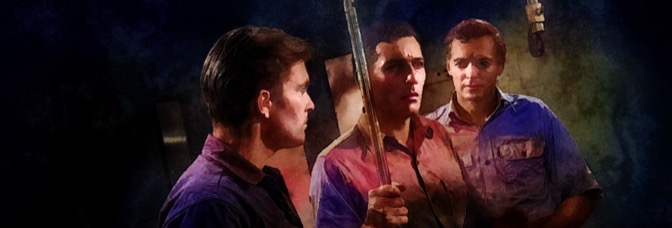
Night of the Blood Beast (1958, Bernard L. Kowalski)
Not to be overly pedantic, but the title should be Nights of the Blood Beast. While the “Blood Beast” part is a little complicated, the film does take place over a couple nights. Two Nights and Four Days of the Blood Beast. The Beast is a space monster. Maybe. It’s definitely a space creature, but it’s unclear if it’s a monster. It might just be misunderstood while having a very discomforting physical presence around the…

Attack of the Giant Leeches (1959, Bernard L. Kowalski)
Attack of the Giant Leeches stops more than ends. Some plot elements seem to go unresolved, but since the film never actually explains those stakes, maybe they don’t. Director Kowalski likes long lingering shots implying giant leech attacks, except there’s little distinction between ominous shots with leeches and those without. Since the characters never pay attention to the ominous spots, just the camera… no one, human or leech, can say. The film opens with redneck…
The Thomas Crown Affair (1968, Norman Jewison)
The first twenty-five minutes of The Thomas Crown Affair is a bank heist. Starting with its planning. After opening titles suggesting the film is about stars Steve McQueen and Faye Dunaway doing fashion advertising, we meet future wheelman Jack Weston. Weston gets hired by a mystery man to do a job. We jump forward in time and meet some other mystery men (including a baby Yaphet Kotto), along with McQueen. They're all getting in place…
Judgment at Nuremberg (1961, Stanley Kramer)
Insofar as it has a protagonist,Judgment at Nuremberg is the story of recently electorally defeated Maine judge Spencer Tracy. Tracy is the chief justice on a military tribunal hearing cases in the Nuremberg trials, the Allied attempt to hold the Germans accountable for their actions during World War II. Tracy's coming in towards the end of trials; the American public has lost interest, more enthusiastic about hating the Communist Russians than their enemies… the defeated…
The Fabulous Baker Boys (1989, Steve Kloves)
The Fabulous Baker Boys opens with pseudo-protagonist Jeff Bridges saying goodbye to his latest cocktail waitress one-night stand (always his decision, never hers–Baker Boys is all about taking advantage of patriarchal privilege). Under the opening titles, he walks to work. Baker Boys takes place in Seattle and regularly features its skyline, but director Kloves is careful never to show the Space Needle. Much like its characters, the film exists on the edge of reality. Bridges…
Tormented (1960, Bert I. Gordon)
Tormented is the story of how the world’s greatest jazz pianist (Richard Carlson) lost it all because he wasn’t a forty-eight-year-old virgin. I mean, also because he let his former lover, played by Juli Reding, fall to her death without trying to help her. Good thing they’re on an island where any peculiar death results in a ghost haunting. Hence, Reding can take her vengeance while also revealing Carlson’s skinny moral fiber. Carlson’s on the…
The Dark Past (1948, Rudolph Maté)
The Dark Past opens with a lengthy, confidently showy, and capable POV sequence. Lee J. Cobb is arriving at work, just like anyone–and the movie does a lengthy “peoples is peoples” bit–except he’s a police psychiatrist. It’s his job to save kids from becoming hardened criminals, thereby not being on the taxpayer dime. It’s progressive but not too progressive. Cobb’s not some wuss. Cobb is outstanding in the film. It’s a sometimes silly role with…
Zero Hour! (1957, Hall Bartlett)
Stop me if you’ve heard this one before: fighter pilot suffering PTSD boards an airplane in a last-ditch effort to salvage a bad relationship only for the plane to serve rotten fish, requiring this unstable pilot to fly the jet to safety. And there’s an exclamation point at the end of the title. No, it’s not Airplane!, it’s that film’s (still) unofficial source material–Zero Hour!. The difference being Hour plays it straight, instead of making…
Rebecca (1940, Alfred Hitchcock)
Rebecca opens with protagonist Joan Fontaine narrating, establishing the present action as a flashback—which is kind of important considering how much danger Fontaine will be in throughout. She’s got to make it since there’s the narration. Some of that danger is in Fontaine’s head. Or, at least, she sometimes apprehensive of the wrong person. Sort of. Rebecca is a passionate romance, a suspenseful thriller, and a reluctant character study. Fontaine’s nameless protagonist isn’t the one…
The Odd Couple (1968, Gene Saks)
Even when The Odd Couple plods, it never feels stagey, which is impressive since it’s from a stage play (Neil Simon adapted his own play), it mostly takes place in the same location, and many of those sequences are just stars Walter Matthau and Jack Lemmon following each other around and bickering. The one thing director Saks can do—the one thing he can reliably do—is not make the movie stagey. Thank goodness. While Saks doesn’t…
One-Percent Warrior (2023, Yamaguchi Yudai)
The One-Percent in One-Percent Warrior’s title does not refer to the super-rich, but rather when someone transcends in their film-related martial arts excellence. The majority of the film is just a forty-minute action sequence with star Sakaguchi Tak roaming around an abandoned zinc factory—on its own little CGI island—and kicking various butt. A lot of it is the same butt. It was in the second or third big beat-down I realized all of the bad…
The Moon (2023, Kim Yong-hwa)
The Moon runs about two hours, but it’s got enough story for eight. About the only way to tell all the story it’s got overflowing would be a miniseries remake. And even then, you could probably toss on another couple of episodes to even it all out. The film concerns South Korea’s second attempt at a moon landing. Their first attempt blew up five years before this one. Moon takes place in 2029, so the…
Dr. Cheon and the Lost Talisman (2023, Kim Seong-sik)
Until the third act, when it suddenly becomes clear the film never really had anywhere to go (at least not in this installment), Dr. Cheon is mostly delightful. Even the listless ending isn’t not entertaining, it’s just listless. After a magic-heavy dream sequence opening, Cheon settles into the gag–Gang Dong-won is a “doctor” who solves hauntings for his YouTube channel. Lee Dong-hwi plays his faithful sidekick, who does all the editing, takes the pay, doesn’t…
The Swiss Conspiracy (1975, Jack Arnold)
The Swiss Conspiracy opens with a lengthy title card and voice-over explaining—broadly—the Swiss banking system. Then, the movie’s opening titles, an absurdist, almost silly montage of Swiss postcards, set to composer Klaus Doldinger’s least funky music in the film. Doldinger’s score is always fun and cool (and often quite good), even when it doesn’t precisely match the onscreen action. Swiss is a budget-conscious, European location thriller. There are picturesque car chases, there’s even choreographed fisticuffs…
The Childe (2023, Park Hoon-jung)
For the first half or so, The Childe ostensibly has three lead characters. The protagonist is Kang Tae-ju; he’s a half-Korean, half-Filipino illegitimate son of a Korean rich guy. Life has sucked, leading to Kang becoming an underground boxing champ (which has so shockingly little to do with the movie it’s like they forgot it was a thing), which keeps him and Mom going, but then she gets sick. She needs an operation, so he…
Creature from the Haunted Sea (1961, Roger Corman)
If Creature from the Haunted Sea weren’t atrocious, it’d have to be fantastic. There’s no possible in between for the film, which is high concept, no budget. The film starts as a political spoof about Cuban generals fleeing the revolution with gold. They enlist the aid of gambling gangster Antony Carbone, who has a yacht. Carbone’s also got a wacky crew—Southern belle girlfriend Betsy Jones-Moreland, her goofy younger brother (Robert Bean), an undercover agent (Robert…
Devil’s Partner (1960, Charles R. Rondeau)
Devil’s Partner opens with an old man in his shack killing a goat to seal a deal with Old Scratch. The man’s arrangement is simple—his soul for two years. Wait, two years of what? Shh, watch the movie. We also never get to see any more of Old Scratch than his hand. It’s effective but given how well the movie does with the makeup—Ed Nelson plays the protagonist, the old man’s nephew, and puts on…
The Magnificent Fraud (1939, Robert Florey)
The Magnificent Fraud tells the unlikely tale of an actor on the run who just happens to be in the right place at the right time for the role of a lifetime. Akim Tamiroff’s stage actor’s enjoying a residency of sorts in San Cristobal’s hottest nightclub, one maybe owned by the president’s troubleshooter, Lloyd Nolan. We get to see Tamiroff do Cyrano, then Napoleon. The latter performance is a particular plot point because it’s where…
The Terror (1963, Roger Corman)
The Terror is not camp, which is bewildering, not just because it’d be better if it were camp, but because, based on its vitals, it seems like it can’t not be camp. The film stars Jack Nicholson as a Napoleonic officer—he does not attempt an accent, thank goodness—who gets involved with some supernatural goings-on involving a European noble (Boris Karloff), the single servant in his giant castle (Dick Miller), a witch (Dorothy Neumann), her sidekick…
Something went wrong. Please refresh the page and/or try again.
 The Stop Button