The Stop Button
blogging by Andrew Wickliffe
Category: 1978
-

Stop me if you’ve heard this one. A group of highly trained men takes over a state-of-the-art skyscraper. They are led by an enigmatic leader whose primary contact on the team is the computer wizard. They have rigged the roof to explode. They have thirty or so hostages on the thirtieth floor, and they are…
-

In a more modern context, The Con Caper and the Curse of Rava take on additional depth. First, there’s convicted state or federal senator (or congressman) William Smithers. He’s a white guy who once upon a time gave Black woman Chip Fields her first chance in the early seventies after she would’ve spent most of…
-

Bride of the Incredible Hulk is just the season two two-part opener, “Married,” as a theatrical release (for overseas). But it’s also a remarkably self-contained outing for Bill Bixby (and even more so for series costar Jack Colvin, who gets a single scene). The movie opens with Bixby arriving in Hawaii to consult with preeminent…
-

Night of the Clones and Escort to Danger is a strange way to watch a couple episodes of “The Amazing Spider-Man.” Without anywhere near enough episodes for syndication, the show’s producers packaged a couple episodes together so they would have TV movies for syndication. Well, TV movie length, anyway. Some of these duets would come…
-

Killer of Sheep is a series of vignettes, usually connected with a sequence at the slaughterhouse (though not always slaughter, but sometimes, so be ready), always connected with a piece of music. Sometimes the music recalls a previous scene or musical selection, creating a narrative echo between the sequences. And even though Sheep is incredibly…
-

I wasn’t expecting much from this issue; the team of writer Len Wein, penciller Marshall Rogers, and inker Dick Giordano hasn’t impressed in their one-and-a-fifth (they did a bookend on a reprint) issues of Detective so far. Wein’s writing a sequel to Rogers’s arc with Steve Englehart, trying to maintain continuity, like Batman hallucinating a…
-

When Steve Englehart started his Detective run, he quickly settled on a fascist, macho narration style to describe Batman and his male perfection. When Hugo Strange showed up and proved to be just as cut, the two men complimented each other’s physiques and prowesses, with Strange’s evil assistant lady making fun of them. At the…
-

Despite my youthful indiscretions in reading the famed Steve Englehart and Marshall Rogers, I had no idea what came after it. Turns out neither did DC at the time, since this issue’s got Len Wein, Rogers, and new inker Dick Giordano doing three new pages around a reprint from 1971. Batman and Commissioner Gordon go…
-
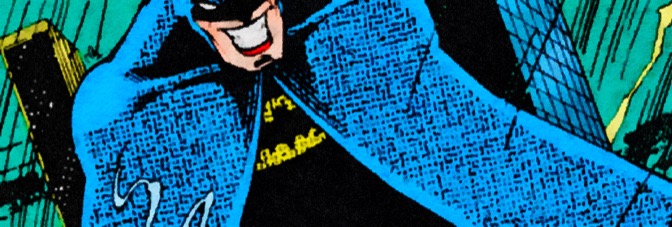
I either made a crack about Steve Englehart writing the narration for Detective Comics for the “Batman: The TV Show” announcer, or I thought about making the crack. This issue Englehart’s back at it, ad nauseam. Then Chief O’Hara shows up doing banter, and maybe it’s supposed to be a grim and gritty remake of…
-

So, reading this issue—the first of the Joker Laughing Fish two-parter—it’s clear why the comic’s got such an excellent reputation. Even with the utterly banal, fascist narration and Batman talking like a tool, it’s a great comic. Four things happen in the comic, all excellent for one reason or another. First, Batman goes to confront…
-

It’s half an excellent issue. The first story is a big success, an And Then There Were None type mystery set at a research hospital on Mercury. It’s the done-in-one feature. The second story’s a little shorter, but with the cliffhanger. Unfortunately, it’s also kind of bad. The writing’s not terrible, but the art falls…
-

Maybe I need to be more invested in the big villain reveal—it’s Mordru, who’s some kind of space wizard who the Legion always foils. He talks a lot and has no weaknesses other than being buried underground. Only four Legionnaires are left to take him on—Superboy, Karate Kid, Lightning Lad, and Saturn Girl. Last issue,…
-
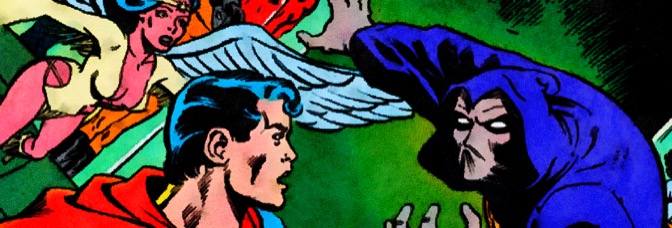
There’s no messing around here: writer Paul Levitz is doing a future sci-fi superhero war comic, which is one heck of a flex. He’s even doing it with Joes Staton and Giella art. The art’s nowhere near as bad as I thought it’d be when I saw Staton’s name; the layouts are fine. At their…
-
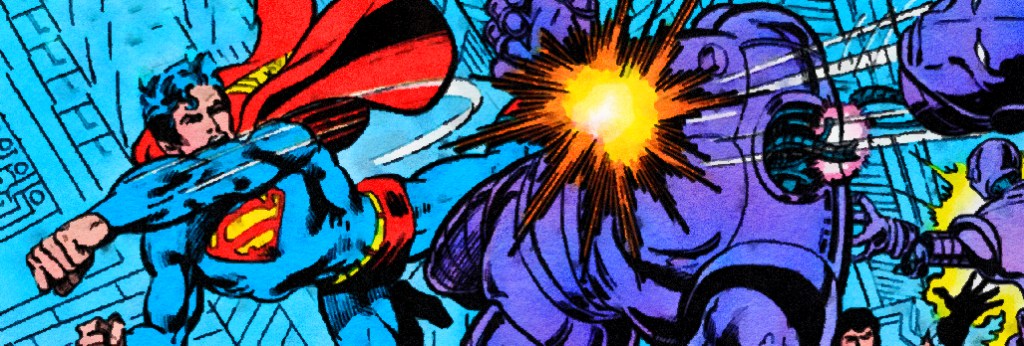
The issue opens with that female Science Police officer from a few issues ago thinking her way through an exposition dump. It’s Earthwar! Though they never call it Earthwar (one of the stories was called, Prelude to Earthwar). She’s been hanging out in Legion headquarters watching all the reports come in: Wildfire, Dawnstar, and supporting…
-

The feature opens with Legion leader Wildfire yelling at the “camera” about war. He’s actually yelling at the probably corrupt officials sabotaging a diplomatic conference, and Wildfire’s team is picking up the pieces after terror attacks. The last issue ended with Brainiac 5, off on another mission, saying war on Earth was imminent. They’re not…
-
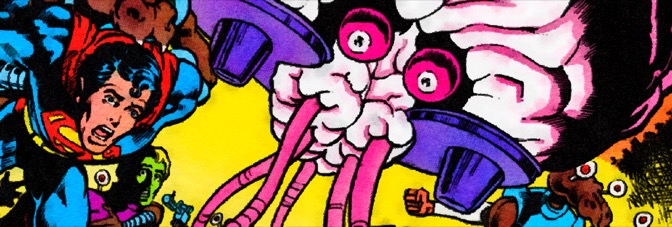
Writer Paul Levitz’s A, B, and C plot structuring from Legion of Super-Heroes is famously good, so I’m really hoping what he’s doing in this issue is figuring that system out. The feature story starts with one plot—Mon-El and Wildfire leading a diplomatic mission—switches over to another with Brainiac 5 and Superboy—while both teams ignore…
-
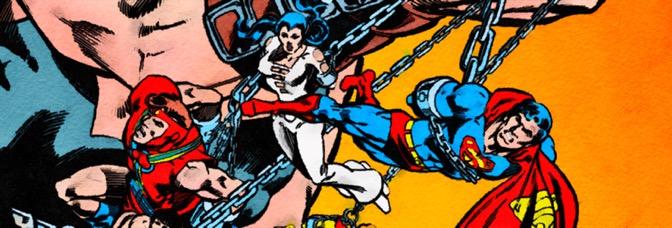
So Howard Chaykin doing layouts of a teen superhero book without being pervy. All the dudes look about forty-five. It’s hilarious. It’s not good, but it’s hilarious. There’s only one female Legionnaire in the story—Phantom Girl—who’s not as scantily clad as Cosmic Boy, so not the salacious Chaykin one might expect. Also, he’s just doing…
-
I went into this issue doubly hesitant because it’s about Ultra Boy being framed for murdering his ex-girlfriend, An Ryd, and I avoid Ayn Rand fans. Maybe it’s just the letters; maybe there’s no connection. Or just a name familiarity one. The character’s barely in the comic, just long enough to double-cross Ultra Boy and…
-

This issue reprints a couple Adventure Comics from 1967, written by a sixteen-year-old Jim Shooter, proving he was better at writing comics in his teens than in his thirties. Though I’m sure there’s an abundance of evidence on that one. Shooter also does the layouts, with Curt Swan penciling and George Klein inking. The art…
-

This issue is weird. The story’s weird, and the issue’s weird. The story’s weird because it’s about the Legion committing numerous intergalactic crimes because their financial benefactor is in danger. The issue’s weird because, well, the art is… lacking. And the art’s from Walt Simonson and Jack Abel. I’m not the most well-read on Simonson,…
-

The cover promises an “epic-length novel,” which apparently works out to sixty-one pages. It’s four chapters, starting with Superboy traveling to the future for Saturn Girl and Lightning Lad’s wedding. Once there, he discovers a militaristic world where the Legion (and the U.S.) is fighting moon colonists, led by the Chinese. We find out later…
-
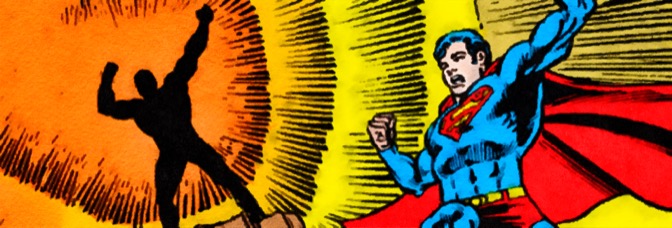
Who’s James Sherman, and why have I never heard of him before? He pencils two of the three stories in the issue, with Bob McLeod inking him on the first, Joe Rubinstein on the second, and he’s good. He’s a little too designed-focused, but more on the second story, and the design element comes from…
-

This issue’s got two stories, benefits of being a fifty-two-page giant on the regular. The first story’s by Paul Levitz, Mike Grell, and Vince Colletta. Colletta also inks the second story, but the rest of the team’s different; second story is Gerry Conway and George Tuska. The comic itself is basically burying the lede—Conway’s second…
-

Griffu has all the trappings of hard-boiled detective fiction–a reluctant “hero,” in this case the titular Griffu, whose not a private investigator but a “legal advisor” (read, apparently, debt collector), a femme fatale (or three), and an intricate plot line involving corruption and class—only set in seventies Paris. And, of course, there’s the omnipresent narration.…
-

There are three different things going on throughout The Buddy Holly Story. Well, more than three but there are the three big different things. There’s Robert Gittler’s screenplay, which has one narrative gesture for most of the film. There’s Gary Busey’s lead performance, which is resolute in both its sincerity and its anti-inscrutability. And there’s…
-

What a Nightmare, Charlie Brown! is not about Charlie Brown (Liam Martin) having a nightmare. He does get told, eventually, about a nightmare, but he’s only in the special at the beginning and the end. He gets the bright idea to play “sled dog” with Snoopy and have Snoopy lead him around like they’re in…
-

It was until after The Cheap Detective was over I realized there’s never anything about Peter Falk’s fee. It’s not clear whether he’s cheap or not. It’s never addressed. It’s one of the many things Neil Simon’s screenplay never gets around to addressing, like if the third act is all a scheme or if it’s…
-

It’s incredible Tooth Brushing only runs five minutes. The cartoon (an educational short produced for the American Dental Association) starts innocuously enough. Charlie Brown gets out of the dentist, heads home to try out his new brush and other dentist goodies–he’s also got fresh instructions from the dentist. He runs into Snoopy, then he runs…
-

Somewhat recently I read an observation along the following lines–Ingmar Bergman created great roles for actresses by giving them absolutely awful emotions to essay. Whoever said it (I’ve tried, without success to properly credit her) said it a lot better. But at around the hour mark of Autumn Sonata, I couldn’t think of much else.…
-

The extended version of Superman runs three hours and eight minutes, approximately forty-five minutes longer than the theatrical version (Richard Donner’s director’s cut only runs eight minutes longer than the theatrical). The extended version opens with a disclaimer: the producers prepared this version of the film for television broadcasts (three hours plus means two nights).…
 The Stop Button