The Stop Button
blogging by Andrew Wickliffe
Category: 1972
-
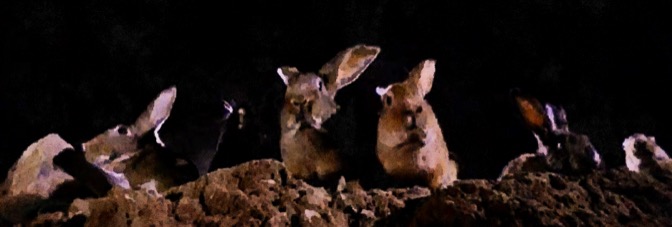
Night of the Lepus is about giant bunny rabbits. The movie’s got lousy special effects. The composite shots of regular-sized bunny rabbits blown up to giant-ish size are bad, but the life-size giant killer bunny rabbit arms and body parts—only used for rapid-cut action sequences—are worse. When they have the bunny rabbits run around on…
-

“Liza with a Z” closes with a Cabaret medley, including Liza Minnelli playing the Emcee for a couple songs. She starts in the audience, a la the “Cabaret” Broadway revival (only twenty-six years before), and quickly works her way onto the stage, joined by dancers, and does a whirlwind ten-minute set. The opening titles tell…
-

Blacula gets by on novelty and hero Thalmus Rasulala’s effortless charm. Rasulala is a medical examiner with the LAPD; the movie’s got a hilariously silly name for the job and department; it just means he gets to go around and flash an ID card and get things done. He’s also the only Black cop in…
-

Oh, good grief. When I complained ad nauseam about Archie Goodwin’s writing, it didn’t occur to me Marvel would’ve found someone worse to do an issue. Gardner Fox scripts this issue, and, yikes, is it a bad script. While not every line of dialogue has fifty percent exposition—Frank Drake mentions Dracula’s ancestor every time he…
-

I was so ready to cut Archie Goodwin some slack on this issue’s script. Not just at the beginning, but even halfway through when the dialogue’s at least terse, so not overly wordy. Only then Goodwin starts leaning in on the second-person narration, not for human protagonist Frank Drake. No, Goodwin does the second-person narration…
-

This issue has Tom Palmer inking Gene Colan, so there’s very little one can actually complain about. Just observe. Archie Goodwin’s the writer; he employs the second-person narration to lesser effect than the previous writers. His dialogue’s overwrought even for a seventies Marvel comic, and then his exposition suggests he had a thesaurus on hand.…
-
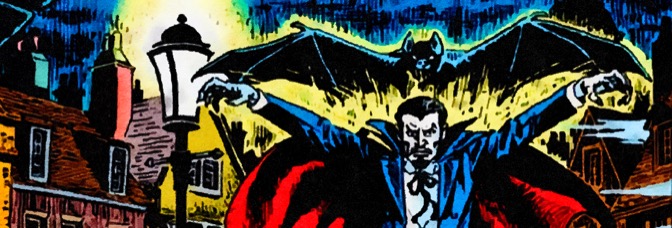
It’s another exquisite issue, thanks to Gene Colan’s pencils. He’s got Vince Colletta inking, but it doesn’t detract. Colan’s so good he even makes the last issue recap page work well, as protagonist Frank Drake (anglicized from Dracula) remembers how he got into his current predicament. This issue follows Drake from Transylvania back to England;…
-

I’m sure there’s a difference between a Gene Colan comic book and a Gene Colan art portfolio but damned if they don’t seem identical. Gerry Conway scripts this issue (from a Roy Thomas plot–according to Thomas), and there’s just the right amount of moody in the text to go with the Colan art. It’s perfect…
-

Frank Chiaramonte inks the Ploog this issue, resulting in some really good art, but not the sublime standard Ploog’s set doing his own inks. It seems like Chiaramonte takes over a few pages into the comic; after a while, the faces lose that Ploog character. The expressiveness. Or maybe, since it’s eventually just the villain,…
-

Werewolf by Night’s got a cliffhanger to resolve at the beginning of its first issue, which is awkward. Especially since writer Gerry Conway’s going to take so many shortcuts. He’s in a race to resolve everything, concluding in a breakneck single-page wrap-up, and he never gets a chance to setup Werewolf as its own book.…
-

The issue opens with a splash page of Jack Russell, in his hip seventies clothes, waking from a nightmare about being the Werewolf by Night (unsure if it’s a nightmare or a werewolf outing), and it’s somehow obvious the art this issue’s going to be superior. In that one page, artist Mike Ploog gets in…
-
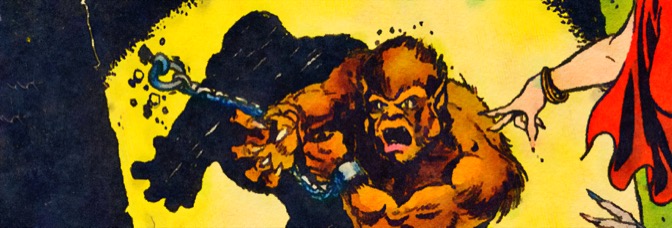
There is no backup story in this issue, just Jack Russell’s third adventure as Werewolf by Night. Writer Gerry Conway—through Jack and the werewolf’s narration—is very clear about it; the first outing as the werewolf was two months ago, meaning we’re skipping Jack’s second Larry Talboting and going straight to the third. There’s not much…
-

From the first page, it’s clear there’s going to be something special about Werewolf by Night. The narration tells us we’re in modern Los Angeles, but artist Mike Ploog visualizes it like an old Universal horror movie set. The architecture, anyway; the accruements are all modern. The page has three panels; the first two have…
-

Snoopy, Come Home’s parts are better than their sum. The film’s a number of vignettes, usually set to music, sometimes with songs. Sometimes there’s connective material between the vignettes, sometimes the circus shows up, and it’s time for a new scene. Also, sometimes, the vignettes have a rough cut between them. Not too rough, there’s…
-

The first act of Cabaret is about introducing British guy Michael York to Weimar-era Berlin and to the life and times of his neighbor Liza Minnelli. Minnelli’s an American ex-pat; she’s landed in a cabaret and is trying to sing, dance, and sleep her way into movies. York’s there to teach English and get some…
-
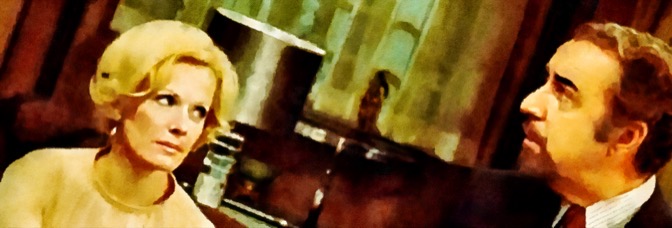
Buñuel arranges The Discreet Charm of the Bourgeoisie as a series of vignettes. Occasionally there will be a surreal bridging device—the cast walking in search of a meal on a highway in the country—sometimes it will turn out to be a dream, sometimes it will be another layer (a narrated flashback, a dream-in-a-dream), sometimes it…
-

I’ve been aware of the “Barbara (Batgirl) Gordon becomes a congressperson” storyline in the seventies since Who’s Who in the DC Universe #2 in 1985—I even have an anecdote about buying the issue at age seven—but I’ve never read the arc before or even read about its details. And now I’ve read it. And it’s…
-
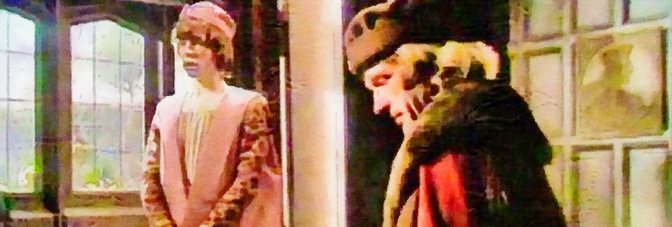
This episode is a direct continuation of the last, but from James Maxwell’s king’s perspective. At least at the start, tragedies quickly start changing it up and Queen Norma West ends up with the most to do… then the episode brings Maxwell in and gives them a joint focus, then it shifts to Maxwell for…
-

I really had no idea how far “Shadow” could drop, did I? I mean, The Fledgling manages to be the worst episode of the series (with only one left) and with Richard Warwick in it but nowhere near the worst part. Though, to be fair, Warwick is in a much reduced role compared to the…
-

Oh, no, Richard Warwick is back. And now we’re getting the story of his time just imprisoned, because the king (James Maxwell) pities him so won’t just execute him. Executing him means taking him seriously as a threat to the crown and Warwick can’t be seen as a threat. And so on and so forth.…
-

I was unprepared for The Man Who Never Was, even acknowledging the anthology nature of the show, which has had great successes, could also have great failures. And the episode is most definitely a failure. But because of casting. It’s a strange episode in general—lots of flashbacks, lots of seventies sly “oh, maybe he likes…
-

Continuing the hit streak is this episode, Do the Sheep Sin?, which has King James Maxwell dealing with a protest march. He’s been taxing the hell out of the poor, albeit somewhat unintentionally (he thought he was taxing the rich, they just put it on to the poor), and the poor decide they’re going to…
-

I can’t say if this episode, The Princely Gift, is better than the previous episode, which was the comedy. Gift is about a Venetian navigator, played by Londoner Derek Smith with an accent you’d think was a little strong even in 1972. He’s working with these three businessmen from Bristol who want to do an…
-

“In the Shadow of the Tower” has been getting really good, but it hasn’t done anything like A Fly in the Ointment in the ointment before. When I grokked the format—different directors, different writers, maybe not everything from King James Maxwell’s perspective (though tellingly zilch so far from Queen Norma West’s perspective), I was kind…
-

The episode starts with guys conspiring to overthrow Henry VII (Robert Maxwell) with the help of foreign money and a pretender king… in other words, “In the Shadow of the Tower” feels like itself again. If itself again means it feels more like the first three episodes than the two before this episode. It’s actually…
-
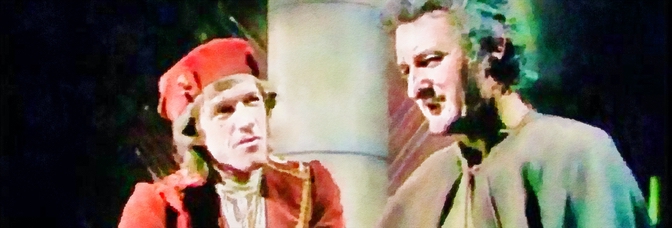
This episode is peculiar. It has a new writer, new director, same production design, same King (James Maxwell), but in this episode, Maxwell’s end credit is just as “The King,” not “King Henry VII.” Because it doesn’t matter who he is. He doesn’t need to be the king. He could just as easily be Pontius…
-
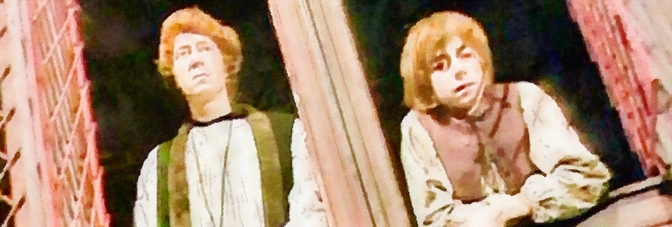
This episode has a different director, Prudence Fitzgerald, and a different writer, Brian Rawlinson, than the first three episodes, which explains a lot of the stylistic differences. Rawlinson being a guy might also explain why Henry (James Maxwell) is cruel in a very different way than he ever has been before. It’s like Rawlinson can’t…
-

So the last episode ended with the Queen (Norma West) giving birth to a son, making the King (James Maxwell) feel more secure in his reign. Because now he had an heir and something something. British royalty nonsense. But Maxwell was overjoyed about it to the point it was disturbing to think about the actual…
-

This episode tells a loser’s story. He played the game of thrones and he lost. The loser in question is Humphrey Stafford; real guy, wikipedia page and everything, played by Maurice Roëves. Roëves is awesome. He also gets to give more personality to Stafford than anyone else in the episode gets near. Sure, it’s not…
-
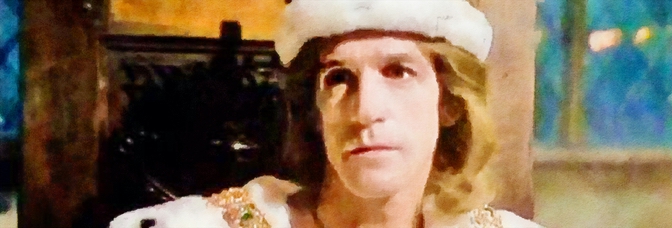
In 2019, some forty-seven years since its first airing, “The Shadow of the Tower” feels like “Game of Thrones” without blood, booze, boobs, rape, battle scenes, dragons, prominent female characters, butts, zombies, and CGI. Oh, but it does have historical accuracy. There’s something really interesting seeing this “game of thrones,” specifically King Henry VII’s game…
 The Stop Button