Category: 1965
-
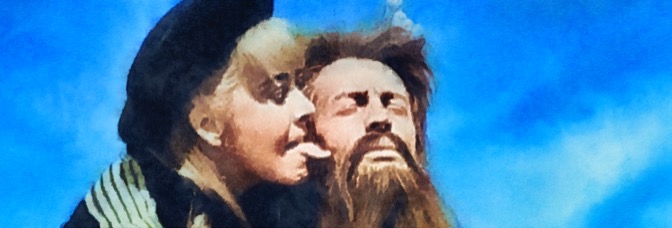
Simon of the Desert opens with the title character, played by Claudio Brook, getting a new pillar after six years on his first(?) one. He’s a priest doing penance (just general penance) and living his life in prayer atop a pillar, eating nothing but lettuce, drinking nothing but water, and a local rich guy appreciates…
-

Harold Pinter television play about a successful toilet manufacturer (Leo McKern) and his eventual downfall due to jealousy and lust. Jealousy is with wife Jennifer Wright (who’s barely in it) and her… brother(?) Charles Gray, who McKern tries manipulating. Lust is secretary Vivien Merchant, who rather encourages him. Or does she… is it all in…
-

Singular Shakespeare adaptation from Welles. Based on Shakespeare’s HENRY plays, focusing on the Falstaff character (played by Welles), the film tracks the boisterous relationship between Falstaff and Prince Hal (someday Henry V), played by Keith Baxter. Henry IV (John Gielgud) strongly disapproves of the friendship, which distracts Baxter from warring like pretender-to-the-throne Norman Rodway. Truly…
-

So much of The Sound of Music is exquisite, the film’s got enough momentum to get over the rough spots. The film has three and a half distinct sections. There’s the first, introducing Julie Andrews to the audience, then introducing Christopher Plummer and family to the Andrews and the audience, which then becomes about Andrews…
-

When Doctor Zhivago got to its intermission, I assumed director Lean would keep things moving as fast in the second half as he did in the first. These expectations were all high melodrama. Instead, the post-intermission section of Zhivago feels utterly detached from the first, even though there are a lot of returning faces. But…
-

At around the seventy minute mark, Repulsion finally gives Catherine Deneuve some personality. Sure, she’s gone completely insane at this point, but she sings a little lullaby to herself. And Deneuve is in at least sixty-five of those seventy minutes without any personality (she loses it again soon after). She is the subject of the…
-
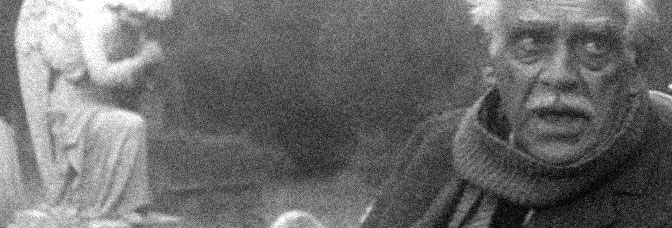
For the first three quarters of Die, Monster, Die!, the biggest mystery in the film is how wheelchair-bound Boris Karloff gets around so well. The lifts become visible in the last act. Karloff’s British upper crust whose family name has fallen on hard times thanks to an embarrassing father. Satanic ritual embarrassing, not hounding the…
-

Two things stick out in “A Charlie Brown Christmas”. First, Charlie Brown is a bit of a drag. Charles M. Schulz, writing the script, initially sets up Charlie Brown as the Scrooge of “Christmas”. While that condition changes a little–eventually, Charlie Brown is the victim of the rest of the Peanuts gang–it’s a disconcerting opening.…
-

So… Godzilla dances in Invasion of Astro-Monster. He also boxes a little. Unfortunately, the boxing part does little to liven up the last half, which is incredibly tiring. The dancing comes earlier—though not by much, but enough to “help.” Godzilla doesn’t appear in the film until the middle mark. Instead, the film’s about astronauts Nick…
-
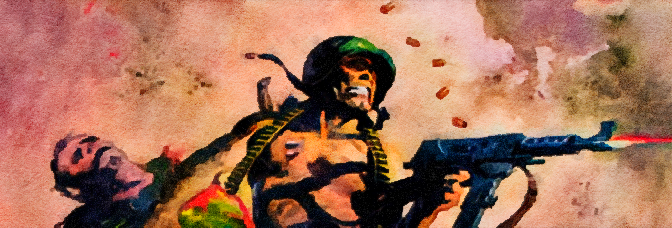
In seven stories–from the Revolutionary War to the burgeoning Vietnam conflict–there isn’t a single moment of humor. Goodwin doesn’t give the reader a single moment to forget he or she is reading a war comic. There’s so little humor, it’s got to be intentional. If Goodwin had just been writing loose, someone would make a…
-

Thunderball is real boring. The problem is two-fold. First, the opening is heavy. After the pre-title bit (which is goofy with the jetpack), it’s a pseudo-Hitchcock, with Connery off in a spa. He sees strange things going on and gradually romances his masseuse. Intercut with these scenes are the bad guys preparing to do their…
-
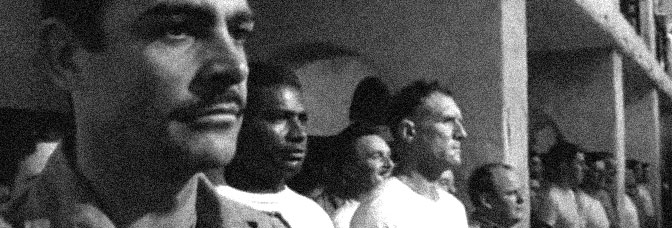
The Hill is quite a few things–Sidney Lumet doing another stage adaptation, almost in real time, a la Twelve Angry Men, a prison drama, a race drama, a military drama, and an example of a decent Sean Connery performance (not a particularly good one, but a decent one). It’s incredibly contrived–desert British prison camp in…
-

Mickey One is what happens when you mix an American attempt at French New Wave and a director (Arthur Penn) experienced in television directing. Arthur Penn did eventually shed those old TV trappings, but certainly not at this point in his career. He’s got lots of shots in Mickey One–its editing is so frantic and…
-

In addition to being the first film of Andrew V. McLaglen’s I’ve seen (which is quite an achievement, considering how much he directed), Shenendoah is the first film I’ve seen where James Stewart plays the patriarch. Unless Mr. Hobbs Takes a Vacation counts and I don’t think it does, not like Shenendoah. The film sets…
-

Formulaic WWII thriller about Norwegian resistance fighters Kirk Douglas and Richard Harris infiltrating a Nazi base to stop them from developing the A-bomb first. Lots of good cross-country skiing footage, lots of reused war footage. Douglas doesn’t act very much in the first half, just gropes every woman in sight. Meanwhile Harris, who’s good in…
-

Okay WWII spy thriller about the Nazis capturing a D-Day planner (James Garner) days before the offensive. They only have… well, longer than thirty-six hours but ostensibly thirty-six hours to crack him. Their plan? Have shrink Rod Taylor convince Garner he’s had amnesia for six years. The first hour’s Taylor’s, which is good because he…
 The Stop Button