Category: 1946
-

The Hoodlum Saint is a surprisingly long ninety-four minutes, though since it takes place over eleven years (at least), I suppose some plodding is to be expected. There’s plenty not to be expected about Hoodlum Saint, starting with the time period. It begins in 1919, with a fifty-four-year-old William Powell returning from the Great War…
-

In the third act of Notorious, director Hitchcock and screenwriter Ben Hecht (who had some uncredited and quite exquisite help) figure out a way to get maximal drama out of a rather mundane situation. Well, mundane as far as the possibilities of American agents in Rio de Janeiro (with the permission of the government) trying…
-

Superior short subject tracking the life of popular European clown Beby; he’s in his late sixties, the world is in the late forties and not so interested in the circus anymore. Seemingly starts with a melancholic take, gives way to something quite different and special. DVD, Blu-ray.Continue reading →
-

A lot goes unspoken in The Big Sleep. It’s very much set in a wartime Los Angeles, but there’s never much said about wartime conditions or Los Angeles. When private detective Humphrey Bogart goes around the city, investigating, he’s only ever encountering women (beautiful women at that, because director Hawks’s Los Angeles is solely populated…
-

If it weren’t for the first half of the film, The Best Years of Our Lives would be a series of vingettes. The film runs almost three hours. Almost exactly the first half is set over two days. The remainder is set over a couple months. Director Wyler and screenwriter Robert E. Sherwood don’t really…
-

Overlong confused (not confusing) thriller about newlyweds Katharine Hepburn and Robert Taylor. Taylor seems too good to be true, except he flies into a rage whenever his missing, saintly brother is mentioned. So Hepburn starts investigating, just without much interest. There’s a real disconnect between Minnelli’s direction and Edward Chodorov’s script. Minnelli does all right…
-

The first thirty-nine percent of Never Say Goodbye is phenomenally paced. It could be a short movie, if there were a little tragedy through in. A little melodrama. Seven year-old Patti Brady is moving back in with mom Eleanor Parker after living six months with dad Errol Flynn. They’re divorced. Flynn’s a successful cheesecake pinup…
-

It’s a Wonderful Life is going to be a tough one. When I was a kid, during the public domain days, Wonderful Life was omnipresent. It became a joke because of that omnipresence. But also because it’s undeniably sappy. And it has angels in it. It’s so saccharine, I didn’t even notice my eyes tear…
-

The Strange Woman opens with Dennis Hoey as a drunken widower and Jo Ann Marlowe as his evil little daughter. Herb Meadow's script is real bad in this opening, but it's nineteenth century kids playing and one of them is a psychopath, how good is the script going to be? But then it jumps forward…
-

Bedlam is about a third of a good picture. It’s like writers Val Lewton and (director too) Robson didn’t quite know how to make it work, what with having to have Boris Karloff in it. Karloff’s the villain, the head of a mental institute in the eighteenth century. Karloff’s so evil–and surrounded by so many…
-
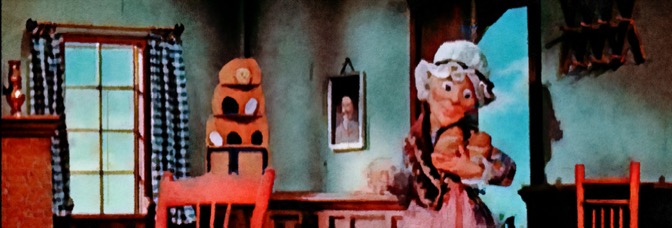
The Storybook Review consists of four nursery rhymes told in stop motion animation. Director and animator Ray Harryhausen has a varying degree of success with the four, usually due to storytelling. For example, the Mother Hubbard entry goes on way too long even though it’s shortened from the original. Some of the problem is the…
-
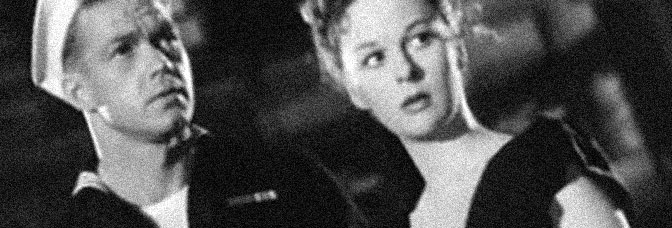
Given all the excellent components, Deadline at Dawn ought to be a lot better. It has a compelling plot–a naive sailor and erstwhile murder suspect (Bill Williams) has to solve the crime before he ships out, but he’s just met a city hardened girl (Susan Hayward) and crushing on her and she’s warming to him–and…
-

Is that Porky Pig cameoing in The Great Piggy Bank Robbery? I kept expecting him to be revealed as the big villain. The story concerns Daffy Duck getting clomped on the head and imagining himself in a Dick Tracy adventure. Now, for Tracy fans, there’s a lot to see, including some inventive takes on the…
-
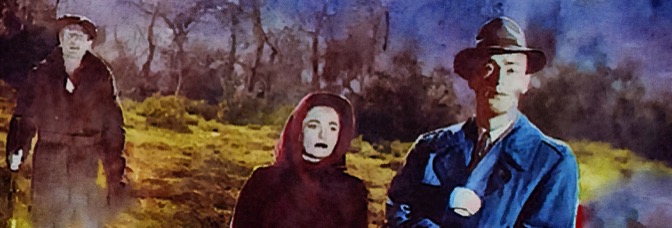
Pichel does such a good job with the majority of O.S.S., it’s a surprise how ineptly he handles the jingoistic last scene. It’s a WWII patriotism picture (is there a proper term for this genre?), so that last scene is requisite, but Pichel could have at least made it work. Instead, he hangs the film…
-
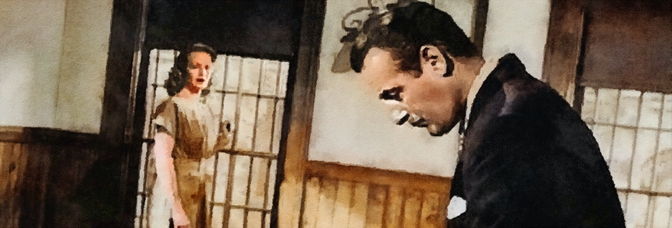
If you took a film noir and removed the noir, you might have something like Criminal Court. The plot is noir. An upstanding attorney (Tom Conway) accidentally kills mobster (Robert Armstrong) and runs off, unknowingly leaving his girlfriend (Martha O’Driscoll) to take the wrap. What does Conway do? Does he try to falsify evidence to…
-

Canyon Passage starts out strange. Dana Andrews shows up in 1850s Portland (Oregon) and, after some character establishing, fends off someone breaking into his room. It got me thinking later if the unseen event leading up to the intruder is actually the film’s dramatic vehicle, the event setting off the action. Because Canyon Passage is…
-
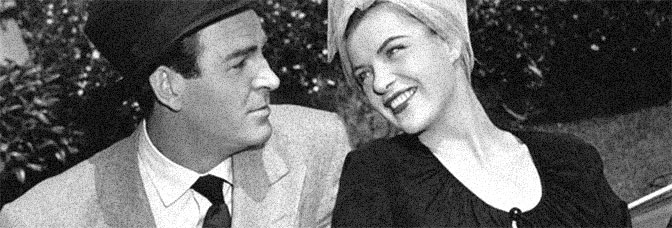
It takes a while for The Runaround to get started… actually, I suppose it’d more accurate to say it stalls out after the first fifteen minutes, then takes another twenty or so to get started again. The film starts out strong with Frank McHugh in a sidekick role–McHugh’s perfect in that role–and lead Rod Cameron…
-

Spectacular adaptation of W. Somerset Maugham novel about WWI vet Tyrone Power trying to fit into the world after the War, whether it’s with too rich for him (but still madly in love with him) girlfriend Gene Tierney, good friend Anne Baxter, or erudite author Herbert Marshall (playing Maugham). Power travels the globe trying to…
-

Slow-moving (but nothing compared to the W. Somerset Maugham source novel) and quite good adaptation about existentially miserable Paul Henreid, who–despite becoming a medical doctor–can’t get over his club foot, which sets him on a course of self-destruction involving a common waitress, played by Eleanor Parker. Phenomenal performance from Parker, good one from Henreid, great…
-

Okay but overlong noir has insurance investigator Edmond O’Brien sure there’s more to his claim involving Burt Lancaster, Ava Gardner, and Albert Dekker. Flashbacks galore don’t add up to a good character arc for anyone involved. Ostensibly based on the Hemingway short story, but not really. DVD, Blu-ray, Streaming.Continue reading →
 The Stop Button