Category: 1944
-

The Suspect is the unlikely tale of middle aged shopkeeper Charles Laughton, who forms a friendship with a young woman in need (Ella Raines), which gets him in trouble with his wife, Rosalind Ivan. There are complications—the film’s established Ivan has been a horrible wife to Laughton and a bad mother to their son, Dean…
-

When Leon Errol saves lead Jon Hall from drowning, even though they’ve previously established The Invisible Man’s Revenge takes place in England, I was sure they’d teleported to Australia. Errol is very Australian. Openly Australian. He’s also the closest thing to amusing as Revenge gets. Despite being the fourth in the series, starring the same…
-

Bogart meets Bacall in the 1940 Caribbean; he’s an old ex-pat fishing boat captaining and trying to keep his head down in Vichy-controlled territory, she’s a young ex-pat more concerned with getting out of where she’s been than where she’s going. The star wattage on Bacall–everyone just sits and watches her, Bogart grinning by the…
-

Constantly disappointing light comedy about turn of the twentieth century newspaperman Dick Powell getting tomorrow’s headlines today and trying to use it to his best advantage, initially involving his wooing of magic act assistant Linda Darnell. Unfortunately Darnell’s barely relevant to the actual plotting… heck, Powell’s often just along for the ride–Jack Oakie, in a…
-

Experiment Perilous is a strange film. Not the plot–well, some of how the plot is handled–but the strangeness comes from the result of how the film is executed. It’s a Gothic family drama set in twentieth century New York City without a lot of the family. There’s a flashback sequence, but Perilous is rather modestly…
-

The Lodger begins four murders into the Jack the Ripper killings (the film actually goes over the historical number but also makes some rather liberal changes to the history). Just after a murder occurs, which seems a rather unfortunate event since the victim passes a number of police officers and even a vigilante gang, a…
-

At the end of Gaslight, when all has seemingly been revealed, there’s only one question left. If Scotland Yard inspector Joseph Cotten isn’t an American in London, why doesn’t anyone notice his lack of accent. It’s a wise choice not to give Cotten an accent–presumably he couldn’t do one–but it also means there’s always something…
-
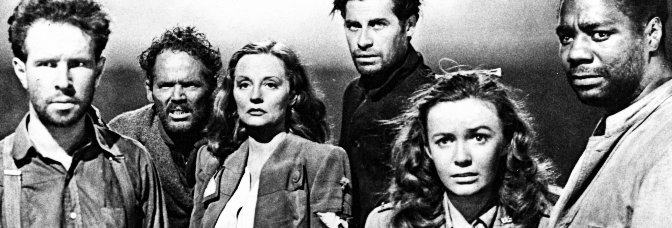
Lifeboat never feels stagy, which is one of the film’s greatest successes. The entire thing takes place in a single lifeboat, with director Hitchcock not doing many medium or long shots of the lifeboat exterior. All the action is with the actors, Hitchcock using distinctive composition–Glen MacWilliams’s glorious photography helping quite a bit, of course–to…
-

Double Indemnity is mostly a character study. There’s the noir framing device–wounded insurance salesman Fred MacMurray stumbling into his office and recording his confession on a dictaphone. Turns out he met a woman and things didn’t work out. MacMurray narrates the entire film. Occasionally the action returns to him sitting in the office, bleeding out.…
-

Even though Give Us the Moon ends up going exactly where I expected it to go, the film’s not predictable at all. It opens with Peter Graves’s post-war layabout. He was a war hero, his father (Frank Cellier) is a rich hotelier, he wants to do nothing with his life except enjoy it. Through coincidence,…
-
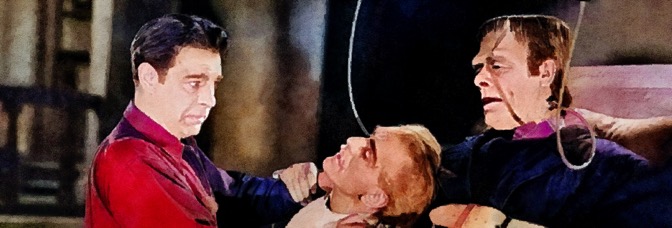
Just over half of House of Frankenstein is glorious. Kenton’s direction is outstanding, the sets are imaginative, the actors are doing great. Beautiful photography from George Robinson. House is a scary movie, what with physically but downright evil Boris Karloff running the proceedings. What doesn’t work–like John Carradine’s “just okay” Dracula–gets smoothed out by unexpected…
-

Murder, My Sweet takes a peculiar approach to the detective story. Lead Dick Powell graciously lets everyone overshadow him in scenes; he doesn’t exactly fumble his way through his investigation, but he does befuddle his way through it. He’s the audience’s point of entry into the mystery and he’s just as confused as anyone else.…
-

Laura is a film with multiple twists and a brilliant screenplay by Jay Dratler, Samuel Hoffenstein and Elizabeth Reinhardt but none of it would work without Preminger’s direction of his cast. Preminger’s direction, in terms of composition, is fantastic. Thanks in no small part to cinematographer Joseph LaShelle, every moment of Laura looks wonderful. Preminger…
-

Russian Rhapsody is a strange–and very funny–cartoon. First, as a historical document, it's a Hollywood cartoon mocking Hitler (before the end of the war and the extent of his atrocities became clear). In Rhapsody, he's an obnoxious windbag and there are a bunch of good jokes at his expense. But once the first act is…
-

The Curse of the Cat People is apparently Kent Smith. Well, him and writer DeWitt Bodeen. Smith and Jane Randolph return from the first film, this one set over six years later. They have a daughter–Ann Carter in an almost perfect performance–who’s a lonely child. She eventually imagines herself a friend, personified by Simone Simon…
-

It’s hard to find anything good about Enter Arsene Lupin. Ella Raines isn’t as bad as the other primary cast members, though she’s not as good as some of the bit players. The film does hold some historical value both in the use of the Universal European backlot set for England–apparently, 1944 London looks a…
-

Mademoiselle Fifi is split down the center, roughly, into two parts. The first involves Simone Simon on the trip to her hometown. The second is when she reaches the town. The film takes place in occupied France during the Franco-Prussian War, but it opens with a title card presenting it as an analogue to World…
-

Screwball Squirrel opens with the protagonist mocking a Disney-like cartoon squirrel and sending him packing. The Disney-like squirrel sounds and looks enough like Thumper from Bambi I forgot Thumper was a rabbit. This moment establishes the cartoon—because the protagonist, the never named Screwy Squirrel, is mocking the cute squirrel to the audience. Avery doesn’t do…
-

The Mummy’s Curse feels like a Universal attempt at a Val Lewton picture. It’s from 1944, so Lewton’s modern horror pictures had already come out. It’s hard to believe Universal changed their approach to monster movies so radically between this picture and the previous Mummy entry. Curse is set on the bayou in Louisiana (Lewton…
-

The Mummy’s Ghost is, with a couple problems, really good for a monster movie (and leagues ahead of Universal’s other 1940s Mummy features). It’s not so much about the Mummy as the victims and the investigation (but the police investigation, not the scientific–and everyone believes in mummies walking around animate, so there’s no convincing to…
-

Arsenic and Old Lace has to be one of the finest–if not the finest–film adaptations of a stage production. Nothing about the film, save the knowledge it’s from a play, suggests its theatrical origins… not the one night present action, not the one set. It’s an ideal motion picture comedy, down to what has to…
-

It’s hard to know how Youth Runs Wild was supposed to turn out. RKO took it away from producer Val Lewton–the State Department was concerned the film would be detrimental to morale–but they were over his shoulder the entire time. The question is whether Youth Runs Wild was ever anything but silly propaganda. It’s a…
-
Though Hotel Reserve is a British production of a continental story (in other words, British actors playing French and Germans), it does have a certain flare to the visual. It’s a spy thriller set in the south of France with lots of models standing in for buildings and lots of sets. It very often looks…
-
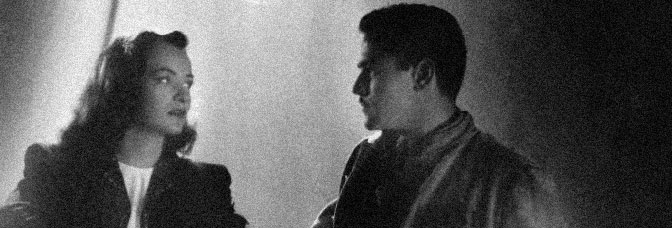
There’s a distinct, definite brilliance to Siodmak’s direction. The film itself is unique in casting a woman as the hero in a film noir, essentially Bogart in The Maltese Falcon, while maintaining her as female. Ella Raines’s boss (played, in the film’s only mediocre performance, by Alan Curtis) is falsely convicted, due to perjury. Raines…
-

There are a handful of “Sturges moments” in The Great Moment. I suppose I’d define those moments as the ones where the predictable or familiar filmic device transcends artifice (even if it’s as artificial as the text a character is reading appearing on the screen for the viewer to read as well) and becomes… ideal.…
-

I’m a fan of Warner Bros.’s old hour-long b-movies, so I found The Last Ride particularly distressing. It’s not poorly directed–Lederman even has one or two really good shots–and the writing, at least scenically, isn’t bad. There are some funny moments and the teaser is excellent. It all falls apart pretty quickly, however (it is…
-

Jerome Cowan’s detective in Crime by Night slides through the film soaked in bourbon. While the film’s mystery isn’t a bad one, perfect for a seventy minute running time, the suggestions of off-screen actions are a lot more fun to think about. The detective, with his love interest secretary along (played well by Jane Wyman,…
-
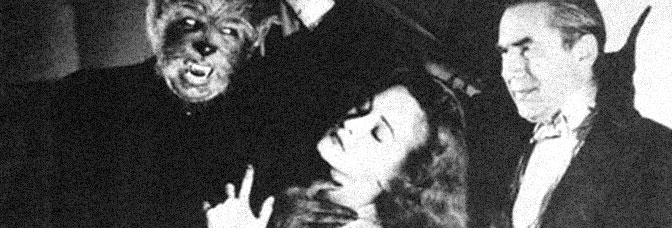
The Universal monster movies notably ignored modern events–when World War II came around, the clocks turned back on all their European-set monster movies to some indistinguishable point. The Return of the Vampire, a Columbia cheapie, on the other hand, sets the events directly in contemporary settings, both after the First World War and during the…
-
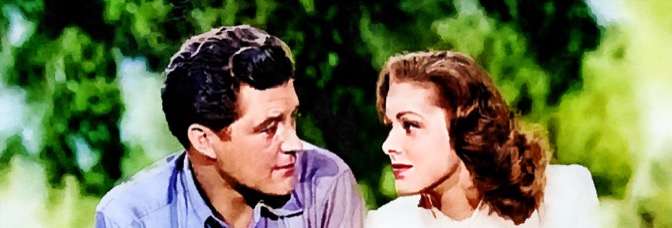
Delmer Daves–for someone whose directing occasionally makes me cover my eyes in fright–does an all right job with The Very Thought of You. He has these tight close-ups and, while there are only a few of them, they work out quick well. Otherwise, technically speaking, he doesn’t have many tricks. He’s on the low end…
-
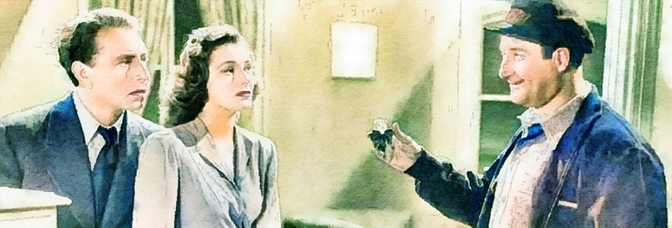
A little too long but good enough adaptation of Sutton Vane’s play, OUTWARD BOUND, updated to a World War II setting. A group of Warner Bros. contract players end up on the same mysterious ship without any memory of how they go there. Even in this new environment, their existential baggage overwhelms them. Paul Henreid’s…
 The Stop Button