Category: 1939
-

It would be interesting to know how much of Inspector Hornleigh features Gordon Harker (playing Inspector Hornleigh) on screen. While Harker does get a fair amount of the running time, a lot is spent on his sidekick, played by Alastair Sim, and the villains. The script’s approach to narrative drains the mystery from the film.…
-

I’ve seen Bachelor Mother at least twice before but didn’t remember the most salient feature of the film. I even forgot what a big part Donald Duck plays in it (though I did remember David Niven’s watching the clock to wait to say “good afternoon” as opposed to “good morning”). No, what I forgot was…
-

Gordon Harker was fifty-five when Inspector Hornleigh on Holiday came out. It’s very strange to see a film from this period with someone his age the lead in a comedic mystery. I’ve never seen him in anything and I can’t remember seeing Alastair Sim in anything but I know Sim’s name. I spent the entire…
-

Oh, those silly liberal apologists, not letting police detective Bruce Cabot beat confessions out of suspects. Don’t they understand these criminals are really working for the Nazis? Okay, Homicide Bureau never actually says Nazis, just warring foreign powers, but they mean the Nazis. The funniest part of the movie is the end, where the police…
-

The Saint Strikes Back is George Sanders’s first Saint film. It’s strong, even though John Farrow might not be the right director for it. The script’s great, playing to Sanders’s strengths of being the charming cad, but Farrow’s close-ups are poorly conceived and some of Frank Redman’s lighting is questionable. Jack Hively, who went on…
-

Every eight years or so, I watch Drums Along the Mohawk to see if it gets any better. According to my cursory notes from my last viewing, it apparently has gotten a little bit better. As the titles rolled, I was hopeful–it is John Ford after all (his first color film) and screenwriters Lamar Trotti…
-

Watching The Secret of Dr. Kildare is about two things–seeing Lionel Barrymore’s fantastic performance (even as he’s spouting expositional dialogue, it’s riveting) and finding out the deep dark secret of patient Helen Gilbert. It’s the third film in the series and the staples are already in place–Lew Ayres, under some false pretense, stops working for…
-

Someone thought Calling Dr. Kildare was a good idea. Sitting through the turgid eighty-six minute running time, that thought occasionally popped into my head. Someone thought this story was a good idea. Lew Ayres’s young Dr. Kildare (this one’s set three months, give or take, after the first entry) has a spat with Lionel Barrymore…
-

It’s hard to say who gives a better performance in Blondie Meets the Boss, Larry Simms as Baby Dumpling or Daisy the dog. Simms has a lot of funny lines–all the best lines are from kids talking about adults, it was hard not to think this entry should have been called “Kids Say the Darndest…
-

One of the unfortunate developments of television is the proliferation of hour-long mystery dramas. While these programs might be good, it means movies like The Saint in London don’t get made anymore. The film’s not episodic, with an abbreviated first act–George Sanders (playing the Saint for the first time) gets no introduction. But the first…
-

Low budget filmmaking–both today and in the past–has always been the most successful when the narrative takes the budget into account. Navy Secrets takes place over one day, with most of the locations being in cars, apartments or restaurants. In other words, easy sets. There’s one slightly more complicated scene in a park. The scenes…
-

Beau Geste is a colonial adventure, European soldiers under siege in the Arabian desert. There’s some imagination to the telling, but not at all enough. The strangest thing about the film is the title–Gary Cooper plays Beau Geste, who in some ways is the least of the film’s characters. I think Cooper must get the…
-
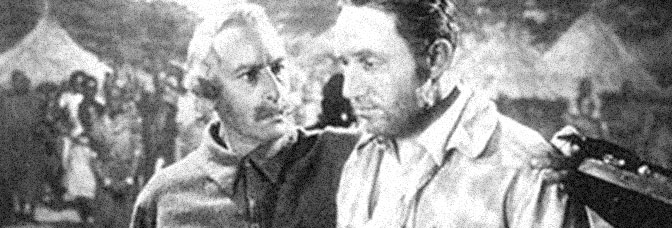
There are some beautiful sequences in Stanley and Livingstone, unfortunately, they’re mostly the second unit work from Africa. These sequences–the endless line of men trekking across great expanses–reveal the landscape and wild life of the continent with fervor. Later on, they’re even incorporated into a great rear projection. Spencer Tracy walks from the right of…
-

Barricade is a nice bit of pre-World War II propaganda, one of handful of ones supporting the Chinese government. The film lays it on rather thick, with heart-warming flag moments, frequent prayer, and reminders to the audience there are some people in the world worrying about more than a run in their stockings. Except the…
 The Stop Button