Category: 1936
-

Tournament of Death is an unexpectedly strong chapter. There’s a lot going on. There’s the cliffhanger resolution, there’s Buster Crabbe facing off with Charles Middleton for the first time since Chapter One, there’s Frank Shannon saving the day, there’s Jack Lipson having character development, there’s Richard Alexander having hilarious character development, and there’s Jean Rogers…
-

It’s another heavy chapter. Despite a valiant escape effort, Buster Crabbe ends up back in chains. He and his fellow, shirtless men in shorts shovel radium into king hawkman Jack Lipson’s furnance. Lipson’s still testing Jean Rogers’s affections. She’s got a couple rather good moments as she tries to misdirect Lipson. Lipson’s a little better…
-

Flaming Torture is about flaming torture. Buster Crabbe and his allies get captured when they’re trying to rescue Jean Rogers. While Rogers has an arc with Priscilla Lawson–Rogers has to seduce moron king of the hawkmen Jack Lipson (in an atrociously annoying performance)–all Crabbe gets to do is get tortured. With flames. Crabbe has little…
-

Despite a lackluster resolution to the cliffhanger–there’s a questionably timed emergency response–and some dawdling, The Destroying Ray eventually comes through. Director Stephani, along with the editors, works up a pace throughout and stops at just the right moment for maximum effect. Most of the chapter is a bridge between Buster Crabbe and company in the…
-

Battling the Sea Beast opens with Buster Crabbe fighting an octopus. Mostly it’s Crabbe–quite enthusiastically–feigning a struggle against one or two legs of the octopus, which shows no life once they’re battling. Before it was stock footage; with the fight, it’s a passive prop Crabbe has to get going. And it’s the only fight scene…
-

There’s some good action in Captured by Shark Men, with Buster Crabbe rescuing Jean Rogers from Charles Middleton and then an undersea sequence with a giant octopus. The cliffhanger resolution is relatively decent, with Crabbe up against a giant lizard monster. Most of the chapter is either action or leading up to action, but when…
-

The Tunnel of Terror opens with Buster Crabbe and Priscilla Lawson quickly escaping from the previous chapter’s cliffhanger. The unfortunate lizard monsters (real lizards standing in for giant monsters) make a brief return, but soon Crabbe and Lawson are just on the run from the guards. Pretty soon, Crabbe is on his own and piloting…
-

In just around twenty minutes, The Planet of Peril, the first chapter of Flash Gordon, boldly defines itself. It establishes the ground situation–Earth is about to be destroyed by a collision with another planet and the world’s in panic. It establishes the leads–Buster Crabbe’s a blond, smart guy jock, Jean Rogers is his airplane co-passenger…
-

Joan Crawford is top-billed in Love on the Run. Unfortunately, she has absolutely nothing to do in the entire film. Maybe if Clark Gable had something to do besides deceiving everyone (and then rescuing Crawford) the movie might make it through better, but he doesn’t. Love on the Run is eighty somewhat charming minutes of…
-

Mr. Deeds Goes to Town is astoundingly (and rightfully) confident. Director Capra and screenwriter Robert Riskin don’t shy away from anything in the film–Capra’s more than willing to go with sentimentality, but the film isn’t often sentimental. Even when Jean Arthur’s world-weary reporter breaks down, she doesn’t get sentimental. Most of the film involves Arthur…
-

Keep Your Left Up is a genial little short set in a small French country town. The arrival of the postman sets off the short, which eventually has local do-nothing Jacques Tati in the ring against boxer Louis Robur. The charm comes mostly from the setting, Clément’s excellent composition and Jean Yatove’s oddly mismatched score.…
-

There is very little economy to After the Thin Man; instead, screenwriters Frances Goodrich and Albert Hackett and director W.S. Van Dyke act with rampant abandon. The first twenty or so minutes of the film is just audience gratification–it’s a sequel to a popular film and the filmmakers are giving the audience what they want.…
-

Without Orders has enough story for a couple movies or at least one twice as long–it runs just over an hour. Instead, everything gets abbreviated. There's flight attendant Sally Eilers who has a sturdy fellow in pilot Robert Armstrong, but he's too concerned about helping her with her career and not enough with sweeping her…
-

Sabotage demands the viewer's attention. It opens with a dictionary definition of Sabotage, forcing the viewer to read something and then immediately relate it to the rapidly edited sabotage of a power station. This sequence, which sets off the first act of the film, takes place in maybe a minute, maybe less. Charles Frend's editing…
-

Killer-Dog is the story of a dog on trial. Really. It’s a courtroom short concerning a farm dog accused of being a sheep killer. Tourneur and producer Pete Smith take a while to get to that detail though, just referring letting the sensational title do the work of riling the viewer’s imagination. It’s a rather…
-
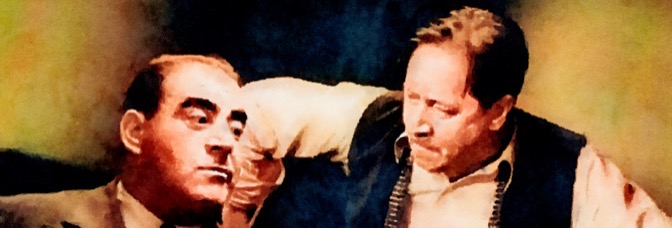
How to Be a Detective is a disjointed Robert Benchley miniature. He sets it up as a lecture on detecting practices and director Feist (and Benchley and his co-writers) miss the jokes. Towards the end, Feist mimics detective movie filmmaking techniques, which gives the short a boost, but it’s too little too late. There simply…
-

With a better director, a competent editor and a slightly stronger screenplay, The Ex-Mrs. Bradford might be more than an amusing diversion. While William Powell and Jean Arthur are great together, the film underuses them in general and her in particular. There’s this great dinner scene where she’s seeing if they’re going to get poisoned…
-

What an unmitigated disaster. It takes a lot for me to open with such a statement–well, maybe not, but certainly for a film I finished watching, even if it only does run sixty-two minutes. But Revolt of the Zombies might be one of the worst things ever and really shouldn’t be. Okay, worst things ever…
-

Murder at Glen Athol should be just a little bit better. The script has a number of twists, with Strayer handling them ably, but it’s just too short as it turns out. The film runs under seventy minutes, which would be fine for a B mystery, but Glen Athol (the title is problematic–Glen Athol is…
-

Even with the overbearing music and the strange lighting for emphasis (play-like, it dims to concentrate attention on an object or person), lots of Mary of Scotland is rather well done. Ford’s got some excellent shots and, at times, creates anxious scenes. It’s hard to get particularly excited during most of the film because, while…
-
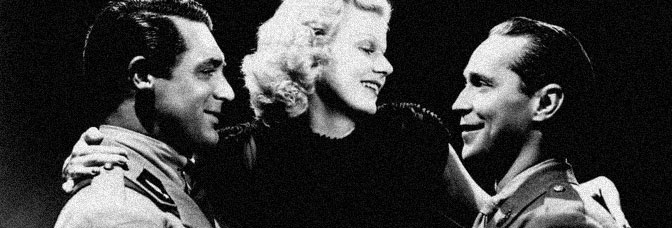
The war story love triangle: girl mets boy, girl marries boy, girl thinks boy dies, girl meets second boy, girl marries second boy, first boy returns, one of the boys dies. Suzy isn’t even an interesting spin on it. The film throws in a relationship between lower class Jean Harlow with her upper class father-in-law…
-
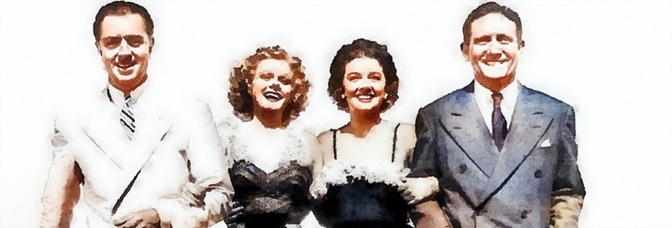
Good but not great comedy about socialite Myrna Loy suing a newspaper for libel and editor Spencer Tracy enlisting fiancée Jean Harlow and pal William Powell to try and foil Loy. Harlow and, eventually, Tracy become third wheels in a Loy and Powell picture, with Harlow getting the least out of the film. Tracy has…
-

Outstanding, ambitious biopic of Samuel Mudd (Warner Baxter), the doctor who unknowingly treated John Wilkes Booth and ended up tried for treason for his trouble. Fantastic performances from Baxter and Gloria Stuart as Mrs. Mudd. But Ford’s direction–along with Nunnally Johnson’s script–really put the film over the top; it’s beautifully produced, with Ford ably toggling…
-
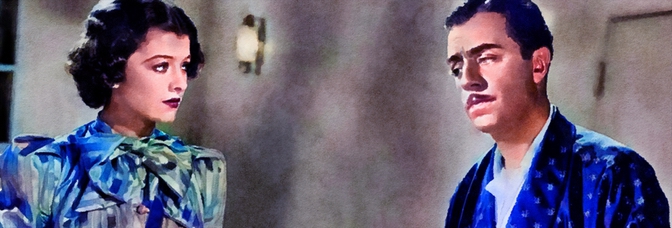
Direct sequel to THE THIN MAN spends the first act reminding the audience why they love Nick (William Powell) and Nora (Myrna Loy) so much before getting into the mystery part, which involves Nora’s wealthy family. Some classic set pieces, some hilarious jokes–especially ones involving Powell trying to cope with his in-laws–and a dynamic murderer…
-

Problematic, reductive adaptation of Maxim Gorky play about residents of Russian flophouse and their successes and failures trying to get out of poverty. Great performances from Jean Gabin and Louis Jouvet, but director Renoir loses track of the film when away from them. DVD.Continue reading →
 The Stop Button