Category: 1930
-
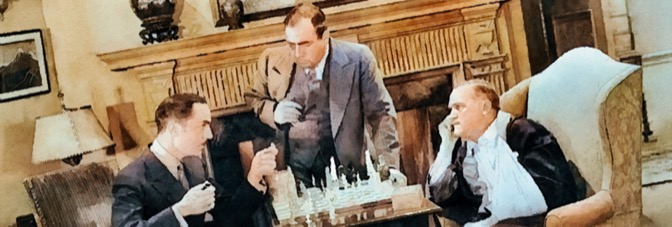
The most interesting part of The Benson Murder Case is the Black Tuesday setting. I missed the newspaper dates for the montage about the stock market crash so I’m not sure if they do the Black Tuesday or just a Black Tuesday, but the movie opens with broker Richard Tucker selling off all his clients’…
-
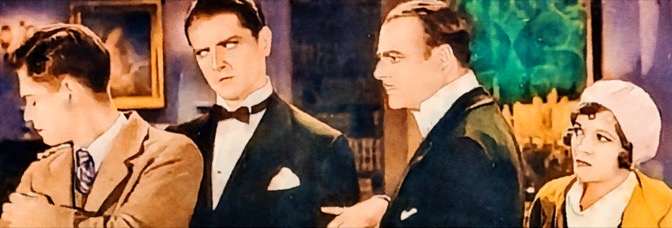
The Pay-Off opens with young lovers William Janney and Marian Nixon in Central Park, snuggle-napping on a bench in the middle of the night because they’re got to maintain their chastity. Everything’s about to change for them because Janney’s finally saved up enough money they can get married, only he talks about it too loud…
-

Niagara Falls doesn’t have a credited screenwriter, which is a shame as it’d be nice to know who wrote the occasionally rather witty dialogue but also who came up with such a dark short. Not even dark comedy. Just dark. The short starts with recent newlywed Helen Jerome Eddy preparing for her honeymoon to–you guessed…
-

After initially teasing some kind of narrative, Animal Crackers gives it up and embraces not just being a stage adaptation (hope I don’t forget to talk about that aspect) but also a series of sketches. Not just comedy sketches, but also musical ones. The film takes place over a day. It starts one morning, it…
-

For the first act or so of All Quiet on the Western Front, director Milestone very gently puts the viewer amid the naïveté of the film’s protagonists, a group of students who drop out to enlist (in the first World War). He opens with this gorgeously complicated shot–brilliantly edited by Edgar Adams and shot by…
-
Framed feels a little like it was a silent turned into a talkie. About half the time, instead establishing shots for scene changes, there are expository title cards. Usually they’re for time changes, as though director Archainbaud couldn’t think of anything else. It’s hard to say how many of Framed‘s problems are Archainbaud’s fault. Most…
-

Snow Time is another strange cartoon from Foster. It’s wintertime in cute cartoon animal land and everyone’s having a swell time skiing, synchronized skating and so on. Until this cat’s tail gets cut off because he’s messing around in a ski lane. But Foster and co-director Davis don’t follow his story. Presumably he’s just done……
-

Congo Jazz is a great example of how old Hollywood racism works. Having Bosko, the lead in the cartoon, be a little black kid isn’t really overtly racist… until Harman and Ising have him meet a couple monkeys. Guess who looks like who? And then, sort of confirming racists are morons, it turns out the…
-
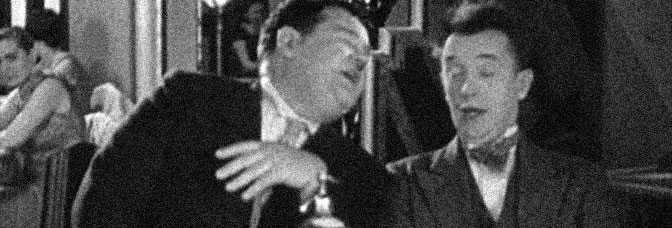
The Nightlife is an unfunny mess of asynchronous sound. If I’ve ever seen a Laurel and Hardy picture before, I can’t remember, and maybe starting off with one of their Spanish-language pictures was a bad idea. There’s no ambient sound for most of the short and it often feels like a silent comedy drug out…
-
Bubbles might be of modern interest because to Judy Garland fans, as an eight-year old Garland and her sisters show up at one point. But to anyone else? Well, it may also be interesting as an early sound short. There’s a lot of coordinated tap dancing in the short and I kept wondering if the…
-

The Limejuice Mystery is, in puppets, the meeting of Sherlock Holmes (renamed Herlock Sholmes here) and Anna May Wong (who’s also renamed for legal reasons, I imagine). Now, there are some good Holmes jokes–like the bobbies dancing to Holmes’s violin solo and Holmes’s hobby of cross dressing–but the Wong stuff is uncomfortable. Limejuice isn’t some…
-

It takes The Booze Hangs High nearly half its running time to have its first gag… but it’s worth the wait. An adorable little duckling tells its mother it needs to go number two. Without dialogue or visual followthrough, but the message is clear. And, all of a sudden, Booze starts getting better. It starts…
-
The Golf Specialist has a very odd beginning. W.C. Fields doesn’t even show up for almost three minutes (significant in a twenty minute short); instead the film follows Shirley Grey as the house detective’s wandering wife. It’s a set-up for later, but it’s an odd way to start. The short’s only got two sets—a hotel…
-

I wonder how Eugene Pallette felt–more, how his co-stars felt–about having the closest thing to a close-up in The Benson Murder Case. I’ve never been more acutely aware of shot distance than I was during the film. Tuttle has a standard pattern. Long shot–usually a lengthy long shot, sometimes an entire scene is one shot–followed…
 The Stop Button