Category: Fargo
-

This episode runs under forty minutes. The first few episodes ran over an hour. So why does “Fargo: Season Four” need a coda? I mean, besides them not finishing the story last episode so they could eek out just one more. The episode opens with a montage of all the people who have died this…
-

Is it sunny and nice in Kansas City in the winter? This episode presumably takes place in January 1951 and unless there was an unexpected heatwave… it’s like they forgot what month it takes place. The episode opens with a lengthy montage sequence showing the gang war in progress, along with some grim and gritty…
-

East/West does not make up for the previous episode but it does call the whole shark-jumping into question. Because East/West is director Michael Uppendahl and writers Noah Hawley (I really want to know how much he does on these episodes where he’s co-credited) and Lee Edward Colston doing a big ol’ Barton Fink homage. A…
-

It’s pretty obvious episode director Sylvain White has seen The Untouchables a bunch and maybe one of the Godfather movies–III probably—but there’s no evidence he’s seen, you know, Miller’s Crossing, Fargo, or even an episode of “Fargo.” Despite the episode seemingly having a bigger budget than most, it’s startlingly poorly directed. The Nadir isn’t where…
-

I was really happy to see Dana Gonzales directed this episode because the direction’s bad and since I no longer have any confidence in “Fargo” anymore whatsoever I was worried it was one of the good directors this season going to pot. This episode seems to reveal the big problem—and not just co-writers (with Noah…
-

So it’s another lackluster episode and it’s hard not to notice Dana Gonzales directed this one too. And Noah Hawley has three co-writers on it. Enzo Mileti, Scott Wilson, Francesca Sloane. Not sure any of them are at fault more than any of the others. Though the one who had private hospital doctor Stephen Spencer…
-

Until the end of the episode—which brings in the Fargo theme fully for the first time—everything is character revelation and potentially development. Oh. And a Trump reference. The Trump reference is really bad. The most character revelation revolves around dirty cop Jack Huston. We find out from Chris Rock some of his back story—while Huston…
-

It’s the end of the first act, with normal guy Andrew Bird making a big mistake and now everything afterward is never going to be the same again, which is kind of what “Fargo” stays consistent about, season to season. I think. Bird pays off he and Anji White’s debt to Chris Rock—in one of…
-

I’m sad “Fargo” turns out to need Timothy Olyphant so much. I noticed him in the credits online but figured they’d cut him out so much he was barely appearing, but he gets the opening of this episode. Before disappearing. He plays a Mormon U.S. Marshal who can’t shut up about religion and eats carrot…
-

If last episode was a big Miller’s Crossing homage—though there’s a big Miller’s nod here too—when this episode opens with a prison break, I had to wonder if it was going to be all Raising Arizona nods or if it was a one-off. Seems to have been a one-off. I wonder if Noah Hawley’s going…
-

“Fargo,” season four, is firmly planted in traditional American literature. Sure, it’s got a female, Black teenage narrator (E'myri Crutchfield), but… female, Black teenage narrators are traditional American literature too. The episode opens with Crutchfield giving a history lesson, though most of the history plays out onscreen and not specifically in her narration. Her narration…
-
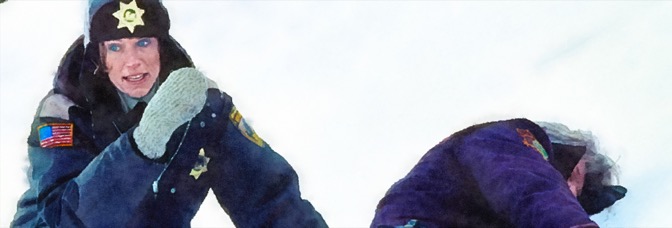
Much–probably most–of Fargo is exceptional. The Coens take over half an hour to bring their protagonist into the movie. They spend that first half hour with the villains, even having time to make said villains simultaneously lovable and even more dangerous. William H. Macy isn’t just some loser who schemes to rip off his father-in-law,…
 The Stop Button