Category: ★½
-

The Oklahoman is–well, I don’t want to sell it short because its discussion of racism and prejudice are rather straightforward and singular for pictures of its era–but at its core, the film’s a love triangle between fifty-two year-old Joel McCrea, thirty-five year-old Barbara Hale and twenty-six year-old Gloria Talbott. Talbott’s supposed to be playing an…
-

According to John Travolta (who was originally cast and probably wasn’t just making it up–as it was pre-Battlefield Earth and he was still somewhat legitimate), when ABC wouldn’t let him out of his “Welcome Back, Kotter” contract, Malick was forced to cast Richard Gere and shredded the majority of Days of Heaven‘s screenplay, instead going…
-
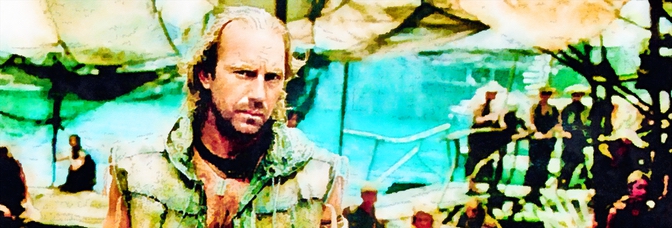
I haven’t seen Waterworld since the theater–probably opening day. I remember it being an unimpressive sci-fi adventure without a lot of distinct characteristics, but certainly not a disaster. Watching it again after fourteen years, that description holds (for the most part). The film–even in the three hour extended version–moves quickly. There’s always something going on,…
-

I wonder, did Lew Ayres ever feel like Jimmy Kildare was a heel? I mean, he’s an unbelievably nice guy–he won’t propose to nurse Mary Lamont (Laraine Day sleepwalks through almost all of Dr. Kildare’s Strange Case, since there’s only one scene where she needs to do anything) because he doesn’t want to make her…
-

Every eight years or so, I watch Drums Along the Mohawk to see if it gets any better. According to my cursory notes from my last viewing, it apparently has gotten a little bit better. As the titles rolled, I was hopeful–it is John Ford after all (his first color film) and screenwriters Lamar Trotti…
-

Watching The Secret of Dr. Kildare is about two things–seeing Lionel Barrymore’s fantastic performance (even as he’s spouting expositional dialogue, it’s riveting) and finding out the deep dark secret of patient Helen Gilbert. It’s the third film in the series and the staples are already in place–Lew Ayres, under some false pretense, stops working for…
-
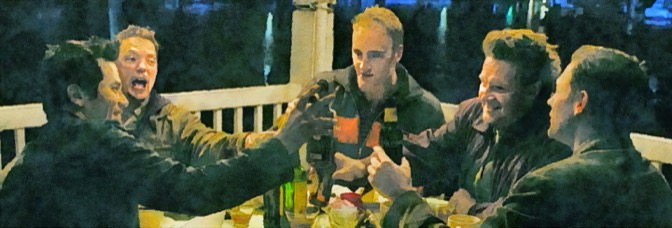
The Groomsmen looks wrong. The film doesn’t have any grain and the lighting suggests it’s shot on some kind of DV (it isn’t). Everything is very controlled–a bright outdoor scene doesn’t seem bright in Groomsmen, it seems like the color has been toned down so as not to offend. It looks like a Mentos commercial…
-
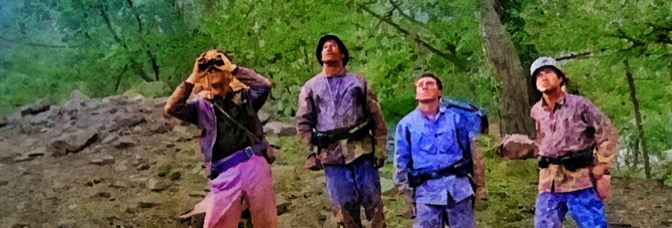
Fear and Desire‘s a mess to be sure, but it’s hard to understand why Kubrick later strove to have it willfully forgotten. The film’s greatest faults–the script and the acting–pale when compared to Kubrick’s success as a director and editor. He described the film as amateurish and that adjective certainly does describe the script well…
-
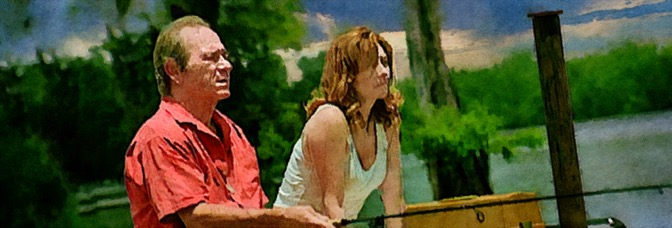
Second attempt (Alec Baldwin tried in 1995’s HEAVEN’S PRISONERS) to turn James Lee Burke’s Dave Robicheaux novels into a film franchise. Tommy Lee Jones is good in the lead and the supporting cast is all fine (Peter Sarsgaard is fantastic) but the script’s a mess. The “mystery” involves Jones, Hollywood actors (Sarsgaard and Kelly Macdonald),…
-

For a while, somewhere in the late second act, Sam’s Song is really good. It has its characters established and it seems like it’s going to take an interesting path getting to its inevitable plot point. The film is mostly about Jennifer Warren, who has a husband (Jarred Mickey) apparently eager to philander; they’re wealthy,…
-

Don Coscarelli’s Phantasm is not any kind of cinematic wonder. Coscarelli is a decent director in terms of composition and his screenplay has some inventive moments. Mostly, the writing credit is due because of his enthusiasm for the content. There’s nothing like seeing adults defer to the wisdom of a teenage boy–and A. Michael Baldwin…
-

Awkward failure about a knife thrower (Daniel Auteuil) and his target (Vanessa Paradis). They meet when he saves her from jumping off a bridge (hence the title) and soon bond. The knife-throwing becomes a metaphor for their “romance,” though Paradis takes various lovers, which drives Auteuil nuts. Charming leads, glorious black and white photography, and…
-

Death Race opens with an almost too classy intro text (reminiscent of Escape from New York, intentionally I’m sure) informing the viewer in 2012, the U.S. economy collapses. Death Race opened in August 2008… is Paul W.S. Anderson now a seer? With all-powerful, insulated corporations and cops beating protesters… it’s the perfect movie for this…
-

“a monstrous creation ; especially : a work or agency that ruins its originator” Frankenstein. (2008). In Merriam-Webster Online Dictionary. Retrieved October 2, 2008, from http://www.merriam-webster.com/dictionary/Frankenstein I wish I could use the OED, but it doesn’t seem worth thirty bucks. Especially ruins. Two important words for a Frankenstein adaptation. Jed Mercurio does a future Frankenstein,…
-

Baby It’s You is a John Sayles film I never expected to see… it’s John Sayles for hire. Sayles has had a lucrative career as a ghostwriter of blockbusters (Apollo 13 famously had his name on one poster… but not after the WGA got done). But Baby It’s You is the first of his films…
-

Torpid isn’t an adjective I get to use often, but I can’t think of a better one to describe The Mississippi Gambler. It’s a boring melodrama, trading entirely on the charisma of its cast–Tyrone Power might have been able to handle the weight, but the film concentrates on the loveless marriage of Piper Laurie (as…
-

Greystoke ought to work. From the opening, it really seems like it might. It survives a massive narrative hiccup–switching perspective from young Tarzan to explorer Ian Holm. It establishes people in ape costumes as believable, sympathetic, feeling characters. It’s got beautiful cinematography, Hugh Hudson’s a fine director, and John Scott’s got one great score for…
-

Wings in the Dark is three-quarters overwrought melodrama with the remainder squandered potential. The film opens with Myrna Loy as the protagonist, an aviatrix (never thought I’d get to type that word) whose flying abilities can’t compensate–in terms of professional opportunities–for her lack of male gender. This part of the film, with Loy trying to…
-

Amores perros could be a public service announcement about canine cruelty in Mexico City. Mexico City has a population of around nine million and takes up about six hundred square miles. For such a big city, it’s kind of odd the cast keeps running into each other, since their only connection is being the subject…
-

The train thriller has been a film standard for seventy years, probably longer. I can’t remember the last one, as the genre’s sort of fallen off in the last ten years. The naive American tourist is trouble genre is younger, but not by much. Transsiberian combines the two–a natural combination–but it’s far more of a…
-

I remember The Terminator being a lot better. Even as it started–I think during the first chase sequence (Michael Biehn in the department store)–I thought about the great highway chase sequence at the end. Then, as things went sour during, I kept waiting for that sequence, sure it would bring things around. But it doesn’t…
-
Thanks to Joint Security Area, I was leery of Oldboy going in. While Park Chan-wook has a large fan base, all JSA did was convince me they weren’t seeing the same movie. Finally, after Oldboy, I can understand why he has the fan base… and it’s unfortunate. Park had his big revelation ending to Joint…
-

Mothra is a strange mix of Japanese monster movie, 1950s Hollywood sci-fi and Disney. The last ingredient only becomes clear at the end of the movie, though it’s probably present throughout (as Mothra returns home with the two fairies, it’s clear Mothra would have made a fine animated feature). But the strangest element of Mothra…
-

I’d forgotten Prince of Darkness‘s more fanciful notions–Jesus the space alien, still sent to Earth to save us from the Devil, but this time, the Devil’s kind of a space alien too (or not)–and its less creative ones (the Devil uses projectile vomit to posses people). It’s Carpenter at his strangest, the late 1980s period,…
-

Michael Mann’s director’s cuts are sometimes large and sometimes small. They usually include music changes. In the case of Miami Vice, he adds an opening, changes some music and does a few little things. It’s too bad, because even though it having an opening works out nice, neither of these major choices seem to be…
-

All I wanted from The Incredible Hulk was dumb fun. I figured Louis Leterrier could deliver. Unfortunately, it’s not dumb fun, but Leterrier does deliver–and instead of fast food, it’s rather good French. Frequently, Hulk showcases Leterrier’s directorial abilities and they’re significant. Leterrier handles everything the story needs–be it rural or urban, Brazil or New…
-

Count Yorga, Vampire is a retelling of Dracula, modernizing it to the then-contemporary 1970 and changing the locale to Los Angeles. It’s also incredibly low budget–not so low budget it has bad acting (its acting is actually the strong-point)–but it has blacked out windows on houses and cars (so night scenes can be shot at…
-

Iron Man is a qualified success. Robert Downey Jr. is fantastic throughout–the movie’s greatest strength is how much screen time he gets–and Jon Favreau does really well with the Iron Man scenes and the action scenes in general (he does terrible with almost everything else). But, while it also moderately succeeds as a romantic comedy–Downey…
-

Capra tries for another entry in his humanist series (Mr. Deeds, Mr. Smith and John Doe) and fails miserably. Two of the principal ingredients–Robert Riskin and Gary Cooper–are missing, but since State of the Union is from a play, it’s questionable if Riskin could have helped (Union‘s problems are fundamental). As for Cooper… Spencer Tracy’s…
-
Nightmare Alley is–or should be–a cautionary tale about the dangers of foreshadowing and being really cute about it. The end of the movie is forecast in the opening scene, then again in the third or fourth scene–hammered in for those who weren’t paying enough attention the first time. The second time key phrases are dropped…
 The Stop Button