Category: ★½
-

If I had any foresight, I would have realized Broken Flowers wasn’t going to end well. Actually, most of the film is just a ruse to disguise that fact. Instead of thinking about how the film was going to turn out, I spent all my time marveling at Jarmusch. His composition, his dialogue, everything, just…
-

I think I watched The Gauntlet for masochistic reasons, namely screenwriters Michael Butler and Dennis Shryack, the late 1970s, early 1980s version of Mark Rosenthal and Lawrence Konner–incompetent Hollywood writers. Even so, the film’s not wholly terrible. It’s rarely exciting, just because the action sequences are so poorly written, and Clint approaches the whole thing…
-

Has copyright lapsed on John Williams’s “Promenade (Tourists on the Menu)” composition from Jaws, because this film uses it all the time. While Undead is a fun little movie, I’m pretty sure Lionsgate would get their butts sued off if it got out they were violating such an obvious copyright, and I have to go…
-

Mickey One is what happens when you mix an American attempt at French New Wave and a director (Arthur Penn) experienced in television directing. Arthur Penn did eventually shed those old TV trappings, but certainly not at this point in his career. He’s got lots of shots in Mickey One–its editing is so frantic and…
-

I can’t remember–if I ever have–seeing a film where the main character goes through more changes than in Investigation of a Citizen Above Suspicion. Actually, he doesn’t change, but the truth keeps getting more and more revealed to the viewer, making him more and more different. First he’s a smart bad guy, then he’s a…
-

While Frankenstein: The True Story singularly credits Mary Shelley as source material, the actuality is a little more complicated. A Universal-produced TV mini-series, True Story actually mixes some of the Shelley (basically, the end in the Arctic and a brother for Frankenstein), with Universal’s 1930s films, Frankenstein and Bride of Frankenstein (with a little of…
-

Girl with a Suitcase plays a little like The Nights of Cabiria. Watching Suitcase, one can’t help but feel like the filmmakers were quite familiar with Cabiria. Cabiria, of course, is from a certain period of Fellini and Suitcase feels a little like that Fellini, only the diet version. The film does have a lot…
-

Pan’s Labyrinth is a pretty film. Gorgeous cinematography, great locations, intricate make-up (bad CG, but it’s only really noticeable once). Guillermo del Toro does a decent job directing the film but has these really annoying transitions–the back of someone’s head frequently becomes a tree in the forest in unending pans. His script is competent and,…
-

Apparently, when Christopher Guest doesn’t do pseudo-documentaries, his films simply don’t work. I didn’t realize For Your Consideration was different in that approach until a lot further in than I should have, probably fifteen minutes or something. As it opens and introduces the set-up (I guess that part would be called the first act, which…
-

There’s something real strange about Trancers. It’s not the film’s obvious references to early 1980s sci-fi successes, Blade Runner and The Terminator (cop travels back in time to fight zombie bad guys who look like regular people). It’s certainly not the direction–while Trancers is incredibly low budget, $400,000 still was a few bucks in 1985,…
-

Here’s a rule: if you’re going to have your three principal characters each narrate parts of a story (the first act, for example), make sure they keep doing it through the rest of the drama. Multi-character, scene-specific narration is a terrible idea, but at least stick with what you set-up. Not surprisingly, Daisy doesn’t stick…
-

DV Michael Mann–because there is a difference between Michael Mann on film and Michael Mann on DV–doesn’t bother giving Miami Vice a first act. I suppose he intends the absence to be some sort of cinema verite thing, but it doesn’t work, it just gives the audience no characters to identify with. Lethal Weapon 2…
-

Conquest of the Planet of the Apes is about a bunch of ape slaves overpowering their human masters. Any film with a thirty second recap of the previous sequel by Ricardo Montalban has to be at least amusing, but Conquest is actually better than amusing (until the actual revolt begins). Since the film didn’t have…
-

In its opening, Toni is established as an immigrant’s story. Foreign workers (Spanish and Italian) go to the south of France to work the quarries. The opening “prologue”–it’s never announced as a prologue, but there’s an “end of prologue” card–shows the workers’ arrival. The end also shows workers arriving, three years later, after the title…
-

The war story love triangle: girl mets boy, girl marries boy, girl thinks boy dies, girl meets second boy, girl marries second boy, first boy returns, one of the boys dies. Suzy isn’t even an interesting spin on it. The film throws in a relationship between lower class Jean Harlow with her upper class father-in-law…
-

One Crowded Night opens strong enough–a Mojave desert motel and lunch counter, run by a family with a past, with employees with romantic woes. It’s an RKO B-picture, as the most recognizable people in the cast are bit players from bigger films. It’s filmed on location (at the motel) and it starts centered around Anne…
-
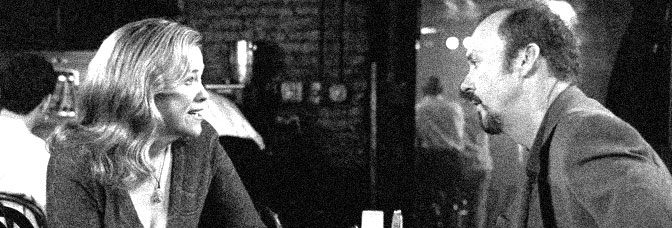
In many ways, Game 6 is the Michael Keaton movie I’ve been waiting ten years to see. He’s the lead, it isn’t a comedy, he’s got a grown kid, it ought to be a return to form. It’s a mildly high profile film, or at least it should have been, as Don DeLillo wrote it.…
-

Back in the late 1980s, The Punisher was part of that period’s comic book movie wave. Most of these films had little to do with Batman’s success and most of them failed, both commercially and artistically. Teenage Mutant Ninja Turtles, of course, succeeded financially. Watching this Punisher film (I have no interest in the new…
-

Do the British have an unending supply of novels about wise-beyond-their-years young women (unjustly poor or ordinary, of course) who have slightly dim older sisters who can’t see love in front of their eyes while all the time these younger women suffer for their sisters’ happiness? It certainly seems so. I Capture the Castle, the…
-

Poorly written drama about single mom (Noni Hazlehurst) working in the Melbourne music scene. She falls for heroin-addicted actor Colin Friels, which causes all sorts of problems because Hazlehurst is a mom after all. Alice Garner (daughter of source novel author Helen Garner) is the kid; she probably gives the best performance in the film.…
-

Walter Matthau hated Charley Varrick. He must have been stuck in a contract or something. It’s understandable why he did, however. Matthau’s whole image is one of the likable curmudgeons. Varrick casts him as a gum-chewing (for that Matthau effect) bank robber… who doesn’t do it because he needs the money, but because crop dusting…
-

Ninety-six minutes of dumb fun involving an sea monster terrorizing an underwater mining operation. Great cast of recognizable eighties supporting players like Ernie Hudson, Richard Crenna, Daniel Stern, and Meg Foster. Peter Weller’s a good lead, Amanda Pays is good as his love interest; really good performance from Crenna too. Despite the prestigious screenwriters (David…
-

Mostly enchanting Disney tale of a snobbish Cocker Spaniel named Lady who meets a below-her-station Standard Schnauzer named Tramp and, through a series of adventures and misadventures, falls for him. The film relies a little too heavily on the songs, letting them take over when they shouldn’t, and the finale ignores its stars for the…
-

Formulaic WWII thriller about Norwegian resistance fighters Kirk Douglas and Richard Harris infiltrating a Nazi base to stop them from developing the A-bomb first. Lots of good cross-country skiing footage, lots of reused war footage. Douglas doesn’t act very much in the first half, just gropes every woman in sight. Meanwhile Harris, who’s good in…
-

Not exactly romantic comedy or drama about school teacher Park Hae-il perving on and manipulating colleague Kang Hye-jeong into dating him–the film goes from being a cringe-y “sexual harassment comedy” to a cringe-y “sexual harassment drama.” Really strong performance from Kang and some potentially good dramatic developments in the plot get flushed for the pat…
-

Aged very poorly eighties teen comedy about Molly Ringwald’s sixteen birthday getting forgotten because of big sister’s wedding. Movie more belongs to Anthony Michael Hall (as a lusty nerd pal of Ringwald’s) and Michael Schoeffling (Ringwald’s dream guy). Likable performances from the cast; absurdly shallow hi-jinks–with racism, ableism, and terrible treatment of women; not unsuccessful.…
-

Ostensible mystery thriller (written by Arthur Miller) about renowned private investigator Nick Nolte taking Debra Winger’s case, even though she doesn’t give him any information about the case. It’s not exactly predictable but if Nolte’s so good, he really should piece things together based on the clues we get. There’s romance at some point, but…
-

Watchable–thanks to good acting and direction–and beautifully designed melodrama about the rugged 1950s Australian newsreel cameramen and their manly pursuit of the capital n news. Sometimes hard to believe melodrama–often involving William Motzing’s music ruining scenes. There’s also the problem with how the authentic newsreel footage mixes in. Very assured, but to no good end.…
-

Profoundly boring story of the creation and opening of the Moulin Rouge. Well-acted, with Jean Gabin in the lead, just completely pointless. The film’s a series of conflicts and resolutions without any rising action, the opening as a backdrop–no idea if it’s historically accurate, but it would be nice to have some drama. Or a…
-

Disappointing “serious” war action movie about lieutenant colonel Gene Hackman shot down behind enemy lines in Vietnam with no one willing to save him except helicopter pilot Danny Glover. Wooden dialogue, bad music, and director Markle shoots close-ups when they should be long shots and vice versa, but it could be a lot worse. Both…
 The Stop Button