Category: Film
-

Knives Out is very successful, very neat riff on the Agatha Christie-esque genre of mystery stories, specifically the limited cast, the intricate death, the “gentleman detective.” Out’s gentleman detective is Daniel Craig, who plays his French-named character as a Southern Gentleman with aplomb. He’s always delightful, even though he’s—intentionally—not particularly good at the investigating, rather…
-
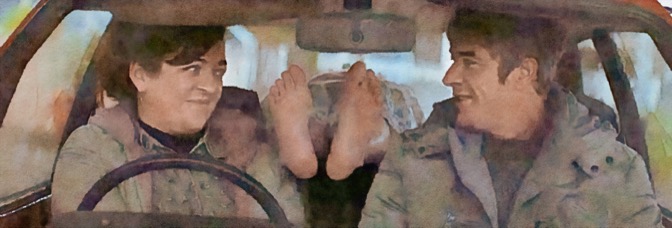
A few minutes into Extra Ordinary, after a stylized prologue and then opening sequence, I realized it was a low budget marvel. The film has under five locations and six characters. Directors Ahern and Loughman widen the proverbial lens to make it feel bigger with choice location shooting—being able to do the driving in the…
-

The absolute saddest part of Justice League: The Encore Edition is the new stuff’s not bad. It’s not great, but it’s not bad. You almost want to see the movie, which is basically Ben Affleck Batman teaming up the not even A-list for 2021 of DC Comics movies stars and roaming a post-apocalyptic wasteland. But…
-

About two minutes after I had the thought, “Oh, no, what if the morale of Fixed Bayonets! is ‘it isn’t the generals who are the heroes but the men,’” the film reveals the morale to be it isn’t the generals who are the heroes but the men. The film opens with a title card establishing…
-

As intentional as Kazan gets with his direction of James Dean, he’s orders of magnitude more intentional on Julie Harris. Harris is top-billed and the natural protagonist, but Dean’s a supernova. He’s the lead, he’s the star, he’s dynamite, a press agent’s dream. Only he’s got a really quiet part for most of the movie;…
-

Dr. Jekyll and Mr. Hyde—it’s pronounced Gee-kyl, incidentally, as in Fronkensteen—is a stunning disappointment. It’s difficult to know where to begin, given the film is about a scientist, Fredric March, who’s really horny for his fiancée, Rose Hobart (and she’s horny for him too), but her dad, Halliwell Hobbes, thinks March’s a no good horn-dog…
-

The Eagle and the Hawk starts light and ends very heavy. Astoundingly—and appropriately—heavy. Eagle is a WWI flying ace picture, all about a group of British fliers who go to France only to discover war isn’t like playing polo actually. Right after an inventive segue from opening titles to the present action, the film has…
-

There are a number of scenes in Under the Rainbow you probably wouldn’t have imagined had been put on film. Starting with Billy Barty playing a Nazi spy who accidentally hits Hitler in the balls because he’s a little person. When that scene began, I was thinking about how you don’t see a lot of…
-

Life is profoundly cheap in Ewoks: The Battle for Endor. The film’s ostensibly about little human orphan Aubree Miller’s adventure with her Ewok buddy Warwick Davis and the old man (Wilford Brimley) who takes care of them after a group of bad guys appear out of nowhere and destroy the Ewok village and pew pew…
-

We don’t see John Dall court Peggy Cummins in Gun Crazy. We get to see them meet cute when Dall—back home after the Army (and reform school before the service)—and his pals go to carnival and see Cummins’s shootist act. Dall was in reform school for breaking into a store to steal a pistol and…
-

Despite Dana Andrews and Peggy Cummins being perfectly serviceable leads, Night of the Demon never really comes to life without antagonist Niall MacGinnis around. MacGinnis is a Satanic cult leader who conjures forth demons from Hell—hence the title—to deal with his enemies and—while he never explicitly confesses to his enemies… he takes a delight in…
-

Most of The Bay is tolerably tedious and mediocre. Levinson’s doing a found footage documentary—he may also provide the voice of filmmaker—about a bunch of sea cockroaches eating its way through a little Maryland town. It plays like a combination low rent Michael Crichton adaptation—the action skips to various government agencies and their internal camera…
-

Once The History of Time Travel gets to the gimmick, it’s a good gimmick. Writer and director Kennedy even manages to get a good finish with the gimmick, which is something since it means making the third act of History incredibly tedious to build anticipation. And a lot of History has already been tedious, so…
-

Flora & Ulysses is a perfectly functional multi-quadrant family movie. Khan’s direction is good—sometimes really good—and kid lead Matilda Lawler is good so, you know, it’s fine. I mean, it’d be better if Lawler actually got to be the lead in the movie instead of it splitting between her separated parents, blocked romance novelist Alyson…
-

I’m not sure what I thought Elizabeth Is Missing was going to be—I only half read a description—but when it became clear Glenda Jackson’s character (not Elizabeth) would be searching for that character (played by Maggie Steed) but also Jackson having Alzheimer’s and also sort of live action flashbacks with her younger self… Well, I…
-
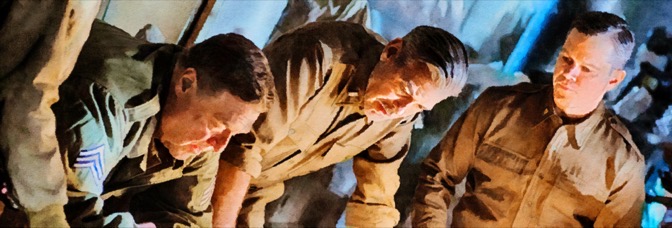
The Monuments Men is cute. It probably shouldn’t be cute, or if it should be cute, it should somehow be more cute. But it’s fairly fubar. The film’s got very little dramatic momentum since it can never find a tone and also because its scenes try to skip over the drama or do whatever it…
-

Smack-dab in the middle of The Informer is a romance between IRA commander Preston Foster and his gal, Heather Angel, sister to an IRA man (Wallace Ford). Foster and Angel steal moments together on one fateful night, tragic circumstances giving them unexpected time with one another, but those same circumstances sort of foreshadowing their very…
-

Until the action-packed last thirty minutes, Stagecoach is a class drama. A group of strangers and acquaintances are in a stagecoach, traveling West, post-Civil War. It takes fifteen minutes at the start of the film to get them in the coach, with some of the time spent on establishing the characters (and why they’re traveling),…
-

The Famous Sword Bijomaru is a tragedy. Well, at its best, it’s a tragedy. The film—which runs sixty-five minutes and has zero subplots, very few close-ups, and no establishing shots or sequences—opens with apprentice swordsmith Hanayagi Shôtarô presenting his benefactor, Oya Ichijirô, with a new sword. Hanayagi is an orphan, Oya took him in at…
-
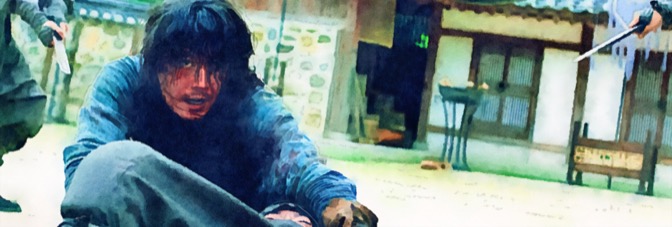
Many years ago, Val Kilmer talked about how the original Tombstone director got replaced and one of that guy’s crimes was making the actors wear accurate textiles, which doesn’t matter on film. You can have a lightweight poncho and it’ll look the same on screen. Welp. I don’t know if it’s the benefits of shooting…
-

Not even halfway through Mad Love’s sixty-seven minute runtime it’s clear all the film’s going to have to do to succeed is not to fail, which isn’t going to be easy. The film’s about a brilliant surgeon (Peter Lorre) who’s sort of publicly stalking married stage actress Frances Drake. Now, he falls in love with…
-
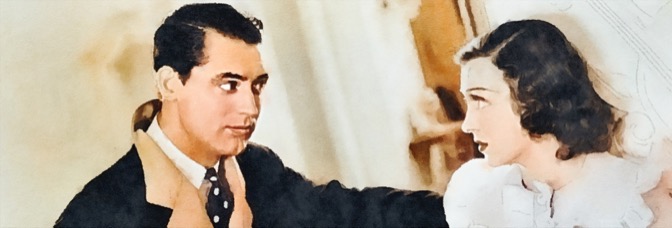
There’s a funny moment in Ladies Should Listen. As in a singular one funny moment. I can’t remember the joke because it wasn’t very good and was too busy being shocked at something vaguely amusing in the film, especially coming from Rafael Corio, who has the distinguished honor of giving the worst performance in a…
-

Parade somehow loses the plot after intermission. Given the plot is just a night at the circus, usually showcasing director Tati’s pantomiming, it shouldn’t be possible to lose such a thing. But Parade does. Maybe intermission not coming halfway through the film should be a sign. And at least the post-intermission material sails by relatively…
-

For the first hour, Trafic has a lot of gems. The film opens with a car manufacturing plant with a lot of nice, precise composition and editing, and director Tati maintains an interest in the goings-on of cars and their drivers. The action centers around an auto show in Amsterdam (presumably filmed at a real…
-

The Suspect is the unlikely tale of middle aged shopkeeper Charles Laughton, who forms a friendship with a young woman in need (Ella Raines), which gets him in trouble with his wife, Rosalind Ivan. There are complications—the film’s established Ivan has been a horrible wife to Laughton and a bad mother to their son, Dean…
-

The Lady Refuses gets frustratingly close to making it to the finish. It collapses in its final moments, though it’s barely been keeping it together through the third act, when everything (by everything the main plot and the single directly related subplot) comes together and profoundly fizzles. The only reason it provides any tension at…
-

The Match Factory Girl is a hyper-focused character study. It opens with the visually fascinating process of a match factory before introducing lead Kati Outinen. Technically protagonist, obviously more subject. She quite noticeably doesn’t talk for the first twenty minutes or so, which says more about her situation than her character—no one’s interested in what…
-

I spent much of Take Care of Your Scarf, Tatjana waiting for the character, played by Kati Outinen, to forget her scarf because I thought the title was Don’t Forget Your Scarf, Tatjana. I knew the film only ran sixty-two minutes and so assumed there’d be some scarf-forgetting. Oops. Is there scarf-forgetting? No spoilers. But…
-

L’Atalante begins with a wedding procession; village girl Dita Parlo has married commercial barge captain Jean Dasté and is going off to live with him on the barge. The wedding guests drop all these details through exposition—we’re not privy to the newlyweds’ conversations as they walk through the village to the barge. Juxtaposed, first mate…
-
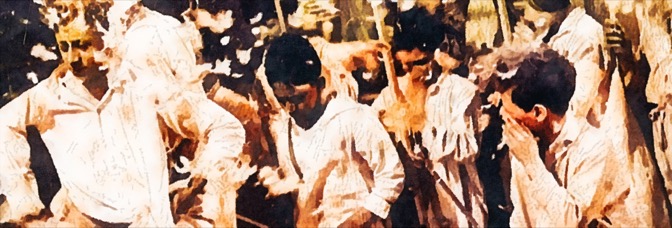
There are some truly excellent moments in Zero for Conduct, usually when director Vigo slows down the film (literally) and focuses attention on how the characters are experiencing said moments. The biggest one—though maybe not best—comes during the prelude to insurrection, when the students in a boys’ school are marching towards… well, it turns out…
 The Stop Button