Category: Mystery
-

True Believer is never quite anything it sets out for (story-wise)–it’s not the story of a lost man finding his way, it’s not a legal drama, it’s not the story of a young lawyer spurning riches for morals. Instead, it’s a courtroom movie with corruption, chase scenes through metal shops, a great Brad Fiedel score…
-

Somehow Altman lets The Gingerbread Man get away from him. Never the direction, which holds up until the end–and seeing Robert Altman direct a fight scene is something to behold–but the plotting. The film starts high, thanks to the compelling plot and the performances, but then the plot gets more and more… not convoluted, but…
-

The Black Dahlia really ought to be a lot better. The film’s problems vary from the slight to the significant, but for some reason, the James Ellroy plot keeps things going. The film ends on a problem too, which makes writing about it immediately following a pea in the bed–and the last act is a…
-

Seeing as how I’ve actually written a scholarly paper on the British film industry (not of Suspended Alibi‘s era, but the early silents… and the observations, unfortunately, still hold), it’s sort of nice to be able to put some of the experience to use. As a country, Britain has produced a wealth of fine actors…
-

There’s one singularly profound moment in Gone Baby Gone, when Affleck plus vieux has one of those filmic moments directors rarely have. He takes a broken, melodramatic scene and makes it sublime. It’s a wonderful moment, coming just after the film’s second ending and before the third and fourth. The film has a lengthy list…
-

With Conrad L. Hall shooting it and James Horner (pre-Titanic and fame) scoring, Class Action is great looking and sounding. Apted’s composition is frequently excellent. But it’s a vehicle for Mary Elizabeth Mastrantonio and it, rather unfortunately, eventually just works on that vehicle level. There’s no real surprises, no real content… just running time with…
-

I thought there were no anti-conservative Hollywood films for a long while after 9/11, so I guess Runaway Jury went under the radar. It appears to have been a significant bomb and, watching it, it seemed strange to see John Grisham’s name on screen. It’s been a long time since adaptations of his novels have…
-

Most of Quicksand plays like a multi-national mystery from the 1970s, filled with familiar faces (or a few familiar faces anyway). About three-quarters of it, approximately. There’s good and bad stuff in those seventy minutes. Michael Keaton’s excellent, which isn’t surprising. Michael Caine shows up for what appears to be a small role (it gets…
-

Every time I watch Thomas Crown, I wonder if there’s some magical explanation for all John McTiernan’s other films (except Die Hard, which is, too, singular). Because The Thomas Crown Affair, as I love saying, is the last great utterly mainstream film. But there’s something more… the tone of the film, the Bill Conti score,…
-

There’s something untranslatable about the last line of a novel. Even though maybe it shouldn’t, it essentially sums up everything–not just the scene or the story or the characters, but the reader’s experience as well… (whether the writer’s experience of writing the book is summed up in the line is, obviously, immaterial). With No Country…
-
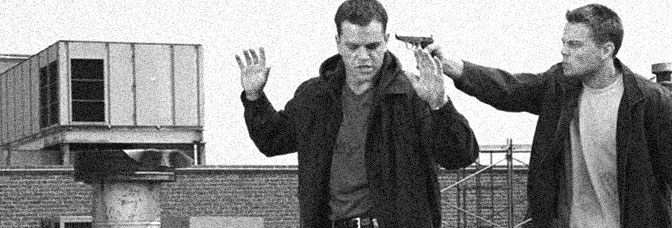
It’s hilarious, of course, Scorsese finally won an Oscar for the film least like his work. The Departed is the really serious movie Mel Gibson and Richard Donner never got around to making in the late 1990s… but Scorsese–I don’t know if Scorsese adds something to the mix or if he just knew how to…
-
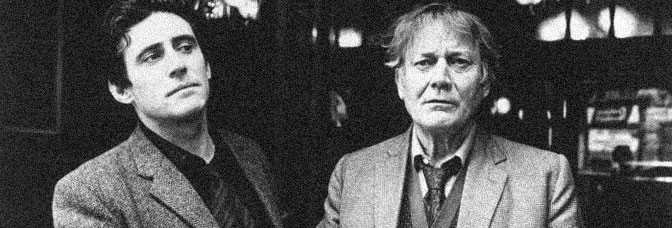
Defence of the Realm starts–and spends about a half hour being–a British variation of the Hollywood newspaper reporter story. There’s the story and the reporter’s dilemma about his morality–there’s even the wise old mentor (Denholm Elliot) for the young reporter getting his first big break (Gabriel Byrne). It’s not particularly good, it’s not particularly bad.…
-

Until the current administration, I could always take comfort knowing the British probably did more terrible things than the Americans ever could. For instance, they might test atomic bombs in Australia and radiate the aborigines, which is the public service announcement of Ground Zero. It isn’t only a PSA, it’s also a reasonably thrilling thriller…
-

Last Embrace goes a long way in showing what’s wrong with Hitchcock homages. Most of Last Embrace isn’t even a real Hitchcock homage–it’s a Niagara homage and Niagara was Henry Hathaway–but Embrace is supposed to be Hitchcock, down to Miklos Rozsa’s score (but he never did any Hitchcock). So it’s kind of a second-hand Hitchcock…
-

Thanks to a frantic trip through the New York skyline and Danny Elfman’s familiar score, Extreme Measures’s opening credits play like an unused Batman sequel opening… until the two naked guys run out on to the street. It’s an odd opening (and the naked guys and their plight are compelling enough one forgets Elfman until…
-

I’m having a hard time understanding certain aspects of Switchback. Primarily, Dennis Quaid’s terrible performance. I’m wondering if Jeb Stuart instructed him to imitate a log or if it was just Quaid’s read on the character. To be fair (to Stuart, not to Quaid), the character is a pretend protagonist. Stuart’s more interested in his…
-

I had all sorts of plans on how to start off this post, but the idiotic ending has hindered them. I mean, the whole film suffers from being incredibly stupid (Argento’s characters are the most unbelievable I can remember seeing in recent memory), but the ending actually goes for a kind–not an aspiration for high…
-

About ten minutes in to F/X, I got wondering how the film was going to deal with being a special effects-filled film about a guy doing special effects for films. I suppose they didn’t have to deal with that relationship, but it kept seeming more and more like they were going to need to address…
-

Inside Man has got to be the cleverest remake of The Taking of Pelham One Two Three made to date, starring Denzel Washington as Walter Matthau and Clive Owen as Robert Shaw and Jodie Foster as Martin Balsam. Okay, just kidding. Kind of. Inside Man, rather pointedly, follows in the Dog Day Afternoon tradition of…
-

If one were to, empirically, examine the films of the 1990s and onward to the present, he or she might be inclined to not believe in Blow Out. Literally, not believe such a film could exist. Not only does Brian De Palma’s remake of Blowup work, it succeeds… partially because of De Palma’s script (here’s…
-

With two major exceptions, The Constant Gardener is defined by what it is not rather than what it is… It is not a thriller, it is not a mystery, it might not even be a narrative. It is a (justified) condemnation of Western pharmaceutical companies–with Western government’s express permission–treatment of sick African peoples. It’s also…
-

People hate The January Man, just hate it. It’s famous for being hated, in fact. It’s one of the earliest movies I can remember real bile about. Dune’s another one, but Dune deserves it. The January Man gets a lot of it because it’s from the pen of John Patrick Shanley, that screenwriting whirlwind behind…
-

Malice starts relatively okay, but it’s got a terribly flawed first half. Until the point Bill Pullman takes over as lead character, especially as Alec Baldwin and Nicole Kidman are spiraling through their lawsuit, it seems like Malice is going to be a well-produced disaster. It’s well-made, reasonably well-directed–Becker does a good job for the…
-

I’m pretty sure I saw the Blood Simple director’s cut twice in the theater. Seems like I did. The second time I helped a couple underage Coen fans get in, and I already knew the recut was a disappointment. I got the original cut from the UK, where it used to be available and might…
-
Mortal Sins is a couple things one would think were mutually exclusive. On one hand, it’s a standard direct-to-video thriller, even if it shot on location in New York (featuring a bevy of actors who went on to “Law and Order” guest spots). On the other, it’s a serious attempt at an examination of the…
-

I don’t know where to start talking about The Illusionist. I mean, I only have two choices, so it’s really just a coin toss. I’ll start with Neil Burger. Burger adapted the script from a short story, which means he was probably confined to some degree. The Illusionist is not a “wow“ of a film…
-

I can sit through almost anything. Within certain limits, but–realistically–anything. If there’s a point, whether it enriches me or if it just gives me the opportunity to crap-mouth it in a post, anything. I have never, ever–and this broad statement covers foreign films, silent films, cartoons–sat through so much of a movie with no idea…
-

The Drowning Pool is a strange sequel. Not only doesn’t it continue Harper‘s attempt to make PIs hip and modern (more hip than modern, actually), it’s also doesn’t seem like the same character. In Drowning Pool, Newman’s Harper is the standard 1970s Newman character. He’s sick of the world, but he can’t quite give up…
-

Delusion opens poorly. It opens like an independent film (not a Miramax release or a Fox Searchlight, but something a guy who owns a chain of car washes invested in) and it opens poorly, like most independent films open. The acting is bad, the writing is bad (the direction is fine). I’ve seen Delusion before…
-

From the first scene in The Long Goodbye, it’s obvious Robert Altman was on to something with casting Elliott Gould as a character (Philip Marlowe) most famously personified by Humphrey Bogart. It isn’t just Gould not being Bogart and Gould not being a traditional noir detective in any way (Gould’s Marlowe is more concerned with…
 The Stop Button