Category: Swedish film
-
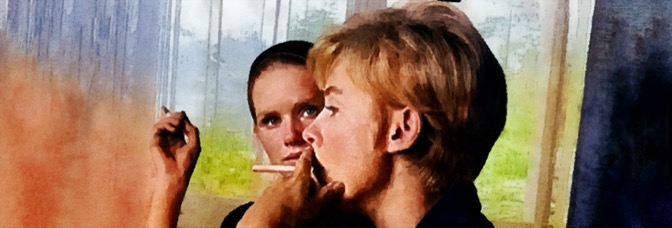
Persona begins with a series of unrelated, sometimes startling, sometimes disturbing images. It’s leader on the film reel, and it establishes the film’s narrative distance. We’re not just removed from the action; the action’s on display at multiple levels, including one involving a young boy, played by Jörgen Lindström, who provides bookends for the film.…
-

Somewhat recently I read an observation along the following lines–Ingmar Bergman created great roles for actresses by giving them absolutely awful emotions to essay. Whoever said it (I’ve tried, without success to properly credit her) said it a lot better. But at around the hour mark of Autumn Sonata, I couldn’t think of much else.…
-

At eighty-nine minutes, Through a Glass Darkly never has a chance to get tedious, which is part of the problem. Writer-director Bergman has just introduced the characters, just established the ground situation, when he tries a graceful segue into the characters and their relationships being familiar in the second act. They’re not. They’re still being…
-

Wild Strawberries is about a septuagenarian doctor (Victor Sjöström) being awarded an honorary degree. Sjöström’s narration sets it up in the first scene, before the opening titles. Director Bergman’s script, through the narration, lays out the entire ground situation before the titles, in fact. Sjöström is a widower, he has an adult son, he has…
-

The Seventh Seal has a lot of striking imagery. Gunnar Fischer’s cinematography is peerless, but it’s more–it’s how the photography works with the shot composition, how the shots work with one another (Lennart Wallén’s editing is simultaneously amiable and stunning). And then there’s how it all works with Erik Nordgren’s music. Bergman’s going for theatrics…
-

Darkness Falls runs fifteen minutes. The entire short film is set up for its end twist, which multi-hyphenate (including writer and director) Vinsencius hides fairly well. The short never meanders towards its conclusion, instead it just stops and muscles through a bunch of expository dialogue and then ends. The narrative requires newly introduced characters to…
-
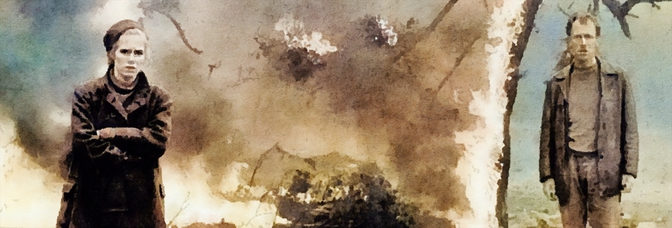
Shame has three or four sections. Director Bergman doesn’t draw a lot of attention to the transition between the first parts, he hides it in the narrative. Liv Ullmann and Max von Sydow are a married couple living on an island following a war. Not much information about the war, but they’re concert violinists turned…
-
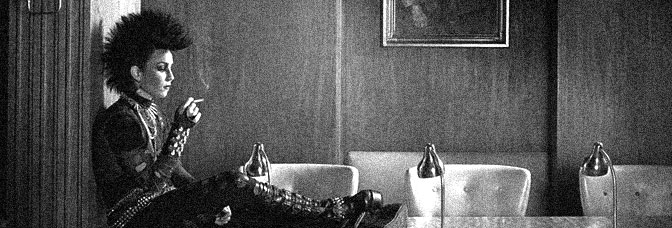
The first half of The Girl Who Kicked the Hornet’s Nest falls victim to the Halloween II phenomenon. The main character–in this case Noomi Rapace–is in the hospital and out of commission. Hornet’s Nest is never comfortable giving insight into Rapace’s actions, which makes it a mildly pointless final entry. I mean, a Hollywood ending…
-

Calling The Girl Who Played with Fire pointless is an insult to all the other pointless sequels out there. Fire–and I’m sure it’s a faithful adaptation of the source novel, which is undoubtedly pointless as well–is the worst kind of sequel. It has no new story, so it just goes back and forces one out…
-

There’s enough story for three really good movies in The Girl with the Dragon Tattoo, maybe even four. The film opens with two of them, a good, old fashioned journalism movie, and then the very serious experiences of Noomi Rapace. There’s some crossover, but it’s all contrived. Then the film blossoms and has two more…
-

I wonder how Let the Right One In would work if it made any sense. There aren’t exactly plot holes so much as nonsensical details. Why a vampire–even if she is stuck as a twelve-year-old–would want to hang out with other twelve year olds is never explained. Her assistant, who drains blood from bodies for…
 The Stop Button