Category: Foreign
-

I wonder how Let the Right One In would work if it made any sense. There aren’t exactly plot holes so much as nonsensical details. Why a vampire–even if she is stuck as a twelve-year-old–would want to hang out with other twelve year olds is never explained. Her assistant, who drains blood from bodies for…
-

I never know how to describe Ashes of Time. The first–and probably last–time I tried, I described it as a mix of Magnolia and Crouching Tiger, Hidden Dragon. As difficult as it is to describe, it’s got to be impossible to advertise–a character-based martial arts film, where fight scenes lack any visceral impact. Wong stylizes…
-
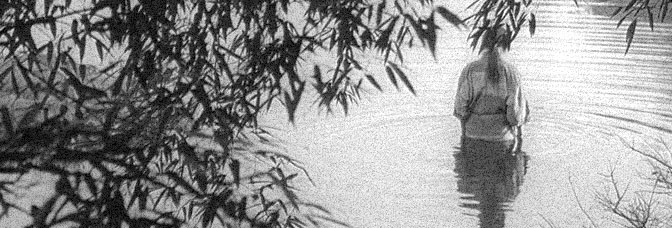
Sansho the Bailiff is one of cinema’s most depressing pieces. I don’t think, after about twenty minutes into the film, there’s a single positive moment. Good things happen–occasionally–but they only lead to bad things (or the revelation of bad things). The film opens with an epigraph, establishing the time period and some basics. It also…
-
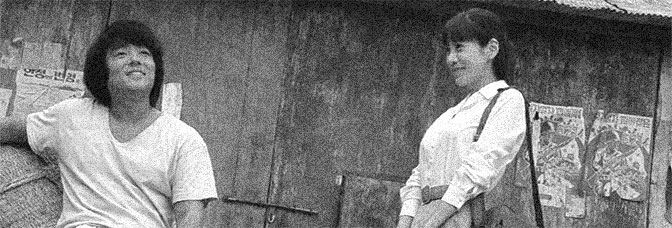
Mission Sex Control opens as an almost farcical comedy. The Korean President (circa 1972) meets with his cabinet to discuss family planning and its effect on the GDP. The meeting devolves into a screaming match between two cabinet members, then the opening titles splash across the screen. It all seems very comic, even as the…
-

Amores perros could be a public service announcement about canine cruelty in Mexico City. Mexico City has a population of around nine million and takes up about six hundred square miles. For such a big city, it’s kind of odd the cast keeps running into each other, since their only connection is being the subject…
-

I don’t think I’d ever realized M‘s technical importance. Lang creates quite a few filmmaking standards here, still in use today. Non-specific to genre, M features some brilliant off-screen dialogue work. It’s the earliest example (I’ve ever seen) of hearing a scene’s action while looking at something else. There’s also Lang’s approach to the sound.…
-

In graduate school, one of my classmates (or is it colleagues in graduate school?) was having trouble figuring out how to convey the fantastic, but not do magical realism. Another of my classmates (colleagues) recommended she watch Field of Dreams. Everyone was a little thrown by the comment, including me, but then I realized it…
-

Maybe half of Ghidorah is interesting. Or has the potential to be interesting. After the giant monster-heavy opening credits (stills of Godzilla and Rodan in battle), that aspect disappears for a while. Instead, Ghidorah is a strange mix of reporter and political intrigue movies. Hoshi Yuriko is a reporter for a news program covering strange…
-
Thanks to Joint Security Area, I was leery of Oldboy going in. While Park Chan-wook has a large fan base, all JSA did was convince me they weren’t seeing the same movie. Finally, after Oldboy, I can understand why he has the fan base… and it’s unfortunate. Park had his big revelation ending to Joint…
-
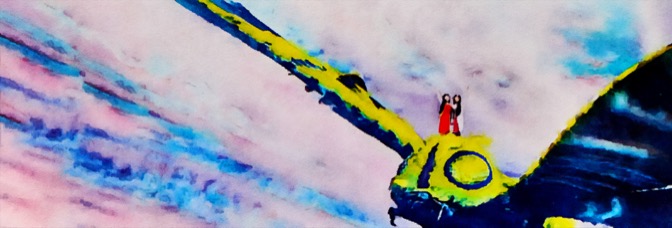
Mothra is a strange mix of Japanese monster movie, 1950s Hollywood sci-fi and Disney. The last ingredient only becomes clear at the end of the movie, though it’s probably present throughout (as Mothra returns home with the two fairies, it’s clear Mothra would have made a fine animated feature). But the strangest element of Mothra…
-
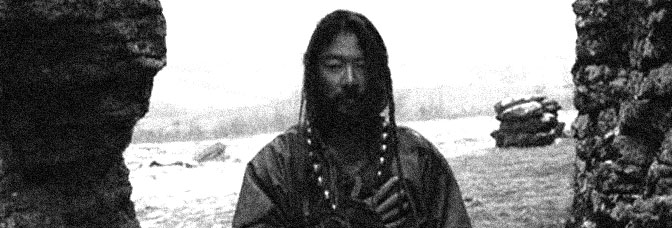
Mongol starts real strong. The Mongolian steppe lends itself quite well to Panavision composition and director Bodrov utilizes it fully. Bodrov’s approach to the material is interesting, if far from unique. For the Mongols riding on horses, he mimics Dances With Wolves. For battle scenes, especially at the end, he mimics Gladiator (which was just…
-

Taxi 2 is a sequel in the least artistic, but possibly most admirable way. It picks up an indeterminate time after the first movie, doesn’t deal with the first movie’s conclusion (Samy Naceri becoming a race car driver), and doesn’t really have a story. Instead, it opens with a car chase, then some humor, then…
-

A Good Lawyer’s Wife is beautifully directed. Im shot it Super 35 (full frame, then cropping it down to 2.35:1) and he uses a lot of steadicam, creating these fragile, exquisite compositions. Usually when I kick off with a description of the excellent technical filmmaking, it isn’t a particularly good sign. This one is no…
-
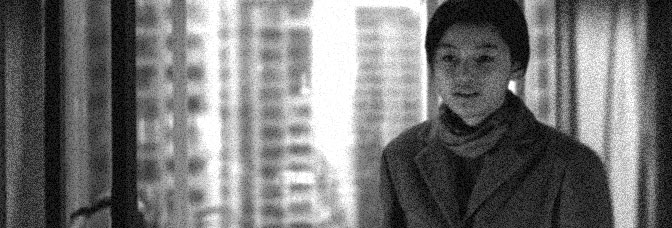
The Uninvited is a technically a horror movie, I suppose. There are ghosts and all. With the exception of the protagonist finding a kindred spirit–and her seeing ghosts too–the whole thing could work as a drama about trauma. In fact, as a drama, it would work well. During the movie, when the inevitable dumb horror…
-

Tell Me Something is, for a graphically violent serial killer movie, kind of goofy. It mixes genres–well, but it leads to the problem–starting off a straight cop movie, moving to the serial killer, then bringing in Shim Eun-ha as the damsel in distress. The serial killer aspect slows over time (especially since the killings, all…
-
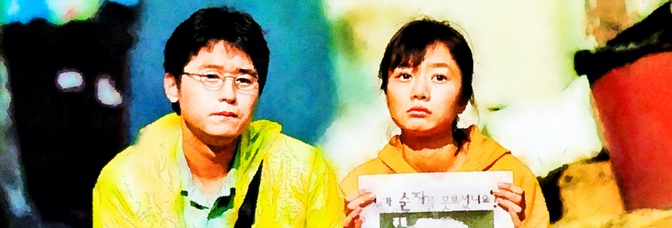
Bong’s first film is unique, not just of Korean cinema, but of most. It’s a mostly lyrical piece–lyrical in the storytelling sense, not the filmmaking (there are only a couple of stylized moments in the film)–juxtaposing Lee Sung-jae and Bae Du-na. Lee’s a grad student trying to become a professor, Bae’s an office assistant in…
-

Even with rats doing cute tricks–and maybe because of it–Invincible Enforcer is an unwatchable piece of… of something. I’m not even sure the correct noun. It’s my first or second attempt at a Shaw Brothers production and what’s really amazing about it is the editing. It’s got all the fast edits of a modern Hollywood…
-

I remember when Stalingrad came out on VHS. I was working at a video store and argued for ordering it, based on the ads mention of it having the same producer as Das Boot. Still, I was a little surprised at how much the opening credits try to go for a Das Boot feel. It’s…
-

Japanese manga adaptations tend to be absurd–at the same time amateurish and sublime, as all the actors in Battlefield Baseball keep a straight face throughout. The movie’s low budget, so very few of the punches connect and waiting for Versus’s Sakaguchi to have similar, beautifully choreographed fight scenes (even with Kitamura producing) is in vain.…
-

Taxi benefits greatly from its length–eighty-six minutes–and from Besson’s general understanding of how to amuse an audience. He does it to some success in his American films (a rather limited one, but he manages to create likable characters and not bore the viewer), but with Taxi, he does a lot better. The main selling point…
-

Deliberate, somehow endless–it clocks in at ninety-five–Tristana is something of an anti-Buñuel or, at least, I was expecting something a little more uncanny. Tristana is so normal, it’s something of a surprise (the film occasionally seems ready to leap into the surreal, but it remains grounded throughout). But it’s very boring, in that good way…
-

Episodes of the “Twilight Zone” ran thirty minutes, or whatever without commercials, for a very good reason. Stretching a one-note story out to an hour would be too exasperating. Woman in the Dunes stretches it out to, I guess, two and a half hours. The film starts interestingly enough. An entomologist looking for bugs finds…
-

The fabulous, “has to be a set” of a small business district adjacent a canal is not the best thing about Hotel du Nord, but it’s uncomfortably close. The film’s solidly directed, with some nice composition and some nice camera movement, but it’s nowhere near enough to pluck the film from the tub of melodramatic…
-
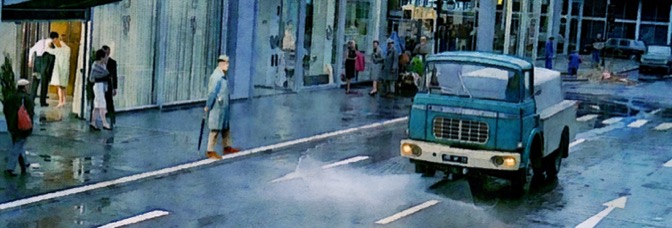
Play Time opens as an attack on modernity worthy of George Amberson Minafer, dealing with the personality-free office place populated by cubicles, to the lines of similarly dressed men on their ways home after work or the same type of men all getting into the same kind of car after their work day. There’s some…
-
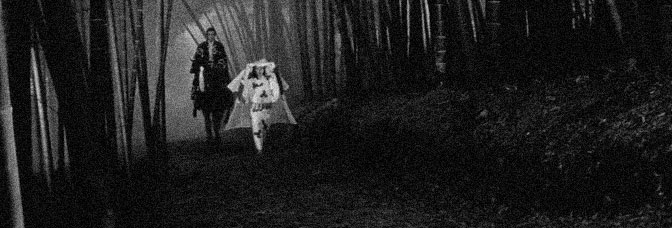
I thought I was going to start this post with a witty remark regarding the film’s use of repetitiveness to excellent overall effect, but then the movie ended and, by that time, much of the excellence had drained. Kuroneko is a gorgeous film–Shindo uses theatrical lighting effects for ghostly emphasis, which really works–and for a…
-

Sky High has got to be one of the stupider movies I’ve ever seen. There are other factors contributing to it being bad, as stupidity doesn’t necessarily undo a film, but it’s real stupid. Shockingly, the screenwriter worked on Kitamura’s perfectly fine Azumi. Sky High‘s a prequel to a TV series, which is an adaptation…
-

Paradise Murdered is particular kind of murder mystery… I’m having trouble coming up with a good adjective. I need something to take various elements into account: it’s uncanny, post-paced, engaging… it’s also laugh-out-loud funny. So I guess it’s madcap. Or zany. I’ve never seen a film so deftly toggle between being funny and being disturbing.…
-

I can’t believe I’m about make this statement… Angel-A would be better if it were American. Besson could still direct, still write the base story (someone else would have to come in and add… you know… subplots), still have his lead Rie Rasmussen (who’s Danish, not French, as IMDb informs… which makes sense–I’ve never seen…
-

While the Koreans do make the best ‘dying girl with mysterious illness falls in love’ better than anyone else, I’m not sure it’s an honor one would want. The amazing thing about how well they make these films is I don’t have any complaints with the writing of …ing. It’s fine. It’s effective, engaging, occasionally…
-

To say Godzilla vs. SpaceGodzilla has it all is an understatement. It has more than that. It has dirt bikes, black holes, a “Muppet Babies” version of Godzilla, a superwoman, walks on the beach at sunset, and, apparently, the first butt shot in a Godzilla movie. It’s a wacky mess, proving having no story is…
 The Stop Button