Category: Cult
-

Mad Monster Party? spends a solid portion of its runtime only slightly amusing. It’s technically competent stop-motion animation with a charming voice performance from Boris Karloff as Boris von Frankenstein. He’s just discovered the anti-life formula and has become destroyer of ravens, potentially worlds. Having run the gamut from creating life to creating anti-life, Karloff…
-

Either there’s a good story behind Fist of Fear, Touch of Death’s production or it’s exactly what it seems to be, some producers got ahold of the rights to an old Chinese movie, 1957’s The Thunderstorm, starring a teenage Bruce Lee in a non-martial arts role (in fact, it’s incest melodrama), and couldn’t figure out…
-

Once it’s clear directors Patching and Serritiello are going to be able to keep Gelateria going, the question becomes how can they possibly end it. The film opens with a lone figure on a rocky beach, yelling into the sea. The water has sound, the yells don’t have sound. Given how the film ends… it’s…
-

Released in 1998, Six-String Samurai makes the big move of using a very familiar piece of music from the Pulp Fiction soundtrack (Misirlou, which is also the music on the Pulp Fiction trailer) during a big action sequence. It’s not a bold move, because Samurai hasn’t got any boldness. It even walks back being tough…
-

Low budget oddity from director Hall (Sr.) promoting his son (Hall Jr.) as a blond Elvis-type, only Hall Jr. doesn’t have any discernible talent. Good hair volume though? Hall Jr. and girlfriend Marilyn Manning discover a caveman (Richard Kiel) living in the wilds of Southern California and Hall Sr., intrepid explorer, heads off to get…
-

When I decided to write about Patterns of Evidence: The Moses Controversy, it was because I wanted to make the wee dick move of putting it in Stop Button’s rarely used “Cult” category. Thought it’d be funny. Controversy, which never suggests it’ll be anything but writer-director-star Mahoney setting up a flimsy straw man and knocking…
-

Tell Your Children, or Reefer Madness, is sort of mundanely bad. Sure, Carl Pierson’s editing somehow pads shots to make the sixty-six minute movie drag even more than it does because of the terrible script and bad acting, but the script is just dumb and bad. There’s nothing exciting about it, other than to see…
-
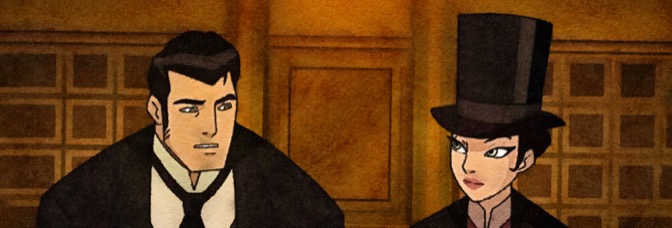
The first act of Gotham by Gaslight is rough. It establishes Batman (Bruce Greenwood) in the Victorian era. He’s fighting with Fagin-types while “Jack the Ripper” is attacking prostitutes. Jim Krieg’s script, which will go on to impress at times, is rather problematic with the first Ripper victim. Director Liu’s already opened the film with…
-

Incubus is the day in the life of a dissatisfied succubus (Allyson Ames) who, after killing three men in the ocean and condemning their souls to hell, decides she wants a challenge. Her sister, also a succubus (and played by Eloise Hardt), counsels her against the impulse. But Ames won’t be dissuaded. She wants to…
-

Ragnarok is a “video [comic] strip.” There’s no animation, though occasionally there are electric crackles, just panning, scanning, and zooming across illustrations while three voice actors perform multiple roles. There are sound effects–minimal ones, which sometimes works to great effect, sometimes doesn’t. There’s no credited director or editor. The illustrators get credit, as does writer…
-

Director Moore snuck cameras into Disney World (and Disneyland) to tell the story of a creepy dad who goes insane while on the last day of the family vacation. Moore, who also wrote the tedious script, has reasons for the insanity, but they’re all nonsense because Tomorrow is more about showcasing the guerrilla filmmaking and…
-

There’s a lot to be said about Batman: The Killing Joke, both the comic book and its animated adaptation. It’s another of Alan Moore’s unintentional curses on mainstream comics; listening to his dialogue spoken… it’s clear he was hurrying through the Batman stuff. Or Kevin Conroy just doesn’t do it right. I don’t know. Because…
-

Justice League: War raises the “interesting” question of whether or not superheroes are any fun to watch when they’re vain, selfish bullies. It sort of leaves the answer unresolved, though it’s definitely a lot more entertaining when Alan Tudyk’s Superman leaves for a while. Tudyk’s performance isn’t any good but it’s probably not his fault.…
-

You know what would have been nice? If the makers of Justice League: The Flashpoint Paradox had any idea what they were doing. In the last act, there’s all this Flash action–he’s running around, fighting at super speed–and it’s all fantastic. Even with a cruddy director like Oliva. But there’s none of it before the…
-

Tales of the Night is a visual masterpiece. It’s computer generated silhouette animation, usually two dimensional (though director Ocelot does branch occasionally into the third), about what seems to be a futuristic theatre company. Late one night, two young actors (and costume designers and writers) and the guy who seems to be their director, sit…
-

The strong parts of Batman: The Dark Knight Returns, Part 2 make the weak ones often easy to ignore. But nothing’s strong enough to overcome the weakest spots. First is the misogyny. I assume it’s straight from the comic. The filmmakers chose to embrace it (the fidelity to the source material is a lot of…
-

It’s interesting to hear Peter Weller voice Batman in Batman: The Dark Knight Returns, Part 1 (is that title long enough?) since Dark Knight Returns, the comic, always felt like Batman meets Robocop. Not so much because of the tone, but because Frank Miller uses media intercuts to flesh out the setting just like Robocop…
-

Batman: Year One should be much, much better. As it stands, as animated adaptation of Frank Miller and David Mazzucchelli’s comic books, it’s a fantastic proof of concept. It’s no surprise, given much has already been adapted, albeit uncredited, into Batman Begins. I guess Christopher Nolan doesn’t know how to cite. But co-directors Sam Liu…
-
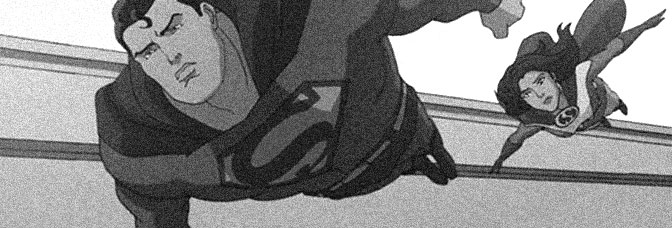
All-Star Superman, the comic book, is maybe the best Superman comic book. Based on empirical observation (i.e. the other animated DC Comics movies from Warner Premiere), I assumed All-Star Superman, the animated movie, would be awful. I was wrong. It’s wondrous. It’s not without its problems, of course. The movie is based on the comic,…
-

Kevin Conroy has been doing the Batman voice for, off and on, almost twenty years. If his work in Apocalypse is any indication, he’s gotten a little tired of it. At least there’s only one aspect of a phoned-in voice performance. Some of it might be the awful script from Tab Murphy (probably taken verbatim…
-

Apparently, given the chance, comic book writers write screenplays just like comic books. Sitting through Under the Red Hood is not an unpleasant experience–Bruce Greenwood, voice alone, is the best Batman since Michael Keaton, animated or actual–but it’s got an atrocious plot structure. First, the movie would be unintelligible for anyone who didn’t read Batman…
-

The new wave of superhero cartoons for, ostensibly, adults (because they’re rated PG-13) has turned out a handful of decent pictures. The directors of this one, Montgomery and Liu, separately, directed the entirety of that handful. So I thought I’d try it for them. Plus, this one’s written by Dwayne McDuffie, who’s a comic book…
-
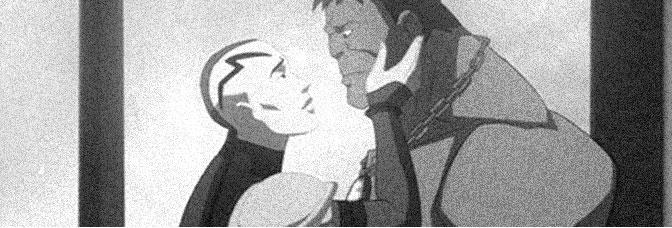
I think the only reason I liked this one is because it’s incredibly harsh (no pun). Not only do they have one character–while thirteen years old–killing her parents (after they’re turned into zombies) on screen, she then kills her little brother, now a zombie too (off screen), and later having a little kid die in…
-

I’m sure there are some hardcore gay comics less homoerotic than Jeph Loeb’s Superman/Batman, so the prospect of seeing it as a cartoon was irresistible. While Warner Premiere ostensibly intends their latest line of animated DC Comics adaptations for “adults” (i.e. men in their twenties and thirties with the discretionary income to waste it on…
-
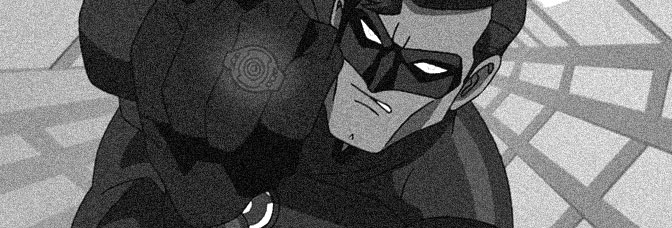
There’s a certain amount of competence to the plotting in Green Lantern: First Flight. It’s too bad the filmmakers didn’t pay the same attention to the characters. The film basically lifts the plot structure from any number of established sources–Star Wars, The Matrix, a little Superman here and there–to tell this origin story about a…
-

They really should have cast Rosario Dawson as Wonder Woman. Never thought I’d be typing those words–even if it is just voice casting–but Dawson is so much better than Keri Russell, whose Wonder Woman comes off as dependent on Nathan Fillion’s male for everything down to pseudo-feminist banter. Russell’s voice defers and doesn’t suggest any…
-
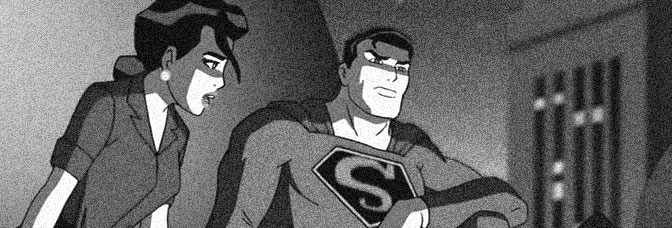
In terms of ambitiousness, Darwyn Cooke’s The New Frontier is in many ways as ambitious as a superhero comic book can get. Cooke tied DC Comics superheroes to the American political landscape of the 1950s and, while he didn’t have an absolute success, he did just fine, never losing the zeal (occasionally letting it go…
-

Compilation of three short films by director Harris. The first is a segment for the TV news about a young man in Utah who likes to get into Olivia Newton-John drag and perform. Second is Sean Penn reenacting that segment, only while addressing the damage Harris’s handling of the actual news item did to the…
 The Stop Button