Category: Classics
-

As Captains Courageous enters its third act, Spencer Tracy (as a Portugese fisherman) reminds Freddie Bartholomew (a spoiled blue blood kid Tracy rescues after he falls overboard from an ocean liner) it’s almost time to go home to his regular life. It’s a shock for Bartholomew, but also for the viewer. Even though the first…
-
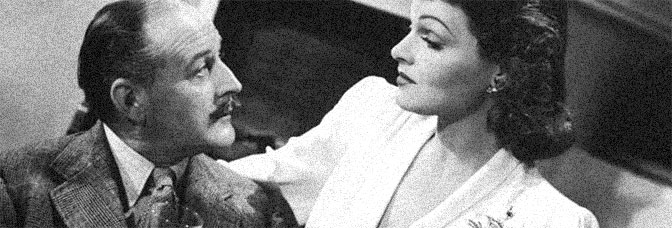
Quartet opens with what turns out to be a questionable introduction from source story author W. Somerset Maugham. In the rather stodgy introduction to the film–featuring adaptations of four personal favorites from Maugham’s extensive bibliography–Maugham indentifies adjectives critics have given his work over the years. Those adjectives prove useful during some of the film’s more…
-
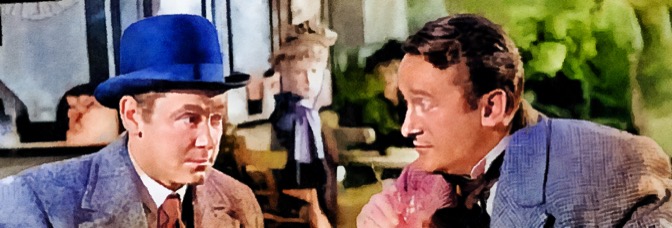
The Moon and Sixpence has a number of serious problems, all of them the fault of director and screenwriter Lewin. As a director, while never spectacular, Lewin manages some competence and ambition. He tells Moon and Sixpence in a series of summarized flashbacks. Those flashbacks, narratively and budgetarily effective, end up being the film’s undoing.…
-

Overlong confused (not confusing) thriller about newlyweds Katharine Hepburn and Robert Taylor. Taylor seems too good to be true, except he flies into a rage whenever his missing, saintly brother is mentioned. So Hepburn starts investigating, just without much interest. There’s a real disconnect between Minnelli’s direction and Edward Chodorov’s script. Minnelli does all right…
-
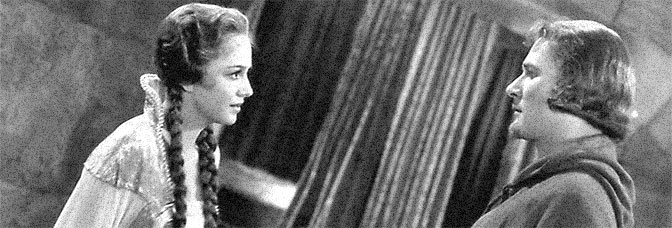
The Adventures of Robin Hood gets by on a lot of charm. Charm and costuming (good and bad). The film opens with title cards setting the scene. Sherwood Forest, evil King’s brother, righteous nobel, beautiful damsel, insidious villain, and Technicolor tights–Claude Rains looking like a Little Lord Fauntleroy grew up and broke bad. Rains, with…
-
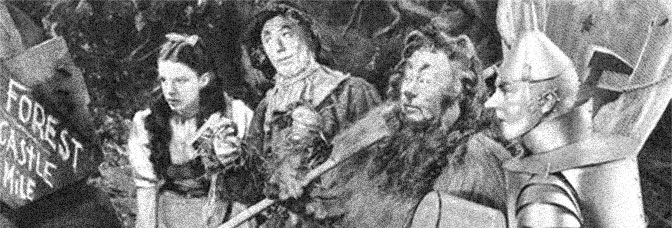
By the time the door opens and Dorothy (Judy Garland) finds herself over the rainbow, The Wizard of Oz has already completed one full narrative arc and is starting another. The film opens with Garland in a crisis–she’s a teenage girl on a farm where no one has time for her (it’s a busy farm,…
-

Duck Soup is madness. It’s not divine madness or sublime madness. It’s comedic madness, which is fine, but it’s a tad frantic and a tad distracted. The film opens with Margaret Dumont’s wealthy widow getting Groucho Marx installed as a head of state. Turns out evil Louis Calhern–a neighboring country’s ambassador–wants to create unrest and…
-

A Connecticut Yankee fumbles on pretty much every level, including wasting lead Will Rogers. The big problem is the script, from William M. Conselman. It doesn’t help any director Butler can’t mount an action or comedy sequences, because there’s nothing else in the picture. It doesn’t even work as a Rogers vehicle because his character’s…
-

Valentino opens with lead Anthony Dexter (whose resemblance to Valentino got him the job, not his acting abilities) doing the tango. It’s the troupe’s rehearsal and it’s fine. It’s not concerning, which is sort of cool for the film, because most of the scenes are concerning. George Bruce’s screenplay–based on his own story, “Valentino As…
-

The Blot has a lot of plot. Lot of plot. Director Weber fills the film with characters and subplots–unfortunately, not many of the supporting cast get credited so I’ll just have to compliment based on their characters. The main plot is about rich college kid Louis Calhern who discovers–because he has the hots for his…
-

The most impressive things about The Little Foxes are, in no particular order, Bette Davis’s performance (specifically her micro expressions), Patricia Collinge’s supporting performance, director Wyler’s composition, director Wyler’s staging of the narrative (adapted by Lillian Hellman from her play and set in a constrained area but a living one), Herbert Marshall’s performance, and Gregg…
-

The first thirty-nine percent of Never Say Goodbye is phenomenally paced. It could be a short movie, if there were a little tragedy through in. A little melodrama. Seven year-old Patti Brady is moving back in with mom Eleanor Parker after living six months with dad Errol Flynn. They’re divorced. Flynn’s a successful cheesecake pinup…
-

Peyton Place takes over a year and a half starting in 1941. Director Robson has a really slick way of getting the date into the ground situation. Robson and cinematographer William C. Mellor go a little wild with Peyton Place–there’s a lot of location shooting and Robson tries hard to make the viewer feel enveloped.…
-

Vigil in the Night is supreme melodrama. I mean, in its first ten minutes, the film manages to establish a small English town’s hospital, introduce stoic nurse Carole Lombard and her flighty sister Anne Shirley, throw them into tragedy and crisis, and kick Lombard into an entirely new setting. Vigil in the Night is an…
-

It’s a Wonderful Life is going to be a tough one. When I was a kid, during the public domain days, Wonderful Life was omnipresent. It became a joke because of that omnipresence. But also because it’s undeniably sappy. And it has angels in it. It’s so saccharine, I didn’t even notice my eyes tear…
-

Rear Window is an absurdly good time. It’s breathtakingly produced and the set is a marvel on its own, but it’s also an absurdly good time. You’ve got Thelma Ritter chastising James Stewart not just for peeping, she also chastises him for not being serious enough about Grace Kelly. How could it not be an…
-

Champion is a boxing picture. It ends with a big fight, as boxing pictures are wont to do. However, as the fight starts and the film cuts between all the people Kirk Douglas’s Champion has wrong, the film isn’t asking the viewer to root for the protagonist. Douglas is a bad guy. The entire third…
-

Journey Into Fear has a number of insignificant problems, a couple significant ones, and one major one. The major one is Foster’s direction. It’s not bad, it makes good use of the sets, it even uses some of the supporting cast well, but it’s not frightening, it’s not exciting. Journey Into Fear, not just because…
-
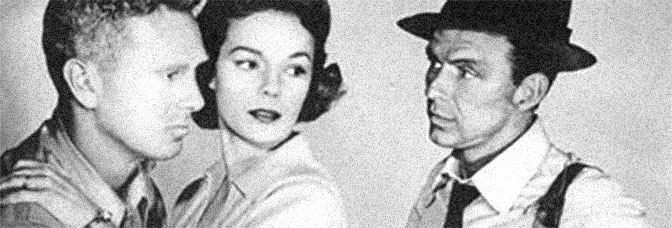
I’m sure there’s got to be some examples of well-written “Red Scare” screenplays, but Suddenly isn’t one of them. Writer Richard Sale’s got a lot of opinion about the dirty Commies, he just never gets the opportunity to have any one character fully blather it out. They’re too busy blathering out patriotic platitudes while being…
-

Pride of the Marines is a disappointment. It never gets particularly good, but it does have a lot of potential–at least from its cast–so when it starts getting better and then slips, it’s a disappointment. The film starts before Pearl Harbor with John Garfield’s would-be bachelor falling for Eleanor Parker. Garfield’s reasoning for wanting to…
-

Patterns is a short and simple picture. Van Heflin is the new man at a corporation; he suspects he’s there to replace his assigned mentor, Ed Begley. He has a ruthless boss (Everett Sloane) and a similarly ruthless wife (Beatrice Straight). Will Heflin, called a rising young man (Heflin was forty-eight on release), give in…
-

Even though Give Us the Moon ends up going exactly where I expected it to go, the film’s not predictable at all. It opens with Peter Graves’s post-war layabout. He was a war hero, his father (Frank Cellier) is a rich hotelier, he wants to do nothing with his life except enjoy it. Through coincidence,…
-

Midnight is a rather smart film. Screenwriters Charles Brackett and Billy Wilder are able to do a whole bunch of plot twists–always through comedic means–because of how they’ve got the film structured. The film opens with Claudette Colbert arriving in Paris, penniless. Taxi driver Don Ameche takes pity on her and falls for her. There’s…
-

Sullivan’s Travels is almost impossibly well-constructed. Director Sturges, editor Stuart Gilmore and photographer John F. Seitz go through various, entirely different narrative devices and do them all perfectly. Whether it’s a high speed chase, Veronica Lake having a screwball comedy sequence on the studio backlot, Lake and lead Joel McCrea having soul-searching conversations, McCrea and…
-

Joan Crawford is top-billed in Love on the Run. Unfortunately, she has absolutely nothing to do in the entire film. Maybe if Clark Gable had something to do besides deceiving everyone (and then rescuing Crawford) the movie might make it through better, but he doesn’t. Love on the Run is eighty somewhat charming minutes of…
-
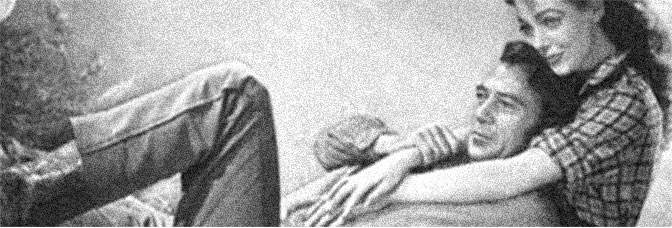
Along Came Jones gets by on its gimmick and its charm–it’s got a lot of charm, both from the cast and Nunnally Johnson’s screenplay, which is good as director Heisler doesn’t bring any. Jones is a lower budget Western, lots of rear screen projection, lots of boring setups from Heisler. He prefers medium long shots,…
-

The Third Man runs just over a hundred minutes and takes place over a few days. It’s never clear just how many; director Reed and writer Graham Greene are both resistant to the idea of making the film too procedural. Greene’s scenes, even when they’re expository, still strive against lucidity. Everyone in the film is…
-

Detective Story, the film, is William Wyler’s “production” of Sidney Kingsley’s play of the same title. Philip Yordan and Robert Wyler adapted the play. Wyler directed and produced the film. It is a stage adaptation and proud of it. The phrasing above is directly adapted from how the film opens and credits Wyler and Kingsley…
-

Thirteen Women runs just under an hour. A minute under an hour. There was pre-release cutting on the studio’s part. But with those fifty-nine minutes, director Archainbaud is still able to create one heck of a creepy film. The film’s not a mystery. It’s not even a thriller. It’s all gimmick, but it’s suspenseful all…
-
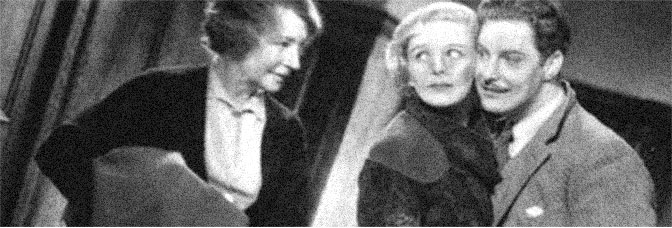
There are numerous good moments in The 39 Steps. Even the clunky finale is a good moment–director Hitchcock knows he’s got a good moment, he just doesn’t know how to fill in around it. This inability on Hitchcock’s part makes The 39 Steps immediately interesting when compared to the rest of Hitchcock’s filmography, but far…
 The Stop Button