Category: Classics
-

The first third of City Streets is this awesome bit of experimenting from director Mamoulian as he tries to figure out how to make a sound picture. Lots of great shots and camera setups, usually with too dawdling cuts. William Shea holds everything just a few seconds too long. But the montage imagery itself is…
-

What’s so frustrating about Champagne for Caesar is how little the film really would’ve need to do to be a success. It just needed a rewrite. Someone to come in and fix Hans Jacoby and Frederick Brady’s script, which is usually fine but they really can’t figure out what to do with Celeste Holm. And…
-

From the first scene, Mighty Joe Young is concerning. There’s a nice establishing shot of an Africa plantation, with some great matte work, then little White girl on the plantation Lora Lee Michel sees a couple African men passing with a basket. She wants what’s in the basket, so there’s a nice lengthy barter sequence…
-
From the first scene, Mighty Joe Young is concerning. There’s a nice establishing shot of an Africa plantation, with some great matte work, then little white girl on the plantation Lora Lee Michel sees a couple African men passing with a basket. She wants what’s in the basket, so there’s a nice lengthy barter sequence…
-

The You in You Can’t Get Away With Murder refers to Billy Halop, nineteen year-old punk kid who doesn’t respect what sister Gale Page sacrifices for him and instead runs around with neighborhood tough Humphrey Bogart. They knock over gas stations, they play pool, it’s a good life… at least until things go wrong during…
-

I finished watching It Came from Beneath the Sea, which I regret, particularly because the whole reason I didn’t shut it down was for the big special effects finale, when the giant radioactive octopus finally attacks a city. Incidentally, it’s San Francisco, which doesn’t turn out to be anywhere near as cool looking as I…
-

The Princess Comes Across is an uneven mix of comedy and mystery. Too much mystery, too little comedy, noticeable lack of romance. The romance is an awkward afterthought in Walter DeLeon, Francis Martin, Don Hartman, and Frank Butler’s script (four screenwriters is probably too much even in 1936; definitely for this kind of picture), which…
-

Niagara has some noir-ish elements to it—femme fatale wife Marilyn Monroe stepping out on war veteran husband Joseph Cotten—but it’s not about the darkness, it’s about the light. And its location shooting. Niagara takes full advantage of the falls, not just for scenery but for multiple story elements (we find out Monroe’s stepping out because…
-

Bogart meets Bacall in the 1940 Caribbean; he’s an old ex-pat fishing boat captaining and trying to keep his head down in Vichy-controlled territory, she’s a young ex-pat more concerned with getting out of where she’s been than where she’s going. The star wattage on Bacall–everyone just sits and watches her, Bogart grinning by the…
-

Singular character study about reluctant but ace Korean War flier William Holden and the people around him. The film toggles between Holden, devoted and uninformed wife Grace Kelly, and admiral Fredric March, who’s taken an interest in Holden’s career. Rambunctious helicopter rescue pilot Mickey Rooney also figures in. Great acting, direction, writing (Valentine Davies adapting…
-

Very smart comedy about married lawyers Katharine Hepburn and Spencer Tracy. She’s the crusading progressive, he’s the assistant D.A. Usually they’re just adorable together but then Hepburn defends a wife on an attempted murder rap–the wife (a phenomenal Judy Holliday) shot her cheating husband. And of course D.A. Tracy’s the prospector; martial courtroom warfare ensues.…
-

After a strong build-up, mostly thanks to Jack Palance’s great lead performance, this heist picture implodes in the third act. He’s an ex-con, sprung (by a delightful Lon Chaney Jr.) to knock-off a resort hotel’s jewelry vault. If he can get his young punk sidekicks in shape for it, which seems questionable with Shelley Winters…
-
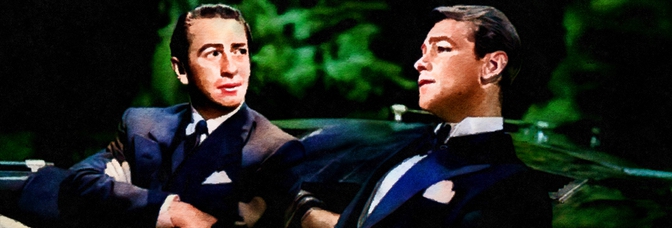
Not bad adaptation of F. Scott Fitzgerald novel makes plenty of adjustments for the Production Code and has some significant misses in the casting department, but lead Alan Ladd takes the part seriously, tries, succeeds. Unfortunately no one in the supporting cast comes anywhere near close, with both narrator Macdonald Carey and lost love Betty…
-

Singular film noir from Welles. It’s a family affair, with Welles writing, directing, acting and then wife Rita Hayworth playing the female lead. She’s the gorgeous, married rich woman, he’s the able-bodied Irish sailor. The film’s peculiarly, intentionally told tale of lust, hatred, and murder. Everett Sloane’s phenomenal as Welles’s boss and Hayworth’s husband. Some…
-

High concept propaganda picture without enough concern for executing that high concept; neither from writer Dalton Trumbo or director Fleming, leaving the cast to (ably) fend for themselves. After a protracted setup with Spencer Tracy doing a middling job romancing Irene Dunne, the story moves to Tracy mentoring new flier Van Johnson (who will eventually…
-

Magnificent comedy about successful Broadway producer John Barrymore finding his muse in untrained lingerie model Carole Lombard. The film charts the rise and fall of their partnership, which gets romantic, in the first half, spends the second half giving them a chance to reunite (in a train-set screwball comedy). Awesome performance from Barrymore, great one…
-

Smart, fun, and funny political satire slash history lesson about the rise of Machine politician Brian Donlevy, charting his path from Depression-ravaged forgotten man to thug to politician to lover to fighter. Great performances from everyone involved–Donlevy’s got the least flashy part but he holds the whole thing up. Muriel Angelus is great as his…
-

Overall disappointing noir about down-on-his-luck screenwriter Humphrey Bogart getting his mojo back thanks to fetching neighbor Gloria Grahame taking an interest. Unfortunately they’ve just met because Bogart’s a murder suspect and, despite falling for him, Grahame isn’t exactly sure he didn’t do it. The leads are far better than the script, just never at the…
-

Rather strong character study masquerading as a thriller about wealthy housewife Joan Bennett contending with a rebellious teenage daughter (Geraldine Brooks, in the film’s only weak-ish performance), the daughter’s skeezy older lover (Shepperd Strudwick), and the blackmailer who finds out about the illicit affair (James Mason)–all while getting the house ready for Christmas. Bennett’s phenomenal,…
-

Outstanding period drama about unmarried heiress Olivia de Havilland’s courtship by charming but poor Montgomery Clift and the repercussions for de Havilland’s relationship with her father, Ralph Richardson. Small story grandly told; Ruth and Augustus Goetz adapted their own play (which was adapted from Henry James’s Washington Square). Fantastic performances from everyone involved, stellar direction…
-

Vapid multigenerational Irish family epic about Oliver Parker, Dennis Price, and Dermot Walsh running the family copper mine and having to contend with the locals. Margaret Lockwood plays the woman who enraptures the first generation of sons, which leads to the problems for the next generation’s. Runs just under 100 minutes, has about a scene…
-

Constantly disappointing light comedy about turn of the twentieth century newspaperman Dick Powell getting tomorrow’s headlines today and trying to use it to his best advantage, initially involving his wooing of magic act assistant Linda Darnell. Unfortunately Darnell’s barely relevant to the actual plotting… heck, Powell’s often just along for the ride–Jack Oakie, in a…
-

Pretty good but should be a lot better considering the stars and director WWII submarine picture. Clark Gable is the commander who strong-arms his way onto Burt Lancaster’s boat to take it on a Captain Ahab suicide mission against a very successful Japanese destroyer. Good acting from the leads (almost great from Lancaster) and nice…
-

Way too chaste to be effective “potboiler” (maybe a Kansas potboiler?) about ne’er-do-well William Holden (playing somewhat younger than his 37 years) coming to a small town to beg a job off college pal Cliff Robertson, only to get in between Robertson and his best gal, local restless beauty queen Kim Novak. Excellent supporting performances…
-

Flashback heavy noir suffers Horner’s frequently inept, always disinterested direction, a bad script (from Dwight Taylor), and a horribly miscast Richard Boone. Boone’s an obsessive but ostensibly wimpy detective who takes on the murder case of title character Jean Peters. No spoilers, it’s in the opening credits. Elliott Reid is the prime suspect, Jeanne Crain…
-

Major missed opportunity adaptation of a Somerset Maugham model about working girl Joan Crawford temporarily stranded on a South Seas island with Christian missionary Walter Huston. Huston takes it upon himself to make Crawford godly or ruin her life if she doesn’t consent to it. Sometimes great Crawford performance just doesn’t work with Huston’s loud…
-

The longest continuous stretch of Invasion of the Body Snatchers is about fifteen minutes (the film runs eighty). Small California city doctor Kevin McCarthy and his long-lost lady friend Dana Wynter have just spent the night holed up in his office, hiding from their neighbors, who have all been replaced by “pod people.” The pods…
-

Secret People is a very peculiar propaganda picture. It’s mostly set in 1937, almost entirely involving Italian immigrants, and it’s very pro-British. The film downplays the idea fascist regimes are dangerous (fascist regimes in 1937, remember) while getting behind the idea of doing whatever the British government says, even if what they say is appease.…
-

Stalag 17 opens with narration explaining the film isn’t going to be like those other WWII pictures, where the soldiers are superhuman and the film bleeds patriotism. No, Stalag 17 is going to be something different—first off, it takes place not on the battlefield, but a German prison camp. Through coincidence, the camp is entirely…
-

Moonfleet is a very strange film. The protagonist is ten year-old Jon Whiteley; the film starts with him arriving in the coastal village, Moonfleet. It’s the mid-eighteenth century. Moonfleet is a dangerous, scary place. Sort of. Whiteley is in town on his own because his mother has died (Dad is a mystery, but nowhere near…
 The Stop Button