Category: Classics
-

Either Alan Ladd was in a bunch of makeup or he’d just had his eyes done because the way his eyebrows don’t move is disturbing. There are a few scenes where Liesen, presumably in an attempt to keep down the expository dialogue, has Ladd try to communicate with his eyes. They fail. Those scenes, and…
-

I’ve seen Bachelor Mother at least twice before but didn’t remember the most salient feature of the film. I even forgot what a big part Donald Duck plays in it (though I did remember David Niven’s watching the clock to wait to say “good afternoon” as opposed to “good morning”). No, what I forgot was…
-

Man Made Monster, at least for the first fifteen minutes (of an hour), gives Lon Chaney Jr. one of his best roles. He gets to be the affable guy his other performances from the forties often hint he’s capable of being, but never gets to be. Not surprisingly, Monster takes that aspect of his character…
-

About two minutes after I finished watching Mystery of the 13th Guest, I realized no one ever solves the titular mystery. There’s a mysterious thirteenth guest in the first scene; the guest is absent and his or her identity is never revealed. Tim Ryan’s police lieutenant is supposed to be sort of dumb (but smarter…
-

Gordon Harker was fifty-five when Inspector Hornleigh on Holiday came out. It’s very strange to see a film from this period with someone his age the lead in a comedic mystery. I’ve never seen him in anything and I can’t remember seeing Alastair Sim in anything but I know Sim’s name. I spent the entire…
-

For the first twenty minutes or so–it runs just over an hour–A Shriek in the Night seems like it might be a decent, b mystery. Ginger Rogers is appealing as the reporter undercover as a murder victim’s secretary and Purnell Pratt is great as the police inspector on the case. Unfortunately, it isn’t about the…
-

What an unmitigated disaster. It takes a lot for me to open with such a statement–well, maybe not, but certainly for a film I finished watching, even if it only does run sixty-two minutes. But Revolt of the Zombies might be one of the worst things ever and really shouldn’t be. Okay, worst things ever…
-

I think The Speckled Band is a period piece but maybe not. There aren’t any exterior establishing shots in London, so no automobiles. It’s a question because the Sherlock Holmes in this film isn’t some recluse… he’s got an office and three secretaries. The film has a very episodic feel to it, but not in…
-

Ralph Bellamy gets top billing here, but he doesn’t deserve it. I’m always stunned when, with a reasonably early feature motion picture like Before Midnight, the filmmakers are clearly exhausted with the genre. Midnight‘s a big house mystery (enclosed setting, certain number of suspects) but the opening establishes the majority of the film is set…
-

For a while, I almost thought White Zombie was going to feature a good Bela Lugosi performance. It does not. However, it does feature one of the best Bela Lugosi performances I’ve ever seen. He plays a zombie master who controls his helpless zombies (who mostly do manual labor for Lugosi at his sugar mill–I…
-
My reaction to Bad Day at Black Rock is a guarded one. It runs eighty-one minutes and is frequently long when it should be short and short when it should be long. The conclusion, for instance, is something of a misfire. Ironically, after abandoning him for fifteen minutes near the beginning, the film sticks with…
-

Manhattan Tower opens with the Empire State Building and closes with it. I’m not entirely sure they ever call it by name in the film but it’s not supposed to be “real,” I don’t think. Tower‘s Empire State is a world onto itself, so much so, it’s a shock people leave it to go home…
-

Murder at Glen Athol should be just a little bit better. The script has a number of twists, with Strayer handling them ably, but it’s just too short as it turns out. The film runs under seventy minutes, which would be fine for a B mystery, but Glen Athol (the title is problematic–Glen Athol is…
-

The Mummy’s Curse feels like a Universal attempt at a Val Lewton picture. It’s from 1944, so Lewton’s modern horror pictures had already come out. It’s hard to believe Universal changed their approach to monster movies so radically between this picture and the previous Mummy entry. Curse is set on the bayou in Louisiana (Lewton…
-
If you took a film noir and removed the noir, you might have something like Criminal Court. The plot is noir. An upstanding attorney (Tom Conway) accidentally kills mobster (Robert Armstrong) and runs off, unknowingly leaving his girlfriend (Martha O’Driscoll) to take the wrap. What does Conway do? Does he try to falsify evidence to…
-

The Mummy’s Ghost is, with a couple problems, really good for a monster movie (and leagues ahead of Universal’s other 1940s Mummy features). It’s not so much about the Mummy as the victims and the investigation (but the police investigation, not the scientific–and everyone believes in mummies walking around animate, so there’s no convincing to…
-

As Return of the Scarlet Pimpernel enters its third act, there’s this startling suggestion… one of the good guys has been sleeping with Robespierre to get in his good graces. I’m unaware of such an overt implication in any Hollywood films of 1937. Unfortunately, that singularity is about all Pimpernel has going for it. Otherwise,…
-

Oh, those silly liberal apologists, not letting police detective Bruce Cabot beat confessions out of suspects. Don’t they understand these criminals are really working for the Nazis? Okay, Homicide Bureau never actually says Nazis, just warring foreign powers, but they mean the Nazis. The funniest part of the movie is the end, where the police…
-
I’m not sure I’ve ever seen a horror film not interested in being scary before Ghost Ship. It seems like a strange concept, but certainly one with a lot of possibilities. Unfortunately, I’m not sure Sewell knew he was making a scary movie without a single scare. I don’t really know what he was doing.…
-
I’m not sure when the “old dark house” mystery film started–I haven’t seen any silent entries in the genre but I imagine there must be some, especially since the genre also appears to have been popular on stage. The Ghost Walks, in 1934–five years into talkies–shows the genre staling already. In an inventive plot development,…
-

For the majority of Brief Encounter, I had very little opinion of Lean’s direction. It’s incredibly dispassionate and functional, but very solid. I think I assumed it’d be innovative (along the lines of the Archers) but it’s not. Very realistic, very British. Until the second to last scene, when Lean has to essay the most…
-

Of all the Universal monster movies, The Wolf Man “deserved” a real sequel most. With Frankenstein Meets the Wolf Man, Lon Chaney Jr.’s abilities to essay the Larry Talbot role really shine through. I’ve read (and maybe even repeated here) Chaney never gets credit for playing such a physical role while being a bigger man.…
-
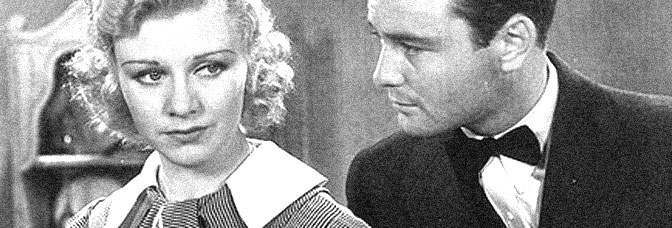
Ayres is a degenerate gambler (who cleans up nice) and Rogers is the girl who loves him, despite herself, of course, in this breezy melodrama. In terms of particulars, it has almost nothing to recommend it. Ayres is a little bit too believable as the callous lead, who purposely eschews all advice as he lucks…
-

I wish I knew if Remember Last Night? is supposed to be a knock-off of The Thin Man or if it’s just a highly coincidental release, coming a year later, with a similarly intoxicated, ritzy couple solving crimes as they get more intoxicated (Robert Young and Constance Cummings play the couple in this film). Remember…
-
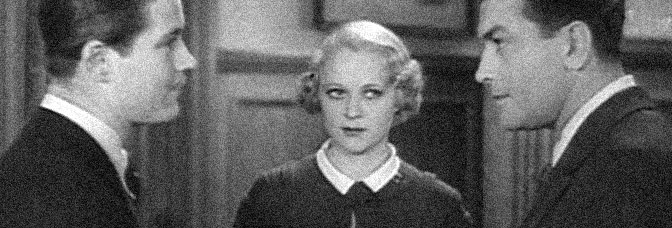
Maybe the film should have been called The Lecher, the Floozie and the Rube, because Central Airport doesn’t have anything to do with the plot. I kept waiting for it to turn into a Grand Hotel at an airport, but it’s really a soaper about pilot Richard Barthelmess who romances air show parachuter Sally Eilers…
-

It’s hard not to be, at least, somewhat impressed with The Vampire Bat, if only because it came out in 1933 as a knockoff Universal horror picture. Except at this point, there’d only been Frankenstein, Dracula and The Mummy. The Vampire Bat brilliantly resembles a Universal horror picture in every way but the filmmaking. There’s…
-

The Mummy’s Tomb is better than its predecessor, without a doubt. Harold Young’s direction is strong. It’s not quite scary, but he’s at least going for scary. It’s sort of like an episode of “Cheers;” it takes place in small town Massachusetts and there’s a mummy roaming the streets. You can see the “Cheers” gang,…
-

The Saint Strikes Back is George Sanders’s first Saint film. It’s strong, even though John Farrow might not be the right director for it. The script’s great, playing to Sanders’s strengths of being the charming cad, but Farrow’s close-ups are poorly conceived and some of Frank Redman’s lighting is questionable. Jack Hively, who went on…
-

It’s been a long time since I’ve seen this film. There’s no discernible reason for it to be called The Mummy’s Hand. I can only guess it has to do with the way they cut the trailer, maybe having the hand come out as a shocker. It’s not a traditional Universal horror film; it’s one…
-

The Oklahoman is–well, I don’t want to sell it short because its discussion of racism and prejudice are rather straightforward and singular for pictures of its era–but at its core, the film’s a love triangle between fifty-two year-old Joel McCrea, thirty-five year-old Barbara Hale and twenty-six year-old Gloria Talbott. Talbott’s supposed to be playing an…
 The Stop Button