The Stop Button
blogging by Andrew Wickliffe
Category: Directed by David Lee
-
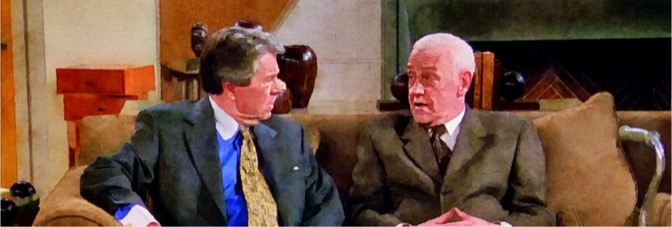
As usual, I regret not keeping better track of writing credits. Joe Keenan gets the credit this episode; he’s been writing “Frasier” since season two with numerous big successes, but based on Out with Dad, I’d have thought him a newbie. The episode picks and chooses plot points from outstanding—and memorable—episodes and mixes them a…
-
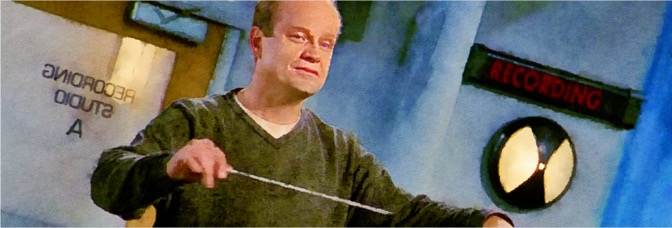
I’m feeling a little like the boy who cried wolf, on the lookout for “Frasier”’s inevitable, impending fall; the show’s two episodes away from the “mythology” two-parter, and those two episodes have been excellent. This one’s all about Kelsey Grammer going overboard while composing a theme song for his show. Station manager Tom McGowan wants…
-

This episode’s very funny, but often in a “the less you think about it” way. The script’s credited to Mark Reisman (his first credit on the show), and it very impressively gives almost everyone in the main cast a story thread. Except for John Mahoney, who gets a couple hilarious bits but not a thread,…
-

Credited writers Alex Gregory and Peter Huyck wrote the shittiest episode of “Frasier” ever (thus far) earlier this season, and so I was dreading this one. Especially since the logline seems primed for a bad episode—Kelsey Grammer hooks up with not one but two women (consecutively, not concurrently) and has to pick the one he…
-

What I can’t figure out with episode director David Lee, whose name I’ve come to dread this season, is the obviously uneven enthusiasm. This episode’s got a couple literal set pieces—there’s an auction scene and a restaurant scene (in addition to the apartment)—and there’s a lot of detail during those sequences but the blandest three-camera…
-
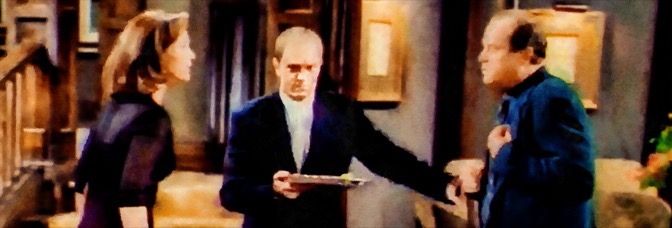
Sometimes marathoning “hurts” a traditional broadcast show. They were meant to be watched weeks or months apart, with commercial breaks distracting and obfuscating tropes. They’re not meant to be strung together. But even with those caveats, it’s kind of weird “Frasier” did an episode about a dinner party right after doing an episode called The…
-

Turns out I’ve been bullish episodes where Jeffrey Richman gets the script credit. I thought his name was on my unenumerated list of problematic “Frasier” writers. And this episode certainly has a bunch of problematic elements. Lots of misogynistic jokes, some fat-shaming, and I think some other ableism. It’s also a “sitcom as continuous” play…
-

In terms of "Frasier"'s concept, To Tell the Truth is the most significant episode they've ever done. They've irrevocably changed something about one of the characters. When you watch the show in reruns, there's before and after this episode, six and a half years into the show's run, and resolving a story arc starting in…
-

The second half of the episode is such accomplished screwball I totally forget the first half ranges from problematic to cringe, with way too much self-awareness. The episode opens at the cafe, with Kelsey Grammer and Peri Gilpin talking about being out of work and David Hyde Pierce showing up to whine about not being…
-

It’s an outdoor episode for the most part, with the main action being Kelsey Grammer and David Hyde Pierce trying to get into a play. So it’s the two of them outside the theater—presumably on location, though I suppose there might be a big theater exterior on the Paramount backlot—trying to avoid looking desperate for…
-

While this episode does a great job with Eugene O’Neill references—Kelsey Grammer at one point remarks to David Hyde Pierce they’re brothers out of an O’Neill play (because Hyde Pierce is suffering narcolepsy due to divorce proceeding stresses and Grammer is a sex maniac regarding ex-wife Bebe Neuwirth) and then the title cards all riff…
-

It’s a very fun riff on Midsummer Night’s Dream with confused romantic intentions at a ski resort weekend. There’s a very quick setup with Kelsey Grammer combination guilting and bartering Peri Gilpin’s ski weekend prize away from her—as she’s pregnant and can’t enjoy the weekend, Grammer’s passive aggressive reasoning goes, wouldn’t it be better for…
-

It’s a potentially great episode, done in by David Lee’s oddly inept direction during the most important scene—though Ken Lamkin’s photography doesn’t help—and the script. Jay Kogen gets the credit. I’m starting to recognize the new crop of writers on “Frasier” and it’s never for good reasons. The episode resolves one of the show’s longer…
-

Perspectives on Christmas is an exceptionally easy episode, starting with the title. There’s even a plot point about someone not trying hard enough with Christmas presents after making a big deal about trying hard with Christmas presents, which seems to be some kind of meta plea to be allowed an easy Christmas episode from writer…
-

I glazed over the director credit—I knew it was David Lee, but David Lee turns in particularly distinctive episodes, usually just competent ones. But this time he gets to do something special—half the episode is shot on location in Seattle (the only time in the series, apparently), with David Hyde Pierce and Kesley Grammer walking…
-

There’s very little as satisfying as the season premiere immediately addressing my problems with the previous season’s finale and remedying them. That episode ended with Kelsey Grammer, lovelorn, following a woman (Lisa Guerrero) onto an airplane and pretending he was always on her flight. This episode opens with Guerrero getting very creeped out by Grammer’s…
-

Ham Radio relies heavily on the situation in situation comedy; it gets some good laughs, but because of who’s in the episode—and how it’s written for those particular guest stars (specifically Edward Hibbert). But the David Lloyd-credited script only advances by one-upping itself, trying to appear chaotic but always coming through linearly and predictably. Not…
-

“Frasier” has gotten to the point where—unless I miss the writer credit—I eagerly anticipate it. So after listing all the producers and executive producers (who’ve had writing credits on excellent episodes this season), the writing credit on Talking Bird is Jeffrey Richman, whose name wasn’t familiar (and it’s his first credited script on the show),…
-

I just realized we never get to see the undoubtedly hideous antique Kelsey Grammer is supposed to get from Marsha Mason. Mason’s John Mahoney’s new girlfriend (who the show’s established sons Grammer and David Hyde Pierce do not like because she’s too… earthy) . Grammer and Hyde Pierce get back from antiquing and Mason promises…
-
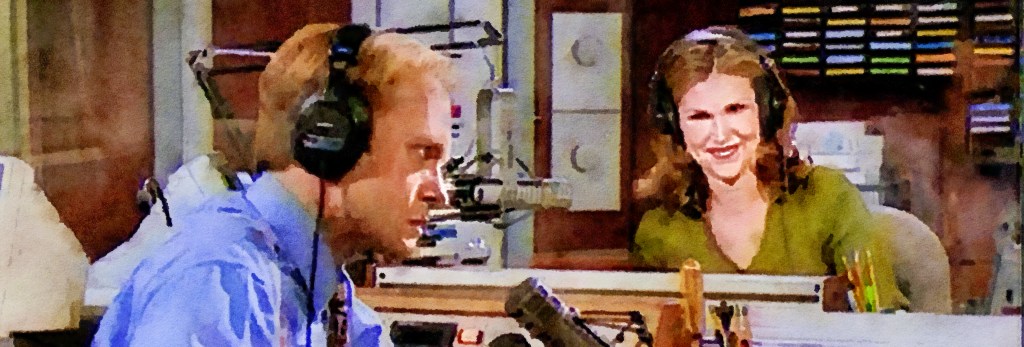
The last time David Hyde Pierce got to run an episode, he shared it with Jane Leeves; this time, after Kelsey Grammer heads off to a conference leaving Hyde Pierce guest-hosting the radio show for a week, it’s all Hyde Pierce. I missed the director credit—but did happily catch the Rob Greenberg writing one, so…
-

The Impossible Dream ages surprisingly well. Or, actually, maybe it doesn’t because you can imagine the exact same story being done twenty-five years later…. The episode opens with Kelsey Grammer waking up in a seedy motel, discovering a tattoo on his arm and a lover in the shower. The lover turns out to be Edward…
-

Joe Keenan for the win. I missed the writing credit on this episode and put off finding out who wrote this marvelous script until now. Keenan starts the season out on a very high point, with an endless amount of always good one-liners as the regular cast gets to do a group showcase episode. Jane…
-

For the third season finale, “Frasier” goes with the wholesome flashback (with some bite) route. The script’s from Linda Morris and Vic Rauseo, which is appropriate for the flashback—although they’re executive producers, they haven’t had many script credits this season—but they wrote a bunch in the first and second seasons. The episode opens establishing it’s…
-

The episode opens on David Hyde Pierce in couples therapy—Milo O’Shea plays the counselor—are we finally going to get an appearance from Maris. And if we’re not, what are we getting in compensation. We get Kelsey Grammer. It’s a “Crane Brothers” team-up episode, complete with a list from dad John Mahoney to remind everyone of…
-

It’s a quintessential “Frasier” if only because it plays with some very familiar, very ingrained snob tropes. Writers Elias Davis and David Pollock did another episode earlier this season—and The Club is their final contribution to the series, unfortunately—and have a great handle on the characters. The successful “guest” writers (i.e. not also an exec,…
-
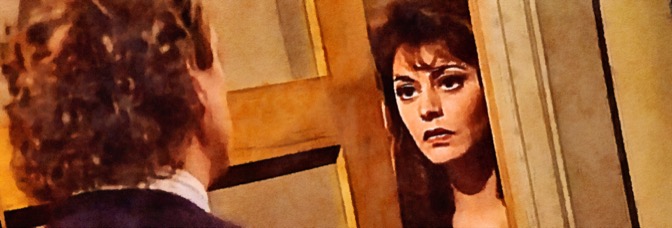
Once again it’s a “Frasier” where it feels like they’re trying to one-up something, but they’re not actually trying to one-up anything. It’s just Kelsey Grammer trying out an extremely physical episode—extremely physical bits are mostly David Hyde Pierce’s forte (though Grammer’s had at least one good one this season already)—but after a certain point,…
-

There’s a really bad line in this episode—written by Joe Keenan, back after a big success with his first script a few episodes ago—about Kelsey Grammer not being willing to emcee a Catholic Church charity event but willing to do the “Miss Teenage Seattle” one. So. Ew. Nineties. Also it comes up in a conversation…
-

Being cishet, it’s not my place to say whether The Matchmaker has aged well. It seems to have aged well. The episode, guest-starring Eric Lutes as Kesley Grammer’s new boss, who happens to be gay and thinks Grammer is into him (because Peri Gilpin lets him think it, as she’s mad Grammer viciously slut-shamed her…
-

Mid-Winter Night's Dream has another wonderful script from Chuck Ranberg and Anne Flett-Giordano, showcasing Jane Leeves and David Hyde Pierce’s range while relying on Kesley Grammer and John Mahoney’s… well, reliability. Ranberg and Flett-Giordano play with audience expectation and their own foreshadowing to craft the episode; because it’s not an easy episode (it’s also where…
-
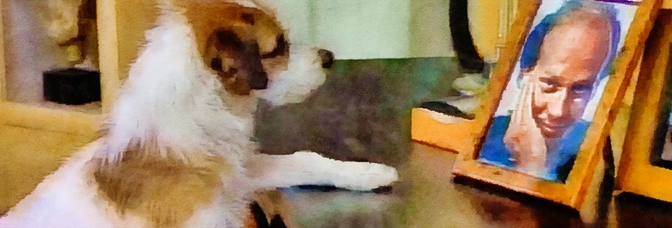
This episode has two celebrity guest callers—Judith Ivey is the patient and Joe Mantegna as part of the plot. Mantegna is a Seattle Times newspaper columnist who can’t stand lead Kelsey Grammer’s show. Grammer has a couple great monologues where he reads from the articles and rants about them. Mantenga calls up during the second…
 The Stop Button