The Stop Button
blogging by Andrew Wickliffe
Category: Directed by Kurosawa Akira
-
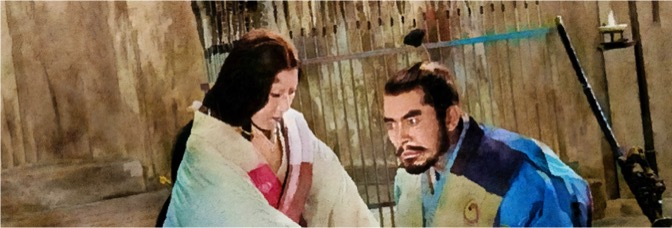
Co-producer, co-writer, director, and editor Kurosawa loves himself some Macbeth. Throne of Blood is Macbeth in feudal Japan, with Mifune Toshiro and Yamada Isuzu as the doomed couple. Kurosawa and his co-writers structure the film as a historical war epic, with modern-day bookends, and then fit Mifune and Yamada’s Macbeth into the war epic. But…
-
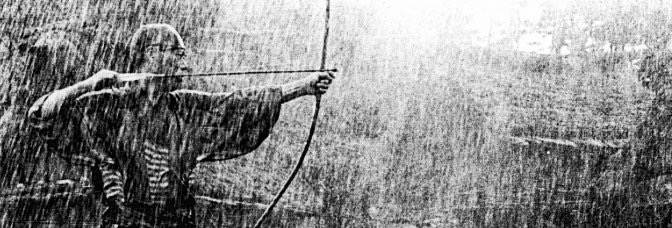
Seven Samurai is about a farming village, under imminent threat of bandits raiding and stealing their crop–and possibly doing much worse–who decides to hire samurai to defend them. They send four men–Fujiwara Kamatari, Kosugi Yoshio, Tsuchiya Yoshio, and Hidari Bokuzen–to town to hire the samurai. They can’t pay them, but they can feed them. The…
-

Where to start with Rashomon? Starting at the beginning means talking about the bookends–three strangers stranded in the rain, two telling the third different versions of the same story, each ostensibly true. The rain pours down around them, drowning out their voices. Rashomon is a film without a protagonist; it eschews the very idea of…
-

Drunken Angel never hides its sentimentality. The film’s protagonist, an alcoholic doctor working in a slum (Shimura Takashi in a glorious performance), is well aware of his sentimentality. He resents it–Shimura has these great yelling and throwing scenes–but it’s what keeps him going. It also allows director Kurosawa to have intensely sentimental sequences without affecting…
-

Scandal presents an incredibly humane side of Kurosawa, one his historical pictures don’t convey. He shows the desperate sadness of people and offers little visible hope throughout. There’s one scene, when the protagonist (played by Mifune Toshirô) and the main character (Shimura Takashi) come across a pond reflecting the stars and Mifune comments about the…
-

Great procedural about a police investigation into government corruption with a phenomenal lead performance by Mifune Toshirô in the lead. Intricate, complex screenplay–inspired by HAMLET no less–but tender and playful in a very un-HAMLET way. Kurosawa’s got a deliberate focus as the film follows multiple characters through the run time, with salient events often coming…
-

Good, if impersonal, Kurosawa epic about thief (Nakadai Tatsuya) getting recruited to impersonate a warlord (also Nakadai). Complications, obviously, ensue. Kurosawa seems beholden to historical accuracy at the expense of natural drama. The film’s so packed with information, it could even use some more run time (as is, it’s over two and a half hours).…
 The Stop Button